Ten years of ownership covers two machines with almost nothing in common. One of them went camping twenty weekends a year and spent the other thirty-two on a shelf, at whatever temperature the garage happened to reach in August. The other ran a fridge in an off-grid cabin every night for a decade. Both owners will describe their machine as ten years old, which is true and close to useless as a description of its condition. The cells in those two boxes have lived unrelated lives. So have the capacitors, the fans, the gaskets and the connectors. Each ages on a schedule of its own. Manufacturers write the distinction into their paperwork without drawing much attention to it. A residential iron phosphate warranty commonly reads ten years, four thousand cycles, or 37 megawatt-hours of throughput, whichever comes first, with a minimum of 70 percent capacity retention at the end of the term. Three clocks run at once inside that sentence. One counts days and never stops. One counts cycles. One counts energy pushed through the pack. Whichever limit arrives first closes the cover, and for any particular owner the answer becomes obvious as soon as the arithmetic gets done. A machine cycled every night exhausts its cycle allowance well before the calendar runs out. A machine used four times a year is still inside every cycle limit when the tenth anniversary arrives.
Counting the decade in cycles
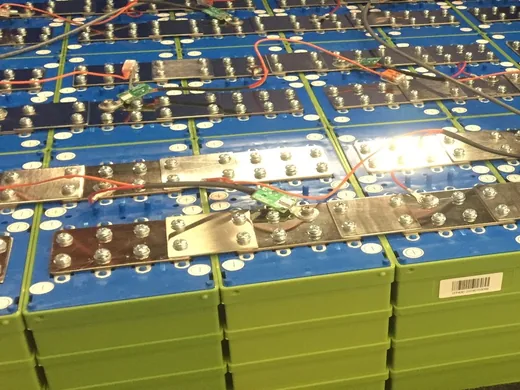
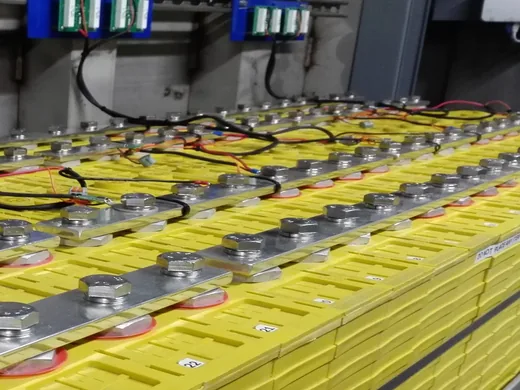
One cycle means a full charge and a full discharge worth of energy, totalled up whichever way it was delivered. Two half-discharges count as one. Published cycle life for lithium iron phosphate cells runs from 3,000 to 5,000 full equivalent cycles before capacity falls to 80 percent of the original figure. Nickel manganese cobalt cells, the chemistry that filled portable machines through the second half of the last decade, carry ratings of 1,500 to 2,500 on that identical measurement. Both bands come from cells on a test bench at a comfortable temperature and a moderate rate. A machine in a garage stays under them.
Set those ratings against how a portable machine actually gets used. Twenty camping trips a year at one cycle each comes to 200 cycles across ten years. Weekly use makes 520. Every other day reaches 1,825. Nightly use arrives at 3,650. Only the last of the four lands inside the rated band for iron phosphate, and only the last two give a nickel manganese cobalt pack anything to think about. Twenty full discharges a year across a decade spends 4 to 7 percent of the cell rating. Which puts the cycle clock in its place for most owners. It is the clock that matters for an off-grid installation working every night. For a machine bought to cover power cuts and holidays it barely moves at all. For the second group the deciding constraint sits elsewhere. Chemistry keeps working on an untouched machine.
What sitting still does to a cell
Capacity fade during storage follows the square root of time. Most of the loss happens in the first weeks after manufacture, then the curve flattens out and keeps flattening. There is a physical reason for the shape. The film that grows on the graphite surface, called the solid electrolyte interphase, consumes lithium as it forms. Growth then throttles itself, because the film obstructs the transport that feeds it. Year ten costs a fraction of what year one cost. A pack down 2 percent after twelve months is nowhere near 20 percent down after a hundred and twenty. Somebody eventually ran the experiment for long enough to check the prediction. A hundred commercial 26650 iron phosphate cells sat at 50 percent charge and 6 degrees for ten uninterrupted years, with the absence of interruptions documented across the whole period. Check-up measurements taken directly after storage found every cell holding 96 to 98 percent of its initial capacity. Resistance changes came out negligibly small. Rate capability up to 3C matched fresh cells. Cell-to-cell spread stayed inside the range of a fresh production batch.
Six degrees is a cool cellar. Warm storage moves the number hard in the other direction. At 45 degrees, calendar aging on its own can finish a cell in roughly a thousand days. Storage at 55 degrees and 90 percent charge for 36 months has been measured with an interphase film past 300 nanometres and conductivity down by more than a fifth. Temperature exerts more influence on the outcome than state of charge does. Two pieces of advice fall out of that. Keep the machine somewhere that never bakes, which for most people means anywhere except a sealed car, a metal shed or a loft. Leave it at 40 to 60 percent charge for storage longer than a month, since a pack held at full charge for years ages measurably faster than one held at half. Neither habit costs anything.
The decade that ends in a lockout
A machine on a shelf is not electrically idle. Chemical self-discharge for an iron phosphate cell runs 1 to 3 percent a month at room temperature. The management board draws its own current on top of that. Between the two, the board is frequently the larger consumer. A modest 3 milliamp standby draw on a 100 amp-hour pack removes 2.16 amp-hours a month. Bluetooth radios, displays that wake on a button press, and idle supervision of the inverter all come out of that budget. Cheap current sensors with zero-point drift add error of their own on top. Run the arithmetic forward across a few years of neglect and the pack crosses a line it cannot cross back over unaided. Protection engages when cells fall below about 2.5 volts each, which on a sixteen-cell pack means the terminals read somewhere near 40 volts against a normal low-voltage cutoff nearer 44. The iFixit field manual for one large station calls deep discharge lockout the most common failure mode in stored or rarely used units. The gate drivers cannot activate, for want of bootstrap voltage to switch them.
Below that protection threshold the chemistry starts doing damage of a different kind. Over-discharge drives the anode potential up until the copper current collector begins to corrode and dissolve into the electrolyte. Copper then plates out on the cathode, on the anode and across the separator, which has been confirmed by electron microscopy on over-discharged cells and which points directly at internal short circuits. A machine found flat after several years in a cupboard may be in that state. Charging it to find out drives the reaction further.
What a genuinely old machine is made of
Anyone holding a portable power station that has genuinely seen ten years of service in 2026 is holding a machine sold around 2016, which settles a question most buyers never think to ask. Portable stations of that era were built almost entirely on nickel manganese cobalt cells, usually 18650 cylindrical cells in a welded pack, because iron phosphate carried a weight and cost penalty that nobody wanted in a box designed to be carried. Iron phosphate reached the mainstream of this product category around 2021 and 2022, before which it was reserved for flagship models aimed at cabins and serious van builds. The gap between the two chemistries decides how a ten-year-old machine reads today. Nickel manganese cobalt is rated at 1,500 to 2,500 cycles to the 80 percent mark against 3,000 to 5,000 for iron phosphate. Heat treats it worse as well: at 45 degrees its cycle life falls 40 to 50 percent below the rated figure, where iron phosphate under identical conditions gives up 20 to 30 percent. Everything written about a decade-old machine, every forum thread and every anecdote about a pack that swelled or a runtime that halved, comes from the chemistry with the shorter fuse and the worse temperature behaviour. That matters in both directions. It means the horror stories are real and were earned honestly. It also means they describe a product nobody sells any more. The ten-year question about an iron phosphate machine bought in 2024 has no field evidence behind it yet, only laboratory storage data, warranty terms and the cycle arithmetic. Anybody claiming to know how a current machine will read in 2034 is extrapolating from those three. Cell formats moved as well. An 18650 of that era held somewhere between 2,500 and 3,500 milliamp-hours. Mass-produced cells today top out near 3,600. The format itself gained far less across a decade than the chemistry did.
Capacitors and the ten degree rule
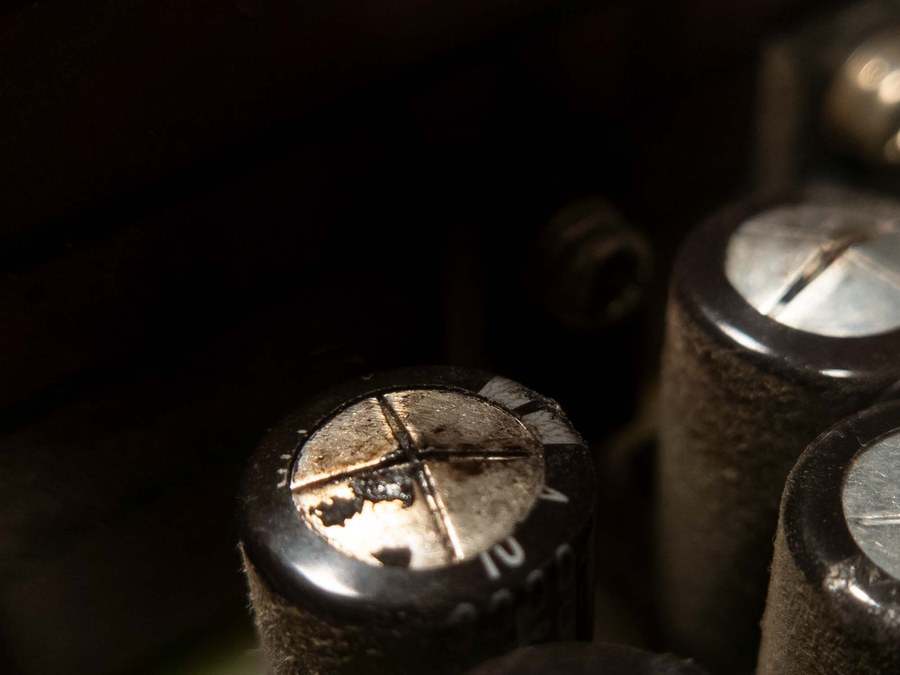
The scored cross on top of an electrolytic capacitor is a designed weak point. Dried residue on the front one means it has already vented. Photo by WizardTim, CC BY 4.0.
Cells get all the attention. Whether a ten-year-old machine still switches on is usually settled by the aluminium electrolytic capacitors in the charger and the inverter. They fail by drying out. Electrolyte diffuses slowly through the rubber seal at the base of the can. Capacitance falls as it goes. Loss factor climbs with it. Somewhere along the way, the supply that depends on those parts starts misbehaving. Manufacturers publish a design lifetime at the maximum rated ambient temperature, normally 105 degrees. Published figures run from 1,000 hours to 10,000 hours and beyond. Those published hours count down to a defined condition, never to a bang. A part reaches the end of its rated life once capacitance falls to 80 percent of its initial value, or once equivalent series resistance climbs to twice what it started at. Loss tangent and leakage current carry their own limits alongside. A capacitor at that point still works. What it no longer does is filter as well as the circuit around it expects, which shows up first as ripple the supply was designed to remove. Manufacturers publish those end-of-life ratios so a designer can decide how much margin the circuit needs at year ten.
The rated hours mean nothing on their own. Aluminium electrolytics follow the Arrhenius relationship closely enough that the industry uses a simple version of it, known as the ten degree rule: every 10 degrees of reduced operating temperature doubles the expected life. A part rated 2,000 hours at 105 degrees returns 4,000 hours at 95 and 16,000 hours at 75. Run the identical part hot and the arithmetic collapses just as fast in the other direction.
Now add the duty cycle, which is where portable machines part company with a mains power supply that runs continuously. A station used 200 hours a year accumulates 2,000 hours of running across a decade. Those hours are the only ones that count against the capacitor rating, because a switched-off machine holds its capacitors at ambient with no ripple current heating them from inside. Ten years of weekend use spends about a tenth of what a part rated 2,000 hours at 105 degrees survives at 75. The cabin machine tells the opposite story. Running an inverter continuously for ten years is 87,600 hours, past every figure in the table above. Those hours also accumulate at an internal temperature well above room ambient, because the heatsinks and transformer are working the whole time. A weekend owner reaches 2,000 hours over an identical ten years.
Which explains a pattern that repair notes keep reporting: the inverter electronics on an old machine tend to give up before the cells do. Gate drivers and power semiconductors die from overvoltage and overcurrent events. Capacitors dry out on hours and heat. Iron phosphate cells sitting behind all of it stay relatively stable through normal operation.
What each clock inside the machine reads after ten years
Part
Manufacturer’s rating
Ten years of weekend use
Ten years of continuous duty
Electrolytic capacitor
2,000 h at 105 °C, 16,000 h at 75 °C
about 2,000 running hours
87,600 running hours
Ball bearing fan
L10 60,000 to 70,000 h at 40 °C
a few hundred fan hours
up to 87,600 h
Sleeve bearing fan
L10 roughly half that
a few hundred fan hours
past rating
USB Type-C port
10,000 insertions
about 1,040 insertions
about 1,040 insertions
USB Type-A port
1,500 insertions
about 1,040 insertions
about 1,040 insertions
Iron phosphate cells
3,000 to 5,000 cycles to 80 percent
200 cycles
3,650 cycles
Nickel manganese cobalt cells
1,500 to 2,500 cycles to 80 percent
200 cycles
3,650 cycles
Fans and the hours they never accumulated
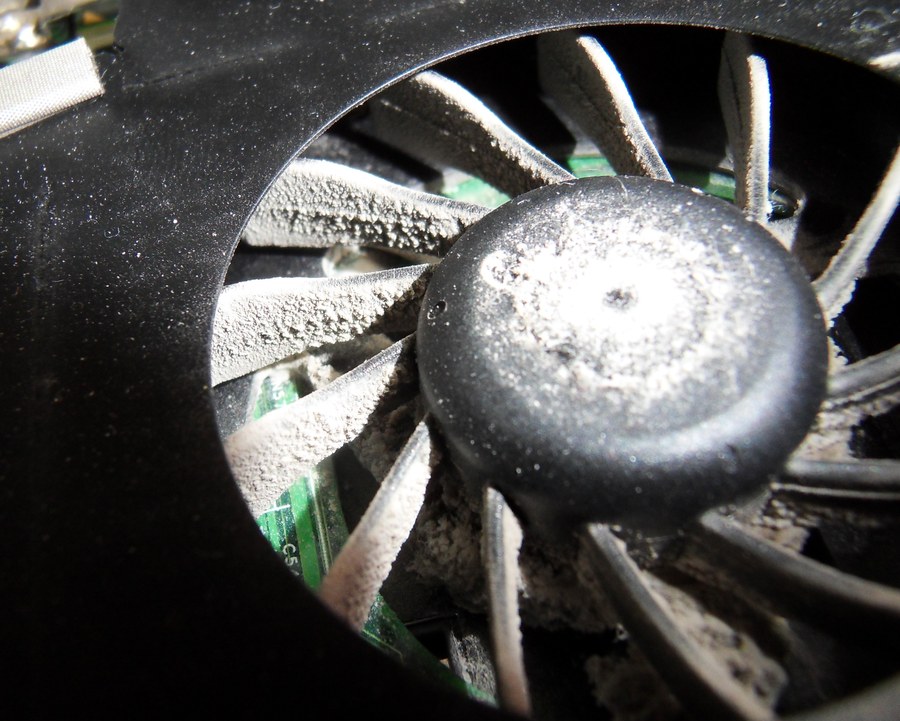
Dust on the blades and in the bearing hub. Airflow falls, the parts behind it run hotter, and the bearing carries the load it was rated for at 40 degrees while sitting well above that. Photo by McZusatz, CC BY-SA 3.0.
Fan ratings come with a letter and a number that deserve reading properly. L10 life is the point at which 90 percent of a large population of that fan is still working within specification. Ball bearing fans reach an L10 of 60,000 to 70,000 hours, which works out at roughly eight years of continuous running. Sleeve bearing fans manage about half of that, or three to four years of continuous duty. Manufacturers quote these numbers at a stated condition, normally 40 degrees and 65 percent relative humidity. L10 carries a second meaning. At the quoted hour count a tenth of that population is already outside specification, which makes the figure a description of a distribution with no promise attached to any individual fan. Conditions matter as much as the hours do. A rating quoted at 40 degrees assumes air at 40 degrees. Air circulating inside a working enclosure sits well above whatever the room thermometer reads. A fan drawing 55 degree air past its own bearing is being measured against a number it was never rated for. A fan in a hard-working machine sounds different by year eight.
How sharply becomes clear at the top of the range. Fan life falls by close to half for every 10 degree rise, matching the behaviour of the capacitors nearby. In testing above 70 degrees, ball bearing fans still logged 45,000 hours while sleeve bearing fans became inoperable altogether. Portable stations only spin their fans under load, which puts a weekend machine at a few hundred fan hours per decade and leaves the bearing nowhere near its rating. A grinding or rattling noise from a machine that has been worked hard for years is the bearing announcing itself. MOSFETs deprived of airflow fail in seconds. A fan that has grown noisy is cheaper to replace than the power stage behind it.
Ports, buttons and the seal around the lid
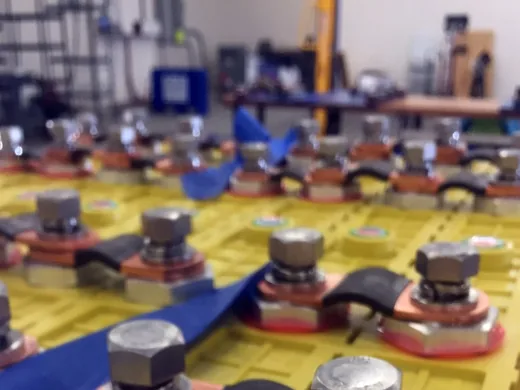
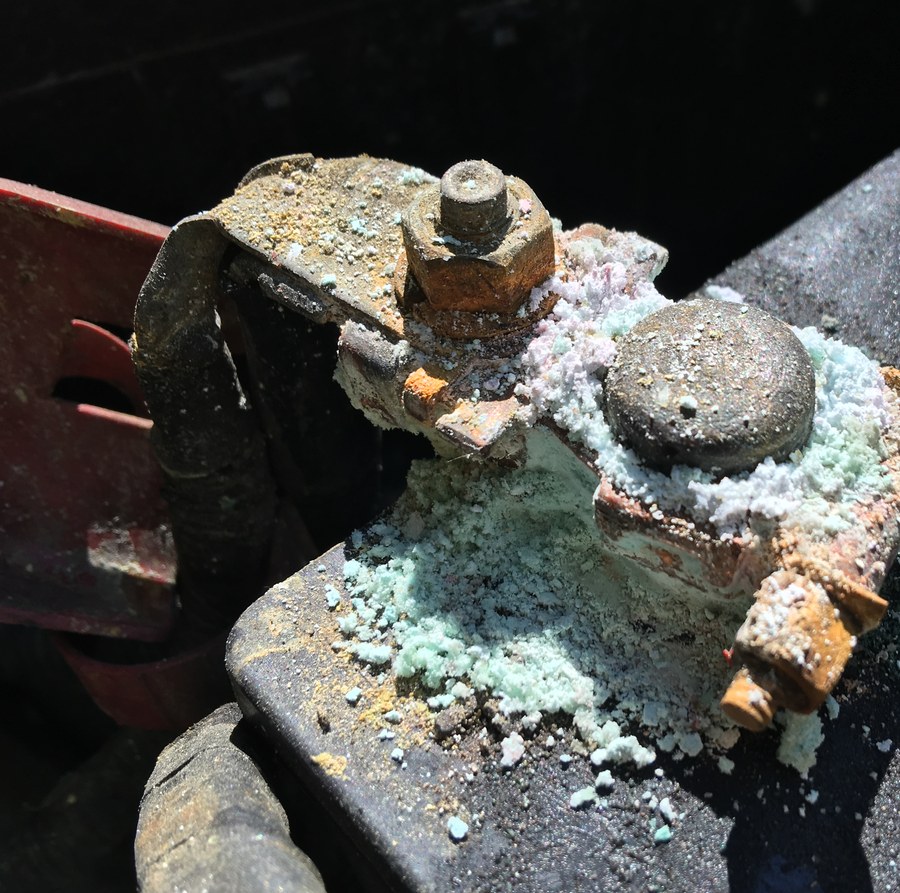
Corrosion products at a terminal clamp. Every milliohm of it sits in series with the cells and is counted by whatever load the machine is carrying. Photo by MarkBuckawicki, CC0.
Connectors carry a published durability rating that most owners will never approach. USB Type-C is specified for 10,000 insertion and extraction cycles, with extraction force required to stay between 6 and 20 newtons even after all of them. Type-A is rated at 1,500. Plugging something in twice a week for ten years comes to about 1,040 insertions. That count sits inside the Type-C figure and close to the Type-A one. Plating decides the real number. Inexpensive pins made with tin over copper typically tolerate around 15 mating cycles before the plating wears through to the base metal, which is a figure two orders below the connector standard beside it. Gold over nickel survives far longer at a cost nobody puts on a 12 volt accessory socket. Mating cycles turn out to be the wrong worry for a machine that mostly sits still. Fretting corrosion is the real one. Tin plating is sensitive to micro-motion, and vibration or thermal cycling produces exactly that: repeated microscopic movement at the contact interface, generating oxide debris that accumulates and raises contact resistance. Higher temperatures increase the extent of the oxidation. The symptom is intermittency. A port works again after being wiggled.
Seals age on a third schedule again. A gasket under permanent compression gradually loses the ability to return to its original thickness, and once it has taken a set it can no longer press outward hard enough to keep the joint closed as the housing expands and contracts through daily temperature swings. Silicone holds its springiness through years of compression better than most alternatives. EPDM stiffens in the cold. Warming under load and cooling overnight then works microscopic cracks into the stiffened rubber. A ten-year-old seal no longer holds the rating printed on the case.
When the percentage stops being true
The number on the screen comes from counting coulombs in and out, with corrections. Counting alone drifts. Error accumulates at 1 to 2 percent every ten partial cycles when the system never reaches a state it recognises, and reaches 2 to 5 percent over a few days in systems with mediocre current sensing. Iron phosphate makes the problem worse by being extraordinarily flat: a 12 volt pack sits between roughly 13.0 and 13.3 volts from about 20 percent charge to 90 percent. That 0.3 volt window covers 70 percent of the usable capacity. Voltage tells almost nothing through the middle of the range. Recalibration is what stops the drift. It needs an end of the range to work with. A board resets its counter to 100 percent when cell voltage climbs to the full charge point around 3.65 volts, and to zero when a cell hits the discharge cutoff near 2.5 volts. Owners who top up from 60 to 80 percent and never do either give the board no reference point for years at a time. That produces the familiar complaint of a display reading 40 percent on a machine that shuts down four minutes later. Nothing has gone wrong with the pack in that story. The board has had no full charge to reset its counter against.
What ten years looks like when it goes well
A machine kept in a house, cycled a few dozen times a year and stored part-charged has a good chance of reading between 70 and 80 percent of its original capacity at ten years, which is also where the industry sets its warranty floor. That is not the end of anything. A pack at 75 percent still runs every load it ran when new, for three quarters as long. Capacity carries on slipping away after that, slowly, along a curve that keeps flattening out year by year.
What tends to be in worse shape is everything the owner never thought about. Rubber will have taken a set. Tin contacts will have grown oxide. The fan, if the machine worked hard, may be audibly rougher than it was. The capacitors will have spent their hours according to how the machine was used, which for a light user leaves plenty in hand and for a cabin installation leaves none. Dust inside the vents does its own damage by insulating the heatsinks it settles on. Vents never cleared in ten years hold a felt of it visible through the grille.
None of that argues against buying a machine expected to last a decade. Ten years of gentle use ends with a pack in good condition and electronics at a few hundred hours. Ten years of continuous duty ends with a pack near its cycle rating and a power stage past 80,000 hours.
Common questions
Is a ten-year-old power station still safe to use?
A pack that has been stored and cycled sensibly, with no swelling, no smell and no heat during charging, is normally fine to keep using at reduced capacity. Deformation of the case, charging that gets hot to the touch, or years spent completely flat all change that answer.
Should I charge one that has been flat for years?
Not without checking the terminal voltage first. Cells left below their protection threshold for a long period can suffer copper dissolution and internal metal deposits, and putting a charger on that is a recognised way to create a fire from a battery that looked merely dead. A pack reading far below its normal cutoff needs testing by an equipped workshop.
Does leaving it plugged in all the time shorten its life?
Holding cells at full charge accelerates calendar aging, and heat compounds the effect. Storage research consistently shows high state of charge producing more capacity fade and more interphase growth than a mid-range charge does. A machine kept permanently on the charger trades pack life for readiness.
What charge level suits long storage?
Between 40 and 60 percent for anything longer than a month, in the coolest place available. Check it two or three times a year and top it back up. Standby drain of a few milliamps reaches the protection threshold within two years.
Which part usually fails first?
On a machine that gets used hard, the power electronics. Repair documentation keeps reporting gate drivers and switching devices dying from overvoltage and overcurrent events while the cells remain in reasonable condition. On a machine that gets stored and forgotten, the answer is the pack, by way of deep discharge lockout.