Safe operation in rain and snow is the set of choices that keeps current inside its intended path when water is landing on everything. Rain arrives in grades that forecasters put numbers on. Under 2.5 millimetres an hour counts as light. Moderate runs 2.5 to 7.5. Heavy runs 7.5 to 50. A downpour is anything past 50. A W-series or L-series machine on a site works through all of those.
The instinct is to worry about water reaching the electronics. A machine rated for outdoor work handles falling rain on its own. The hazard that puts people in hospital sits somewhere else entirely. Water changes the electrical circuit that runs through the person holding the plug.
Grab the wrong thing on a wet slab and the machine’s own ingress rating has nothing to do with what happens next. Rain arriving with a thunderstorm changes the question again. Outdoor trades work to the 30-30 rule. Thunder within 30 seconds of the flash puts the strike inside six miles, since sound covers a mile in roughly five seconds. That’s the moment to stop. Work resumes 30 minutes after the last thunder. A fully enclosed building with wiring and plumbing counts as shelter, and so does a hard-topped vehicle with the windows up. A site shed doesn’t.
02The neutral you cannot see
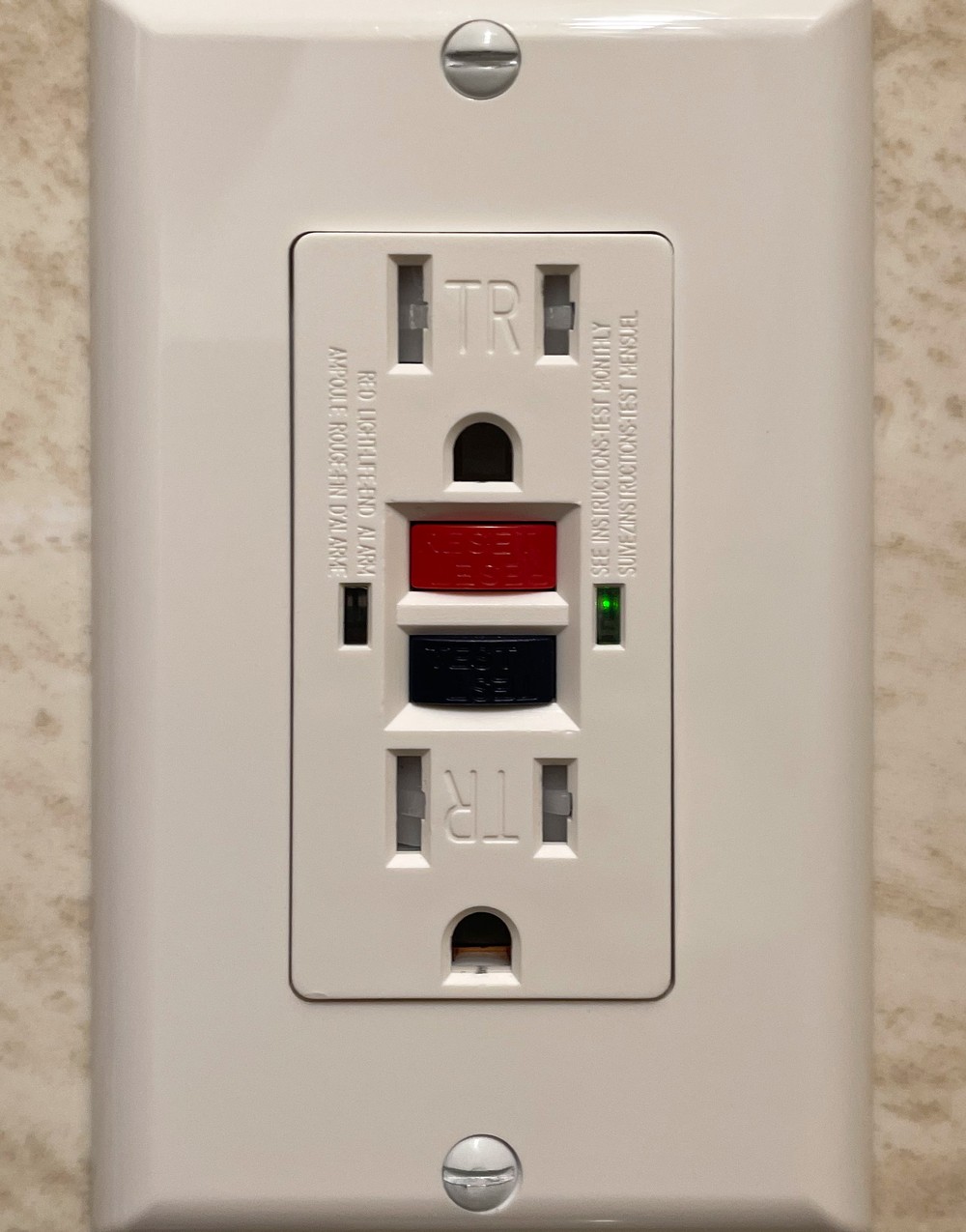
The device owners assume is protecting them. A GFCI compares current flowing out with current returning, opening when the difference reaches 5 milliamps. On a machine whose neutral floats, a first fault to the case can produce no difference at all for it to detect. Photo: Santeri Viinamäki, CC BY-SA 4.0.
Portable machines mostly leave the factory with a floating neutral. Neither output conductor connects to the case or to earth. That arrangement is deliberate and it carries a genuine safety logic. With nothing referenced to ground, a hand on one output conductor and boots on wet ground gives current no complete loop to travel. A bonded machine ties neutral to the case. Bonding is what makes a residual current device work, since a fault to the case then produces real current returning outside the pair of conductors the device watches. Both arrangements are defensible. What isn’t defensible is the assumption owners bring to them. People treat the socket on the front as protected the way a house socket is protected. On a floating machine a first fault to the case can flow nowhere and trip nothing. That case sits at line potential with no indication anywhere. A second fault completes what the first one started, or a hand bridging the case and a puddle does it. Manufacturers who fit ground fault protection to the outlets bond the neutral for exactly this reason. The manual is the only place that says which arrangement you’ve got. Read that page before working in the wet, because the answer changes what every protective device around the machine can do.
03What water does to a body
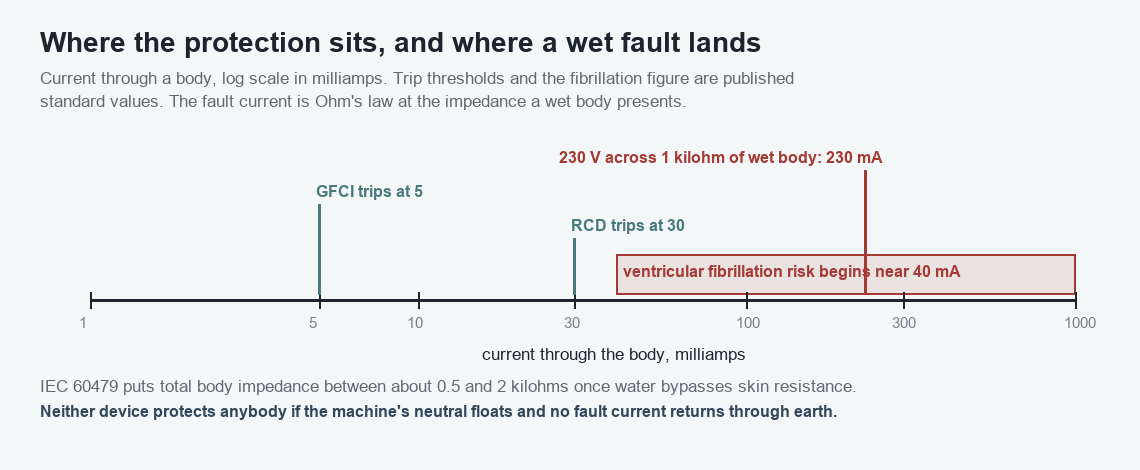
Trip thresholds and the fibrillation figure are published standard values. The fault current is Ohm’s law at the impedance a wet body presents.
Dry skin is the largest part of a person’s electrical resistance. Water removes it. IEC 60479, the standard that collects the research on shock effects, puts total body impedance somewhere between 0.5 and 2 kilohms once skin resistance stops contributing. Tissue underneath the skin sits near 300 ohms on its own.
Put 230 volts across a kilohm and 230 milliamps flows. The threshold where ventricular fibrillation becomes a risk starts near 40 milliamps. That gap is why wet-condition work has its own rules everywhere in the trades.
Protective devices are calibrated for that gap. A North American ground fault circuit interrupter opens at 5 milliamps, chosen around the current where a person can still let go. An IEC residual current device for personal protection opens at 30 milliamps, chosen to sit under the fibrillation threshold for the fraction of a second it takes to operate. The other approach works on the voltage. British construction sites run portable tools on 110 volts centre-tapped to earth, a system BS 7671 defines as no more than 110 volts line to line and no more than 63.5 volts line to earth. The centre tap puts each leg at 55 volts relative to earth. The worst touch voltage on a site tool comes to 55. Across a kilohm of wet body that comes to 55 milliamps, a figure that still sits above the fibrillation threshold.
Both numbers assume fault current has somewhere to go. That’s the assumption a floating output quietly removes.
04Cables and sockets on wet ground
Cable ends are where rain gets in. Gravity does the work for you once the geometry is right. Hang a drip loop in every lead, with the low point of the cable below the socket it plugs into. Water runs to that low point and falls off. A straight run into an upward-facing connector feeds the socket.
Connections belong off the ground. A puddle rising over a coupler puts water inside two connector bodies at once. A weatherproof enclosure rated for outdoor use costs a few pounds and settles it for good. Extension leads want the outdoor rating too, since indoor flex takes on water at the moulding. Keep the machine itself out of standing water. The ingress rating on the case says nothing about the sockets on its front panel with something plugged into them.
05Snow asks different questions
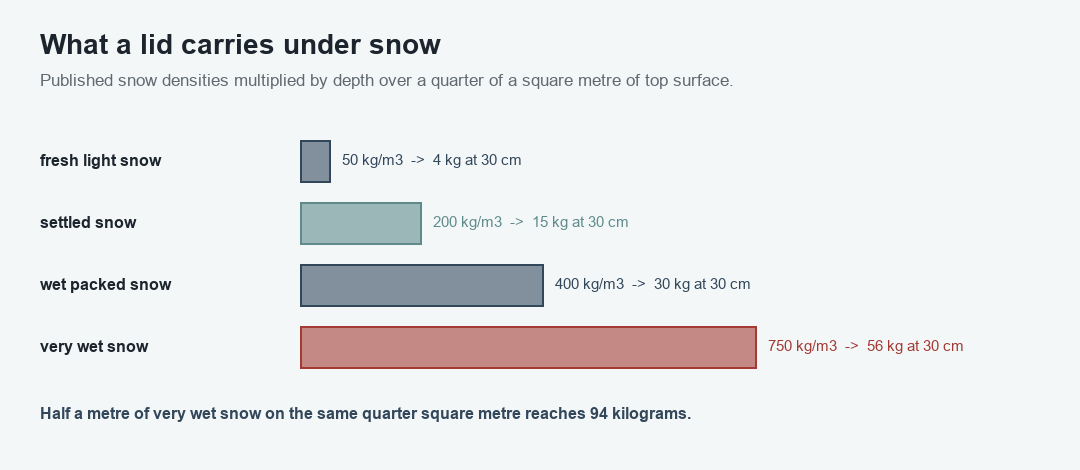
Published snow densities multiplied by depth over a quarter of a square metre. Fresh snow is a nuisance. Wet snow at that depth is a load the lid was never asked to carry.
Snow lands as weight before it lands as water. Fresh light snow runs near 50 kilograms per cubic metre. Settled snow reaches 200. Wet packed snow reaches 400. The thoroughly wet grade climbs to 750.
A quarter of a square metre of top surface under 30 centimetres of wet packed snow carries 30 kilograms. Half a metre of the wettest grade on that lid reaches 94. Vents and fan grilles disappear under a fraction of that.
Melt is the second act. Snow sitting on a warm running machine turns to water at the case and finds every seam. A machine that goes cold overnight refreezes what soaked in. Ice in a vent blocks airflow completely.
Cold carries its own charging rule. A pack below freezing mustn’t be charged until it warms.
Clear snow off before running. Brush it, since scraping finds the vents. Keep the intake and exhaust faces clear by hand. Raise the machine above the snow line on a board or a crate. A unit sitting directly on snow melts a well for itself and settles into standing water by afternoon.
06The case is not the safety boundary
Owners treat the enclosure as the line between safe and unsafe. Electrically it’s nothing of the sort. The reason changes how the whole machine gets handled in weather. Insulation inside an enclosure is specified against two separate distances. Clearance is the shortest path through air between two conductors. Creepage is the shortest path across the surface of the insulating material between them. Creepage is the one weather attacks. Damp air carrying dissolved salts or dust settles as a film on a printed circuit board. That film has a resistance. A slow leakage current begins to run across a surface designed to carry none at all. Standards handle this by defining pollution degrees, from a clean sealed environment up to a conductive-pollution environment. A board specified for the clean end and then stood in the dirty one is being used outside what its spacings were calculated for. That is the real mechanism behind a machine that works for two winters and then starts tripping its own protection on damp mornings. None of it is visible. The tracking damage it leaves is permanent, because leakage current carbonises the board surface, and carbon conducts better than the film that started it. Meanwhile the metalwork carries its own question. A case that is bonded to the output earth is safe to touch during a fault only if fault current can flow somewhere and open a protective device. A case that floats is safe to touch as long as nothing else is touching it, which is a condition nobody can guarantee on a wet site with people and cables around. Driving an earth rod does not settle it either. An electrode gives lightning and static a path. It does little for a fault inside a floating machine, since earth resistance of several tens of ohms can’t pass enough current to open anything. What settles it is bonding. That’s a decision the manufacturer made before the machine was boxed.
Keep everything metal in one electrical group, so any exposed metalwork near the machine shares a connection with the machine’s own earth terminal. Put a portable residual current device between the machine and anything with a long lead when the manufacturer confirms the neutral is bonded.
Ask a supplier one question before a wet job. Is the neutral bonded to the chassis, and does the outlet carry ground fault protection? A supplier who can answer that has thought about the case where a machine’s outdoors for a week.
Published thresholds that decide what happens in the wet. Body impedance is the figure once water has bypassed skin resistance.
Figure
Value
Where it comes from
Body impedance, wet
0.5 to 2 kilohms
IEC 60479 shock-effect data
Internal body resistance
about 300 ohms
tissue beneath the skin
GFCI trip current
5 milliamps
North American practice
RCD trip current
30 milliamps
IEC personal protection
Fibrillation risk begins
near 40 milliamps
IEC 60479 curves
07Common questions
Can a portable power station be used outdoors in the rain?
A machine rated for outdoor work handles falling rain on the case. The connections are the weak point. Keep couplers off wet ground, hang a drip loop in every lead, and use outdoor-rated leads and enclosures. Standing water is a separate matter and the machine belongs above it.
Does a power station need earthing with a ground rod?
For a machine feeding its own outlets directly, an electrode adds little. Earth resistance of several tens of ohms cannot pass enough fault current to open a protective device. What matters is whether the neutral is bonded to the chassis, which is what allows residual current protection to see a fault at all.
Why might a GFCI not trip on a portable machine?
Because a floating neutral gives a first fault nowhere to return to. The device compares current out with current back. A fault to the case that produces no difference between those two operates nothing. The manual states which arrangement the machine uses.
How much snow can sit on a power station before it matters?
Thirty centimetres of wet packed snow over a quarter of a square metre of lid comes to about 30 kilograms. Half a metre of the wettest grade on that area reaches 94. Vents block long before either figure. Clear the intake and exhaust faces by hand and get the machine up off the snow.