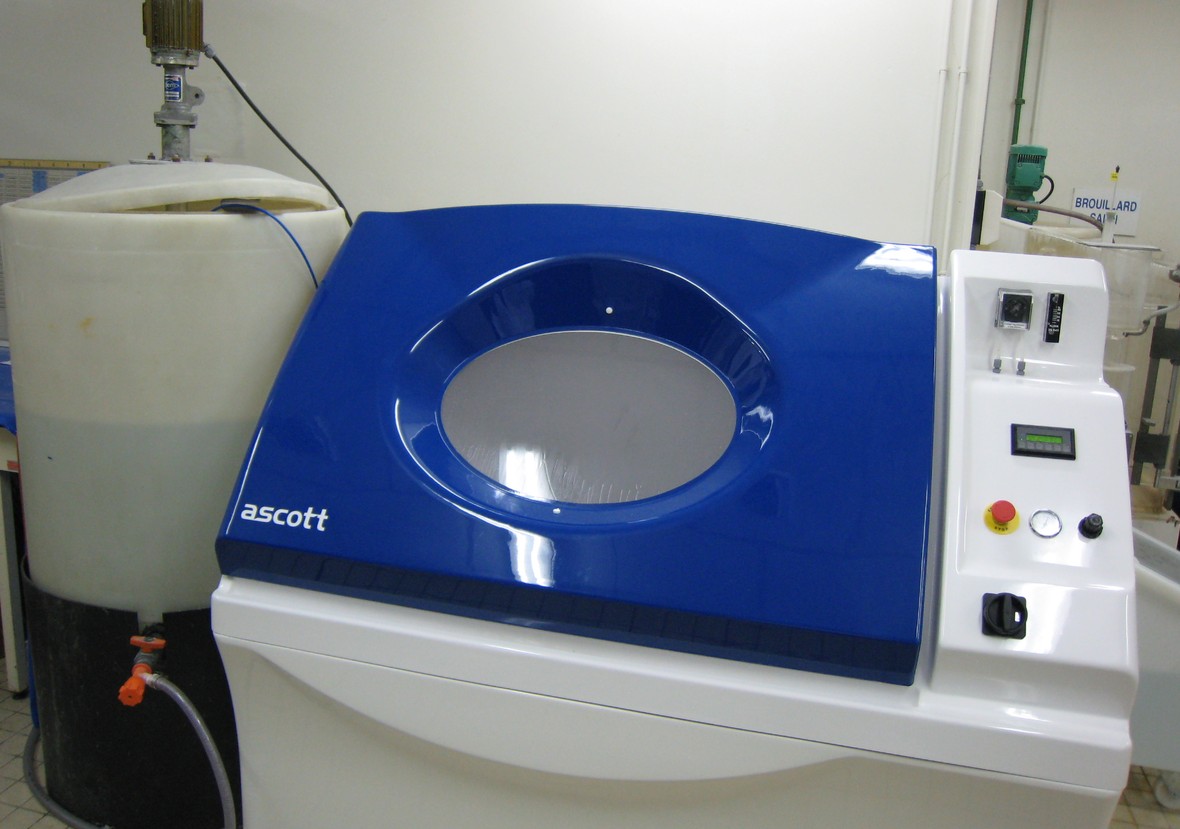
The chamber those hours come from. Brine sits in the tank on the left. An atomiser turns it into fog under the lid. The sign on the wall behind reads salt fog. Photo: Cjp24, CC BY-SA 3.0.
Salt spray tolerance testing is the chamber run that puts a number on a machine’s coastal life. A fan atomises salt water into a sealed box held at a set temperature. The sample sits in that fog for a stated count of hours. Whoever paid for the test then prints the count on a datasheet. ASTM B117 sits behind nearly every hour printed that way. It fixes the fog at 5 percent sodium chloride, the chamber at 35 degrees and the pH between 6.5 and 7.2. Fog has to collect at 1 to 2 millilitres an hour for every 80 square centimetres of horizontal area. Labs check that rate with a funnel 10 centimetres across, at two or more places in the chamber, because a chamber that fogs unevenly gives one corner of the sample an easier ride. What changes from one product claim to the next is the duration alone.
What the number does is rank. Two finishes run through one chamber come out in order. B117 delivers that order with tighter repeatability than any other corrosion test, which is why quality departments keep buying it. The one question it leaves open is how long a W-series machine survives on a quayside.
Why the chamber and the coast disagree
Real salt air works in cycles, wet then dry then wet again.
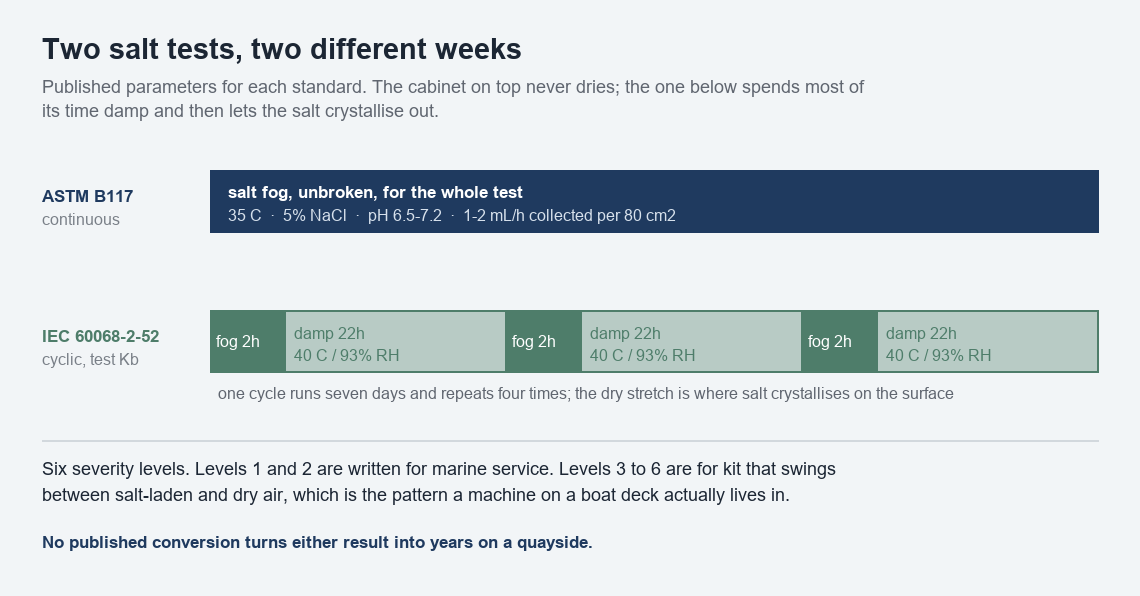
Inside a B117 run the fog never stops. A sample stays wet from the first hour to the last. A machine on a boat deck gets wetted by spray, then dried by sun and wind, over and over, several times a day in working weather. A great deal of coastal damage happens during the drying half, because salt left on the surface concentrates once the water goes, and crystals growing under a coating lift it off the metal mechanically. Park a sample in permanent fog and none of that ever happens to it. The laboratory selling the test says so on its own page. It warns that the conditions do not accurately replicate humidity swings, temperature fluctuations, complex salts or industrial pollutants. The same page notes that some coatings pass the chamber before failing in service. Sunlight is absent too, along with the sulphates and grit that ride in real coastal air. IEC 60068-2-52, test Kb, was written for electronic equipment and builds the wet-dry rhythm into the schedule itself. One published severity puts the sample in salt mist at 35 degrees for two hours, then holds it at 40 degrees and 93 percent relative humidity for the remaining 22, with a seven-day cycle repeated four times. Six severity levels are defined in all. The first two are aimed at equipment living in or beside the sea. Levels 3 to 6 cover hardware that swings between salt-laden and dry air, which is a fair description of a machine carried on and off a vessel. Automotive engineers reached this conclusion decades ago and adopted SAE J2334, ISO 11997 and GM9540P, all of which track field corrosion better than continuous fog does. Salt spray hours aren’t even one test. ISO 9227 covers three of them, with severe differences between the three. Neutral salt spray runs at the familiar pH of 6.5 to 7.2. Acetic acid salt spray drops the pH to between 3.1 and 3.3. Copper-accelerated acetic acid salt spray adds copper chloride on top of the acid and runs the chamber at 50 degrees. The acid variants bite far harder than the neutral one. An hour count carries no meaning until somebody names which of the three produced it.
Which standard, and at which severity. Those two questions get a spec sheet to give up what it knows. A machine quoted at 720 hours of B117 and a machine quoted at four Kb cycles at severity 2 have not sat one exam between them. Neither figure converts into the other.
Ask for the report before the headline. It names the standard, the severity, what got inspected afterwards and what counted as a pass. A pass defined as no red rust on the enclosure leaves contact resistance at the connectors untested.
The two schedules side by side, drawn from the published parameters of each standard. The cyclic one spends the bulk of its week damp and then lets the salt dry out, which is the half of a coastal week a continuous chamber leaves out.
A maker who has run neither test is telling you something by the silence.
Chloride against the oxide film
Aluminium and stainless steel aren’t noble metals. Both are reactive, and both grow a thin oxide skin within seconds of meeting air. That film is the whole defence. Chloride ions attack the film. The metal beneath stays untouched until the film gives way at a weak point. Bare metal then dissolves at the bottom of that break.
What follows is a pit. Since the hole is narrow, the liquid inside goes stagnant and turns acidic, and acid stops the film rebuilding. From there the pit drives itself deeper with no help from outside. A surface can look close to perfect and still carry pits that have gone deep into a wall, which is why coastal inspection means hunting for small dark spots. Alloy choice moves the threshold where pitting starts, and metallurgists rank it with the pitting resistance equivalent number, worked out as the chromium percentage plus 3.3 times the molybdenum plus 16 times the nitrogen. Grade 304 comes out between 18 and 20. Grade 316 carries 2 to 3 percent molybdenum and comes out between 23 and 28.5. In marine immersion trials 316 takes ten to fifteen years to pit.
Damp salt conducts. It turns ordinary condensation into an electrolyte and connects things that were never meant to be connected. Two adjacent pins on a connector, bridged by a film of salty damp, will pass a leakage current between them.
Two metals and one wet path
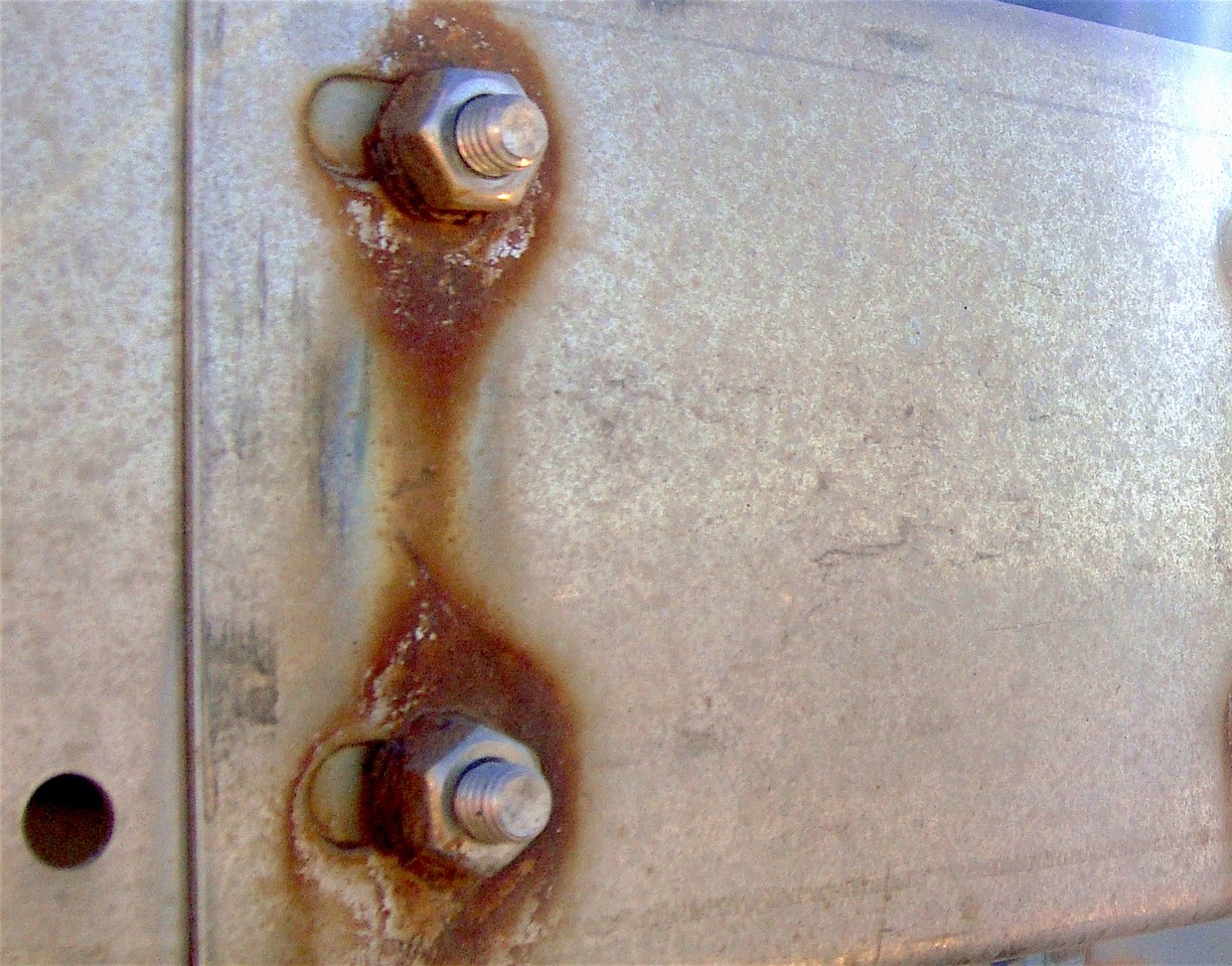
Rust haloes spreading from every fastener. The bolts are the more noble metal here. The plate corrodes, and damage gathers in a ring around each point of contact. The plate here is steel; the geometry carries across to aluminium. Photo: Rees11, CC BY-SA 3.0.
Put two different metals in contact, wet them with something conductive, and you’ve built a battery. Aluminium sits at roughly minus 700 to minus 900 millivolts against a saturated calomel reference. Stainless steel sits near minus 100 to plus 200. The gap of 0.6 to 0.8 volts between them is the driving voltage. Seawater makes an excellent electrolyte. Aluminium holds the more negative potential of the pair and takes the anode role. The anode is the one that dissolves.
How fast it dissolves comes down to area. Designs go wrong here. All the corrosion concentrates on the anode. A small anode wired to a large cathode gets eaten quickly, since the whole galvanic current crowds into a few square millimetres of metal. Reverse the areas and that current spreads thin over a wide surface and does little to it.
Stainless fasteners through an aluminium panel are acceptable, because the fasteners are the small noble part in a large sacrificial panel. Aluminium fasteners into stainless are close to unusable at the coast. Anyone specifying a mounting kit for a boat deck should check which way round the metals sit before checking anything else on the drawing.
Isolation breaks the circuit outright. A nylon shoulder washer, an insulating sleeve through the hole, a smear of jointing compound across the mating faces: any one of them stops metal touching metal. The cell can’t run once that path is gone. The barrier has to stay unbroken. One nick from over-torquing a bolt puts the two surfaces back in contact.
Marine practice puts stranded tinned copper on every conductor, called up by ABYC E-11 to UL 1426 boat cable, since bare copper greens over in salt air. The oxide raises resistance at every strand and every terminal. Solid conductor’s out entirely, because vibration works it until it breaks. On a machine feeding a boat’s DC system the leads an owner adds are often the weakest metal there.
The gap nobody inspects
Crevices do damage that open surfaces get blamed for. Under a washer, inside a threaded hole, between a gasket and its groove, around the base of a connector pin, there sits a pocket of liquid sealed off from the bulk solution. Oxygen in that pocket gets used up first. With no oxygen the passive film can’t rebuild. The trapped liquid turns acidic. Chloride migrates in to balance the charge. What forms is a small self-feeding cell that keeps running whether or not the outside has dried. Crevice attack kicks off at lower chloride levels than pitting needs. It also hides completely. A machine that looks clean from three feet away can carry a corroded ring under every washer.
How far from the water
Distance from the sea is the cheapest variable an owner controls. ISO 9223 sorts atmospheres into corrosivity classes and hangs real numbers on each, measured as first-year metal loss. Marine sites land in C5. Splash zones and offshore platforms land in CX, where zinc gives up 8.4 to 25 micrometres in the first year. ISO 9223 also grades the salt itself by deposition rate, caught on a wet candle and counted in milligrams per square metre per day. Class S0 runs to 3, S1 from 3 to 60, S2 from 60 to 300, and S3 from 300 to 1500. Published measurements put deposition under the S3 limit by 200 metres inland and under 150 milligrams per square metre per day by 2500 metres.
Prevailing wind decides more than the map does. Salt aerosol gets carried inland on onshore wind. Less of it reaches each kilometre further back. The sheltered side of a building a few hundred metres back can sit a full class below the exposed side of one at the same address. Put the machine on the leeward side, out of direct spray, and the class it lives in improves without a single component changing.
ISO 9223 corrosivity classes with published first-year corrosion rates for zinc. The class describes the atmosphere; the rate is how fast metal disappears in it.
Class
Typical environment
Zinc loss, first year
C1
Dry or cold zone, very low pollution
under 0.1 µm
C2
Temperate rural, minimal pollution
0.1 to 0.7 µm
C3
Urban, medium pollution or some chloride
0.7 to 2.1 µm
C4
Industrial, or substantial chloride effect
2.1 to 4.2 µm
C5
Marine, long time of wetness, heavy chloride
4.2 to 8.4 µm
CX
Offshore and splash zones, extended wetness
8.4 to 25 µm
Rinsing, and what it changes
Salt only works when it’s sitting on the machine. Rinse it off with fresh water and the clock stops. Do it after any trip that involved spray. Do it before the salt has dried into the seams, since dried salt needs soaking to shift.
Rinsing isn’t pressure washing. A jet drives salt water through gasket lines and into connector bodies, past seals designed for falling rain. Low pressure, plenty of volume, all the way round including the underside, then somewhere with air moving so water trapped in crevices can leave. A machine put straight back into a closed case after a rinse has swapped salt water for fresh water and kept the wetness.
Cap every unused outlet before the machine goes near spray, because an open port collects a conductive film across its pins. Contacts that have been wet want drying before they carry current again. Solid green water over the deck makes it a wet machine, which is a different problem from a salty one.
When it has already started
Corrosion splits into the kind you clean off and the kind that ends the machine. White powdery bloom on an aluminium case, light surface rust on a fastener head, a dull film across an exposed contact: all cosmetic, all removable. Clean the area, dry it properly, put a corrosion-inhibiting film back over the bare metal.
A pit your fingernail catches has gone further than it looks, and no repair puts that metal back. On a structural bracket or on a case wall carrying a seal, pitting means replacement, because the wall thickness the design counted on is no longer there.
Green or blue crystal growth on a board, a connector gone high-resistance and warm, a fastener that corrosion product has swollen in its own hole: any of these means the machine stops working for a living. Salt inside a live enclosure builds leakage paths between conductors. Leakage paths on a box holding kilowatt-hours are how fires start. Anyone finding crystals inside should stop using it and get it looked at before the machine misbehaves.
Common questions
How many hours of salt spray testing does a coastal machine need?
The hours matter less than the standard that produced them. A B117 figure ranks one finish against another under continuous fog and doesn’t convert into years of service. For equipment heading to the sea, the better question is whether the maker has run IEC 60068-2-52 test Kb at severity 1 or 2, which builds the wet and dry cycle into the schedule. Failing that, ask what the pass criterion was, since no red rust on a case is a much weaker claim than connectors still inside their contact resistance spec.
Can a waterproof rating handle salt air on its own?
No. An ingress rating covers water getting in. Salt air works on the outside of a machine, which the ingress rating doesn’t cover. Exposed metal, fastener heads, connector shells and every place two metals touch all sit outside the sealed volume. A machine needs both of them answered.
Which metals last longest in a marine environment?
Anodised aluminium with 316 stainless is the usual coastal pairing. Grade 316 carries 2 to 3 percent molybdenum, which lifts its pitting resistance equivalent number to between 23 and 28.5, well above the 18 to 20 of grade 304. In marine immersion that difference shows up as ten to fifteen years before pitting, roughly three times what grade 304 manages. The combination matters as much as the alloy does. Two well-chosen metals in direct contact still build a galvanic cell.
How often should a power station be rinsed at the coast?
After every exposure to spray, and before the salt dries. Weekly is a sensible floor for a machine living permanently near the water even when nothing splashes it, because salt aerosol settles out of the air on its own and builds up on every horizontal surface. Include the underside and the port caps, then let it dry somewhere with air moving.