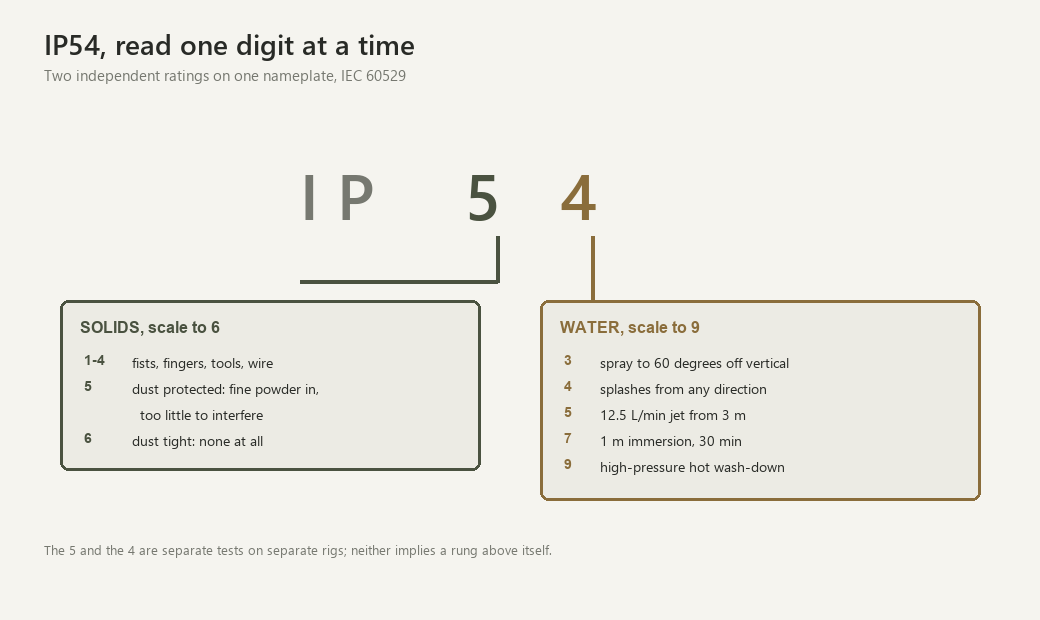
The nameplate code taken apart. Solids on the left scale, water on the right, each digit earned on its own rig; neither implies any rung above itself.
Stamped near the serial number of a weather-hardened power station sits a short code, IP54 on the common outdoor build. The first grades the barrier against solids on a scale that tops out at 6: the lower rungs grade out fists, fingers, tools and wire at 50, 12.5, 2.5 and 1 millimetres, a 5 means dust protected, a little powder getting in, too little to hurt; a 6 means none gets in at all. The second grades water, its scale climbing to 9: a 4 covers splashes thrown from any direction, the 9 at the top covers 80-degree water at 80 to 100 bar from a nozzle 10 to 15 centimetres away, the wash-down rung on vehicle and food-plant gear, grown out of a German vehicle standard. Supplementary letters trail the digits on some plates, a W for weather conditioning among them. Neither digit promises the other’s job. The system dates to the 1970s under IEC 60529. Both scales sit catalogued line by line in the IP code tables.
Indoor-grade stations commonly wear IP20, the 2 standing for that 12.5-millimetre finger stop and the 0 for no water claim at all. It isn’t a swimming certificate. The 4 stops well short of hoses and immersion, separate test rigs further up the table. On a shop listing the quick filter is the second digit alone: 0 through 2 stays indoors, a 3 handles spray to 60 degrees off vertical, 4 and up can face real weather.
Where water finds a way in
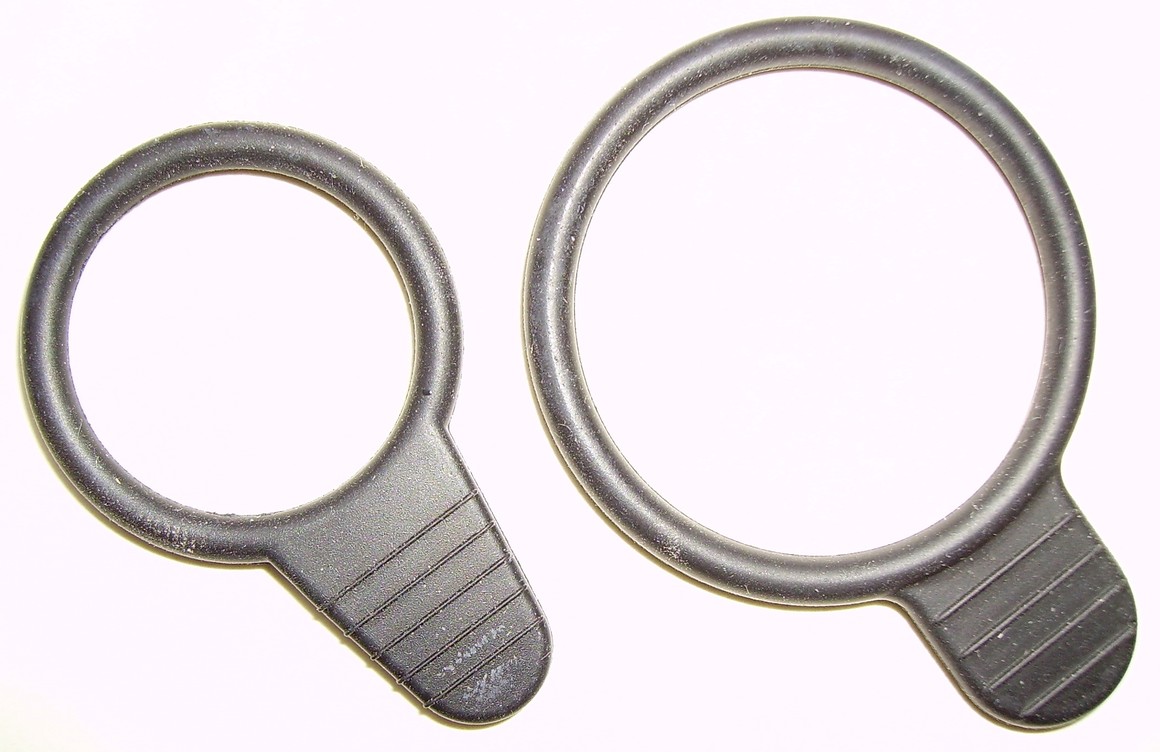
Sealing rings with moulded pull tabs, cousins of the plugs on a station’s port row. A few grams of rubber carry the whole number on the nameplate. Photo: Cjp24, CC BY-SA 3.0.
Lid meets body along a parting line that runs the full perimeter; a soft gasket rides in a groove along it, squeezed by 20 to 30 percent of its height once the screws pull the halves together, the target the O-ring handbooks print for a static face seal. Rubber under that squeeze flows into the microscopic valleys of both plastic faces. Contact pressure is the seal. Assembly manuals stagger the screw order to land the squeeze even, a gasket pinched hard at one corner folding a channel open at the far one. Designers run the line under an overhanging lip besides, standing droplets meeting plastic first and rubber second. Silicone stock holds its spring from around minus 60 to 200 degrees; the cheaper thermoplastic gaskets on budget builds give up their elasticity decades of degrees sooner at each end. Foamed gasket strip takes a softer squeeze across wider gaps and forgives wobbly moulding; cheap shells lean on it.
AC outlets, the 12-volt socket and the USB bank each sit behind a hinged silicone plug, a stretched cap whose moulded lip presses into the recess around the socket. Industrial builds swap the flap for a threaded cap on the heavy connectors, a screw thread loading the seal harder than any press-fit lip manages. A quarter turn past finger-tight is all it wants; the O-ring does the sealing, the thread just holds it there. Plugs do their work only when seated. Leave one hanging after a phone charge and the whole machine is down to the rating of that one open hole. Moulded lanyards tie the caps to the case. USB and 12-volt recesses carry low voltage and forgive the lapse for a spell. The AC recess forgives least. Rocker switches get the membrane treatment on sealed builds, a continuous elastic skin over the mechanism with the click transmitted through it.
Fan openings dwarf all the other entries. Cooling air has to cross the wall somewhere, and there’s no gasketing a hole the size of a palm. Sealed designs route the airflow through a labyrinth in place of a straight hole: a hooded intake facing down, a baffle wall behind it, drainage slots at the lowest point of the bend where thrown water falls out of the airstream and runs back outside. The bends tax the fan a little, flow resistance a straight grille skips, paid for in a slightly larger fan. Splash arrives with little momentum, which lets two changes of direction strip nearly all of it. Exhaust faces get the folded path in reverse, plus a lip that stops roof runoff from walking straight in. Drain slots double as mud traps in dusty rain; a matchstick clears what a season deposits.
Boards inside sealed machines commonly carry a last line of their own, a conformal coating laid 25 to 75 micrometres thick across tracks and solder joints, the film band the IPC coating standard sets. Droplets that beat the labyrinth land on varnish. What would have been a short circuit dries into a stain for the next service to wipe off. Acrylic coatings go on the serviceable boards, the type a rework station softens; harder urethanes cover the sealed-for-life ones, and silicone films go on at double the thickness.
Dust on the intake side
Dust rides the cooling air. A machine breathing site air pulls its own contamination in through the intake, the labyrinth knocking out the heavy grit, the fine fraction sailing on through the bends. Mesh screens on the intake face catch what matters once the holes sit under half a millimetre; the pad rinses clean under a tap, dried before it goes back. Cement dust and plaster sanding are the harsh cases, powders milled far below that mesh size; on those sites the screen buys time between cleanings and little more. A vacuum beats compressed air on a dusty grille, blown air driving the fine fraction deeper past baffles a nozzle can’t follow.
Powder that settles on a sealing lip is a slow abrasive: every open-and-close of a port plug grinds whatever sits on the lip into the rubber face, wearing grooves that water later follows. Grit under a lip shows early as a grey ring on pale rubber, the wear signature to check for. Wiping a plug’s seat with a thumb takes five seconds; it’s the cheapest maintenance the machine gets. Seats clean with a damp cloth and dry fully before closing, since trapped droplets under a fresh cap ride straight into the recess.
Dust that reaches a heatsink asks for more airflow at every load. Sealing only decides how much arrives. A labyrinth plus a screen holds the arriving fraction to grams a season in ordinary outdoor service, a teaspoon by spring. Fine powder clings by static besides; a damp cloth lifts what dry brushing spreads around.
The hole that has to stay open
Cooling and sealing pull the same wall in opposite directions. A 2-kilowatt inverter sheds a couple of hundred watts of heat at full load; air is the only practical carrier at that scale, which writes a permanent opening of tens of square centimetres into the wall. High waterproof grades drop the fan altogether. Fanless industrial builds pour the heat into a finned metal case, aluminium conducting around a thousand times faster than the ABS of an ordinary shell, the whole skin working as one heatsink with fins doubling the surface; the price is a lower continuous rating per kilogram, the trade that buys IP65 on the W-series class of machine. The trade reads in kilograms too, sealed siblings running heavier on the identical electronics, the difference cast as aluminium fin. A fanless case runs hot to the touch on purpose. The skin is the radiator. On the fan-cooled mainstream, IP54 sits close to the ceiling the physics allows.
What the laboratory does
The 4 in IP54 is earned on a specific rig. IEC 60529 mounts the sample on a turntable under an oscillating tube, a semicircle of spray nozzles swinging 180 degrees to either side of vertical, one full swing each 12 seconds or so, the table walking the case round to hand each face to the arc, water metered at 0.07 litres a minute per square decimetre of the sample’s surface. On a mid-size station wearing half a square metre of shell, the metering works out near 3.5 litres a minute, 35 litres across the ten-minute run, delivered from each angle the swing reaches. The pass is judged afterwards with the case open: water may have entered only in amounts that touch nothing live and pool nowhere harmful. A pass means the interior stayed harmless. Rig water runs cool on purpose, well under the skin temperature of a machine that worked all morning; the gap primes the indrawn breath a warm case takes when cold water lands. Technicians seat all the plugs and fit fresh gaskets before the rig starts; the rating describes that machine on that day, seals new from the mould. The report behind the rig lists where water sat, photographs of the opened case filed beside the verdict; a maker chasing a borderline pass redesigns the drain slots before any retest. Development labs test past the rating on purpose, production lines then spot-checking against the standard’s letter. Ten minutes of spray is all the 4 ever promises. Ratings stack no further than their own rig. Each line of the table is its own test and its own pass, the reason a spec sheet sometimes quotes IP54 for the machine beside a separate IPX7 claim for one sealed accessory pod.
The 5 comes out of a different room altogether. Talcum stands in for the world’s dust because it packs fine, flows badly and jams whatever it enters. Milled to a band where three-quarters of the grains sit between 32 and 250 micrometres, it hangs suspended at 2 kilograms per cubic metre of chamber air, circulation held under 2 metres a second, for eight hours on the common cycle. Equipment whose duty cycle heats and cools its own interior is tested with a vacuum pump drawing air through the case, the standard’s way of forcing the breathing a real machine does across a working week. Powder found inside afterwards is weighed against the identical judgement: present, harmless, away from anything it could jam or short.
A 5 in the water column means a 6.3-millimetre nozzle delivering 12.5 litres a minute from 3 metres, a garden-hose class jet held on each face; a 6 steps the nozzle to 12.5 millimetres and the flow to 100 litres a minute, fire-hose territory. A 7 means half an hour fully submerged, the metre measured down to the lowest point of the case.
The five water rigs of IEC 60529 that turn up on and above portable gear
Rating
Rig
Water delivered
Duration
IPX3
oscillating tube, swing to 60 degrees off vertical
0.07 L/min per dm² of surface
10 min
IPX4
oscillating tube, swing 180 degrees each side
0.07 L/min per dm², near 35 L on a mid-size case
10 min
IPX5
6.3 mm nozzle at 3 m, jet on each face
12.5 L/min
1 min per m², 3 min floor
IPX6
12.5 mm nozzle at 3 m, jet on each face
100 L/min
1 min per m², 3 min floor
IPX7
full immersion, lowest point 1 m down
static
30 min
Splash-proof, weather-resistant and rainproof carry no test rig behind them; IP54 does. A listing that names the standard and the digits has agreed to be measured.
An X in either slot, IPX4 say, means untested for that column, no claim either way. Plenty of honest gear wears an X on the solids side; the maker paid for the water rig alone.
The case that breathes
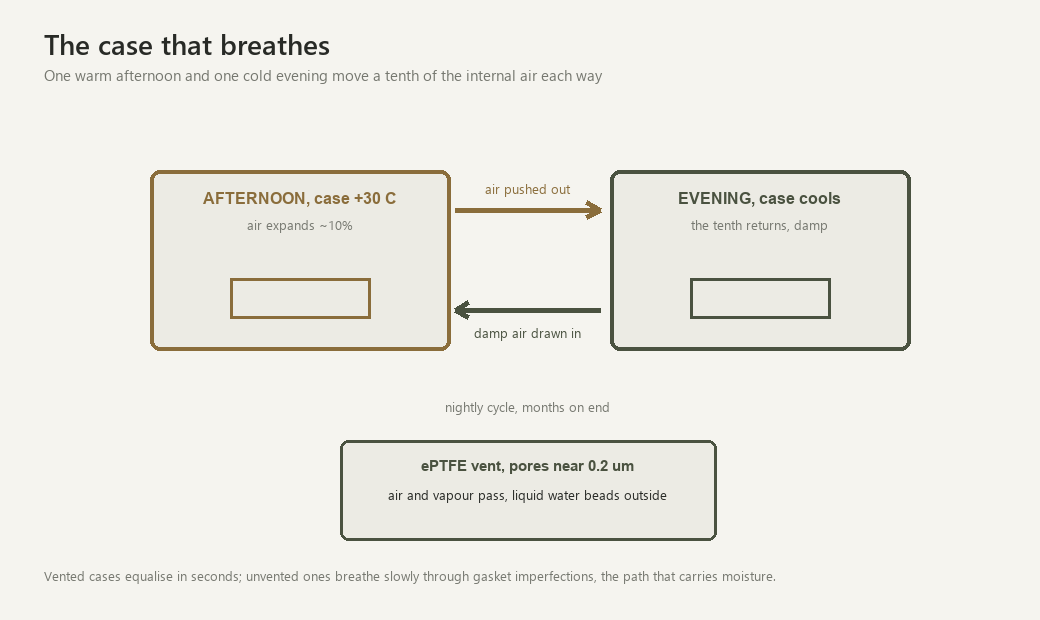
The daily breath of a sealed box. A 30-degree warm-up pushes a tenth of the internal air out; evening pulls the damp replacement in. A membrane vent lets the cycle run without dragging on the gasket.
A sealed box changes temperature and its air obeys. Warmed 30 degrees across a sunny afternoon, the internal air grows by a tenth; that tenth has to go somewhere, and out it goes through whatever path exists. The evening plunge pulls the identical volume back in, now carrying the damp of the hour. Overnight cycles run that pump in miniature, cupfuls of air a night on a 20-litre interior, grams of water a season. Months of them can walk enough moisture past a good gasket to fog a display from the inside. The pane fogs first because glass runs coldest of the interior faces. The dust chamber’s vacuum-pump clause exists for exactly this behaviour.
Engineered builds answer with a vent that passes air and stops water. Expanded-PTFE membrane vents, coin-sized patches with pores near 0.2 micrometres, let air and vapour cross at the smallest pressure difference; liquid water beads on the surface, droplets thousands of times wider than the openings. Data sheets on the screw-in vents quote airflow near 7.6 litres a minute at 70 millibars of difference; a daily cycle asks for a tiny fraction of that. A case wearing one equalises in seconds; a sun-baked machine meeting a cold downpour, the pressure drop that would suck at each seam, passes the moment without strain. Builds without a vent breathe anyway, slower, through the gasket’s imperfections. Storage sheds run the cycle too, milder swings on more days; a boxed machine with a pouch of gel sits out a season drier than a bare one on a shelf. Industrial gear carries them as M12 screw-in plugs; a vent capped in field mud stops equalising until a wipe clears the membrane. Drilling a case to retrofit one trades a warranty for a hole. The feature belongs at the design stage, on a high face clear of pooled water.
Rain-day habits
Under a tailgate, an awning or a table, thrown water arrives rarely and from few directions; the splash rating covers stray hits with margin to spare. A metre of overhang removes the whole vertical component of a rainfall, leaving the wind-driven fraction, the share the 4 was scored against. Ground contact is the quiet risk of a wet day, since a downpour lays a moving sheet of water across any hard surface; a crate under the case keeps the base out of it. Rain falls near vertical in still air. Wind tips it toward the horizontal, straight onto the port face. That’s the one the caps have to stop.
A lead running downhill into a socket delivers each drop it catches straight to the pins. Dressed with a sag below socket height, the identical lead drips at its low point, the drip loop electricians tie in by reflex. A fist of slack makes the loop; depth does the work. Coiled excess lives off the ground on a hook or the handle, clear of the sheet water. Plugs point down or sideways in weather. Bag a working machine in plastic and it turns into a condensation tent by morning, the warm case sweating under the film; a roof with air moving underneath keeps it dry. Bags belong on machines that are off and cold, as dust covers in storage.
Close each cap the moment the cable leaves, wipe the lip when it turns gritty, glance at the seat before pressing home. An IP44-rated outdoor socket box closes over the extension joint for a few pounds. On the AC side, wet hands and live outlets stay apart regardless of any rating.
Seals age faster than boxes
Rubber holds a seal by pushing back. Years of compression teach it to stop. A gasket that has lived flattened takes a permanent set, keeps its dent after the screws loosen, meets the lid with less pressure each season. Sunlight works the exposed parts in parallel, ultraviolet hardening silicone plugs until a cap that once stretched over its recess cracks at the hinge. The case outlives its rubber by years. Laboratories age gaskets on the bench by baking them compressed, a day at 70 degrees standing in for seasons, the recovered height afterwards scoring the material.
The spring check is a one-minute job. Press each plug and watch the spring-back, run a fingertip along the parting-line gasket feeling for hard or chalky stretches, look for any cap sitting proud of its recess. A missing plug is the loudest finding of all. Swapping a parting-line gasket stays a screwdriver job on serviceable builds, new cord pressed dry into its groove, the groove doing the holding. A film of silicone grease on lips and O-rings twice a year keeps the rubber supple; solvent sprays of the workshop-lubricant kind swell and soften seals. Replacement plug sets and gaskets sell as ordinary spares for single-digit money. Figure on five-year rubber for a ten-year case outdoors.
After the soaking
Loads off first, then the input, then a dry cloth over the shell. Switching it on just to check is the one move that turns a wet board into a burnt one; a board that would have dried clean switches on into its own wet film. Tip nothing and shake nothing; water that settled low stays clear of more electronics than water sloshed around the interior. The case stays closed through all of it, service voltages inside persisting after the plugs leave.
A day or two in warm moving air with every cap open drains the accessible spaces; a lidded crate with a kilogram of silica gel pulls the last damp out, the beads holding around a third of their own weight in water. Indicating gel shows spent by colour, pink or green by type. A low oven at 120 degrees for a couple of hours recharges the batch. A display still fogging from inside after the dry-out says moisture stayed; back to the crate for another round. False readings an hour after rain are usually damp in a connector, cleared by the drying that clears the rest. Muddy water leaves grit in the labyrinth after it dries, a job for the next vacuum pass. Spray on the shell shrugs off the day it lands. A dunk in a puddle calls for a service bench whatever the display claims afterwards; salt water doubles the case, conductive residue staying behind after the water has gone.
Common questions
Can an IP54 power station sit out in the rain?
Light rain and splash sit inside the rating. Persistent heavy rain sits at its edge; jets, hoses and pooling sit beyond it, each with its own rig further up the ladder. The 4 was earned under 0.07 litres a minute per square decimetre of swinging spray for ten minutes, roughly 35 litres over a mid-size case. A storm delivers more water for longer from fewer angles. Vertical rain pooling on a flat top finds the seams given time; a slight lean sheds it. Under an awning the question disappears.
Water got into the fan opening. Is the machine dead?
Rarely, when power went off quickly; a bit of thrown water is exactly what the layout expects. The labyrinth behind the grille drops the bulk of thrown water into drainage slots before anything live sees it; coated boards tolerate the droplets that arrive anyway, and units with residual-current protection on the AC side trip themselves the moment leakage starts. Cut the loads, pull the input, give the interior a day of open-cap drying before the next switch-on. A rattle from the fan bay after rain means water pooled past the slots.
Does the bag-of-rice trick work on a wet power station?
Rice barely absorbs anything and sheds starch dust into the ports on top. A closed crate of silica gel holds about one-third its weight in water and leaves no residue; the same beads recharge in a low oven and work again. Moving warm air through open caps does more than either.
Can I charge outdoors in the rain?
Opening the AC or charge port cap suspends the sealing at that hole; mains plus water is its own hazard beyond any enclosure rating. Charge under cover, keep a drip loop in the lead, and let the case run sealed until the weather passes.