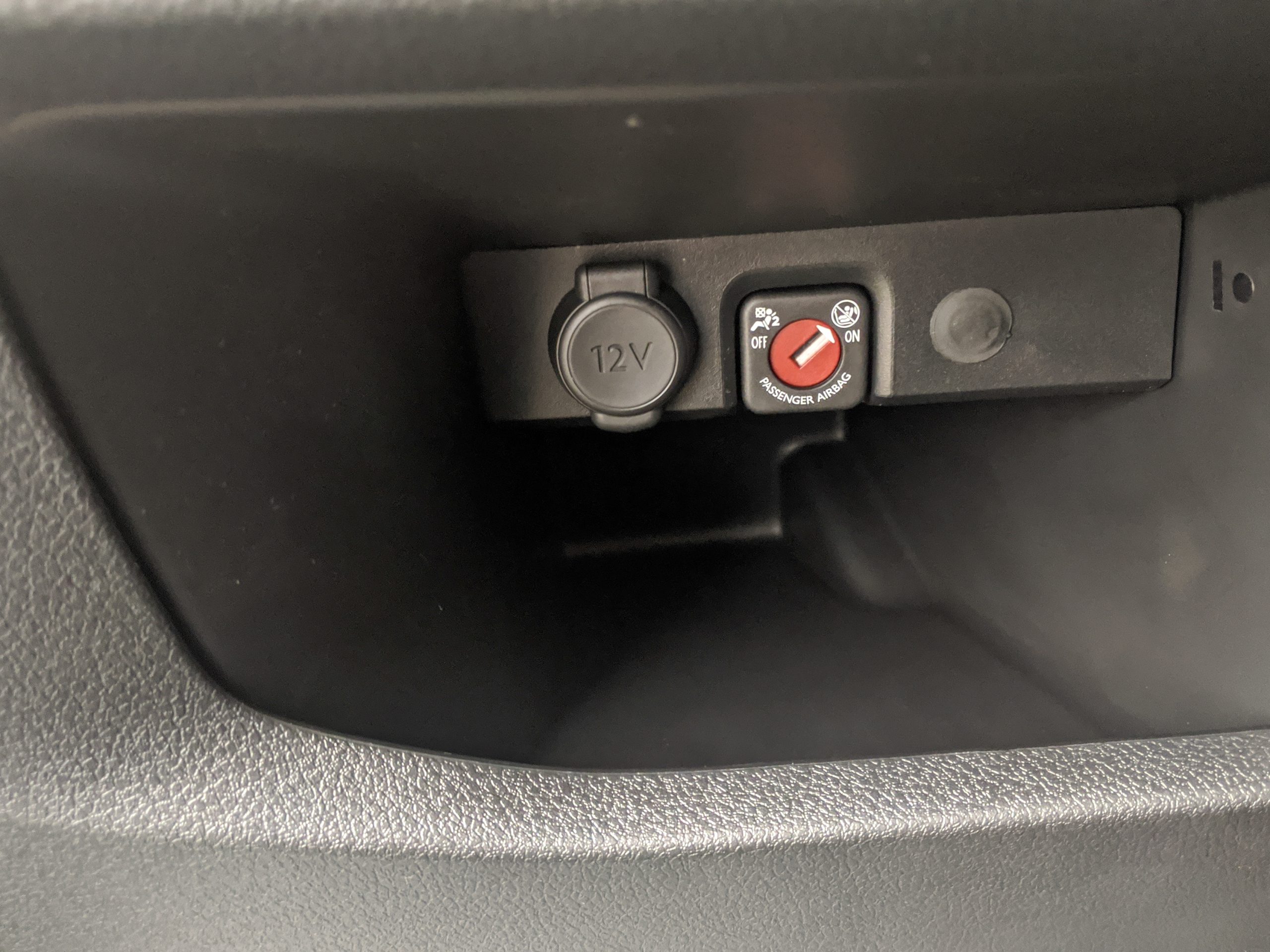
A 12-volt accessory socket in a car dash, capped and marked “12V”. This is the round port a car-charge cable plugs into. The red switch beside it is the passenger-airbag cutoff, unrelated to charging. A power station draws its car charge from a socket like this, through a cigarette-lighter plug. Photo: Vauxford, CC BY-SA 4.0.
A power station can charge from the 12-volt socket in a car. The socket is the round port that once held a cigarette lighter or an accessory plug. A car-charge cable runs from that socket to the station’s DC input. Power flows in at a modest rate, enough to top up a battery over a long drive. Behind the dash, the socket is the same one that once lit a cigarette. Familiar and everywhere, it makes a ready charge point.
The socket makes a handy charge source on the road. No wall outlet is needed, no sun, no generator. A driver plugs in and gains power while the miles pass. The car does the charging as a side effect of driving. On a road trip, the charge comes free with the miles. Every hour of driving banks a little more power.
The rate is the thing to understand about car charging. A 12-volt socket carries far less power than a wall inlet. The charge comes in slowly, measured across a whole drive. Knowing that rate sets the right expectation before the plug goes in. Set that expectation, and car charging never disappoints.
Where the socket’s power comes from
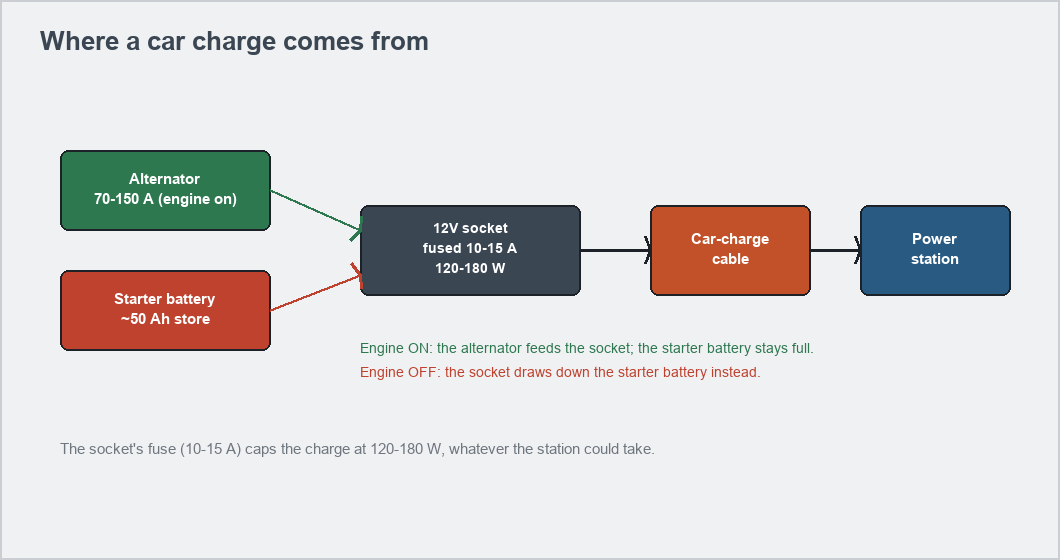
Where a car charge comes from, drawn as a flow. The alternator, in green, makes power whenever the engine runs. The starter battery, in red, is the store that cranks the engine. Both feed the 12-volt socket, fused at 10 to 15 amps for 120 to 180 watts. A car-charge cable carries that to the power station. With the engine off, the socket draws the starter battery down. The figure is illustrative.
The socket draws on the car’s own electrical system. Two things feed that system. The starter battery holds a store of 12-volt power. The alternator makes fresh power whenever the engine turns. Together they run everything electric in the car. Lights, pumps, screens, and the socket all draw on the same supply.
With the engine running, the alternator carries the load. It spins with the engine and makes far more current than a socket draws. The charge to the station comes from that fresh power. The starter battery stays full the whole time. Driving, in effect, charges the station for nothing.
With the engine off, the socket draws on the battery alone. No fresh power comes in. Every watt sent to the station leaves the starter battery. That small store is also the one battery that starts the car. Drain it too far, and the engine will not turn over. That risk is the whole reason to watch a parked charge.
The engine decides how safe car charging is. Run it, and the socket stays fed while the starter battery holds full. Leave it off, and the socket pulls only from that battery. More than anything, the engine sets whether the charge costs the car a thing. Running or parked changes everything about the charge.
The current limit of the socket
A 12-volt socket carries a limited current. A fuse guards it, set at 10 or 15 amps on many cars. At 12 volts, that fuse allows somewhere between 120 and 180 watts. The socket takes no more, whatever the station could accept. Behind that round port sit a fuse and a thin wire. Neither was built to carry big power for long.
The fuse is there to protect the car’s wiring. The thin wires behind a socket carry only a limited current before they heat. A fuse blows before the wiring is at risk. A draw past the fuse trips it. The charge ends there. Better a blown fuse than a smouldering wire. Cheap to replace, the fuse takes the hit first.
That limit puts a hard cap on car charging. A station able to take 500 watts from the wall still draws only 120 through the socket. The socket is the bottleneck, whatever the station allows. No cable or setting lifts a charge past what the fuse permits. Whatever the station’s own rating, the socket has the final say.
What that limit means for charge speed
At 120 watts, a car socket charges slowly. A 1000 watt-hour station needs the better part of a day at that rate. Real losses stretch the figure past ten hours. A full charge from empty is more than a single drive. Empty to full on a socket alone asks for an unusually long road. Few drivers ever charge a big station that way.
A top-up is what the socket does well. An hour of driving adds around 120 watt-hours to the station. A long day on the road adds a real share of a small battery. The charge keeps pace with light use along the way. Run a fridge and charge the station, and a drive keeps both going.
Charge time falls in proportion to the power. Double the input, and the hours halve. A 120-watt socket takes twice as long as a 240-watt one. The socket’s low power is the whole reason car charging runs slow. Nothing in the cable or the station changes that basic rate. Only a higher-current outlet lifts it at all.
Matching the charge to the battery keeps the wait sensible. The smaller the station, the further a drive’s charge goes. A 250 watt-hour unit gains a real share in a couple of hours of driving. The biggest units still lean on a wall charge for their main fill. Between those, a mid-size station gains a useful chunk each day. A day of errands can hold a 500 watt-hour unit steady.
Charging with the engine running
Charging while driving is the natural way to use the socket. The engine spins the alternator. The alternator makes far more power than the socket draws. The station takes its share. The car never feels the load. A hundred-odd watts is nothing against an engine’s output. The alternator hands it over without a flicker.
A long drive turns into a slow charge that costs nothing. Hours behind the wheel feed the station steadily. The power costs nothing beyond the fuel already burning. A road trip doubles as a charging session. By the end of a long day, the station has gained real ground. Six or eight hours of driving move a serious share of charge.
An alternator has current to spare. It makes 70 to 150 amps for the whole car. The socket’s 10 or 15 amps is a small slice of that. Plenty of headroom sits above the socket’s draw while the engine runs. Only a parked car ever feels the socket’s draw.
Charging with the engine off
With the engine off, the socket becomes a drain on the starter battery. Every watt to the station comes out of the small store meant to crank the engine. An hour at 120 watts pulls about 10 amp-hours, a large bite from a 50 amp-hour battery. A long stop can leave the car unable to start. Charging parked is a borrow against the one battery a driver cannot afford to flatten. The longer the engine stays off, the deeper the socket cuts into the crank battery.
The DC-to-DC step inside the station
The station converts the car’s 12 volts to its own. A power station’s battery sits at a higher voltage than 12. A DC-to-DC converter steps the input up to match. The conversion runs at high efficiency, with a small loss to heat. Inside the box, the conversion runs unseen. A little warmth on the case is the only sign of it.
The input accepts a range of voltages around 12. A typical DC input takes anything from 11 to 30 volts. That range covers a 12-volt car and a 24-volt truck alike. The converter sorts out the exact voltage on its own. A camper on 12 volts and a truck on 24 both plug into the same port.
The converter also guards against a rough car supply. Voltage from a socket is rough, sagging and spiking through a drive. The input smooths those swings away. The battery sees a steady charge. The converter turns a rough supply into a steady charge. Spikes and sags never reach the cells.
The car-charge cable and connectors
A car-charge cable links the socket to the station. At the car end sits a cigarette-lighter plug, at the far end the station’s DC connector. A fuse often sits inside the plug for a second layer of safety. Many stations ship the cable in the box. No special adapter is needed beyond that one cable.
Each brand picks its own connector at the station. A barrel jack, an XT60, or an Anderson plug all show up. The station’s manual names the one it takes. A matching cable is the only special part car charging needs. Get the connector right, and the rest is plug-and-go. One cable covers the whole job.
A thick cable keeps the small voltage from sagging. At 12 volts, even a little resistance costs a noticeable share. Heavy wire on a short run delivers nearly all the socket’s power. A thin or overlong lead gives some of it up to heat. At 12 volts, cable quality shows up more than at higher voltages.
As much as the cable, the plug’s own fuse matters. A plug rated for the full socket current carries it and stays cool through a long charge. Checking the plug’s rating avoids a slow or failing charge. A good plug pays for itself in every fast car charge. A quick look at the plug before a long trip saves a slow charge. The cable and the plug together set the real ceiling.
The 12-volt input on the station
A station takes the car charge through a dedicated DC input. Among the other inputs on the case sits the port. Its label names the voltage range and the current it accepts. That input feeds the same charger the wall and solar use. One charger inside handles every kind of input. Car, wall, or sun, the port sorts it out.
One DC port often serves both the car and a solar panel. The two share a voltage range.
Topping up on a road trip
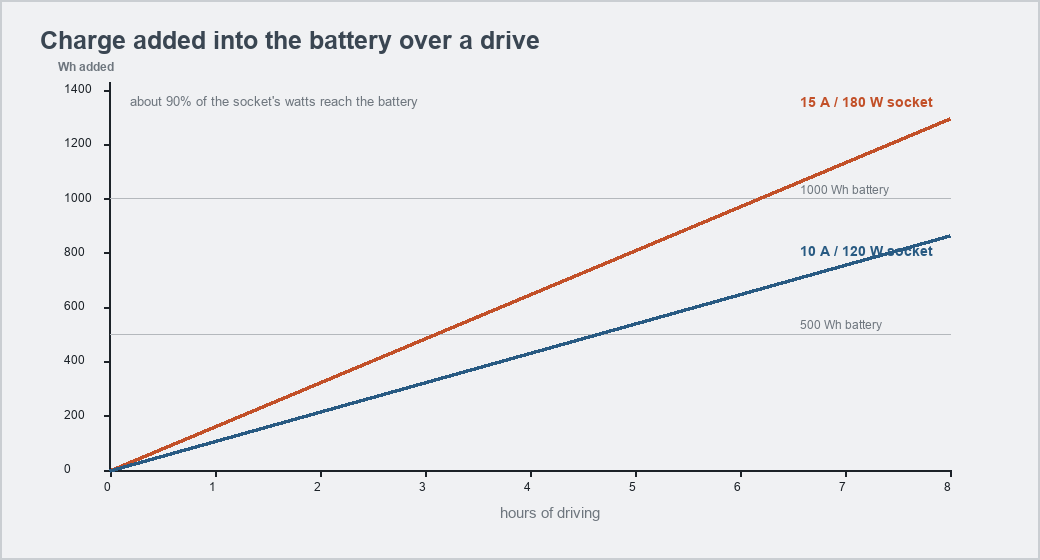
Charge added into the battery over a drive, at two socket powers. Over an eight-hour drive, the charge into the battery reaches about 1300 watt-hours on a 15-amp (180-watt) socket, and proportionally less on a lower-amp one. Only about 90 percent of the socket’s watts reach the battery. The 500 and 1000 watt-hour lines mark two common battery sizes. The figure is illustrative.
A real road trip shows what car charging adds. Start with a 500 watt-hour station and a 12-volt socket fused at 15 amps, good for about 180 watts. Plug in at the start of a six-hour drive. At 180 watts, the station takes in around 180 watt-hours each hour. Over six hours, that comes to a little over 1000 watt-hours of raw input. Losses in the cable and the converter trim perhaps a tenth. What lands in the battery sits near 950 watt-hours across the day. For a 500 watt-hour station, the drive fills it and holds it there, with power to spare for a phone or a cooler along the way. The engine runs the whole time. The charge costs nothing beyond the fuel already burning. Nothing leaves the starter battery. The alternator carries the load without strain. Now picture the same six hours on a 10-amp socket, good for 120 watts. The input drops to about 120 watt-hours an hour, near 720 over the drive, close to 650 into the battery after losses. Still a full charge for a 500 watt-hour unit, with a little less to spare. Scale the battery up to 1000 watt-hours, and the same drive lands a solid half-charge. Scale it to 2000, and the drive tops up a fifth. The pattern holds: a drive adds a fixed pool of watt-hours set by the socket. A bigger battery just takes a smaller share of that pool. Big batteries treat the drive as a slow top-up. The smaller the battery, the more of it a single drive fills. The socket’s watts, the drive’s hours, and the battery’s size are the three numbers that matter. Multiply the first two for the pool. Divide by the third for the share. That quick sum turns a dashboard socket into a real charging plan. A driver who plans it that way is never surprised by the reading at the end of the road. Take a different trip: a two-hour errand run on a 10-amp socket. That adds only about 200 watt-hours, a small dent in any but the tiniest station. The socket does its best work over a long haul. Over a week of commuting, those small dents still add up. A station topped a little each day rarely runs low. The car becomes a steady charger that never asks for a wall plug.
Across cars and stations, the lesson holds. A drive adds watt-hours in proportion to the socket’s power and the hours driven. Against the battery’s size, that pool makes its dent. The smaller the battery, the bigger the dent from a single drive.
The table below sets a few cases side by side. It pairs a socket power with a battery size and a drive length. The watt-hours added and the share of the battery filled follow from those. Reading down it shows where car charging earns its keep. Set against a battery size, the socket’s watts tell the tale.
Charge added into a battery over a 6-hour drive, by car input (illustrative)
Car input
Fuse
Power
Added in a 6-hour drive
Cigarette socket
10 A
120 W
~650 Wh
Accessory socket
15 A
180 W
~950 Wh
High-amp outlet
20 A
240 W
~1300 Wh
DC-to-DC charger
30–50 A
400–600 W
~2500 Wh
For a small battery on a long drive, the numbers pay off. A modest station topped up over hours of driving reaches camp ready. A larger one still gains a useful margin from the same drive. Either way, the charge arrives for the price of the drive alone. No outlet, no fuel stop, no wait beyond the driving itself. The trip and the charge share the same hours. Nowhere does a driver pay twice for the same time.
One rule carries all of it. Watt-hours in equal the socket’s watts times the hours of driving, less a tenth for losses. That figure, against the battery’s size, is the charge a trip delivers. Everything else is detail. Hold that one sum, and any trip’s charge is easy to guess.
Protecting the car’s starter battery
During car charging, the starter battery deserves care. It exists to crank the engine, nothing more. A flat starter battery strands a car as surely as an empty tank. Car charging has to leave that battery able to do its job. A dead crank battery far from help is a bad day. Guarding the crank battery is the first rule of car charging.
Safest of all is to charge only with the engine running. A turning engine keeps the alternator feeding the socket. The starter battery stays topped up throughout. On power the car makes fresh, the station charges. Engine on, the starter battery never even notices. All the power comes fresh from the alternator.
A parked charge calls for a watchful eye. A brief top-up with the engine off does little harm. The longer it runs, the lower it pulls the starter battery. Watching the time, or the car’s voltage, keeps a parked charge safe. A glance at the voltage tells when to stop. Below about twelve volts, the parked charge has gone too far.
Some setups guard the starter battery on their own. A low-voltage cutoff stops the draw before the battery is too flat to start. A dual-battery system gives the socket a second battery to drain. Either one turns a risky parked charge into a safe one. Either guard lets a parked charge run without worry.
Where 12-volt charging fits
Car charging shines on the long road. A day of driving between stops feeds a station for free. An overlander far from any outlet leans on the car for power. Travel time turns into charging time at the socket. Miles on the road double as miles of charging. A long drive pays a real charging dividend.
Best beside the other inputs, the socket is a top-up. A wall charge at a hotel fills a station fast overnight. Solar adds power through a sunny afternoon. The car socket covers the hours in between, on the move. Together the three keep a station full on any trip. No single input has to carry the whole load. Each one covers the hours the others cannot. Between wall, sun, and socket, a station rarely runs dry.
Higher-power car inputs
Some cars offer more than the cigarette socket. A dedicated 12-volt outlet may carry 15 or 20 amps. A hardwired line from the battery can carry far more. Each lifts the ceiling above the standard socket. These outlets show up on some cars only. The cigarette socket stays the common default.
A DC-to-DC charger unlocks the highest car charging. Wired to the car’s system, it pulls 30 to 50 amps safely. It manages the alternator and the starter battery together. A serious overlander fits one for real charging on the move. Wired in once, it charges as fast as the car allows. Thirty to fifty amps beats the cigarette socket many times over.
These setups ask for wiring beyond a plug-in cable. An installer runs heavy cable from the engine bay. In return, the station gains a fast car charge. For a built-in rig, the effort pays back on every long drive. For a van that lives off-grid, the wiring pays off. Run once through the engine bay, the heavy cable lasts the life of the rig.
Reading the 12-volt spec
A station’s spec sheet names its car-charging input. A line gives the DC voltage range and the maximum current. The car socket’s own fuse sets the real limit, usually a lower number than the station’s own maximum. The lower of the two decides the charge. Read both numbers, and the slower one wins.
Ratings of their own ride on the cable and the plug. A plug fused at 10 amps caps the charge there. The station may accept more than the socket can give. Matching all three unlocks the full car charge. A mismatch anywhere holds the charge below the socket’s limit. Cable, plug, and port all have to agree. Line all three up, and the full car charge flows.
Getting the best from car charging
Car charging rewards a few simple habits. Charging with the engine running keeps it free and safe. Thick wire on a short run delivers the socket’s full power. A small station gains the biggest share from a day’s drive. A few small habits add up to a better car charge, each costing no more than a moment’s thought. Habit, more than gear, sets the car charge a driver gets.
The socket’s limit is the number to plan around. Twelve volts and 10 or 15 amps set the ceiling. A whole drive adds what an hour of wall charging would. Planning at that rate keeps expectations in line with the road. A drive is about an hour at the wall, no more.
A portable power station makes car charging a plug-and-go affair. A user connects the cable and the charge begins. Voltage, conversion, and limit are all the station’s to handle. From the dashboard socket comes a steady trickle of charge. Plug in at the start of a drive, and forget about it. The station tops up while the road rolls by. Hours later, the station reads fuller than it did.
Charging a power station from a 12-volt car socket turns driving into charging. The socket gives a slow, free feed while the engine runs. A short cable and a matched plug carry its full 120 or 180 watts. Over a long drive, that steady trickle fills a small station and adds a useful share to a larger one. Driving and charging become one and the same. That is the quiet appeal of the car socket.
Frequently asked questions
Can I charge a power station from my car’s 12V socket?
Yes. A car-charge cable runs from the cigarette-lighter socket to the station’s DC input. The socket allows somewhere between 120 and 180 watts, set by its 10 or 15-amp fuse. At that rate the charge is slow, best used as a top-up over a long drive with the engine running.
Will charging from the car socket drain the car battery?
With the engine running, no. The alternator makes far more power than the socket draws. The starter battery stays full. With the engine off, every watt comes out of the starter battery. A long parked charge can leave the car unable to start. Charge with the engine running whenever the battery matters.
How long does it take to charge a power station in a car?
At 120 watts, a 1000 watt-hour station needs more than ten hours, longer than a single drive. A 500 watt-hour station fills over a long day of driving. The rule is simple: watt-hours in equal the socket’s watts times the hours driven, less about a tenth for losses.
Why is car charging so slow?
The 12-volt socket is fused low, at 10 or 15 amps, which caps the power near 120 to 180 watts. The same station’s wall inlet takes several times as much. The socket is the bottleneck, whatever the station allows. The charge comes in at a trickle set by the fuse.