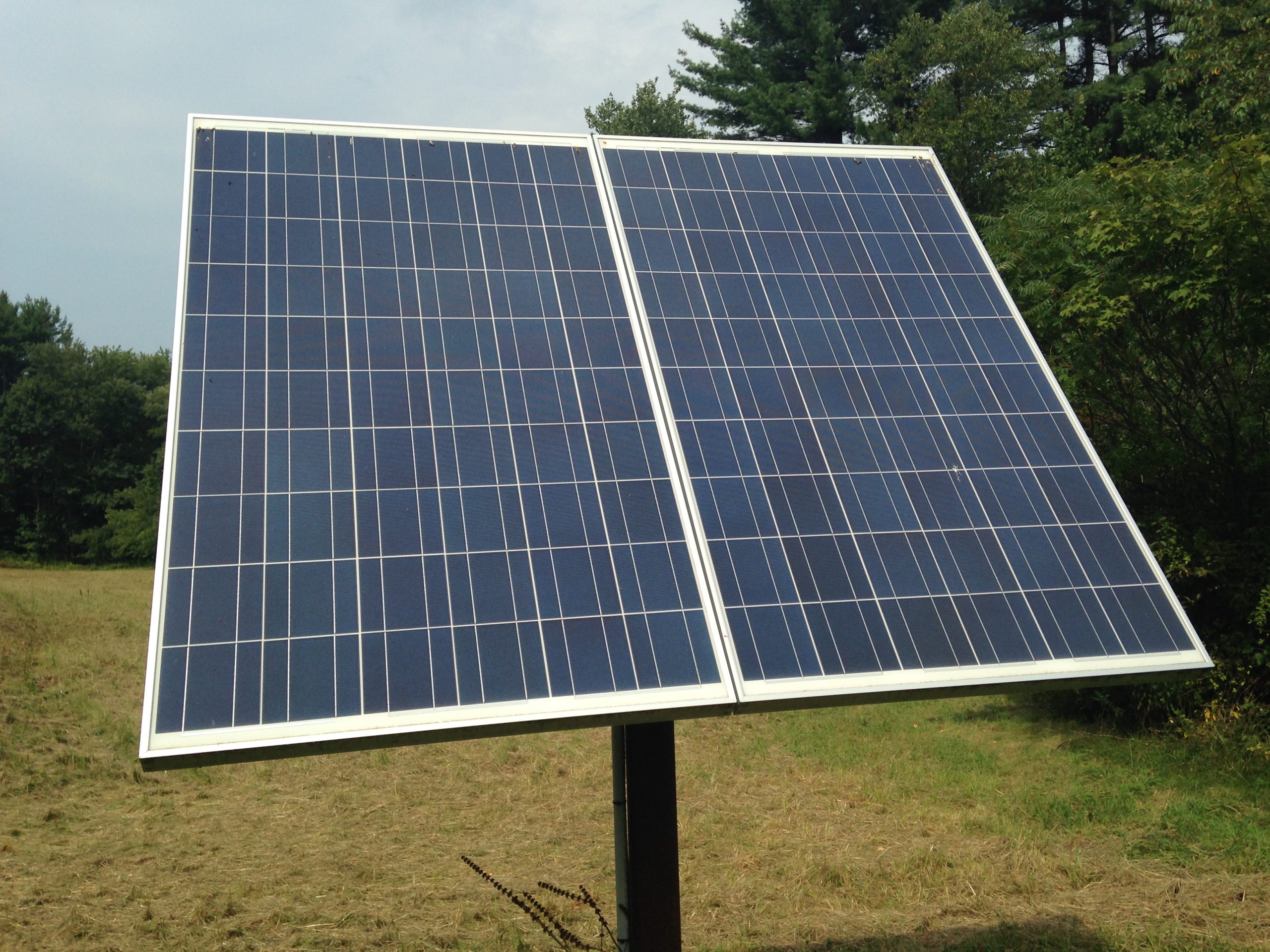
Two polycrystalline solar panels on a pole mount, outdoors under a hazy sky. The blue cells are crossed by the fine grid of conductor lines that carry the current off the panel. A pole mount aims the panels at the sun and lifts them for airflow. The overcast light here is the kind of real-world condition that holds output below the lab rating. Photo: MarkBuckawicki, CC0.
A solar panel rated at 200 watts feeds a power station something closer to 140 on a good day. The rest leaks away in a string of losses, a little at each step from the panel to the battery. Sun strength, heat, angle, and the charger each take a share of the sixty missing watts. The label on the back is a lab number, a fair starting point for the real figure built up from it. That gap from label to battery holds steady enough to plan around.
The rating comes from a lab, under a fixed and generous set of conditions. Sun outdoors rarely matches the lab. Heat, angle, dust, and the charger’s own losses each take their cut. What reaches the battery is the rated number after all of them. Together those cuts set the real figure a panel delivers.
Real numbers set honest expectations. Chosen for its real output, a panel keeps a power station fed through a day. Each loss along the way has a cause and a rough size. Naming them turns a vague shortfall into a clear budget. A planner who knows the budget sizes a panel right the first time. The same budget flags a panel too small before it ships.
What the rating means
The number on the label is a Standard Test Condition rating. Engineers measure it under bright, even light of 1000 watts per square metre. They hold the panel at 25 degrees. They shine a fixed spectrum, the light of a clear midday sun straight overhead. Those four conditions almost never line up in a backyard.
Those conditions stack the deck in the panel’s favour. Full midday sun on a clear day reaches that 1000 figure for only a few hours. A panel sitting in the sun runs far hotter than 25 degrees. The label captures a best case, met outdoors only now and then. Treating the label as a daily figure leads straight to disappointment. Planning at the real fraction sets a panel up to satisfy.
Two panels with the same label can perform differently. Build quality, cell type, and the glass all play a part. Tolerance alone moves a panel a few percent off its label, in either direction. The rating names a target met within a band. Two units off the same line can sit a few watts apart.
STC still gives a fair way to compare panels. Every maker tests to the same standard. A 200-watt panel beats a 100-watt panel by the label, and keeps that lead in the field. The label ranks panels fairly against each other. For a real figure, a sunny afternoon and a meter beat any spec sheet. The real number shows up only outdoors.
Sunlight strength through the day
Sunlight drives everything a panel does. Its strength is measured in watts per square metre. At noon under a clear sky, it nears the 1000 of the lab. Morning and evening sun runs far weaker. A square metre of noon sun carries the energy of a small heater. Spread over a panel’s face, it adds up to real power.
The sun climbs and falls across the day. Low in the sky, its light crosses more air and arrives dimmer. Climbing higher, it sheds that loss and arrives at full strength. A panel follows that arc, rising through the morning to a midday peak and falling away after. By that same arc, a fixed panel meets the sun head-on only near midday.
Installers fold the day’s arc into one number, peak sun hours. It counts the hours of full 1000-strength sun a place receives. A spot with five peak sun hours gathers as much as five hours at full strength would give. The real day stretches that energy over more hours at uneven strength. Five peak sun hours might spread across ten hours of actual daylight.
Season and place set the peak sun hours for a spot. Across a year, a typical place averages three or four, more in clear summer months. The same panel gathers far more on a long bright day than on a short grey one. A daily harvest tells the real story better than any peak wattage. A bright winter noon can still out-produce a hazy summer morning.
Pointing the panel at the sun
A panel makes its rated power only when it faces the sun square on. Tilted away, it catches the light at a slant. The cosine of the angle between the panel and the sun sets how much power survives. Off by 30 degrees costs about a seventh of the output. Off by sixty degrees throws away half.
Aiming a portable panel pays well for the minute it takes. Propped to face the sun, a panel catches far more light than one laid flat on the ground. Through the day the sun moves. A fixed panel drifts off aim. A nudge every few hours holds it near square. A few seconds of aiming returns more than any other free move.
Some setups chase the sun for the last few percent. A motorized tracker turns a panel to follow the arc. For a portable panel, a hand and a few re-aims do the same job. Many users just aim well once at midday and leave it there. For a portable panel, a good noon aim captures the bulk of the day’s energy. The morning and evening tails matter less than the broad midday.
Heat and the panel
Heat is the quiet thief of solar power. A panel turns part of the sunlight into electricity. The rest becomes heat in the cells. Sitting in full sun, those cells climb well above the air around them. A panel can run thirty degrees hotter than the afternoon air. Dark glass in still air traps the heat fast.
Warm silicon makes less voltage. For every degree above 25, a typical cell drops about four-tenths of a percent. A panel at 60 degrees, common in summer sun, sits 35 degrees over the lab mark. That alone trims more than a tenth off the power. On a still, hot day that loss climbs higher still.
Airflow under a panel keeps the cells cool. Raised on a stand, a panel lets air carry the heat away. It runs cooler than the same panel flat against a hot roof. The same sun then yields a little more. A breeze across the back of a panel works like a quiet fan. Even a small gap makes a measurable difference.
Heat and bright sun arrive together, which softens the gain. A blazing summer noon brings the strongest light and the hottest cells at once. A clear, cold day suits a panel best. Spring and autumn often beat midsummer for a day’s harvest. Mild, sunny weather is a panel’s sweet spot.
The charge controller’s cut
Between the panel and the battery sits the charge controller. Sun and heat keep moving a panel’s best voltage. The controller hunts for that best point many times a second, a trick called maximum power point tracking. It then converts the panel’s voltage down to what the battery wants. That tracking marks the difference between a good harvest and a poor one. Without it, a panel and a battery rarely meet at the right voltage.
The conversion itself costs a little. A good MPPT controller runs at 95 to 99 percent. A few percent of the panel’s power turns to heat in the electronics. The rest passes through to the battery. A controller running cool wastes the least. Good heatsinking holds that loss near one percent.
An MPPT controller earns its keep by holding the panel at its best point. It converts the extra voltage into extra current. On a cold, sunny day that gain can run 20 to 30 percent above what a simple controller would pass. Nearly every power station that takes solar carries one. Its gain shows up best on cold, bright days, when panel voltage runs high.
Losses in the wiring and the glass
Small losses hide in the wiring. A long, thin cable drops a little voltage along its run. Every connector adds a touch of resistance. Together they cost a percent or two. Heavier wire on a short run gives nearly all of it back.
Dust shades a panel cell by cell. A film of grime can cost a few percent. A quick wipe brings it back.
The power station’s own input limit
Every power station caps its solar input. A model rated for 200 watts of solar takes no more, no matter how much a big array offers. Panels totalling 300 watts into a 200-watt port spend the extra on nothing. Matching the array to the port keeps every watt useful. A small margin covers the rare bright, cold peak. Sizing the array a touch under the port keeps every panel watt landing in the battery.
Clouds and partial shade
Clouds rewrite a panel’s output by the minute. A thin haze dims the sun and the power with it. A passing cloud can halve the output for a moment. Broken cloud sends the figure jumping up and down all afternoon. A solar input figure on a broken-cloud day rarely sits still.
Shade hurts more than its size suggests. The cells in a panel run in a series chain. One shaded cell chokes the current for the whole string, like a kink in a hose. A branch shadow across a corner can cost far more than its share of the area. Even a thin pole shadow can knock out a whole row. Trimming a nearby branch can pay for itself in a season.
Bypass diodes limit the damage from shade. Built into the panel, they route current around a blocked section. A shaded panel keeps making power from its lit parts. Clear ground around a panel keeps every cell in the sun.
What a panel delivers at noon
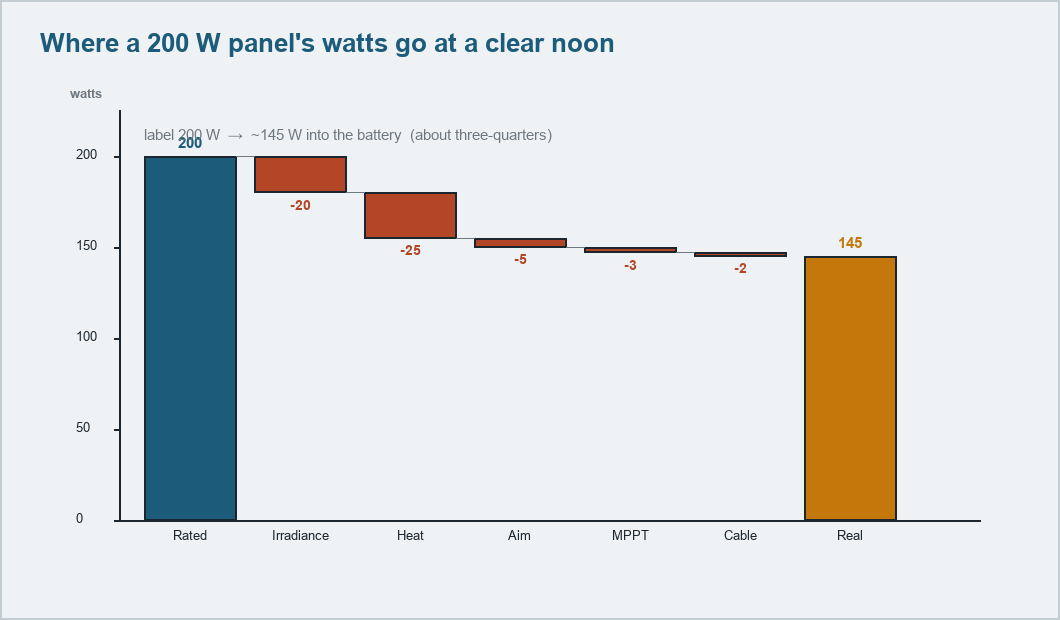
Where a 200-watt panel’s watts go on a clear noon, drawn as a cascade. The blue bar is the 200-watt label. Each red step is a loss: weaker-than-lab sun, heat in the cells, an imperfect aim, the MPPT conversion, and the cable. The gold bar is what lands in the battery, near 145 watts, about three-quarters of the label. The figures are illustrative.
Putting the losses together gives a realistic noon figure. Start with a panel rated at 200 watts under lab light. Real noon sun on a clear day lands a little under the lab’s 1000. Take ninety percent of the label to begin, around 180 watts. The panel sits hot in that sun, 30-odd degrees over the lab mark. Heat trims another tenth or more, dropping it near 155. Aim runs close to square on a hand-propped panel, off by a few degrees. Those few degrees cost a little more, call it 150. The MPPT controller converts at 97 percent, shaving three watts. Cable and connectors take a watt or two. What lands in the battery sits near 145 watts. That figure is the honest peak, the best a clean, well-aimed panel sees around midday on a fine day. Push any factor the wrong way and the number falls further. A hazy sky, a flat-laid panel, a hot still afternoon: each pulls it down toward 100 or below. The same panel on a cold, clear, breezy day, aimed square, can reach a little higher, near 165. Real output lives in that band, somewhere near three-quarters of the label. A buyer who plans around 70 to 75 percent of the rated watts at a good noon plans about right. From that peak the rest of the day follows. An hour after sunrise the same panel makes only a third of its noon figure. Morning and evening and every passing cloud sit lower still. One honest noon figure anchors the whole picture. A buyer armed with that one number plans a panel with confidence. A power station needing 700 watt-hours back each day pairs with a panel that gives it. Guesswork falls away once the noon figure is known. From there, every other hour of the day scales off the peak.
Each step in that chain has a rough size. Sun below the lab strength takes the first and biggest cut. Heat takes the next. Aim, conversion, and wiring take the rest. Knowing the order tells a user which one to fix first. Chasing the small cuts before the big ones wastes effort.
The cheapest gains come from a user’s own hands. Aim costs nothing to fix. A stand for airflow costs little. A clean panel costs a wipe. Those three together can claw back a fair slice of the losses. None of those three costs a cent past a stand and a cloth.
Bigger panels move these numbers up in proportion. From a 100-watt panel peaking near 70 watts to a 400-watt array near 290, the same fraction holds. Close to three-quarters of the label is the rule at a fine noon. A bigger panel buys more watts at the same fraction. Doubling the panel doubles the watts and the daily harvest together.
One figure rules the others, the watts at a clear noon. It sets the ceiling every other hour falls below. A panel that peaks at 145 never beats that on the same day. Planning from the peak, then trimming for the time of day, gives a fair estimate. From one clean midday reading, the whole day falls into place.
What a panel gathers over a day
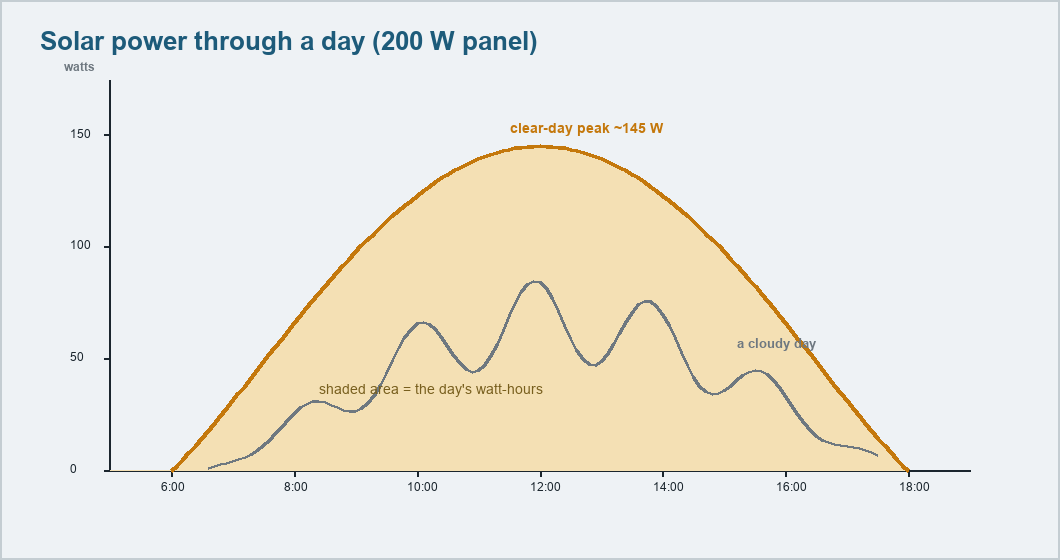
Solar power from a 200-watt panel across a day. The gold curve is a clear day, peaking near 145 watts at noon and falling to nothing at the ends. The shaded area under it is the day’s energy, the watt-hours that reach the battery. The grey curve is a cloudy day, lower and broken by passing clouds. The figures are illustrative.
A peak wattage tells only part of the story. Charging a battery is about energy, measured in watt-hours. A 200-watt panel peaking at 145 does not hold 145 all day. The day’s total comes from the whole curve, summed hour by hour. Two panels with the same peak can gather different totals over a day. A broad, steady curve gathers more than a brief tall spike.
Peak sun hours turn a panel rating into a daily harvest. Multiply the panel’s watts by the peak sun hours, then trim for the real-world losses. A 200-watt panel in five peak sun hours gathers near 1000 watt-hours on paper. After losses, six to eight hundred reaches the battery. That daily figure decides whether a panel refills a battery by dusk. A panel that gathers more than the day’s draw keeps a battery topped.
The table below sets rough daily harvests against panel size and sun. Good sun means four to five peak sun hours and a clean, aimed panel. Poor sun means a short or cloudy day. The spread between the two columns shows how much the weather rules the harvest.
Rough real-world solar harvest by panel size (after losses)
Panel rating
Realistic noon peak
Good-sun day (4–5 PSH)
Poor-sun day (1–2 PSH)
100 W
60–80 W
300–450 Wh
80–150 Wh
200 W
120–160 W
600–900 Wh
150–300 Wh
400 W
240–320 W
1200–1800 Wh
300–600 Wh
600 W
360–480 W
1800–2700 Wh
450–900 Wh
A daily harvest sizes a panel to a need. A power station of 1000 watt-hours, run down each day, wants a panel that gathers that much back. In good sun a 200-watt panel comes close in a day. Poorer sun stretches the job to 400 watts or a second day. Sizing for the worst likely day keeps a system honest.
Measuring the real output
A power station’s own screen shows the solar input in watts. A glance at it under load tells the real figure for that moment. Watching it across a clear noon catches the true peak. The number on the screen settles every debate with the label. A glance at the watts under a clear noon ends the guessing.
A clamp meter or an inline watt meter reads the same thing outside the box. It sits between the panel and the input. It shows volts, amps, and watts in real time. A cheap one pays for itself in understanding a setup. Watching the number climb as a panel is aimed teaches the cosine rule fast.
One reading means little on its own. A figure of 100 watts under thick haze speaks better of a panel than 100 watts in blazing clear sun. Noting the sky and the time beside the watts makes a reading one to keep. A logbook of readings turns a hunch into a record. A week of noon readings paints a panel’s true character. Logged over weeks, a panel’s real output stops being a mystery.
Getting more from the same panel
Several free moves lift a panel’s real output. Aim leads the list. A square aim at midday can add a fifth over a flat-laid panel. A re-aim every couple of hours holds the gain. Aim repays the minute it costs many times over. A panel squared to the sun at noon starts the afternoon ahead.
Cooling comes next. A panel raised for airflow runs cooler. A gap of a few inches under the panel lets a breeze through. The same sun then makes a little more. A hand’s width of air under a panel does the trick. Cooler cells hold their voltage better.
Cleanliness and good cable round out the easy gains. A wiped panel catches every ray its glass allows. Heavy cable on a short run carries the power with little drop. A snug connector wastes nothing to resistance. Clean glass and a tight plug add a steady percent at no cost.
Wiring choice tunes an array to the input. Panels in series add their voltages, a help down a long cable run. Panels in parallel add their currents, a help over a short run. Matching the wiring to the power station’s solar input keeps every panel pulling its share. Either wiring works, picked to fit the cable run and the input.
A note on folding panels
Folding panels trade a little output for an easy carry. Their cells sit on cloth that holds heat more than an aluminium frame does. Their kickstands give a rough aim. A folding panel of a given label often lands a touch under a rigid one of the same. A few watts go to the cloth backing and the looser aim, a small gap of a handful on a 200-watt panel.
The trade still favours folding for a power station. A 200-watt folding panel rolls into a bag and rides in a car, ready to set down anywhere. For a trip, the bulk saved by folding beats the few watts it costs. For a car trip or a campsite, the folding panel wins on the whole.
Reading the numbers and setting expectations
A panel’s real output rewards a clear-eyed read of its label. The number on the back is a lab peak, measured under bright, cool, square light. Sun, heat, aim, and the charger each take a share before the battery sees it. A gap of a quarter to a third from label to battery is normal. Expecting it turns a letdown into a plan.
Honest expectations make solar charging satisfying. A panel planned at three-quarters of its label rarely disappoints. A day’s harvest planned at watts times peak sun hours, trimmed for losses, comes out close. Numbers set this way match what the screen shows. A panel that meets its real figure has done its job. A number met is a promise kept.
A portable power station and its matched panel ship tuned to each other. The maker sizes the panel’s output to the input port. The pairing lands near its rated solar figure in good sun. A user plugs in and watches the watts climb on the screen. No tuning or guesswork falls to the owner.
Real-world solar power output is the rated number after the day has had its say. Sun strength sets the starting size, then heat, aim, and the charger each pare it down. A panel read at its real figure, near three-quarters of the label at a good noon, charges a power station just as planned. Read for what it gives, a panel never disappoints.
Frequently asked questions
Why does my solar panel not reach its rated watts?
The rating is a lab figure, measured under bright 1000-watt light at 25 degrees. Outdoors the sun runs weaker, the panel runs hotter, the aim is rarely perfect, the charger takes a small cut. A panel rated at 200 watts feeds a power station closer to 140 to 150 at a good noon. A gap of a quarter to a third is normal.
How much power does a 200-watt panel make in practice?
At a clear noon, aimed and clean, a 200-watt panel feeds a power station around 140 to 160 watts. Heat, haze, or a poor aim pull it lower. Over a full day with four to five peak sun hours, it gathers roughly 600 to 800 watt-hours into the battery.
Does heat lower solar output?
Yes. A silicon cell drops about four-tenths of a percent in power for every degree above 25. A panel in summer sun can sit 30 to 35 degrees over that mark, costing more than a tenth of its output. Airflow under a raised panel keeps it cooler.
How do I get more power from a solar panel?
Aim it square at the sun and re-aim every couple of hours. Raise it on a stand for airflow. Wipe the glass clean. Use heavy cable over a short run. Together these free moves can add a fair slice back, much of it from a good aim alone.