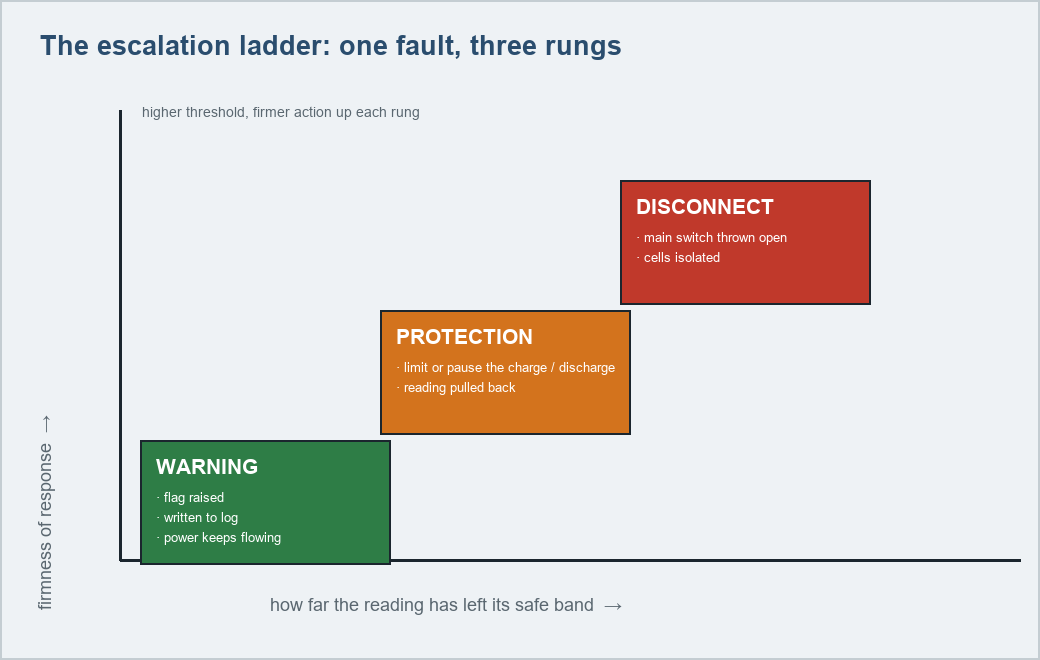
The three rungs of a BMS alarm ladder, drawn as a staircase. A warning, in green, raises a flag and logs the reading while power keeps flowing. Protection, in orange, limits or pauses the charge or discharge to pull the reading back. A disconnect, in red, opens the main switch and isolates the cells. Each rung sits at a higher threshold and a firmer action than the one below it. The figure is illustrative.
A battery management system answers trouble in graded steps. Out of its safe band drifts a reading. In answer, the BMS picks a response matched to how far the reading has gone. The further it strays, the firmer that response. Up the ladder the steps climb in a fixed order, each one firmer than the last. Three rungs hold the whole range, from the first notice to the final cutoff. The order never changes from one fault to the next.
Three levels cover the ground. First comes a warning, a flag raised for notice. Next comes protection, a real change to charge or discharge. Last comes a disconnect, the main switch thrown open. Each level carries its own trigger and its own action. As a fault deepens, one reading can climb all three in turn.
Proportion is what the ladder buys. From the gentlest notice over a cell a few millivolts high, the same framework reaches all the way to the hardest cutoff on a cell racing toward its limit. Every abnormal reading finds its rung. Nothing the BMS sees falls outside the scheme. A clear ladder covers the gentle drift and the hard fault alike.
Why the response is graded
A single hard cutoff would handle the worst faults on its own. It would also treat a momentary twitch the same as a true emergency. A brief spike, a cold morning, a short heavy draw: each would drop the power in full. Fitting the response to the size of the trouble is the job of the graded ladder. Each rung answers a different size of trouble.
The bulk of abnormal readings turn out minor. A load surges for a second when a motor starts. Near the top of a charge, a cell drifts high. On a winter morning, cold slows the chemistry. Logging each of these, a warning lets the system carry on. None of these minor readings calls for cutting the power.
Time is the other thing a graded response buys. While the reading is still mild, a warning reaches a person. There is room to shed a load, move the pack indoors, finish a task. Behind the warning, the protection tier waits in reserve. Each early step holds the next one back a little longer. Minutes of warning can save a shutdown later.
For the worst case, the hardest action stays ready. A dead short, a runaway cell, a sensor reading off the scale: these go straight to a disconnect. When the danger is immediate, the ladder skips its lower rungs. Speed and proportion live in the same system. A real emergency calls for speed before anything else.
The warning tier
Lightest of the rungs is the warning. It catches a reading that has just left its normal band. A flag goes up, a line goes to the log, an indicator lights. Through all of it, power keeps flowing the whole time. Nothing in the power path moves at this rung.
Notice is all a warning asks. The flag stands. Time and value go to the log. Steady through it, the power settings hold. A warning touches the record alone.
Closest to a limit are the readings that warn. A cell near the top of its voltage range. Under a long, heavy load, a pack running warm. Near its rated ceiling, a charge current. Set inside the safe zone, each warning line leaves margin to spare ahead of any harm. Room remains for a person to act before the next rung.
An early flag earns its keep through the head start it gives. Before the protection tier ever triggers, a person sees the warning and acts. A load gets trimmed. A charger gets unplugged. Back inside its band eases the reading. The warning clears on its own. No one need lift a finger for a warning that solves itself.
The protection tier
Protection is where the BMS moves from notice to action. A reading has pushed past the warning line and reached the next threshold. To pull it back, the BMS now changes the flow of power itself. On a cell climbing too high in voltage, it cuts the charge current or halts the charge outright. On a pack sagging too low, it trims the discharge or ends it. On a current above the safe ceiling, it caps the draw. On a temperature past its protection point, it pauses whatever drives the heat. Each action targets the one reading that crossed the line. Power does not vanish all at once. Reducing or pausing the single path that matters, the BMS leaves the rest of the system running where it safely can. A charge halted for a high cell still allows a discharge. A discharge trimmed for a sagging pack still allows a charge to come in. While the reading sits past the line, the protection holds. Once the reading returns to a safe level, the BMS lifts the action and lets normal flow resume. Inside the firmware the whole sequence runs, decided in milliseconds against thresholds set by the cell maker. Many protection limits carry a short delay, a second or two, enough that a brief spike never trips them. A current limit may fold back in stages, easing the draw down by steps. A charge paused for heat picks up again the moment the pack cools a few degrees. A dozen such rules fill the tier, one tuned to each kind of reading the BMS watches. Beyond a line in the log and a brief dip in available power, a person may never know it happened. Out of sight, this rung does more than any other to hold the cells inside their limits across an ordinary day.
Every protection action matches the reading that set it off. A voltage fault touches the charge or discharge path. A current fault caps the draw. A temperature fault pauses the source of the heat. Untouched, every other path holds at its normal setting. One fault moves one path.
Recovery runs the same threshold in reverse. While the reading sits past the protection line, the action stays in place. Back through a recovery point set a little inside the trip falls the reading. Releasing the action, the BMS watches for the fault to return. Set apart from the trip, the recovery point keeps the action from chattering on and off.
Repeated trips tell their own story. Firing again and again, a protection points to a cell or a sensor that needs attention. The BMS counts the trips and logs each one. A pattern in the log marks the part that keeps reaching its limit. A count in the log turns a stray trip into a clear signal.
Nothing is asked of a person for the protection tier to work. It runs on thresholds baked into the firmware. It acts, recovers, and logs on its own. Later, a user reads the result as a dip in power and a note in the history. Between the trip and the recovery, the work runs itself.
The disconnect tier
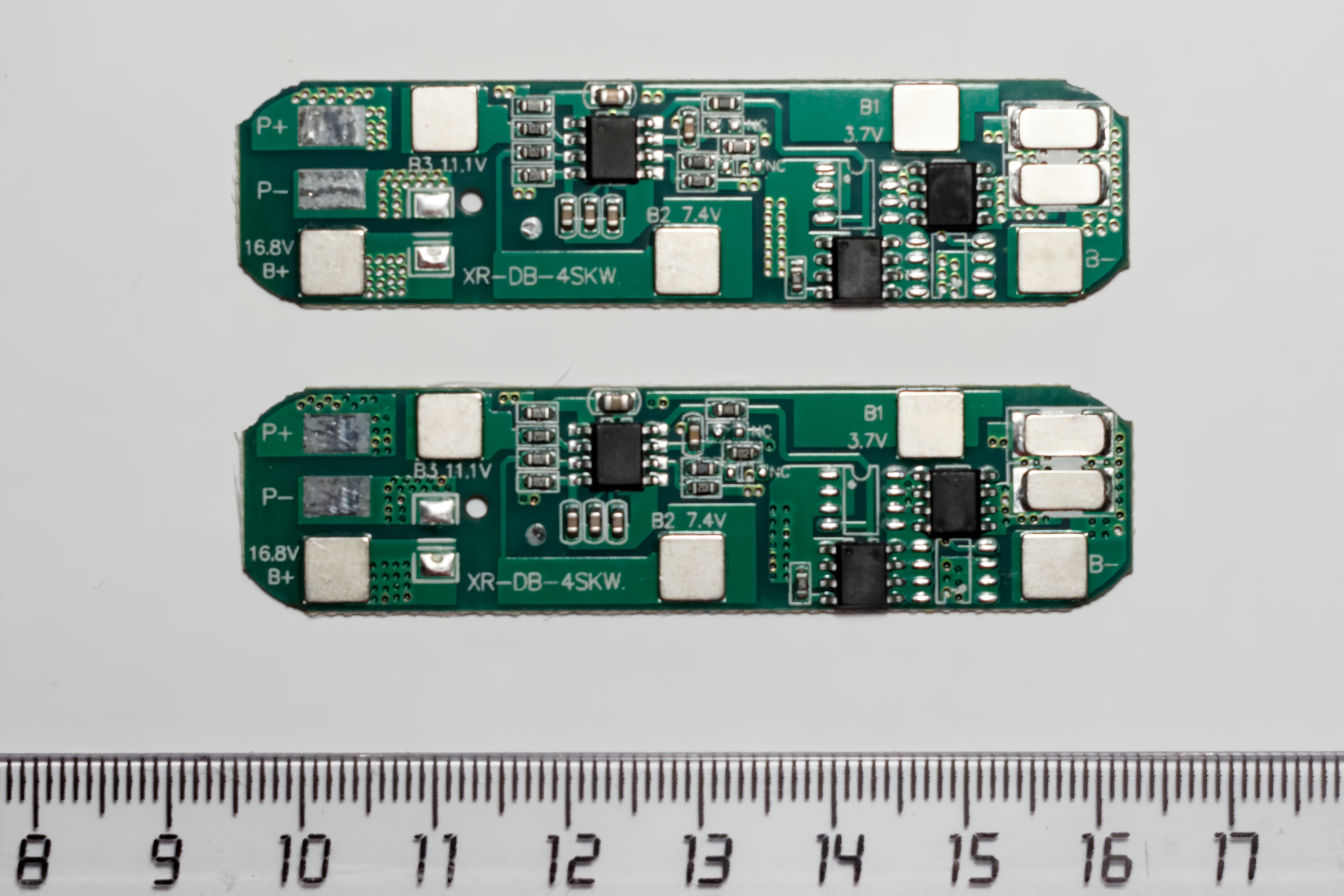
Two generic 4S LiFePO4 BMS protection boards, model XR-DB-4SKW, the kind of board that runs the alarm ladder described here. The small black chips are the protection controller and the MOSFET switches that open to disconnect the pack. The silkscreen marks the cell taps: B1 at 3.7 V, B2 at 7.4 V, B3 at 11.1 V, and the full pack at 16.8 V, with P+, P-, B+, and B- as the terminals. A centimetre ruler along the bottom gives the scale, each board about 7 cm long. The boards shown are a typical example of the type. Photo: Retired electrician, CC0.
Top of the ladder is the disconnect, the BMS’s last resort. A reading has passed the protection threshold and reached the danger line. Opening its main switch, a MOSFET bank or a contactor, the BMS cuts the battery off from everything outside it. At the terminals, current stops. On both the charge and the discharge path, the switch opens together. One open switch covers the whole battery.
Some faults go straight to this rung. A dead short pulls current far past any safe number. In well under a millisecond, the BMS trips. A cell voltage in runaway leaves no time for a gentler step. The disconnect fires the instant the reading crosses the line. No warning precedes a fault this fast.
An open switch holds until the danger clears and something resets it. A latched disconnect waits for a deliberate clear, a charger plugged in or a button pressed. Isolated behind the open switch, the cells sit safe the whole time. Power returns once the BMS closes the switch again. Until then, the pack holds no danger for anything downstream.
Where each threshold sits
Behind every rung is a number that triggers it. The cell maker sets the safe limits. Inside them, the BMS designer places a warning line, a protection line, and a disconnect line. Far enough from the next sits each line, giving the ladder its steps. Spacing is what makes a ladder out of a single limit.
Typical of a lithium iron phosphate pack are the numbers below. Its own set rides in a real BMS, drawn from the cell datasheet and the pack design. The shape holds across nearly every pack: a warning inside the safe band, a protection step further out, a disconnect at the edge.
Typical tiered alarm thresholds for a LiFePO4 pack (per cell unless noted)
Fault
Warning
Protection
Disconnect
Cell overvoltage
3.60 V
3.65 V
3.75 V
Cell undervoltage
2.80 V
2.50 V
2.00 V
Charge overcurrent
1.05 C
1.2 C (delayed)
short circuit, instant
Discharge overcurrent
1.05 C
2.0 C (delayed)
short circuit, <1 ms
High temp, charge
45 °C
50 °C
55 °C
High temp, discharge
55 °C
60 °C
65 °C
Low temp, charge
5 °C
0 °C
charge blocked <0 °C
Cell imbalance (ΔV)
50 mV
100 mV
flag and balance
Down a column runs the ladder for one kind of fault. A cell overvoltage warns at 3.60 volts, protects at 3.65, disconnects at 3.75. Only hundredths of a volt apart run the steps. Each one adds a fresh margin of safety. Reading down, the ladder for that fault stands plain.
Across a row sits the spread of faults the BMS watches. Voltage, current, temperature, and the balance between cells each carry a ladder of their own. By chemistry and by pack the thresholds shift. Down every one repeats the structure of warn, protect, disconnect. Familiar from one fault, the pattern carries to the next. The same reading serves for every fault’s ladder.
Overvoltage up the ladder
As a cell fills past its limit, overvoltage climbs the ladder. Near the top of a charge, one cell can run ahead of the rest. Its voltage rises toward the ceiling the chemistry allows. Against all three lines, the BMS watches that highest cell. One cell out of many drives the whole overvoltage ladder.
The warning comes first, a flag on a cell near full. To ease the current, the BMS may lean on the charger. The protection line halts the charge for that cell. At the top, the disconnect waits for a cell that keeps climbing. Each rung gives the charger one more chance to back off.
Overvoltage protection saves a cell from the damage of overcharge. Held above its ceiling, a lithium cell degrades and, in the extreme, grows unsafe. Well ahead of that point, the ladder stops the charge. Balancing and a healthy charger keep nearly every cell from ever raising the first flag. Kept level, a healthy pack rarely climbs past the warning.
The instant short-circuit trip
A short circuit is the one fault that skips every lower rung. The moment two terminals meet through little resistance, current leaps to many times the rated draw. Sensing the surge, the BMS throws its switch open in microseconds, faster than any warning could form. Behind the open switch the cells fall dark, clear of the heat a sustained short would pour in. Speed alone protects against a fault this violent. A board that trips this fast needs no hand from a person.
Undervoltage up the ladder
As a pack runs down, undervoltage climbs the ladder. Late in a discharge, the lowest cell sags toward the floor of its range. Near the floor its voltage drops more steeply. Against the three lines, the BMS watches that lowest cell. The weakest cell sets the floor for the whole pack.
The warning marks a pack getting low. A flag rises on the lowest cell. Near empty reads the runtime gauge. For that cell, the protection line trims or ends the discharge. Each step gives a person one more chance to ease the load.
Undervoltage protection saves a cell from over-discharge. Drained below its floor, a lithium cell loses capacity. A deep enough drain ends its life. Ahead of the floor the ladder stops the draw. The disconnect stands ready for a load that ignores the warning. Deep drains are what wear a pack out fastest. A floor held is a cell saved.
Left to self-discharge in storage, a pack can drift down to the warning on its own. With no load attached, the BMS still raises the flag. A long enough rest reaches the protection line and opens the switch to guard the cells. A storage charge every few months keeps a resting pack clear of the bottom rung. Even at rest, the ladder keeps its watch.
Heat and cold
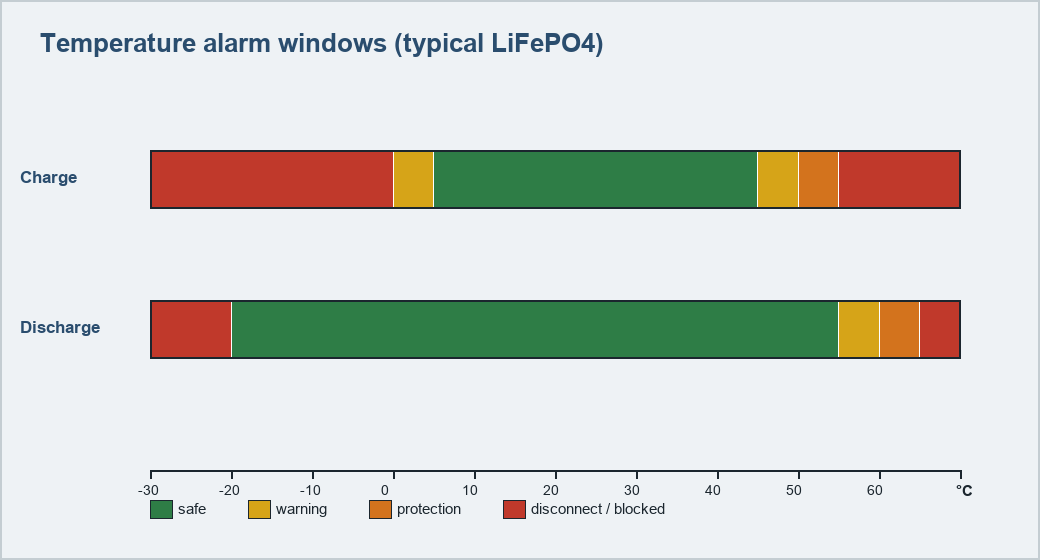
Typical temperature alarm windows for a LiFePO4 pack, drawn on a Celsius scale. Each row runs from a safe band in green, out through warning in amber and protection in orange, to a disconnect or blocked zone in red. On the charge row, the safe band runs from 0 to about 45 degrees, with charging blocked below freezing. On the discharge row, the safe band reaches from about minus 20 to 55 degrees. The exact numbers shift by cell and by pack. The figure is illustrative.
Temperature gives the BMS two ladders to watch. Among the cells sit sensors that read the pack’s heat. Into a set of lines for high temperature and a set for low the numbers feed. Charging and discharging each carry limits of their own. Heat and cold each carry a full ladder.
Heat builds when a pack works hard or sits in the sun. The warning flags a pack running warm under load. To let the pack cool, the protection line pauses the charge or eases the discharge. At the temperature where the cells face real harm, the disconnect waits. Airflow and shade keep a pack off the first heat rung.
Cold brings its own limits, sharpest around charging. Charged below freezing, a lithium cell can plate lithium and suffer for it. Well ahead of any damage, the BMS blocks the charge with the pack that cold. Discharge carries a lower cold limit, since pulling power warms a pack from the inside. Cold charging is the limit a winter pack meets first.
As the pack returns to a safe range, temperature alarms recover. Once the pack cools a few degrees, a charge paused for heat resumes. A charge blocked by cold waits for the pack to warm above its limit. Until the reading sits back inside the safe window, the BMS holds each pause. Patience at the threshold spares the cells either way.
Faults that clear themselves
Many alarms lift the moment the reading comes home. In real time, a self-clearing fault tracks its reading. While the value sits out of band, the flag stands. Once the reading returns inside its limit, the BMS drops the flag. No reset, no wait: the flag follows the reading.
A recovery threshold sits a little inside the trip. Well past that point the reading has to come back before the flag drops. The gap keeps a reading hovering at the threshold from flipping the flag on and off. Engineers call that gap hysteresis. A little gap buys a steady flag.
Self-clearing suits the everyday alarms. A warm pack cools. A surging load settles. After the charge tapers, a cell near full eases back. On its own the BMS clears each flag and writes the episode to the log. Everyday alarms come and go with no hand on them.
Faults that latch
Some faults hold their alarm until a person steps in. Even after the reading comes back to normal, a latched fault stays flagged. In place stays the protection or the disconnect. Clearing it takes a deliberate reset. A latch holds the guard in place past the moment of danger.
Latching guards the faults that mean real trouble. A short, a runaway cell, a sensor gone bad each latch until checked.
How the alarm reaches a person
Unseen, an alarm does a person no good. Through whatever channels the pack offers, the BMS carries the flag outward. A light on the case. A reading in an app. A tone from a buzzer. Off the board and to a human travels the signal. Light, screen, sound: the alarm finds a way out.
Simplest of the channels is a status light. A steady green for normal, an amber for a warning, a red for a protection or a fault: the colour tells the state at a glance. On many packs, the pattern of blinks names the fault. One look at the case reads the alarm. Colour alone tells a passer-by the state of the pack.
Detail is what an app or a screen carries. It names the fault, shows the cell or the sensor, gives the value that crossed the line. Back through past alarms scrolls a history. A reading like that turns a blinking light into a clear account. Numbers on a screen name the cell and the value at fault.
A buzzer reaches across a room. A tone marks a warning a person might miss on a light. An urgent pattern marks a fault that needs a hand. Where eyes are not already on the pack, sound carries the alarm. A tone reaches a person across a dark room. Even asleep, a person can hear the alarm.
The fault log
Behind the live alarms sits a written record. With a timestamp, the reading, and the action it took, the BMS logs each event. Warnings that cleared and faults that latched all land in the log. It builds a history of every time the pack left its safe band. Time-stamped and saved, each event waits for a later read.
A one-time scare becomes a pattern in the log. On its own a single warning means little. The same warning every afternoon points to a load too heavy for the pack. A cell that trips again and again names itself for replacement. Patterns in the log say what a single reading cannot.
Toward the fixes a pack needs the history points. A run of high-temperature warnings calls for better airflow. A repeat undervoltage points to a pack worked too hard. The log reads as a record of where the cells keep meeting their limits. A history points the way to the fix.
Reading the alarm table
On its datasheet shows a pack’s alarm behaviour. For each kind of fault, the spec lists the warning, protection, and disconnect points. It names which faults latch and which clear on their own. Written out, a full table reads as the whole ladder. Every threshold and every latch shows on the page.
A few marks set the good ladders apart. Far enough apart to act in proportion sit the steps. Real hysteresis rides on the recovery points. For a deliberate reset, the gravest faults latch. In plain numbers, a clear table names every threshold. Plain numbers mark a ladder built with care.
A portable power station settles all of it inside the box. Tuned to the cells it guards, the BMS ships with its ladder ready. A user meets the alarms as a status light, an app reading, a clean shutdown near a limit. With nothing to set, the tiers run their course. A buyer reads a clean result with the ladder out of sight.
A tiered alarm system is how a BMS keeps a pack safe without overreacting. A warning gives notice. Protection acts in proportion. For the worst, a disconnect stands ready. Rung by rung, the ladder fits the response to the fault, every time the pack steps out of its safe band. One scheme, three rungs, every fault in its place. That order keeps a battery both safe and useful.
Frequently asked questions
What are the levels of a BMS alarm?
Nearly all systems use three. A warning flags a reading that has left its normal band and keeps the power flowing. A protection step changes the charge or discharge to pull the reading back. A disconnect opens the main switch and isolates the cells. Each level carries a higher threshold and a firmer action than the one below.
What is the difference between a warning and a protection?
A warning is a notice. The BMS raises a flag and logs the value. The power settings hold steady. Protection takes action. The BMS limits, pauses, or ends the charge or discharge to bring the reading back inside its safe range.
Why does a BMS not just shut off at the first problem?
A single cutoff would drop the load on every minor reading, a brief load spike or a cold morning among them. The graded ladder fits the response to the size of the trouble, from a warning on a small excursion to the disconnect on a real danger. The worst faults, like a short circuit, skip straight to the cutoff.
What is a latched fault?
A latched fault holds its alarm until a person resets it, even after the reading returns to normal. Latching guards the serious faults: a short circuit, a runaway cell, a failed sensor. A reset comes from plugging in a charger or pressing a button. The everyday alarms, the ones that clear on their own, never reach this latch.