Self-diagnosis is the work a battery management system does to find trouble inside its own pack. Through every hour the pack is awake, the BMS keeps watch over each cell and over its own circuits. When a reading steps outside a safe range, the system records the fault, names what went wrong, and disconnects the pack the instant a limit is crossed. None of this shows on the outside of a healthy pack; the watch runs in silence until something needs attention.
Behind the watch sits a small processor. It samples the sensors many times a second, holds the safe limits in its memory, and weighs each fresh reading against them. A fault is nothing more than a reading that has crossed a limit. The processor catches it within a fraction of a second of its first appearance. That speed is what separates a small fault from a damaged pack.
Two layers fall under the same watch. One is the pack itself, read cell by cell across the whole stack. The other is the BMS hardware, the sensors and switches the system leans on to see. Should a fault appear in either layer, the unit raises a flag and reports it. Taken together, the two layers let a sealed battery account for its own condition. For long stretches both layers report nothing at all, which is exactly the news a healthy pack should give.
The signals a BMS reads
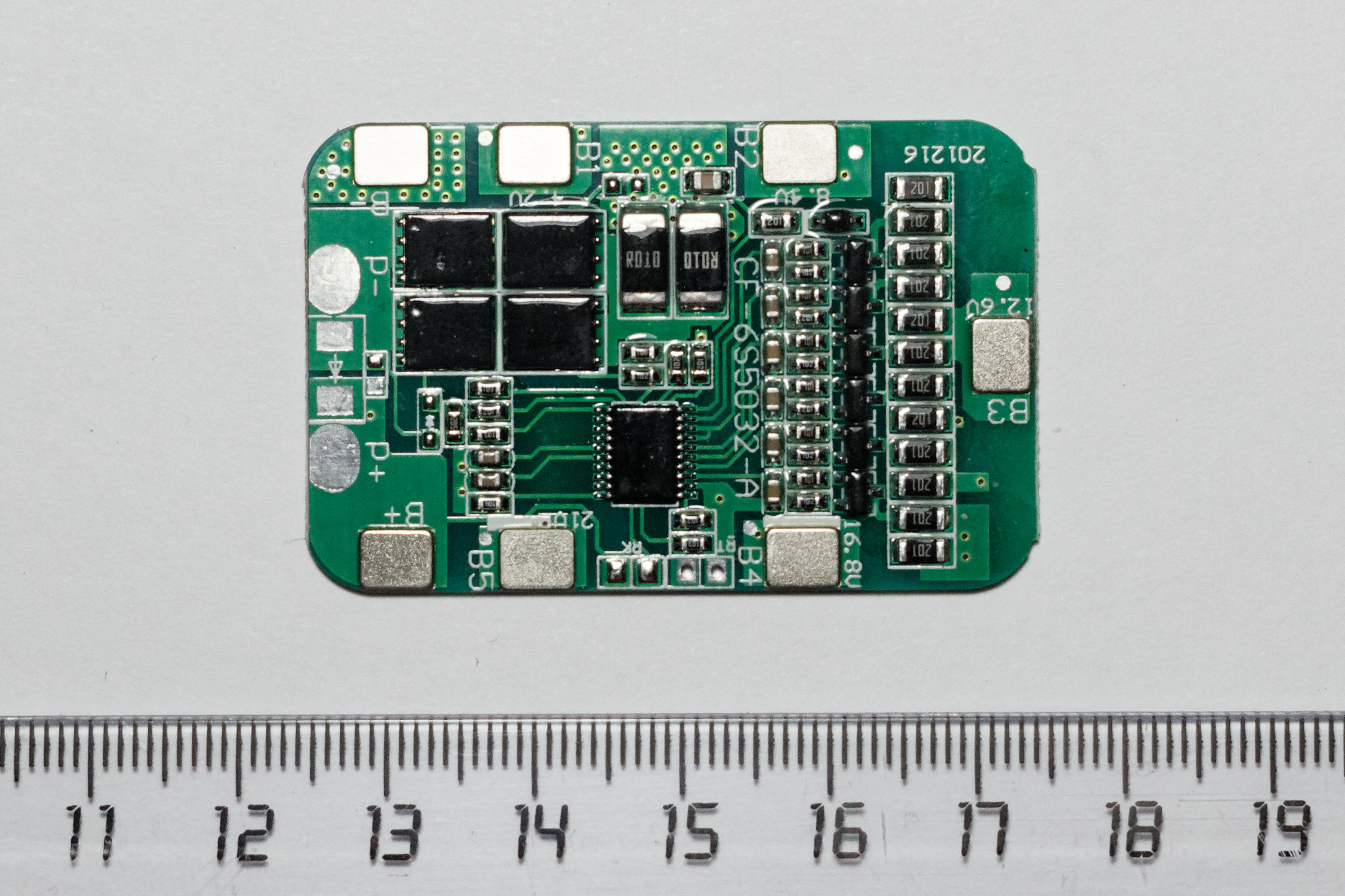
A real generic 6S lithium BMS board, model CF-6S5032-A, above a ruler for scale at about five centimetres wide. The pads marked B1 through B5 are the per-cell sense taps, where the board reads each cell’s voltage. The black blocks are the MOSFET switches that disconnect the pack. The small chip is the controller. The row of small resistors balances the cells. A processor and a wireless link added to this kind of board make the smart BMS that reports to an app.
Almost everything the BMS knows comes from three signals: the voltage of each cell, the temperature at points in the pack, and the current flowing in and out. Trace any fault back far enough and it lands on one of these three numbers. Reading them well, and judging them fast, fills the rest of the system’s day.
Of the three, cell voltage runs deepest. A sense wire reaches the junction of every cell along the stack, letting the controller read each cell alone, one after another, dozens of times a second. Six cells mean six separate voltages to follow; sixteen cells mean sixteen. A cell’s voltage betrays its charge, its state of health, and the earliest hint of nearly any fault. That swing of barely more than a volt, floor to ceiling, also maps the cell from empty to full.
Temperature reaches the BMS through small thermistors pressed against the cells, several of them, set in the spots that tend to run warm. The controller leans on the hottest of these readings, since the worst spot in the pack sets the risk for all of it. A cell that begins to overheat can drag its neighbours toward trouble with it. Placing the sensors well, near the cells that heat first, matters as much as reading them.
Current is read across a shunt, a tiny resistor of known value sitting in the pack’s main path. When current flows through it, the shunt drops a small voltage that the controller turns straight into amps. That single figure tells the BMS both the direction of the flow and the load on the pack at any instant. A shunt this small wastes almost nothing of the pack’s own power to do the job.
How the BMS measures a cell
Every measurement begins at a sense wire. From each cell junction, a thin lead runs forward to the BMS board, one lead for every junction in the stack, each carrying its cell’s voltage to the chip that reads it. How clean that connection stays decides how honest every later reading will be. Corrosion or a cold joint at that point throws off the cell’s reading without touching the cell itself.
At the chip, an analog-to-digital converter turns each voltage into a number, often good to a millivolt or finer. A millivolt is resolution enough to catch a cell that has drifted by a hair. The converter repeats its sample many times a second on every cell. Fresh numbers arrive in a steady stream, fast enough for the BMS to move before a fault can grow.
All of this rests on one stable reference voltage. The converter measures every cell against that fixed internal anchor. Because the accuracy of the anchor sets the accuracy of every reading on the board, a smart BMS tests the reference itself, treating its own yardstick as one more thing that can drift. A drifting reference would lean on every channel at once, which is why it earns a check of its own.
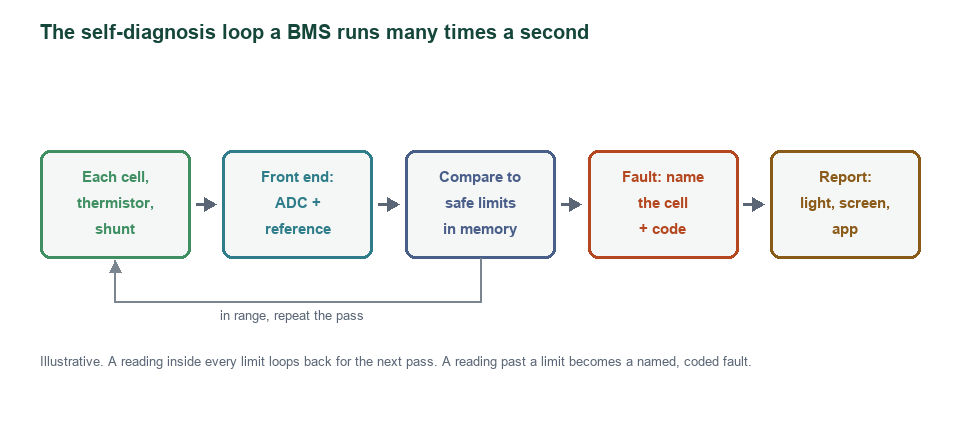
The whole diagnosis runs as a loop with no end. On each pass the front end samples every channel and checks each reading against the limit held in memory. A reading past a bound drops out of the loop as a fault, named and coded in the same instant it is caught. Everything else flows on to the next pass. Over and over the loop turns, many times a second, for as long as the battery stays on.
Temperature and current ride the same front end. The same converter that reads the cells also samples the thermistors and the shunt, each on a channel of its own. A handful of channels, swept again and again, hands the controller a full account of the pack many times a second. Sharing one converter across the channels keeps the board small and the readings in step.
Faults a BMS watches for, with typical LiFePO4 thresholds
Fault
Typical threshold (LiFePO4)
Signal read
What the diagnosis says
Cell overvoltage
> ~3.65 V per cell
per-cell voltage
names the high cell
Cell undervoltage
< ~2.5 V per cell
per-cell voltage
names the low cell
Overcurrent (discharge)
> rated amps, e.g. 100 A
shunt current
trips the cutoff
Short circuit
huge current spike
shunt current
instant cutoff, under 1 ms
Over-temperature
> ~60 °C (charge > ~45 °C)
thermistor
names the hot sensor
Under-temperature (charge)
< ~0 °C
thermistor
blocks charging
Cell imbalance
gap > ~0.05 to 0.1 V
per-cell voltage
flags the outlier cell
The faults it watches for
The faults a BMS knows make a short, well-worn list. Each is a reading that has wandered out of its safe band. For each, the BMS keeps a limit in memory, fixed when the pack was designed. Cross one of those lines and a fault is born.
Voltage sits between a ceiling and a floor. For a LiFePO4 cell, the safe span runs from about 2.5 to 3.65 volts across its whole life. Step outside that span and the BMS raises a voltage fault, tagged with the exact cell that caused it, thanks to the per-cell wiring. Where exactly those limits sit is a balance the designer strikes for the cell chemistry.
Current meets a ceiling in each direction, one cap for charging and another for discharging, both tied to what the cells can take. Push past either cap and an overcurrent fault follows. A dead short is far more violent. It trips a separate, faster cutoff built only for speed. The faster the cutoff acts, the less heat a short can pour into the cells before the path opens.
Temperature, too, is bounded at both ends. Charging stays safe in a window near 0 to 45 degrees, with a little more room for ordinary use; stray past either edge and a temperature fault appears, pinned to the sensor that saw it. Of all the faults, heat does its damage the fastest, which is why the hottest sensor draws the closest watch.
Two faults remain. Let a single cell drift too far from the others over many cycles, and the gap itself reads as an imbalance fault. Let a sensor return something impossible, an open thermistor or a dead voltage tap, and the BMS flags a fault in its own hardware. Both, like the rest, carry a code of their own into the report. Catching an imbalance early is what keeps one weak cell from dragging the whole stack down.
Finding the one faulty cell
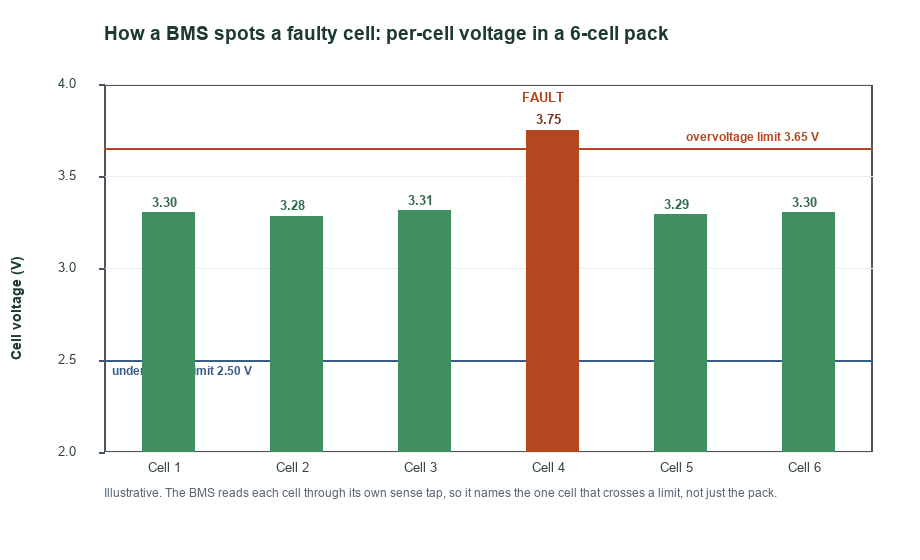
Per-cell voltage in a six-cell pack, with one cell flagged. The BMS reads each cell on its own sense tap. Cell four here reads 3.75 volts, past the 3.65-volt overvoltage limit, and the BMS names that one cell as the fault. The figures are illustrative.
Precise diagnosis is possible only because of the per-cell wiring. The BMS treats the pack as a stack of single cells, each on its own wire to the controller. Down those wires the cells report their voltages, dozens of times a second, hour after hour. The controller holds a fresh figure for each. Sixteen cells become sixteen private windows into the battery, sixteen readings to weigh against the limits at every instant. From the richness of that picture comes everything a smart pack can say about itself. A fault here names one cell, one reading, one moment in time. The depth of the diagnosis mirrors the depth of the wiring, one sense lead for every junction in the stack. Wired this way, a pack can point a finger at the exact cell that needs a hand. No part of the stack stays hidden from it. The same leads that let the BMS balance the cells let it diagnose them, since both jobs come down to reading each cell alone. What a technician gets, in the end, is a battery that says where to look, down to the single cell, long before any trouble spreads. That precision is the whole of what self-diagnosis means in a modern pack. Knowing a pack cell by cell, a BMS can diagnose it cell by cell, tracing a fault to the one lead that carried the news. The hours a blind teardown would burn are saved by a single named line. On that one habit, reading each cell on its own, the entire value of a smart pack rests. Every junction in the stack earns its own lead. Through that one lead the controller gains a cell it can name out loud, by number and by volt. The more leads a pack carries, the more finely it can speak about itself.
Each fault arrives with a cell number attached. When one cell crosses its limit, the BMS knows which by the wire that carried the offending reading. What the technician sees is a line that says cell four, overvoltage, ready to act on at once. No guesswork stands between the report and the repair.
From there the named cell shapes the repair. A technician opens the pack to that one cell and leaves the rest untouched, since the log has already pointed the way. With the cause known before the cover even comes off, the work goes quickly. On a large pack of many cells, that head start can turn a day’s hunt into an hour’s job.
Heat and current point their own way to the source. A temperature fault carries the name of the sensor that ran hot, which fixes the trouble to one spot in the pack. A current fault, for its part, records the direction in which the line was crossed, charge or discharge. Each kind of signal, in other words, addresses its fault as squarely as voltage does.
Telling a real fault from a blip
Not every spike means a fault. The inrush of a starting motor, the brief sag of a cell on a cold morning, these come and go on their own. So the BMS holds back, waiting out a set span, anywhere from under a second to a few seconds, before it will call a reading a fault. A spike gone before that span runs out passes unremarked. Only a dead short skips the wait, caught and cut on its own fast path in well under a millisecond, where the danger leaves no time to spare. Tuning that span is its own fine art, long enough to ignore a motor’s kick, short enough to catch a fault as it forms.
Checking itself
The BMS turns its watch inward as well. A bad sensor or a stuck switch can mask a real fault or invent one that was never there. Before it trusts what it reads, the system puts itself to the test. A pack blind to its own eyes could never keep itself safe.
First comes a power-on self-test. As the pack wakes, the BMS checks its references, looks at each sensor for a believable value, and orders each switch to prove it still answers. Any check that fails throws a hardware fault before a single watt of load is allowed through.
Through the run, the checking never lets up. Readings that ought to match, like two sensors a finger apart, get compared. Any pair that has drifted apart raises a flag. A voltage tap gone open returns a value no real cell could ever show. The system knows at once it is staring at a broken reading. Cross-checks like these catch a fault hiding in the sensors themselves, the kind a single reading would never reveal.
The switches answer to a watch of their own. The BMS drives the cutoff transistors, then reads back whether they moved at all. A switch that will not open or close when told raises a fault as grave as any, since a protector that cannot break the current is no protector at all.
Faults a pack shows in real life
In practice, faults tend to creep in slowly, cycle by cycle. One cell, ageing a touch faster than its neighbours, begins to sag low under load; month by month the BMS watches the gap widen and flags the imbalance long before it could bite. Caught that early, a tired cell needs only a quick swap.
A loose sense lead is the classic fault of an ageing pack. Worked free at a cell junction, the lead feeds the BMS a wild or missing voltage; the BMS, reading the impossible, raises a fault on that exact tap. More often than not, reseating the wire clears it on the spot. Spotting it for what it is, a wiring fault, saves the cells from blame they never earned.
A loosening power terminal shows up as heat. When the terminal works loose, its resistance climbs and it runs hot under load, far hotter than the cells around it; a sensor nearby catches the rise and raises a temperature fault. The diagnosis then sends a technician straight to the terminal.
A dead thermistor reads as a hardware fault outright. Failing open or shorted, the sensor hands back a value the BMS knows cannot be real. The system flags the sensor itself. Swap in a new one and the BMS has its full set of eyes again.
Reporting the fault
The self-diagnosis loop a BMS runs many times a second, drawn as a flow. The front end reads each cell, thermistor, and shunt. The controller compares every reading to its limit in memory. A reading past a limit becomes a named, coded fault that travels out to a light, a screen, or an app. The loop repeats for the whole life of the pack. The figure is illustrative.
A fault does no good until it is spoken. The BMS renders each one as a code, a number or a name that points at the cause, then pushes that code out on every channel it has. Locked away inside the chip, a fault helps no one.
The plainest channels are a light and a screen. A status LED blinks out a pattern for the fault; a unit with a display spells out a short message in words. Either one, at a glance, gives the broad shape of the trouble.
A smart BMS tells the whole story to an app. Over a Bluetooth or wireless link it streams the live cell voltages, the temperatures, the current, and the fault code to a phone, where the app lays out the named cell beside the exact reading that tripped it. The full picture lands in a hand within seconds. From there a user can scroll back through the readings or zoom in on the one cell that raised the alarm.
What a smart BMS adds
What makes a smart BMS smart is the processor behind it and the memory at its side. In one small chip it measures, records, judges, and speaks, carrying the diagnosis well past the simple cutoff a plain protector would manage. A row of bare cells becomes, through that chip, a system able to explain itself.
Memory is what turns scattered faults into a pattern. Logging the cells day after day, week after week, a smart BMS can spot a slow drift in one of them long before it ever trips a limit. That early notice is a warning with time still left to act on it. Day-old data is what makes that possible; without a record, each reading would stand alone, its meaning lost by the next pass.
Communication carries the whole diagnosis out of the box. A link to a phone or a controller passes the readings along in real time, putting the health of every cell within reach from across the room. The sealed box, once mute, now shows its state at a glance.
A few smart units go further still, toward prediction. By tracking how a cell’s resistance creeps up over the months, such a BMS can mark a cell on its way to failing, long before the failure turns sharp. The mark arrives as a soft, early word, well ahead of any hard fault. A cell caught on the way down can be swapped at a time of one’s choosing.
To the user, the app is the face of the whole pack. It draws the cells as a row of bars, each tipped with its live voltage, and paints the named fault in red for the eye to find at once. A wall of raw numbers turns, on that screen, into a shape anyone can take in.
The fault log and its history
Every fault the pack has ever seen lives in the log. Each entry sets down a time, a code, and the cluster of readings around the instant it tripped, written the moment the fault appears and left in memory for whoever comes to read it. Plenty of faults that a glance at the screen would miss sit waiting there in full. Costing the BMS almost nothing to keep, the log can stretch back over months of running.
A history is what turns one fault into a story. A cell that trips an overvoltage every week is telling something a single trip never could; the log lays out how often, how hard, and how lately each fault has struck. Read that pattern and the true cause tends to surface.
The log is as good at tracking what stops as what goes on. A fault born of a one-off, a single cold night, shows up once and then falls silent; a pattern that fades tells the technician the trouble has lifted. Either way, the whole timeline stays on hand for a later look.
After a fault is found
Diagnosis is only the first move.
Naming a fault, the BMS moves in the same breath to protect the pack, its response scaled to how grave the reading is, from a quiet warning at one end to a full cutoff at the other. How those levels are drawn is a study in itself. The same flag can travel on to the inverter or the charger, easing or cutting the flow. In the end the diagnosis is the first link in a chain that closes on a pack kept safe.
Reading the diagnosis
A fault code is where the answer starts. It names the fault, and usually the cell behind it; a manual or an app translates the code into plain words. Behind that short code lies the full state of the pack.
Richest of all is the read through the app. One tap brings up the live cell voltages, the temperatures, and the fault history together in a single view, the named cell sitting right beside the reading that gives it away. What once took a meter and a long afternoon now takes a minute. Nothing in the pack stays out of reach of that single screen.
Self-diagnosis, in the end, is what lets anyone trust a lithium pack. Watching every cell, testing its own senses, reporting in plain terms, a BMS makes a sealed box into something that can speak for itself. Read its fault code on a screen or in an app, and the pack says plainly what it found and where. A battery that diagnoses itself is one to lean on for years.
Frequently asked questions
What faults can a BMS detect?
Across each cell the BMS looks for overvoltage and undervoltage; through the pack, for overcurrent in either direction, over-temperature, a dead short, and a wide imbalance between cells. It watches its own sensors and switches just as closely. Any of these is a reading that has slipped out of its safe range, caught within a fraction of a second.
How does a BMS know which cell is faulty?
Each cell junction has its own wire to the BMS. The BMS reads every cell down that wire on its own. The instant one cell crosses a limit, the wire that carried the reading tells the BMS exactly which cell it was. The fault then names a number, cell four, say, sending the repair straight to it.
What does a smart BMS add over a basic one?
Three things set a smart BMS apart: a processor, a memory, and a way to communicate. With them it keeps a history of every cell, names the precise fault and the precise cell, and sends the lot to an app. That added intelligence is what turns bare protection into a diagnosis a user can read off a phone.
Can a BMS diagnose a fault in itself?
Yes. At power-on a smart BMS runs through a self-test, then keeps testing for as long as it runs. It reads its own sensors for believable values, cross-checks sensors that ought to agree, and makes each switch prove it still answers. A sensor or a switch that fails turns up as a hardware fault of its own.