Frequency switching sets how many times a second the inverter’s output wave rises and falls. A 50-hertz setting makes the wave complete fifty cycles each second. A 60-hertz setting makes it complete sixty. The switch on a power station picks the one its appliances were built for. The choice is one line in a menu, simple to set and simple to change.
The figure travels with the region a device comes from. A power station sold across regions carries both 50 and 60 hertz, set by a switch or a menu. The same unit serves a home grid and a foreign appliance from the one battery. The setting picks whichever of the two an appliance was built around.
The switch makes its biggest difference to what spins or keeps time. A device that turns a motor or counts mains cycles follows the frequency closely. The setting lines the output up with the speed and timing the appliance was built around. The right figure greets the appliance at its first cycle.
Why the grid runs at 50 or 60
The two frequencies are an accident of history more than a choice of physics. Early power systems ran at many frequencies, from below 30 hertz to well over 100, each builder picking its own. Two values won out over time and froze into the standards a power station meets today. The two numbers have stood unchanged for over a century.
Sixty hertz took hold in the United States. The engineers at Westinghouse settled on 60 hertz in the 1890s, as a balance between flicker in the lamps and loss in the iron. The figure spread across the Americas with the equipment built around it. Canada and much of Latin America followed the same path. The 60-hertz standard reached across North America in time.
Fifty hertz took hold in Europe. The German firm AEG built its early system at 50 hertz. The round number suited the metric habits of the continent. The standard carried out across Europe, Africa and much of Asia as those grids grew.
Neither figure is better for a home. Both light a room and run a motor well. The split survives because a grid is too large to change once it is built, with millions of devices wound for its frequency. A power station bridges the two only because it builds its wave fresh from a battery. The unit owes no allegiance to the grid it stands near.
Why a motor cares about frequency
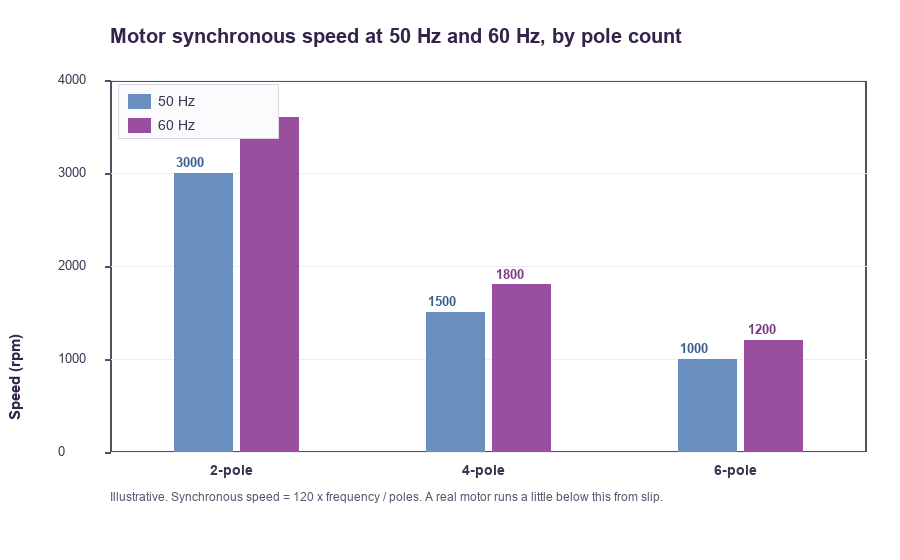
Motor synchronous speed at 50 and 60 hertz, by pole count. Synchronous speed equals 120 times the frequency divided by the number of poles. A 60-hertz supply turns a given motor near a fifth faster than 50 hertz does. A real motor runs a little below these figures from slip. The figures are illustrative.
A motor reads the frequency as its pace. An alternating-current motor turns in step with the rising and falling of the wave. The number of cycles each second sets the speed of the shaft. The tie is a simple piece of arithmetic. The synchronous speed of a motor equals 120 times the frequency, divided by the number of magnetic poles built into it. A two-pole motor on 60 hertz turns at 3600 turns a minute. The same motor on 50 hertz turns at 3000. The drop tracks the frequency, a fall of one-sixth from 60 down to 50. Every alternating-current motor follows the same rule, from the compressor in a refrigerator to the pump in a well. A change in frequency moves the speed of all of them by the same fraction. The frequency reaches the magnetic field as well. The magnetic field inside the motor depends on the voltage and the frequency together, in a ratio the designer fixes. A motor built for a certain voltage at a certain frequency expects that pairing on its terminals. Feeding it the same voltage at a lower frequency pushes the ratio up. The iron core then drives toward saturation. Saturation pulls a surge of extra current and turns it into heat. Heat wears a motor down over the years. The frequency on the label, then, is part of a matched pair the motor was wound to run on. A power station set to the right frequency hands the motor the pace and the field it was built around. The motor turns at its design speed, draws its design current and runs at the temperature its maker planned for. A power station holds that pairing exactly when its frequency matches the motor’s label. The motor then asks for nothing it was not built to give. The same voltage that suits the motor at its design frequency would overdrive it at a lower one. The match of frequency to label keeps the field, the speed and the heat all where the maker set them.
Synchronous motors hold the tie tightest. A synchronous motor locks its shaft exactly to the frequency, turning at the synchronous speed with no slip at all. A clock driven by such a motor keeps time by counting the cycles of the mains.
Induction motors run a touch below the synchronous speed. An induction motor turns a little under that figure, by a few percent, under its load. The slip stays roughly the same fraction as the frequency changes. A higher frequency turns the shaft faster. A lower frequency turns it slower. A change in the hertz shows up at once in the shaft speed.
The load on the motor feels the speed change. A fan turning faster moves more air. A pump turning faster pushes more water. A faster shaft does more work and pulls more power to do it.
The frequency is built into the motor at the factory. The number of poles, the windings and the iron are all chosen for one frequency and one voltage. A motor run at its design frequency sits in the spot its maker aimed for. The label names that frequency for anyone matching a supply to it. The figure is fixed in copper and iron, not a thing to change in the field. A rewind shop can alter the poles, a job far beyond any setting on a panel.
The cost of the wrong frequency to a motor
A motor on the wrong frequency runs at the wrong speed first. A 60-hertz motor fed 50 hertz turns near a sixth slower than its label promises. A clock geared to it loses time. A saw or a tool spins down and cuts with less bite. The slowdown is steady, a fixed fraction set by the frequency. A sixth off the speed is the same whatever the motor drives.
The heat is the deeper cost. A motor fed a lower frequency at its full voltage carries a higher field than its core was built for. The extra magnetism pulls a surge of current that warms the windings. A motor held there for long runs hot enough to age its insulation early. The damage builds over long hours on the wrong wave, out of sight until it bites.
The fix lives in the voltage. A motor moved to a lower frequency wants a lower voltage to match, enough to hold the original ratio of volts to hertz. Engineering practice corrects the ratio by lowering the voltage with a transformer when a motor crosses frequencies. The lower voltage returns the field to the level the windings expect.
A higher frequency speeds a motor up. A 50-hertz motor run on 60 hertz turns near a fifth faster than its label. The extra speed can push a load past its safe limit. The bearings and the driven machine take the strain. A load rated for one speed dislikes a sudden fifth more of it.
The clocks and timers that drift
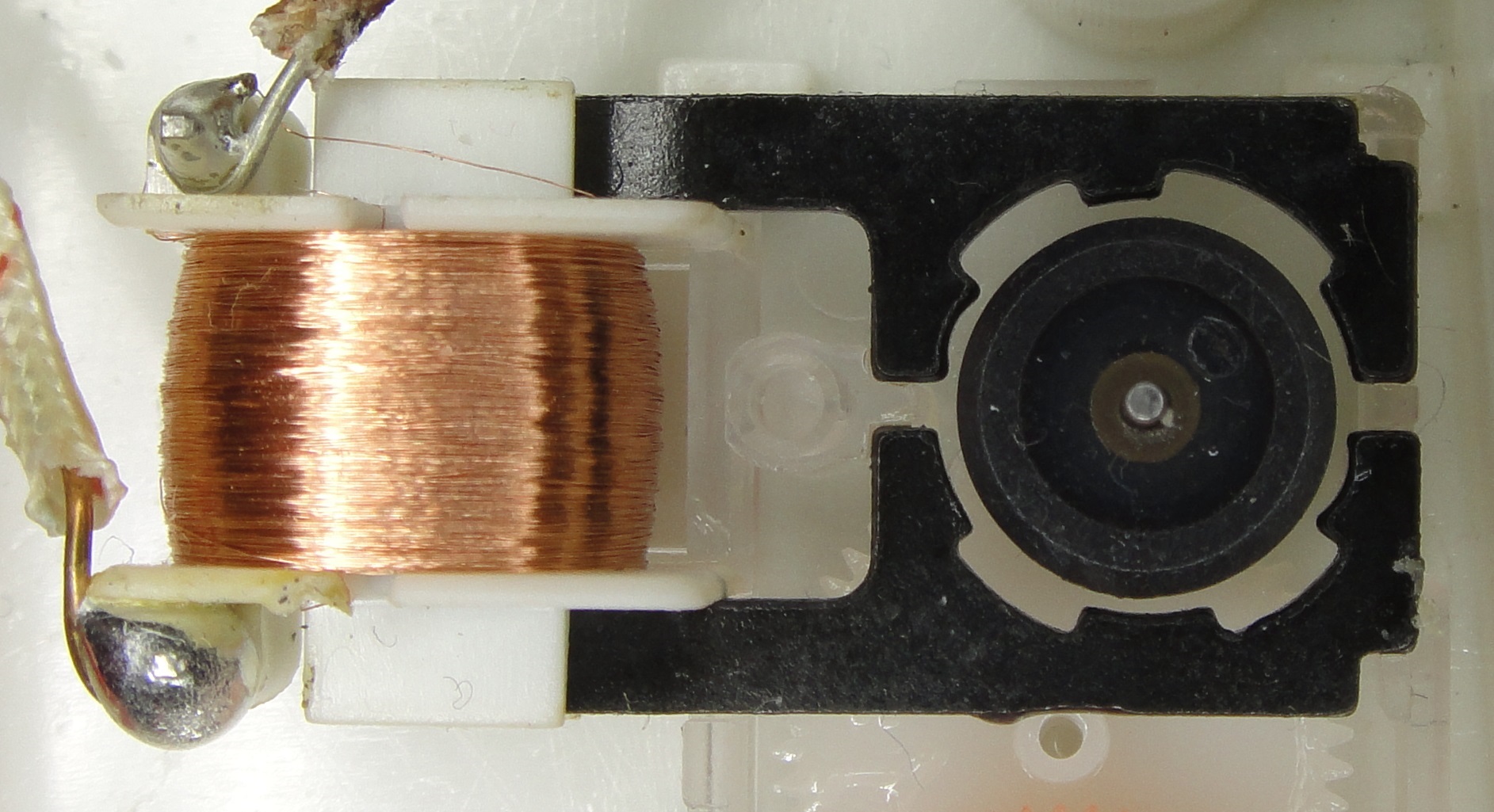
A real single-phase synchronous clock motor with its cover removed, showing the copper coil and the rotor. A synchronous clock keeps time by turning in step with the mains, one measured step for each cycle of the wave. A clock built for 60 hertz run on 50 loses around ten minutes an hour. The frequency reaches the timekeeping directly in a motor like this.
A mains clock keeps time by the frequency itself. A synchronous clock motor turns one notch for each cycle of the wave. The hands move at a pace set by the hertz. The grid holds its average frequency tight over a day, which keeps such a clock accurate to the second over weeks. The mains becomes the pendulum for every synchronous clock on it.
A clock built for one frequency drifts on the other. A 60-hertz clock run on 50 hertz counts short and falls behind, by around ten minutes every hour. An old oven timer, a heating controller, or a motor-driven appliance clock can wander the same way. The drift adds up to a quarter of an hour across a working day. A clock off by that much each hour falls far behind by nightfall.
The other devices that follow the frequency
Other gear follows the frequency in its own way.
A transformer answers to the frequency in its iron. A mains transformer is wound for a frequency. A lower frequency drives its core harder toward saturation. A transformer run below its design frequency heats and hums beyond its plan. A transformer-based charger or a small mains adapter feels this same pull.
Older audio and lighting gear can show the frequency. A turntable driven by a synchronous motor spins at a speed set by the hertz. A wrong frequency shifts its pitch. A fluorescent tube flickers at twice the line frequency, at 100 hertz on 50 or 120 hertz on 60. The flicker is too fast for the eye in either case.
Some appliance timers and shop tools count on the frequency too. A mechanical washer timer or a bench grinder steps or spins at a pace the hertz sets. A wrong setting stretches a wash step or slows a grinding wheel. The trouble lands only on the gear that counts the cycles. The count of mains cycles is what such a timer turns into elapsed time.
The devices that ignore it
A large share of modern gear pays the frequency no mind. A switching power supply rectifies the incoming wave to direct current in its first stage. A 50 or 60 hertz input reaches the same smoothed rail inside it. A phone charger, a laptop brick, an LED driver and the bulk of consumer electronics carry this kind of supply and run on either frequency. A pure heater, a kettle and an incandescent bulb care even less, since a resistive load turns volts into heat or light at any frequency.
How a power station sets its frequency
A power station builds its output frequency from scratch. The inverter switches the battery’s direct current into an alternating wave. A timing circuit decides how fast that wave rises and falls. The frequency is a number the electronics hold, set by the switch on the panel. The wave is born inside the unit, shaped entirely by its electronics.
A crystal reference keeps the figure exact. A small quartz oscillator, the same kind that runs a watch, times the switching to a tight tolerance. The output sits on its 50.0 or 60.0 hertz far more steadily than a public grid does through a busy day. The figure barely wanders from one reading to the next.
The switch changes a setting in the firmware. Choosing 50 or 60 hertz tells the timing circuit a new target. The next cycle leaves the inverter at the new rate. The hardware stays exactly as it is. The same circuit serves both rates from one design.
A fuel generator handles frequency a harder way. A generator ties its frequency to the speed of its engine. A governor holds that engine near a fixed rate. A portable power station carries no spinning part. It holds its frequency from the electronics alone and switches it with a button. The change takes a moment and needs only a press from the user.
How devices respond to a 50/60 Hz mismatch
Device type
Follows frequency?
Effect of the wrong frequency
Typical rating
AC motor (fridge, pump, fan)
Yes, speed = 120 × f / poles
~20% speed change, overheating risk
50Hz or 60Hz
Synchronous clock or timer
Yes, counts cycles
gains or loses ~10 min per hour
50Hz or 60Hz
Mains transformer
Yes, core flux
extra heat and hum, saturation at lower Hz
50Hz or 60Hz
Switching supply (charger, laptop)
No
none
50/60Hz
Resistive load (heater, kettle, bulb)
No
none
any
LED drivers and other electronics
No
none
50/60Hz
Matching the frequency to the region
Matching begins at the appliance. A nameplate names the frequency the device was built for, printed as 50 hertz, 60 hertz, or 50/60 hertz. The setting on the power station goes to that figure.
The region a device came from points the way when a label is unclear. Much of the world runs 50 hertz, across Europe, Africa, much of Asia and Australia. The Americas run 60 hertz, along with parts of Japan and a few other spots. A device bought in a 60-hertz country was built for 60. A glance at the origin settles the setting when the print has worn away.
Japan splits its own grid between the two, 50 hertz in the east and 60 in the west, a divide left from two early suppliers. A traveller within Japan meets both standards in one country. A power station that switches frequency suits either side of that line.
The power station carries the choice for travel and mixed gear. A unit used across borders sets its output to match whatever it powers at the time. A 60-hertz appliance carried into a 50-hertz country still gets its 60 hertz from the station. The station builds that frequency from its battery, the same anywhere it travels.
A label reading 50/60 hertz frees the choice. A device rated for both runs correctly on either setting. The frequency stops mattering for that device. Setting the station to the local standard suits such gear with no fuss.
Dual-frequency gear
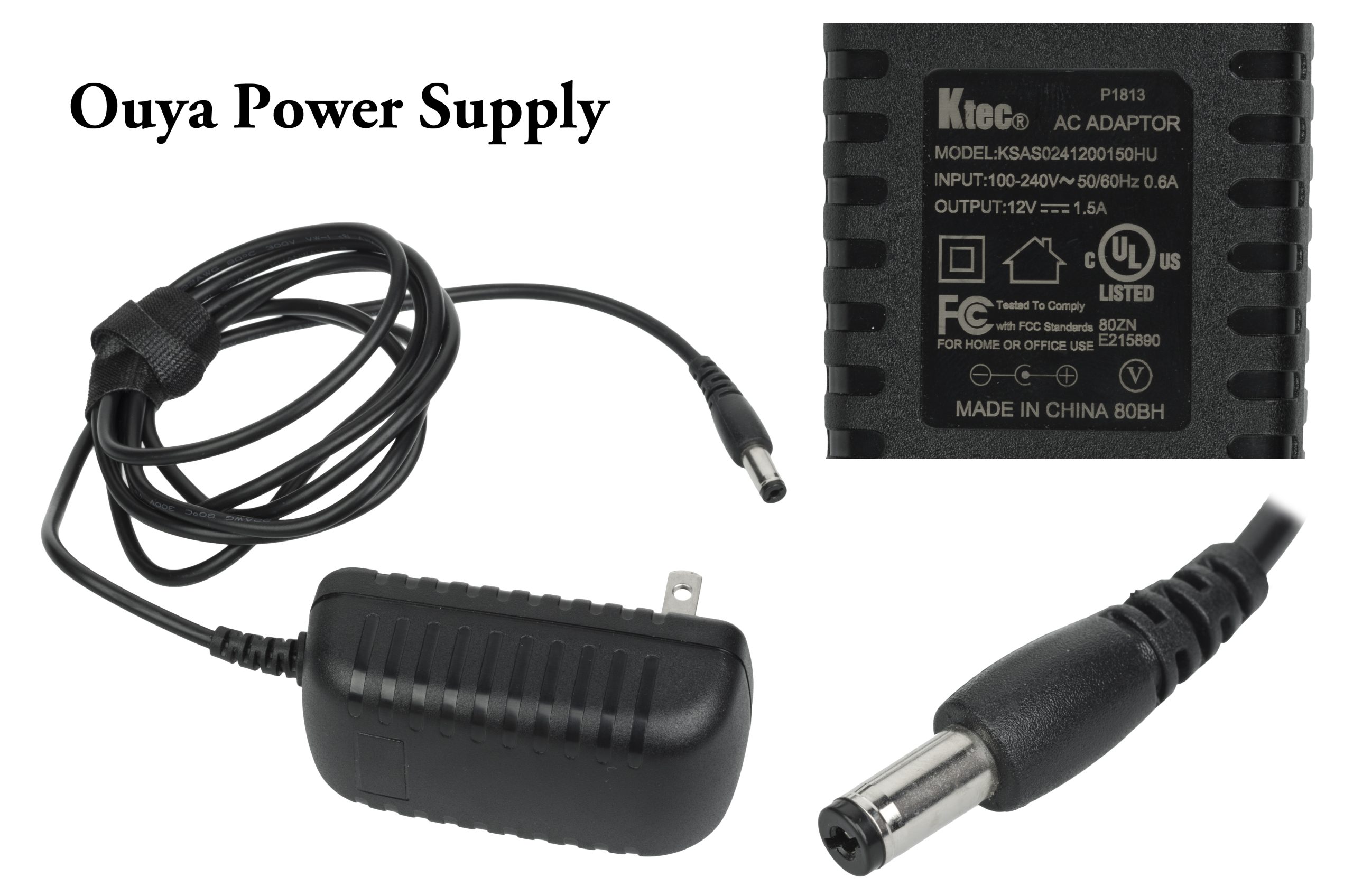
A real universal-input AC adapter. The label reads INPUT 100-240V, 50/60Hz, the mark of a switching supply that accepts either mains frequency. A supply like this rectifies 50 or 60 hertz to direct current in its first stage. The frequency setting does not affect it. The OUTPUT line reads 12V at 1.5A. The words Ouya Power Supply at the top were added to the photo by the photographer, not printed on the unit.
A great deal of modern equipment carries a dual-frequency rating. A label that reads 100 to 240 volts and 50/60 hertz marks a universal-input supply, the kind found on a great many phone chargers, laptops and small electronics. The rating prints right on the brick for anyone to read. The same line lists the voltage range and the current draw beside it.
The switching supply inside makes the wide rating possible. The supply turns the incoming wave straight to direct current, then chops it at a high frequency of its own, far above the mains. The frequency of the wall supply never reaches the sensitive parts downstream. The wide input is why one charger serves a traveller across every grid.
A dual rating makes the frequency switch a convenience for such gear. A laptop or a phone charger on a power station works the same on 50 or 60 hertz. The setting can sit at the local standard and stay there for all the universal-input devices in the bag. One setting covers the phone, the laptop and the camera alike.
A reading of the input line settles any doubt. A label that shows 50/60 hertz needs no thought about the setting. A label that shows one frequency alone asks for the switch to be set to it.
Frequency and voltage travel together
Frequency and voltage come as a regional pair. A 60-hertz region usually runs near 120 volts. A 50-hertz region usually runs near 230. A power station built for travel switches both to match the appliance and its home grid. The two figures belong together on the panel.
The pairing comes to a head when a motor crosses frequencies. A motor carries the field its volts-per-hertz sets. A change in frequency calls for a change in voltage to hold that ratio. A unit that switches voltage along with frequency keeps a foreign motor in its safe range. The two settings move together on a unit built for travel.
Travelling between the two standards
A traveller meets the frequency question at the border. A device packed in a 60-hertz country expects 60 hertz at the far end, whatever the local grid runs. The power station carried along supplies that same 60 hertz anywhere the trip goes. The grid at the destination changes nothing the station puts out.
A motor tool from the Americas keeps its speed on the road. A drill or a saw built for 60 hertz, run from a station set to 60, turns at its rated speed in a 50-hertz country. The tool runs as its maker intended, far from home. The station setting carries its home frequency along for the trip.
A clock or a timer needs the same care abroad. A travel alarm with a synchronous motor, or an appliance with a mains-driven timer, keeps true time only on its home frequency. The station setting holds that timing wherever the trip goes. A clock keeps its rhythm as long as the station keeps the hertz.
Universal-input electronics travel free of the question. A laptop, a phone charger and a camera battery charger run on either frequency with no setting to mind. The station can stay on the local standard for all of them, with the switch saved for the one motor or clock in the bag. The list of fussy devices in a typical bag is short.
Setting and using the switch
The frequency control sits in the unit’s settings. A switch on the panel or a line in the menu picks 50 or 60 hertz. The choice takes effect on the output the moment it is set. The output frequency follows the chosen figure from that point on.
The setting belongs before the appliance goes on. Choosing the frequency with the output off, then connecting the device, spares the appliance any moment on the wrong wave. A motor or a clock meets the right frequency from its first cycle.
The local standard makes a sound default. A station set to the frequency of its home country runs the local gear with no thought. The setting needs a change only for a visiting device from the other standard.
Mixed gear takes the frequency of the fussy device. A load of universal-input electronics runs on either setting. The switch then follows the one motor or clock in the group that cares.
The display confirms the setting at a glance. A power station shows its output frequency on the screen, beside the voltage and the watts. A quick look tells whether the unit sits on 50 or 60 before a motor goes on. The figure on the screen is the surest check before a sensitive load connects.
The wrong setting shows itself in use. A motor running slow or hot, a clock drifting off, or a transformer humming hard points back to a frequency that does not match the load. A glance at the setting and a switch to the right figure clears it. The cure is a setting, never a part to replace.
Reading the label and planning
The frequency hides in plain sight on the nameplate. The line shows hertz next to the voltage, as 120V 60Hz, 230V 50Hz, or 100-240V 50/60Hz. The figure tells the setting the device wants in one glance. The hertz figure sits in the same small print as the voltage and the watts.
A short inventory settles the plan before a trip. A list of the gear, a note of each frequency and a check for any single-frequency motor or clock name the setting the station should hold. The universal-input devices follow along on whatever it picks. A minute with the labels saves an hour of puzzling on the road.
The frequency setting decides how an appliance runs. A power station set to the frequency an appliance was built for hands a motor its design speed, a clock its true time and a transformer its rated field. A reading of the nameplate and a switch to the matching figure keep the gear running the way its makers drew it up.
Frequently asked questions
Can a 60Hz appliance run on a 50Hz power station?
A resistive or universal-input device runs on either frequency without harm. A motor or a clock built for 60 hertz runs about a sixth slow on 50 hertz and can heat up at its full voltage. A power station with a 60-hertz setting solves it by giving the appliance the frequency it expects. The switch handles exactly this case.
What happens if the frequency is set wrong?
A motor turns at the wrong speed and can run hot, since its volts-per-hertz moves off the design value. A synchronous clock gains or loses time. A mains transformer can hum and heat. Setting the station to the appliance’s rated frequency clears any of these.
How do I know which frequency to use?
The nameplate on the appliance names its frequency, as 50, 60, or 50/60 hertz. A device with a single figure needs that figure on the station. A device marked 50/60 runs on either. The region offers a guide when a label is unclear. A device from the Americas runs at 60 hertz. A device from the wider world runs at 50.
Does the frequency affect a battery charger or laptop?
A modern charger or laptop supply takes 50 or 60 hertz without a change in how it works. The switching supply inside rectifies either frequency to direct current in its first stage. The label reading 100-240V 50/60Hz marks this universal input. The frequency setting can sit at the local standard for all such gear.