Precision equipment is gear that depends on the exact shape of its power as much as on its energy. A medical breathing machine, a hi-fi amplifier, a variable-speed motor, and a lab instrument all read the power wave closely. These devices were designed around the smooth sine wave of the grid. A pure sine inverter hands them that same wave. This page sets out why the clean shape matters to them, mechanism by mechanism. The clean wave is part of the design these devices were built into.
Precision gear reads more than the energy in a wave. It reads the timing, the peaks, and the smoothness of the wave to do its work. A wave that strays from a clean sine feeds that gear the wrong information. The shape of the wave is part of the information a precise device works from. A plain heater takes the energy at any shape and turns it into heat. A precise device asks for the shape on top of the energy.
Harmonics, the hidden problem
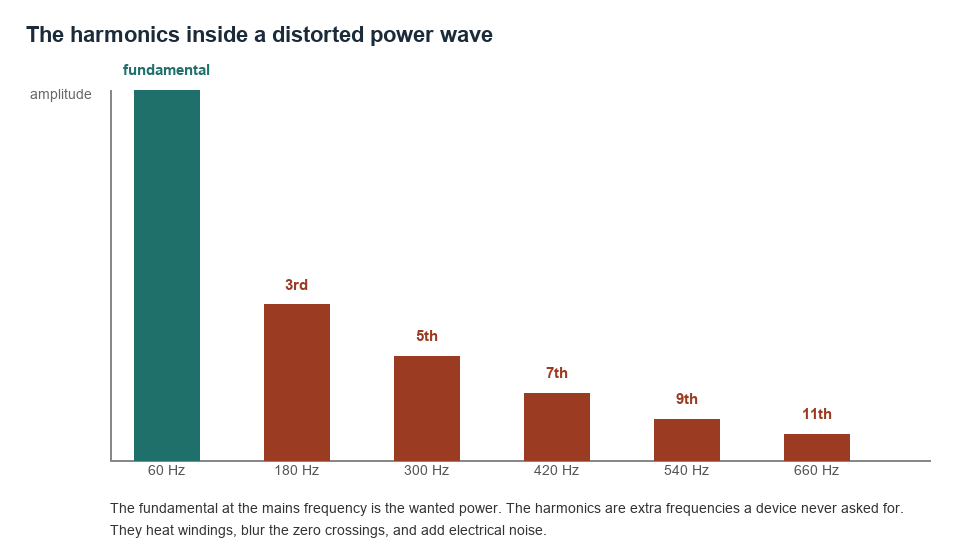
The harmonics inside a distorted power wave, drawn to show the extra frequencies. The fundamental at 60 hertz is the wanted power. The peaks at 180, 300, and higher hertz are the harmonics, energy a device never asked for. The harmonics heat windings, blur the zero crossings, and add electrical noise. The figures are illustrative.
A wave that is not a clean sine carries harmonics. A harmonic is an extra wave at a multiple of the mains frequency. A 60-hertz wave with sharp edges carries energy at 180 hertz, 300 hertz, and higher. Those extra frequencies ride on top of the main wave. The chart shows them as a row of smaller peaks beside the fundamental. The harmonics are the price a wave pays for its sharp edges. Sharp edges and harmonics are the same thing in two views.
The harmonics are energy at frequencies a device never asked for. One reference on power quality notes that non-linear loads draw current in abrupt pulses and send harmonic currents back into the power system. Those currents, the same source notes, can overheat a transformer, sometimes catastrophically. The harmonics are the root of the harm a distorted wave does to gear. The harmonics flow where the power flows, into every device on the line.
The number and size of the harmonics set how far a wave strays from a clean sine. A wave full of sharp steps carries strong harmonics. The total of all the harmonics is the total harmonic distortion, the figure a clean inverter keeps low. The harmonics hide inside the shape of the wave, invisible on the surface. The table lists the first few and what each one does. A clean inverter holds that figure low. A low figure marks a wave close to a clean sine.
Each harmonic does its own kind of harm. The lower harmonics, the third and the fifth, carry the heaviest energy and do the worst damage. They heat windings, disturb controls, and add noise. The higher harmonics fade in strength and in effect. The sections below follow the harm from heat to misreading to noise. Each section follows one path the harmonics take into a device. The harm sorts into heat, misreading, and noise.
Harmonics in a distorted power wave (60-hertz base)
Harmonic
Frequency
Effect on equipment
Fundamental
60 Hz
the wanted power
3rd
180 Hz
neutral overload, transformer heat
5th
300 Hz
motor heating, torque dip
7th
420 Hz
motor heating, control noise
9th and 11th
540 and 660 Hz
added heat and noise
Heat in windings
The first harm is heat in any winding the wave reaches. A motor, a transformer, and a coil all carry windings of copper around iron. A winding has its normal losses at the mains frequency. The harmonics add losses on top, from eddy currents and from the iron’s hysteresis. Those extra losses become heat the winding cannot easily shed. The heat is the harmonics turned into a load on the iron. Every harmonic adds its own small heat to the part. The heat from each one stacks onto the rest.
A higher harmonic frequency drives stronger eddy currents in the winding. A winding fed a wave full of harmonics runs hotter than its rating expects. The heat shortens the life of the insulation and the iron. A motor or transformer on a dirty wave ages faster and can fail early. The harmonics turn into heat the design never planned for. A winding fed clean power stays within the heat it was rated for. A clean wave holds the winding at its rated heat. Rated heat is the heat a part can carry for years.
Precision gear often hides a transformer or a motor inside. A medical pump runs a small motor. An audio amplifier holds a power transformer. A lab supply carries coils that shape its output. The harmonics heat those inner parts the same way they heat a large motor. A device built for a clean wave trusts its inner parts to stay cool on one. The harmonics reach those inner parts as surely as a big motor. An inner coil feels the harmonics like any other winding.
Misreading the wave
The second harm is a device misreading the wave it is fed. Many precision devices look at the wave to set their timing. They watch for the moment the wave crosses zero, twice each cycle, at two clean points on a sine. A distorted wave blurs and multiplies those crossings. A device counting them reads the wrong count. A wrong count sets the device a step out of true.
A dimmer reads the zero crossing to time its switching. A clock built around the mains counts the crossings to keep time. A motor control reads the wave to set its speed. Each of these devices leans on a clean crossing it can trust. A wave with extra crossings throws each of them off. A clean crossing is the beat each of them keeps time to. A clean beat keeps each device on its own schedule. A device times itself by the beat it reads.
Other devices read the size of the wave, its peak or its average. A cheap meter reads the peak and scales it to an RMS figure. A charger reads the wave to set its charging. A device that reads the peak of a distorted wave reads a peak in the wrong place. The reading comes out wrong. The device then acts on a wrong number. A wrong number leads a precise device to a wrong act.
The harm here is quiet and easy to miss. A device on a distorted wave keeps running with slightly wrong readings. A clock gains or loses time. A dimmer flickers or buzzes. A charger fills to the wrong level. Small errors pile up over a long run.
A pure sine wave carries clean crossings and a true peak. A device reads them straight. The wave crosses zero at two points and peaks once, as the device expects. The readings come out right. A device that reads the wave needs a wave it can read without error. The clean shape is the reference the device was built to trust.
The misreading runs deeper than a single wrong number. A precision device builds its whole behaviour on the wave it reads. A motor control reads the wave many times a second to hold a speed. It expects a clean crossing at a known instant, twice a cycle, like the tick of a clock. A distorted wave hands it extra crossings, early and late, scattered around the true ones. The control reads those false ticks as real and corrects a speed error that does not exist. The motor hunts and jitters. A clock built on the mains counts the same crossings to mark the seconds. A wave with double crossings runs that clock fast. The time drifts ahead through the day. A dimmer fires its switch a fixed delay after each crossing to set a brightness. False crossings fire the dimmer at the wrong moments. A flicker or a buzz follows. A charger reads the peak of the wave to judge a battery. A charger reading a distorted peak fills the battery to the wrong mark. Each of these devices was built around a wave it could trust. The clean sine gives a known crossing and a known peak, the same on every cycle. The device reads them and acts on solid ground. The same device on a distorted wave finds that ground shifting under it. The readings wander. The behaviour wanders with them. The harm rarely strikes all at once. It builds as a slow drift away from the right answer, a device doing its job a little wrong, cycle after cycle, until the error grows large enough to notice. The clean wave keeps the device on solid ground from one cycle to the next. A precise device asks for nothing more than a wave it can read the same way every time. The wave it can trust is the whole of what it needs from the power. A readable wave is the one thing a precise device asks of its power.
A device that reads the wave’s average or RMS can be fooled the same way. A simple meter assumes a sine and works back from one point to the whole. A distorted wave breaks that assumption. The meter reads a figure that does not match the real power. A device acting on that figure sets itself a little wrong. The clean wave matches the meter’s own assumption. A meter on a clean wave reads the true power. The reading and the real power agree.
The shape of the wave is information.
Noise and interference
The third harm is electrical noise the harmonics carry into a circuit. The sharp edges of a distorted wave radiate energy across a band of frequencies. That energy couples into nearby wires and circuits as interference. A sensitive circuit picks up the noise on top of its own signal. The noise rides along with the power, unwanted. The harmonics carry their own static into a quiet circuit. A quiet circuit hears the harmonics as noise. Noise on the power becomes noise in the work. A clean wave brings no noise of its own.
The noise spreads further than the wire it starts in. A sharp edge in the wave is a burst of high-frequency energy. That energy radiates from the wires as a weak radio signal. It couples into any nearby cable or circuit board. A sensitive front end picks it up as a hum, a buzz, or a stray reading.
Audio gear shows the noise plainly. An amplifier on a distorted wave can hum or buzz through its speakers. The harmonics leak into the audio path and ride out as sound. A clean wave leaves the audio path quiet. An audio system on a pure sine inverter plays the signal alone. The clean wave keeps the power out of the sound. Silence in the speakers is the mark of a clean wave. A clean wave plays no part of its own in the sound. The sound carries the signal and nothing more.
Measurement and communication gear suffers the same noise. A precise instrument reads a small signal against the power’s noise floor. A radio or a data link picks up the interference as static. The harmonics raise the noise floor the gear has to work above. A clean wave keeps that floor low. Fine signals stand clear above a quiet floor.
Every fine measurement works against a floor of noise. A clean wave keeps that floor low. A signal close to the floor stands clear when the floor is quiet. The harmonics lift the floor and bury the smallest signals. A device that needs to read a faint input needs the floor a clean wave leaves. The clean wave is the silence fine signals stand out against.
The devices that need a clean wave
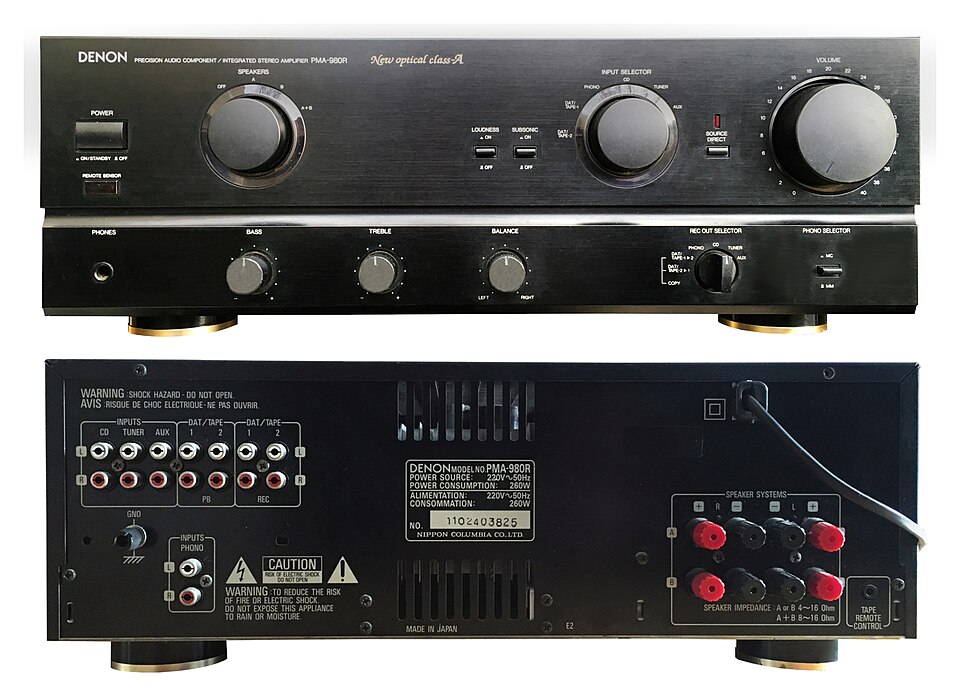
A real Denon PMA-980R, labelled a precision audio component, front and rear. Audio gear is sensitive to power harmonics, which leak into the sound as hum or buzz. The rear plate reads 220 volts, 50 hertz, and 260 watts, beside the input and speaker terminals. The front holds the volume, the tone, and the source controls. A clean sine wave keeps the sound free of power noise.
Some classes of device need the clean wave by their nature. A medical device at home, like a breathing machine or an oxygen concentrator, lists a pure sine wave in its manual. The maker tests it on a clean wave and warns against a dirty one. A clean wave keeps its motor, its sensors, and its timing inside spec. A medical device is the clearest case for a pure sine inverter. A medical maker writes the clean wave into its instructions. The instruction is the maker’s tested word on the power. A medical maker tests on the wave it then names.
Audio and video gear belongs on the clean wave too. An amplifier, a turntable, and a fine speaker all carry the power’s noise into the sound. A pure sine wave leaves the sound clean. A screen or a projector holds a steadier image on a clean wave. The clean shape protects the quality the gear was built to deliver. Quality power gives quality output. A clean input is the start of a clean result. The output is only as clean as the power behind it.
A modern appliance often hides a precision part inside a plain shell. A fridge with a variable compressor runs a control board and a sensing circuit. A washing machine times its cycle on the mains. A furnace runs a board that reads the wave. These everyday machines have joined the list of devices that read their power. A plain shell can hide a precise circuit inside. The board inside reads the wave like any other.
Variable-speed motors and their controls need the clean wave as well. A motor that changes speed reads the wave to set that speed. A drive that controls a motor leans on a clean reference. The harmonics of a dirty wave heat the motor and confuse the control. A clean wave lets a variable-speed motor run cool. The clean wave gives the control a reference it can trust. A control reads a clean wave and holds its speed.
Fine electronics and chargers round out the list. A laser printer, a sensitive charger, and a lab instrument read the wave closely. A microwave oven cooks unevenly on a dirty wave. A clean wave lets each of these run as its maker intended. The list grows as more devices carry boards and motors inside.
A charger or a power supply reads the wave to do its job. A laptop supply spans a wide voltage range and reads the wave to set its output. A battery charger reads the peak to judge a full charge. A fine supply for a lab holds a steady output by watching its input. Each of these reads the wave and trusts its shape.
A camera, a games console, and a fine television all read their power closely. Each holds a board that the harmonics can disturb. A clean wave keeps the picture and the sound steady. The list of clean-wave gear grows with every smart device sold. A modern home fills with devices that read the wave. Each new smart device adds to the clean-wave list. The clean wave serves the whole modern home.
What a clean wave gives
A pure sine wave gives a precision device the exact power it was designed around. The wave matches the grid the maker tested against. The device sees clean crossings, a true peak, and no harmonics at all. Every part inside works the way its design assumed. A pure sine inverter takes the power itself off the list of things that can go wrong for precision gear. The device meets the wave it was tested against. A pure sine inverter brings the grid’s own wave to a battery. The battery then powers precise gear the way the grid would. A precise device cannot tell the inverter from the wall. The inverter passes for the grid in the device’s eyes. The device runs as it would at home on the wall.
Mistakes about precision gear and power
A few mistakes follow from the power a precision device needs. The first is putting sensitive gear on a cheap, distorted wave. The distorted wave harms the gear over time. The saving on the inverter turns into a bigger loss on a damaged device. A precision device earns the clean wave it asks for. The clean wave is the right power for the gear.
The second is judging a device by whether it powers on. A device on a dirty wave often powers on and runs as normal. The harm builds unseen inside it, month by month. A motor heats slowly. A reading drifts slowly. The trouble shows up after the device has run for a time.
The third is ignoring the device manual. A maker that needs a pure sine wave says so in the manual. A line calling for a sine wave, or warning against a modified one, is the maker’s own word. A buyer who reads the manual learns the wave the device needs. The manual settles the question before any damage. The manual carries the answer in plain print. A line in the manual ends the guessing. The maker names the wave in plain words.
The fourth is assuming all inverters carry a clean wave. Two inverters at the same wattage can carry two different waves. A buyer who reads only the watts can buy a dirty wave by mistake. The wave type sits in the spec, beside the wattage. A precision load asks the buyer to read the wave as well as the watts. The wave type sits one line over from the wattage.
The fifth is mixing precision gear with simple loads on a dirty wave. A heater runs fine on a modified wave, so a buyer trusts the whole load to it. The sensitive device in the same load suffers the harm. A mixed load with one precision device calls for the clean wave. One sensitive load sets the wave for the whole inverter. One precise device decides the wave for the mix. The mix follows its single sensitive member. One precise load decides the wave for the whole set. The one sensitive load names the wave. Its needs set the wave for everything beside it. The mix rises or falls to its finest part.
The sixth is trusting a device to protect itself. A device built for a clean wave assumes a clean wave at its input. It rarely checks the shape of the power it is fed. The harm lands on it with no warning. The protection lives in the choice of inverter. The device leans on the buyer to supply a clean wave.
The seventh is forgetting the gear that joins a load later. A clean simple load today may gain a precision device tomorrow. A pure sine inverter bought early covers the new gear with no surprise. A buyer who plans for precision gear leans to the clean wave from the start.
Common questions
Why does precision equipment need a pure sine wave?
Precision equipment reads the shape of the power as well as its energy. A pure sine wave gives it clean zero crossings, a true peak, and no harmonics. A distorted wave heats the windings inside it, blurs the readings it takes, and adds electrical noise. The clean wave keeps a precise device inside the design its maker tested.
What harm do harmonics do to equipment?
Harmonics are extra frequencies in a distorted wave. They raise the losses in motors and transformers and turn into heat. One power-quality reference notes harmonics can overheat a transformer, sometimes catastrophically. Harmonics also disturb the controls and add noise in sensitive circuits.
Will a modified sine wave damage sensitive electronics?
A modified wave can harm sensitive electronics over time. The harmonics heat any motor or transformer inside the device and disturb the readings it takes. A simple resistive load takes a modified wave with no harm. The risk falls on a device with a motor, fine electronics, or a sensitive sensor. The clean wave is the safe choice for that gear.
Which devices need a pure sine wave?
Medical devices, audio and video gear, variable-speed motors, laser printers, and sensitive chargers all run best on a pure sine wave. These devices read the wave closely or carry inner parts that harmonics warm. The device manual names the wave it needs. A pure sine inverter covers the whole mix without question.