




103g Lightest Ophthalmic Ultrasound Probe Handheld Review
A handheld ophthalmic ultrasound probe that weighs about a hundred and three grams is among the lightest built to scan the eye. That weight, near a tenth of a kilogram, is the whole point of it. A probe this light rests on a closed eyelid with almost no hand behind it, travels in a coat pocket, and runs a full eye scan off its own battery. The grams it sheds change how, and where, an eye can be scanned.
A featherweight in the hand
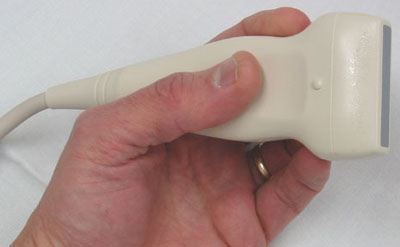
A hundred and three grams is hard to picture until it sits in the hand. It is lighter than most mobile phones. It is about the weight of a small apple, or a deck and a half of playing cards. Held up to an eye, it asks almost nothing of the wrist. A clinician can hold it steady at the lid for as long as an exam takes, with no ache building in the hand. The number is not a boast. The feel of the thing is what matters most in a probe like this. Pick up a probe twice this weight and the difference shows within a minute of scanning. The hand that holds the lighter one stays loose and sure. A tennis ball weighs about half as much again. An egg weighs roughly half of it. These are the everyday objects a hundred grams lives among, and none of them tires a hand that holds it for a minute.
Handheld ultrasound probes run a wide range of weights. Many sit between two and three hundred grams, a comfortable heft for the belly or the heart. An eye probe is a different build. It carries a small high-frequency element and little else, so it comes out light, suited to the gentle work it does. A hundred grams is near the floor of what a working probe can weigh and still hold its battery, its element, and its wireless radio. This probe sits at that floor. Every gram in a probe is a gram the hand carries through a long clinic. Shaving the body down to a hundred-odd grams is a design choice aimed squarely at the eye. What stays in the hand is the element, a small battery, and the shell that holds them, a few ounces resting in the palm.
The shape matters as much as the mass. A probe this light is usually slim, held like a thick pen or a small wand. The balance sits near the tip, where the work happens, so the eye end stays settled on the lid. A cable would pull against that balance, so a probe like this often cuts the cable and goes wireless. The whole weight is then in the hand, with nothing tugging from a cart across the room. A featherweight body lets the design put the grip where the fingers fall, with no heavy tail to counterbalance. The grip is shaped to the fingers, held and guided the way a writing tool is. The probe becomes an extension of the hand. The body is often no thicker than a broad marker pen, with a rounded head that meets the lid. A small light or a band of colour shows it is awake and linked to its screen. The whole tool fits closed inside a fist.
None of this asks the user to learn a new skill. A clinician who has held any eye probe picks this one up and knows it. The lightness shows up as the absence of strain, felt over a long session. The hand does not tire. The wrist does not lock. The probe does not wander off the lid through a long exam. A reviewer notices a light probe most in what stops happening: the fatigue, the drift, the creeping pressure of a tired hand on a soft eye. That absence is the whole case for the weight. A probe light enough to forget is a probe held steady. The weight makes itself known in the wrist over an afternoon. A reviewer who scans a full clinic with one writes most about the ache that never came. The lightest probes win their praise in what the hand does not feel.
| Item | Figure | Note |
|---|---|---|
| This probe | about 103 g | among the lightest for the eye |
| A mobile phone | about 170–200 g | for comparison |
| A typical handheld probe | about 200–300 g | the common range |
| A cart-based scanner | up to about 50 kg | the machine it replaces |
| Ophthalmic frequency | about 10–20 MHz | a high-frequency element |
| Display | a phone or tablet | no monitor to buy |
| Link | wireless | no cable to a cart |
| Body | sealed, wipe-clean | no fan, no moving parts |
Why grams matter at the eye
The eye is the one place a probe must never press. A heavy probe leans on the hand. The hand, when tired, leans on the eye. The lighter the probe, the easier it rests on a closed lid, light as a feather on the gel, its whole weight taken up by the film and the lid. For an organ that gives false numbers under pressure, that lightness keeps the measurement honest. A probe with almost no weight keeps the never-press rule the standards demand, with no effort at all. A scan of the eye runs at the lowest output any ultrasound uses, gentle in the hand from the first eye to the last of a long list. Keeping the tool light is half the battle with an eye unforgiving of pressure.
Steadiness is the other half of it. A scan of the optic nerve sheath, or a measure of the eye’s length, turns on holding a line still to a fraction of a millimetre. A tired hand shakes. A light probe spares the hand the load that builds the shake, keeping the line steady. Over a long screening day, eye after eye, a heavy probe wears the hand down by the close. Fatigue builds unseen through a long list, showing by the fiftieth scan as drift and a small loss of control. The lightest probe is the one a clinician can still hold true on the hundredth patient. A hand under strain passes its tremor straight to the picture. Less weight in the hand means less tremor on the screen. The fine numbers the eye gives up depend on a still line held by a hand at ease.
Travelling light
A probe this light goes out of the building with the clinician. Handheld probes of this kind are the new generation of bedside ultrasound, built ultra-portable to put a scanner in every clinician’s hand. It runs without a cart, without a mains cable, without a tower of electronics on wheels. The whole machine is the probe in the hand and a screen it talks to, a phone or a tablet a clinician already carries. The image travels over a wireless link to that screen. One bag holds the probe, a charger, and a bottle of gel, the whole eye clinic packed into a shoulder bag. Setup takes seconds. The probe wakes, the app opens, and the eye is on the screen. What used to fill a room now rides in a coat pocket. The link runs over the kind of wireless a phone already speaks, with the picture on the glass in real time. A whole eye-imaging system packs into a bag the size of a lunch box. Nothing has to be wheeled, plugged, or booted from cold.
The battery is the heart of a cordless probe. A probe this small carries a small cell, enough for a run of scans on a charge. It tops up from a common charger, the kind that fills a phone. A spare battery, or a power bank in the bag, carries a clinic through a day with no socket in sight. The probe sleeps between patients to save its charge, waking the moment it is lifted to an eye. Battery life is the figure to weigh most in a featherweight probe, since the grams saved come partly from a smaller cell. A clinic that scans all day plans for a second battery. The whole design treats power as something to spend with care. A small lithium cell drives it through a stretch of continuous scanning, then fills again in the time of a coffee break. The probe shows its charge as a bar on the same screen as the image. A clinic far from a socket leans on a spare cell tucked in the bag.
The screen is whatever the clinician already owns. The probe sends its picture to an app on a phone or a tablet, and the glass in a pocket becomes the display. There is no proprietary monitor to buy, carry, or replace. The phone does the computing the probe is too small to hold, and that split is what lets the probe stay light. The app holds the presets, saves the images, and writes the measurements down. It can send a scan to a specialist far away, over the same network that carries a call. A finding taken in a village reaches an eye unit in a city the same minute. The app carries a preset for the eye and others for the rest of the body, so one probe can serve more than a single clinic. A scan saved to the phone syncs to the record the moment a signal returns. The computing power of a modern phone is what a probe this small borrows to stay light.
Cleanliness travels with the probe. A smooth, sealed body wipes down between patients in seconds, with no seams to trap what an eye leaves behind. A fresh film or a clean cover goes on for each closed lid. The probe takes a wipe of disinfectant the way a stethoscope does, ready for the next patient in the time it takes to turn around. Infection control is a real worry where one probe serves hundreds of eyes in a day. A body that wipes clean in seconds is a body that can take that load. A sealed shell with a rating against dust and splashes takes a field day in stride. Nothing inside it can be reached by the grime of a tent or a roadside. The same smoothness that wipes clean keeps the weather out.
Durability rides along too. A probe carried in a bag, set down on folding tables, used in dust and heat, has to take knocks a console never sees. A sealed, solid body with no moving parts outlasts a cabled probe that flexes at the join. The featherweight that survives a year of travel is the one with no weak cable to fail and no fan to clog. Every cut cable and clogged fan is a repair that strands a clinic for weeks. A clinic far from a repair shop leans hard on a probe that simply keeps working. Toughness, in the field, is worth as much as image quality. A cart system carries fans, cables, and a hinged screen, each a part that can fail far from a technician. A probe in one sealed piece takes none of those weak points into the field. The simplest machine is the one least likely to strand a clinic.
What the lightness costs
Shedding grams is not free. A fair review says so plainly. A smaller body holds a smaller battery, so a featherweight probe runs for fewer hours on a charge than a heavier one with room for a big cell. A small body has less surface to shed heat, so a long, continuous run warms the probe and asks for a pause. Fewer buttons sit on a probe this size, so more of the control moves into the app on the screen. The picture from a pocket probe suits a screening eye, a step below the full console on the hardest diagnostic cases. Each of these is a known, fair price of a probe light enough to forget, set out plainly before the choice is made. Heat builds faster in a small shell, so a long unbroken run leans on the auto-pause the eye preset already carries. Each gram saved comes off a part a buyer can plan around: a charger nearby, a spare cell, a console kept for the hardest cases. A fair price is one paid with open eyes.
Who reaches for it
The featherweight probe finds its home wherever the eye clinic has to travel. A screening camp in a remote district sets up under a tent, and a single probe in a pocket scans a line of patients all morning. A mobile eye unit carries a kit from village to village, with no console to lift down from the van. A health worker walks a probe into homes a clinic never reaches. A probe that weighs next to nothing carries an eye service as far as a person can walk, out to the edge of a footpath. The grams saved are what let one person carry a working eye scanner on foot, all day, and still hold it steady at the last eye. Most of the world’s avoidable blindness sits in places a cart scanner never reaches, places a probe carried in on foot can meet. Weight, in the end, decides how far an eye service can walk.
It serves the bedside as well. A patient who cannot sit up to a console, in an emergency room or an intensive care bay, is reached by a probe that comes to them. A clinician checks an optic nerve for raised pressure, or hunts a detached retina behind a closed swollen lid, without moving a sick patient anywhere. Closed swollen lids after an injury are exactly the case for a pocket probe, carried to the trolley in a pocket. The scanner comes to the patient who cannot come to the scanner. The probe lives in a coat pocket through a shift, ready in the seconds it takes to draw it out. A swollen eye after a head injury is one a pocket probe can answer in seconds. The patient too sick to move is exactly the patient a light probe reaches. Reach is the whole value of a scanner at the bedside.
Teaching leans on it too. A light, cheap, pocket probe puts a real scanner in a trainee’s hand from the first week. A student carries one on the ward and practises on every eye, with a teacher looking over the same phone screen. The low weight and low cost let a department hand a probe to every trainee, with spares in the drawer. The cheapest way to make an echographer is to put a probe in their pocket and leave it there. A probe always in the pocket buys the hours on the device that build a skilled eye. The featherweight probe is as much a teaching aid as a clinical one. A department that hands one probe to each trainee builds a roomful of echographers in a year. The hours that build a skilled eye add up only on a probe that is always to hand. A tool left in a locked cupboard teaches no one.
Choosing one well
Weight is the headline number. The frequency, the preset, and the battery count alongside it. A featherweight probe is worth carrying only if it does the eye work well, so a buyer weighs the grams against the rest. The frequency has to suit the eye, a high-frequency element for the fine front structures and the optic nerve behind. The ophthalmic preset has to be built in, holding the output to the gentle ceiling the eye needs. A light probe that is wrong for the eye is no bargain. A scale reading means nothing if the picture it buys cannot answer the question. The grams matter once the eye work is sound. The lightest probe with the wrong frequency reads the eye poorly, and a buyer checks the element before the scale. A spec sheet that leads with grams alone hides the question that decides the scan. Weight earns its headline only behind a picture that answers.
Battery life is the number to read next to the weight. The grams saved come partly from a smaller cell, so a buyer asks how long it scans on a charge and how fast it fills. A probe that runs a full clinic, or one with a spare battery in the box, suits a long day in the field. The weight of a short battery depends entirely on how far the next charger sits. Wireless range and a stable link matter where a scan must reach a screen across a room. The app deserves a look of its own: how it saves an image, how it writes a report, how it sends a scan on to a specialist. A run of a few hundred scans on a charge suits most clinics, with a spare cell held back for the longest days. The number to ask for is hours of continuous scanning, the figure that tracks a real clinic. A stable link and a clear app save more minutes across a day than any single feature.
Cleaning and support round out the list. A smooth body that wipes down fast keeps a busy clinic moving and safe. A warranty and a source of repair matter most where the probe travels far from help. Support stays invisible until the day a probe stops working, the day it becomes the only thing that matters. A featherweight that fails in the field, with no one to fix it, helps no one. A probe used far from a city needs a clear path to repair or replacement, written into the warranty. Service, like weight, is felt most on the days it is missing. The plainest test is the one a buyer can run in a minute: pick the probe up, hold it to a closed eye, and feel whether the hand forgets it is there.
A hundred and three grams on a spec sheet reads as just a number. The same number, held at the eye through a long clinic and across a district with no power, decides whether a scanner stays on a cart or goes to the patient. The lightest ophthalmic probe trades a little battery and a few buttons for the freedom to scan an eye anywhere. For the clinics that carry their eye care to the patient, that trade is the one worth making. The grams are the point. The grams are what set this probe apart. A hundred and three grams is the number that decides whether eye care stays in the building or walks out to the patient. For the clinics that must walk, that number is the whole review.
Common questions about the lightest ophthalmic probe
How heavy is 103 grams?
About the weight of a small apple, or a little more than a deck of cards. It is lighter than most mobile phones. Held to the eye, it asks almost nothing of the hand, which lets a clinician hold it steady through a long exam and a long day of them. The weight is the feature here: it is what lets the probe rest gently on a closed lid, easy on the eye.
Why does a light probe matter for the eye?
The eye must never be pressed, and a light probe is easy to rest on the lid with no weight behind it. A heavy probe tires the hand, and a tired hand leans on the eye and reads a false number. A featherweight also holds steadier for the fine measurements, like the optic nerve sheath or the eye’s length, that turn on a fraction of a millimetre. The lightness shows up most over a long screening day, on the hundredth eye.
What does a featherweight probe give up?
A smaller body holds a smaller battery, so it runs for fewer hours on a charge than a heavier probe. It has less surface to shed heat, so a long continuous run warms it and asks for a pause. It carries fewer buttons, so more of the control sits in the app. The picture suits screening and bedside work, a step below the full console on the hardest diagnostic cases. Each is the plain price of the low weight.
Can a pocket probe replace a full console?
For many eye questions, yes. It runs the same B-scan and reads the same structures. It reaches where a console cannot. For a hard diagnostic case, a full console with its larger screen and finer controls still has a place. The two work together. The pocket probe screens and reaches the patient. The console settles the hardest cases.
Where is a lightweight ophthalmic probe most useful?
Wherever the eye care has to travel. A screening camp, a mobile eye unit, a home visit, a rural clinic with no console: a probe in a pocket scans a whole line of eyes there. It also reaches the bedside, an emergency room or an intensive care bay, where a sick patient cannot sit up to a machine. It serves teaching too, putting a real scanner in a trainee’s hand from the first week.

About the Author
Julien Mercier
Senior R&D Engineer · Medical Ultrasound Transducer Development
Senior R&D Engineer with an M.S. in Applied Physics and over 15 years of experience in medical ultrasound transducer development, specializing in the design verification and performance testing of high-frequency imaging transducers. Currently leading the development and verification of the company’s next-generation high-frequency linear-array transducer, responsible for imaging performance evaluation and reliability analysis in preclinical testing. Brings extensive hands-on experience in piezoelectric element tuning, beamforming parameter optimization, and system-level performance testing.