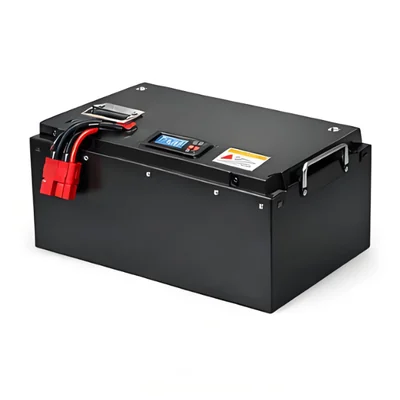
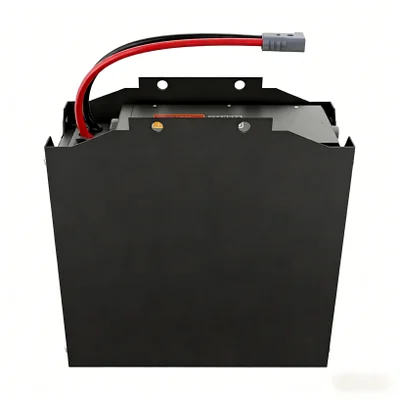
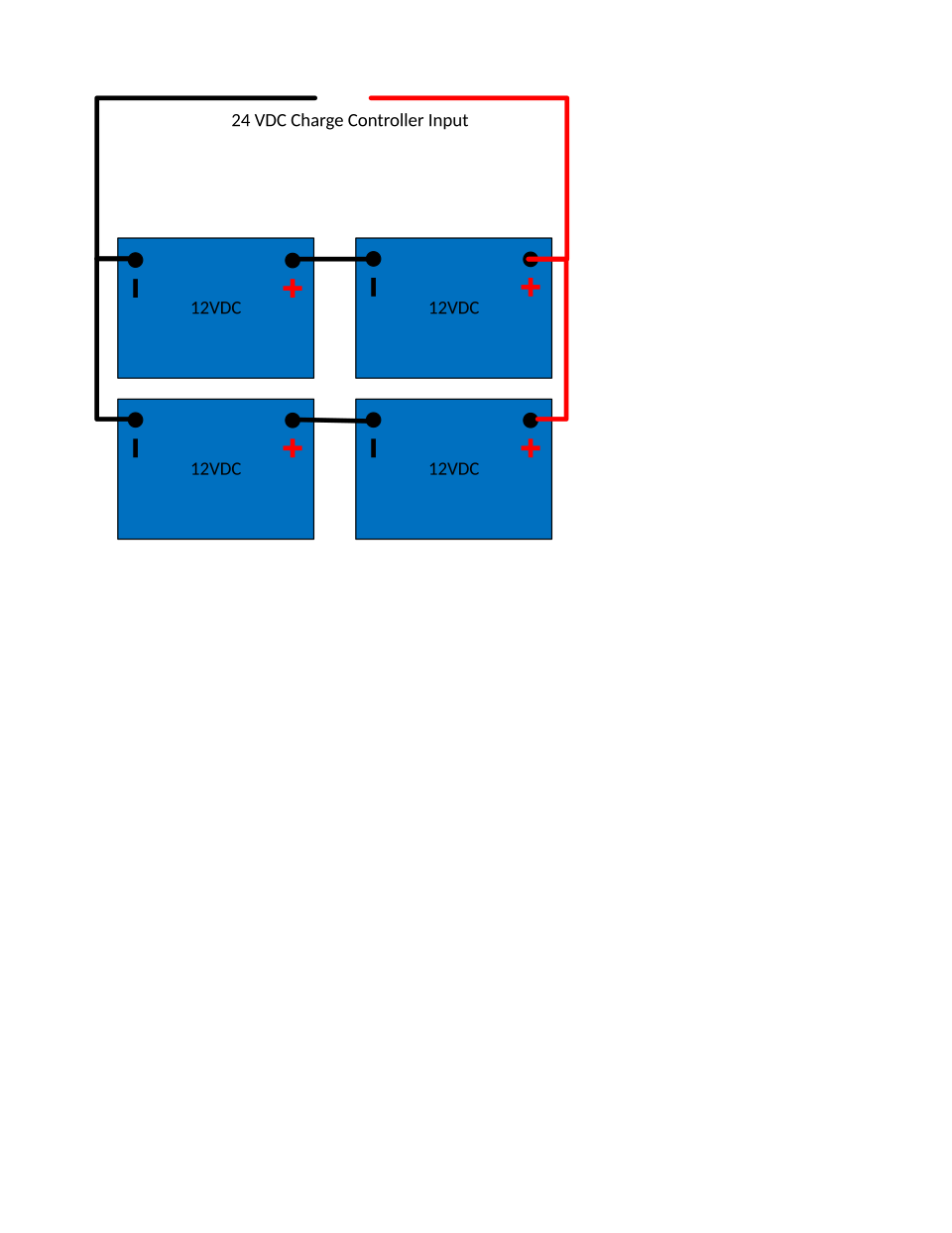
A series-parallel wiring diagram. This example is a 2S2P bank. Two 12-volt blocks in series make the 24 volts shown at the top. The build repeats that string in parallel for more capacity. The plus and minus marks label each block terminal. The 5040-watt-hour pack here uses one series string of fifteen cells at 48 volts.
A 5040-watt-hour pack is built backwards from that one number. Energy in watt-hours equals voltage times charge, so the design splits the target into a voltage and a capacity. The voltage comes from cells stacked in series. The capacity comes from the size of each cell and from cells placed in parallel when one cell falls short. A LiFePO4 pack at 48 volts reaches 5,040 watt-hours on 105 amp-hours of cells, because 48 multiplied by 105 is 5,040. The whole structure follows from that split. Fifteen cells make the voltage. Each cell carries the capacity. A management board watches over all of them, so the live string stays inside safe limits.
The design has three jobs to settle in order. The first is the voltage, set by how many cells sit in series. The second is the capacity, set by the cell and by any parallel grouping. The third is safety, handed to a management board that guards every cell. Each job leans on the one before it. The cell count fixes the voltage. The cell size fixes the energy. The board keeps the whole string inside safe limits. The order matters, since each choice sets the ground for the next. The sections below take the three in turn, then turn to the hardware that holds them together and the faults that follow from getting it wrong.
Series makes the voltage
Voltage is the first choice. It comes from the series count. A single LiFePO4 cell sits near 3.2 volts. Fifteen of them in series sit near 48 volts, because the voltages add along the string. Battery University states the rule directly, that adding cells in a series string increases the voltage. The string is the backbone of the pack. Every cell in it carries the same current. The fifteen cells share one path from end to end, so the current that leaves the last cell is the current that entered the first. One break anywhere in the string stops the whole pack.
The 48-volt figure is the nominal voltage. Nominal voltage is the average the string holds across a discharge. A full string reads about 54.75 volts, at 3.65 volts a cell. An empty string reads about 37.5 volts, at 2.5 volts a cell. The 48-volt label sits in the middle of that range. The pack lives between the full and empty figures every time it cycles. A LiFePO4 cell holds its voltage fairly flat through the centre of that swing, so the pack reads near 48 volts for the bulk of a discharge before it drops near the end.
The series count sets the charger and the wiring with it. A 48-volt pack needs a charger that climbs to 54.75 volts and stops there. The wiring carries the full string voltage, so it is rated for it. The board sets a cutoff at each end, near 3.65 volts a cell on charge and near 2.5 volts a cell on load. Those per-cell limits become the pack limits, 54.75 volts at the top and 37.5 volts at the bottom. The fifteen-cell choice lands the pack in the 48-volt class, a common size for inverters and chargers. The whole power path downstream is built around that one figure.
Series brings one demand with it. The cells in a string must stay close in voltage, because a string is only as strong as its weakest cell. A cell that drifts low drags the whole string down at that point. The string stops at its lowest cell on discharge and at its highest cell on charge, so the weak one ends the cycle for the rest. The management board answers this demand, which a later section covers. The series choice gives the voltage. It also sets up the need for balance across the string.
A full cycle runs the string from top to bottom and back. On charge the current pushes every cell up together. The board trims the fast cells near the top so the slow ones catch up. On load the current pulls every cell down together. The string stops at the first cell to reach the floor. The fifteen cells move as one, since one current runs through them all. A well-matched string reaches the top and the bottom in step. That timing gives the pack its full range, cycle after cycle.
The cell and the capacity
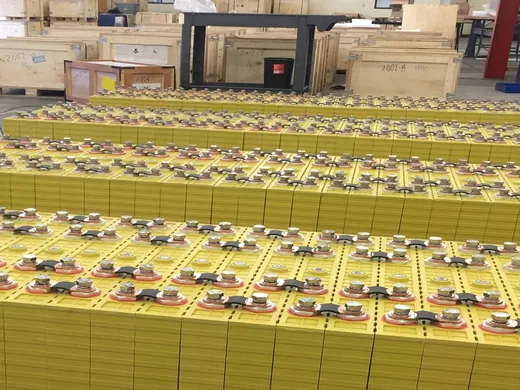
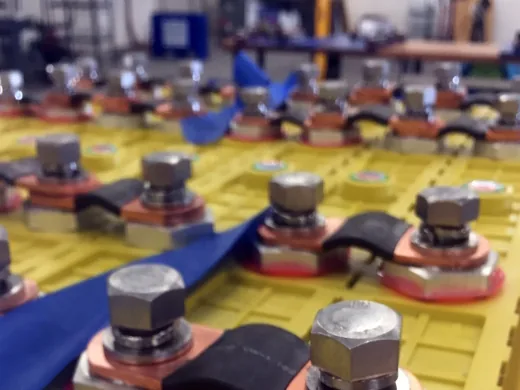
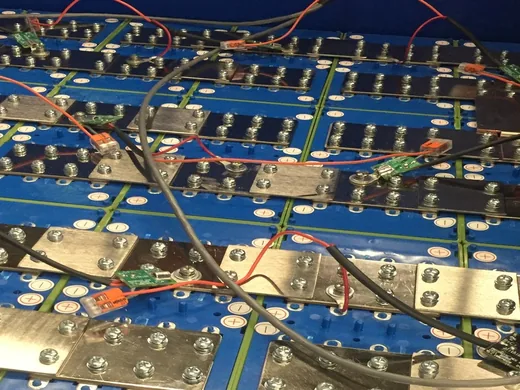
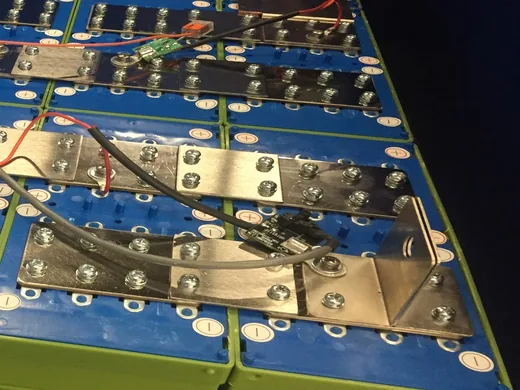
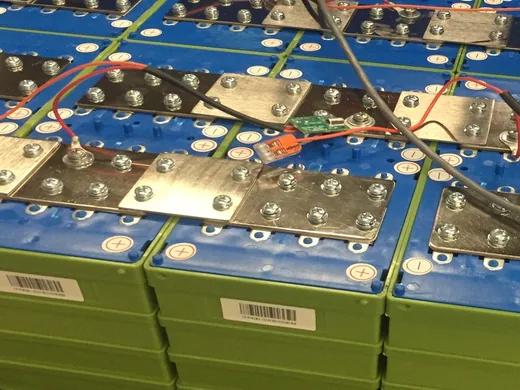
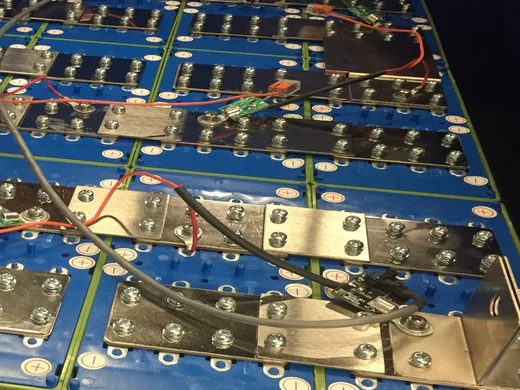
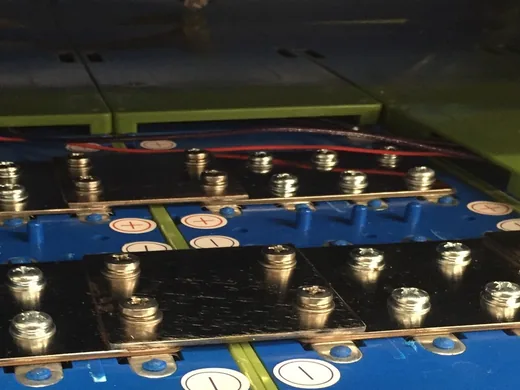
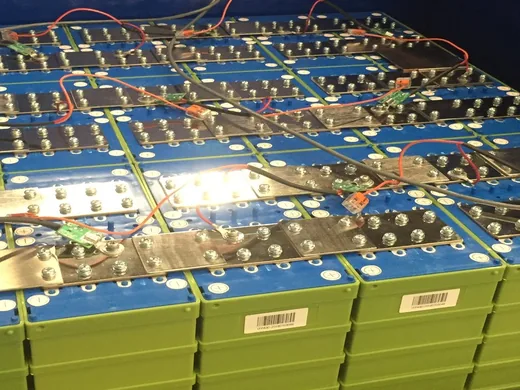
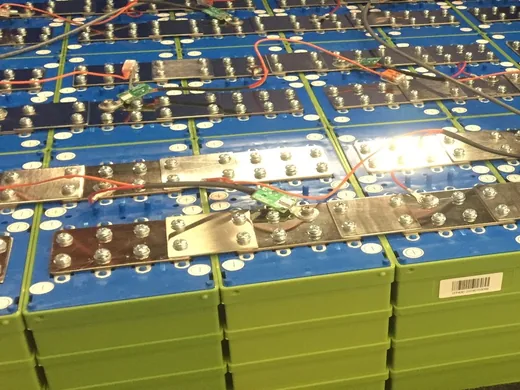
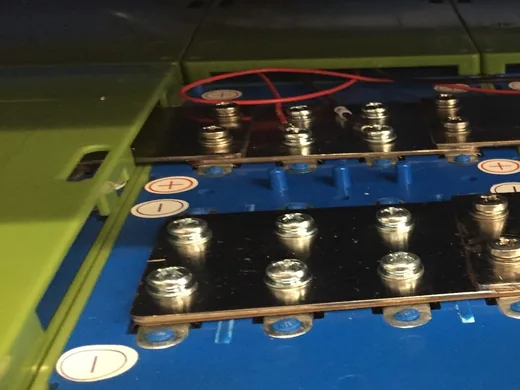
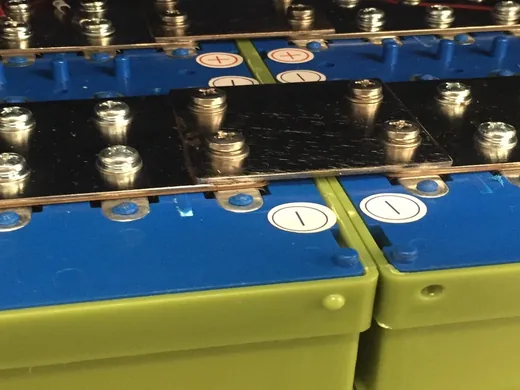
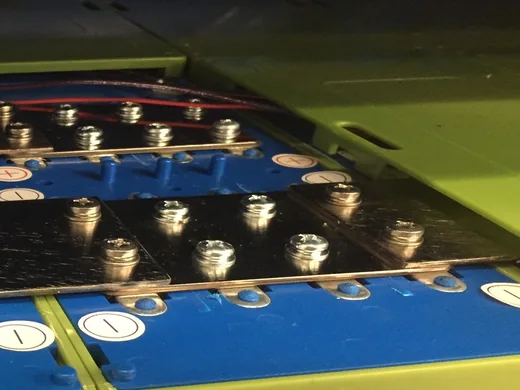
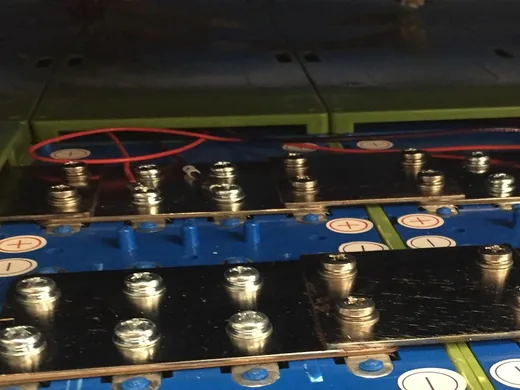
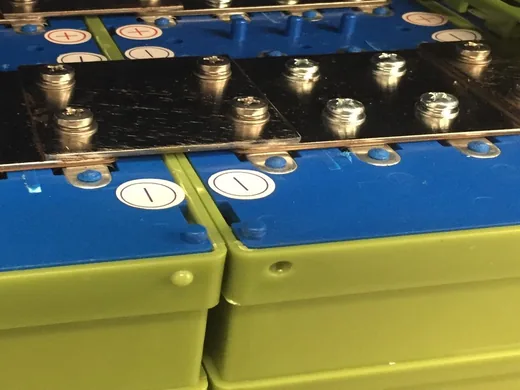
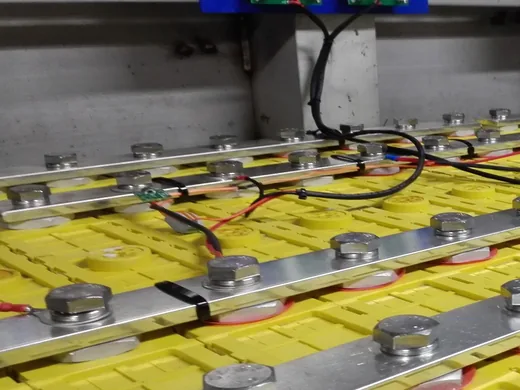
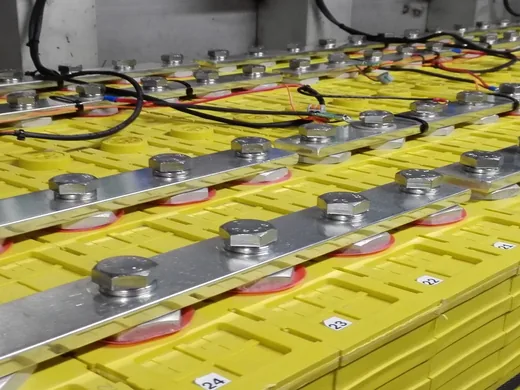
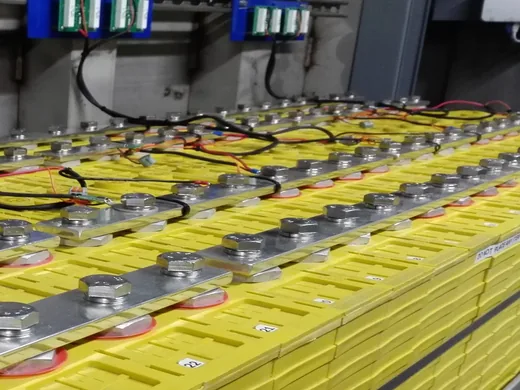
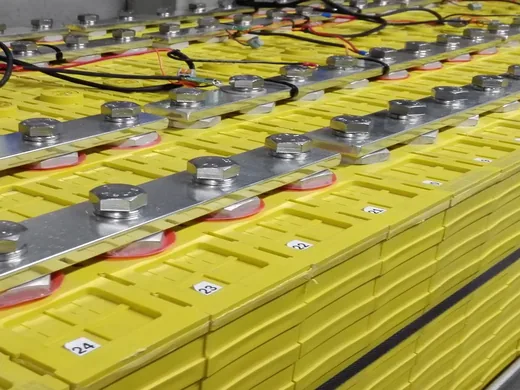
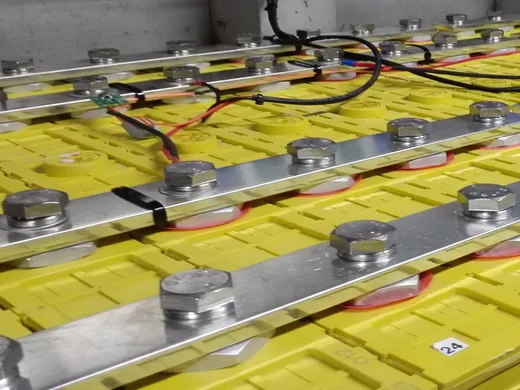
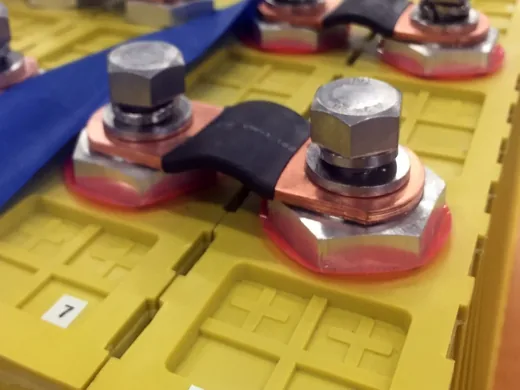
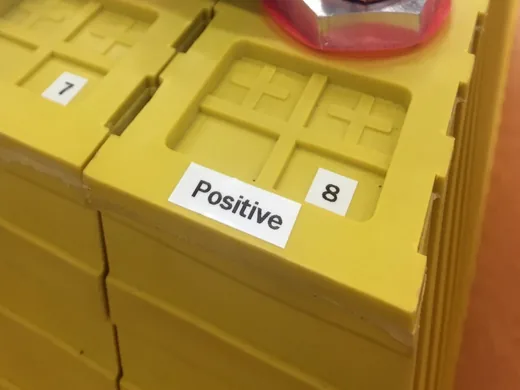
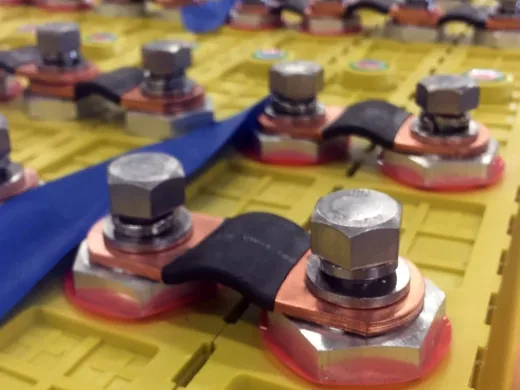
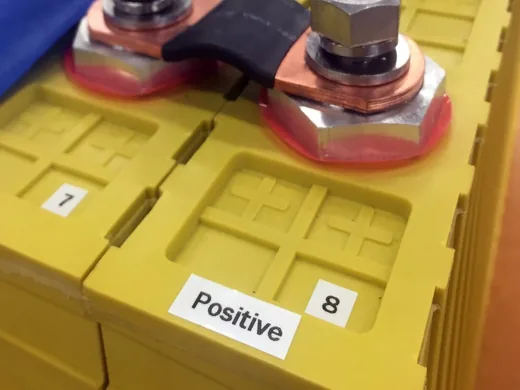
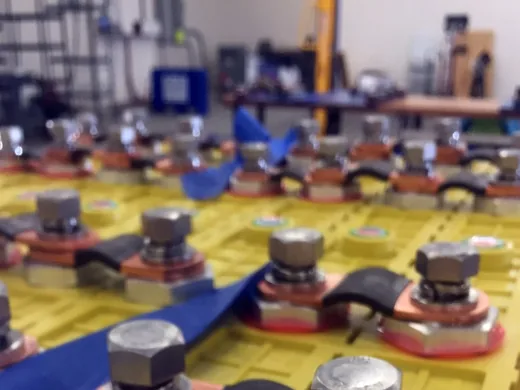
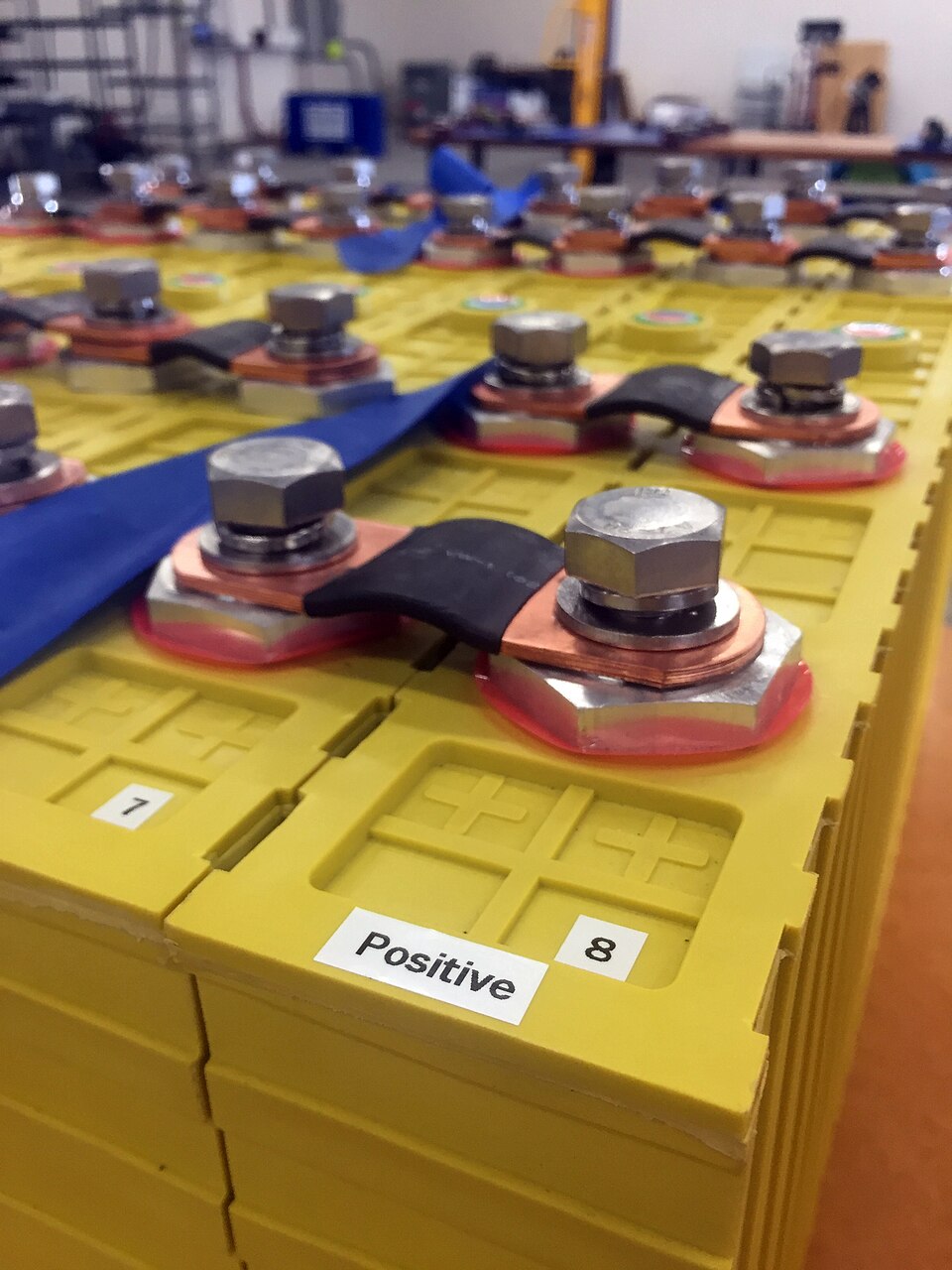
Large-format prismatic LiFePO4 cells, joined by bolted copper busbars across their terminal posts. The white Positive tag and the numbers 7 and 8 are the installer markings. The molded plus signs mark the cell terminals. These cells are rated 700 amp-hours. The worked pack uses 105-amp-hour cells of the same prismatic format. The flexible copper links are the busbars that carry the current from cell to cell.
Capacity is the second choice. It lives in the cell. The worked pack uses a prismatic LiFePO4 cell rated 105 amp-hours at 3.2 volts. Each such cell holds 336 watt-hours, because 3.2 times 105 is 336. Fifteen of them hold 5,040 watt-hours. The pack capacity equals one cell’s 105 amp-hours, since the fifteen sit in a single series string. A bigger number on the label would call for a bigger cell, or for cells set in parallel before the series wiring.
The prismatic cell suits a pack like this. It is a flat metal can with two terminal posts on top. It stacks face to face with its neighbours, which packs the energy into a small box. A pack that needs more than one cell’s capacity places cells in parallel first, then wires the parallel groups in series. A parallel group shares one voltage and adds its amp-hours together. The worked pack needs only 105 amp-hours, so one cell per series position is enough. The structure stays a single string of fifteen cells from end to end.
The cell itself has an internal structure of its own, since the pack repeats it fifteen times. Inside the metal can sits a stack of thin layers. A LiFePO4 cathode, a graphite anode, and a separator run the length of the cell, wound or folded into a flat block. A liquid electrolyte fills the gaps and carries the charge between the two electrodes. The can is sealed steel or aluminium, which holds the stack under slight pressure and keeps air and water out. Two terminal posts pass through the top, one positive and one negative, each a stud that a busbar bolts onto. A small vent sits on the top face, set to open only if the cell is badly abused, so a fault lets gas escape in a controlled way. A fill port, sealed after the electrolyte goes in, marks where the cell took its liquid. The whole can weighs near 2.1 kilograms at 105 amp-hours. The energy packed into that mass is about 336 watt-hours, near 160 watt-hours per kilogram at the cell level. The terminal posts carry the full pack current, so they are wide studs of plated metal. The case carries the cell number and the polarity marks, pressed or printed into the top. A date and a batch code sit beside the rating, so a builder can match cells from one run. The cell carries its own safety mark and its own model code, stamped on the case by the maker. Each of the fifteen cells in the pack is this same unit, built to the same size and the same rating. The pack lines them up, posts alternating positive to negative down the row, so a busbar can bridge each neighbour pair. The structure of the pack is the structure of one cell, set down fifteen times and wired end to end.
Every property of the pack starts at the cell. The cell sets the voltage step, at 3.2 volts. It sets the capacity, at 105 amp-hours. It sets the chemistry, LiFePO4, with its flat discharge and long service life. It sets the size and the mass, near 2.1 kilograms a cell. Fifteen cells bring the cell mass near 32 kilograms, before the case and the hardware go on. The cell is the unit the whole design repeats fifteen times over. The choice of cell is the first real decision in the build, since every figure flows from it.
Busbars tie the string together
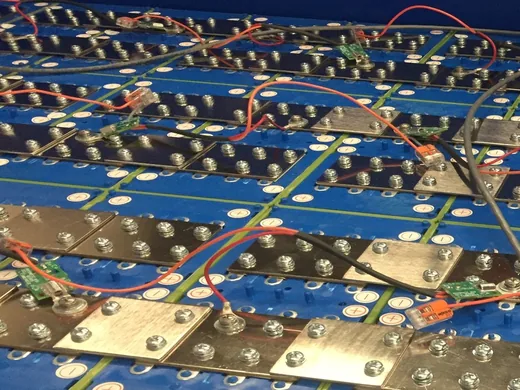
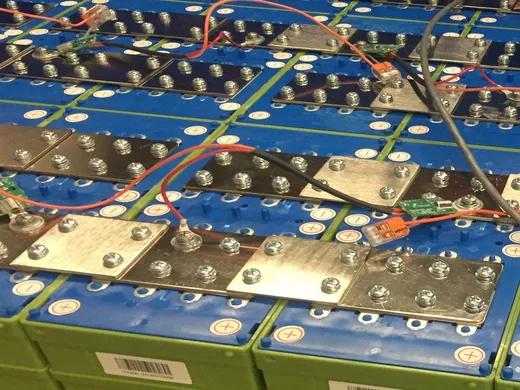
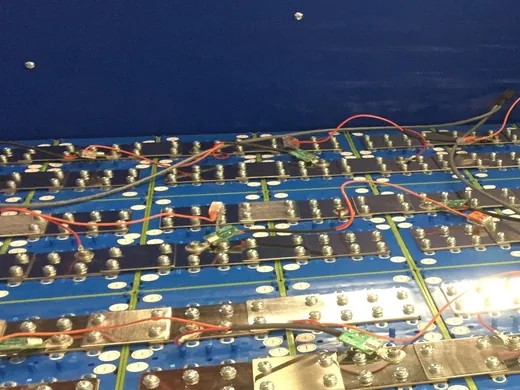
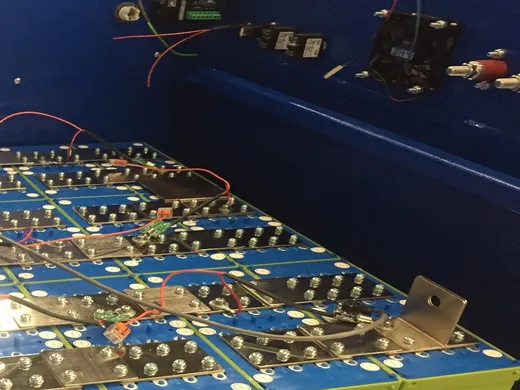
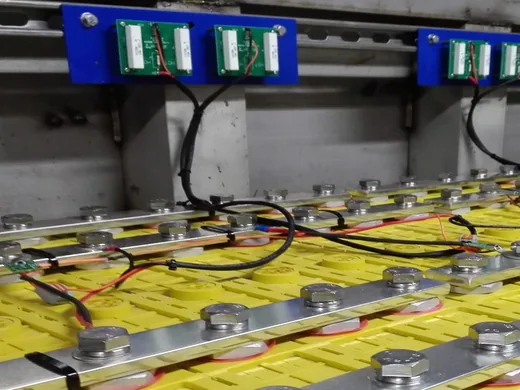
The cells become a string through their busbars. A busbar is a short bar of copper or nickel that bolts or welds across two terminal posts. It carries the full pack current from one cell to the next, so it is sized thick enough to stay cool under that load. A bolted busbar is torqued to a set figure, because a loose joint heats up and wastes energy. A welded link skips the bolt and joins the metal directly. The fifteen cells, joined post to post by fourteen busbars, become one 48-volt string. A thin sense wire taps each junction and runs back to the board, so the board reads every cell on its own. The busbars are the part a builder can see and check. A clean set of joints, each at the same torque, is the mark of a sound pack.
Holding the cells in place
A pack is more than a live circuit. It is also a mechanical structure that has to survive years of use. Prismatic cells swell a little during charge. They breathe with every cycle. A pack holds them under gentle pressure so the swelling stays even and the cells keep their shape. End plates and tie-rods, or a snug case, supply that pressure. A portable pack rides in a vehicle and takes the road with it, so the structure holds the cells against constant vibration. The mechanical design is as much a part of the pack as the wiring. A pack that holds its cells still outlasts one that lets them shift and rub.
Compression does real work for a prismatic cell. A cell held flat keeps its internal layers in even contact, because the gentle pressure presses them together. The force is a fixed figure spread across the cell face, set by the cell maker. A thin foam pad between cells takes up the small growth as the cell ages. The end plates carry that force. The tie-rods hold the plates. The whole stack becomes one rigid block that moves as a single piece.
The enclosure carries the next layer of the job. It holds the cells, the busbars, and the board in fixed positions. It keeps dust and water out, to a rated degree marked on the case. It gives the pack its mounting points and its handles. A portable pack also takes knocks, so the case absorbs shock and keeps the cells from shifting. The box is the part the user sees. It carries the whole structure inside.
Sealing and transport shape the case as much as the cells do. A gasket runs around the lid, so the rated seal keeps out dust and splashing water. The terminals pass through sealed glands, so the current leaves the box without a gap for water to follow. A portable pack meets a shipping standard for shock and vibration, so the structure holds together on a rough road. The handles and the feet are part of that structure too. A case built for the road carries the cells safely for years.
Heat has to leave the pack as well. The cells warm a little under heavy current. The heat moves out through the case and the metal inside. A pack spreads its cells so warmth does not pool in one spot. The busbars and end plates carry some heat to the case. A pack sized with margin runs cool, because a gentle current makes little heat. The cell rating and the current draw set how warm the stack gets in use.
Every cell sits in a fixed place for the life of the pack.
The board that watches the cells
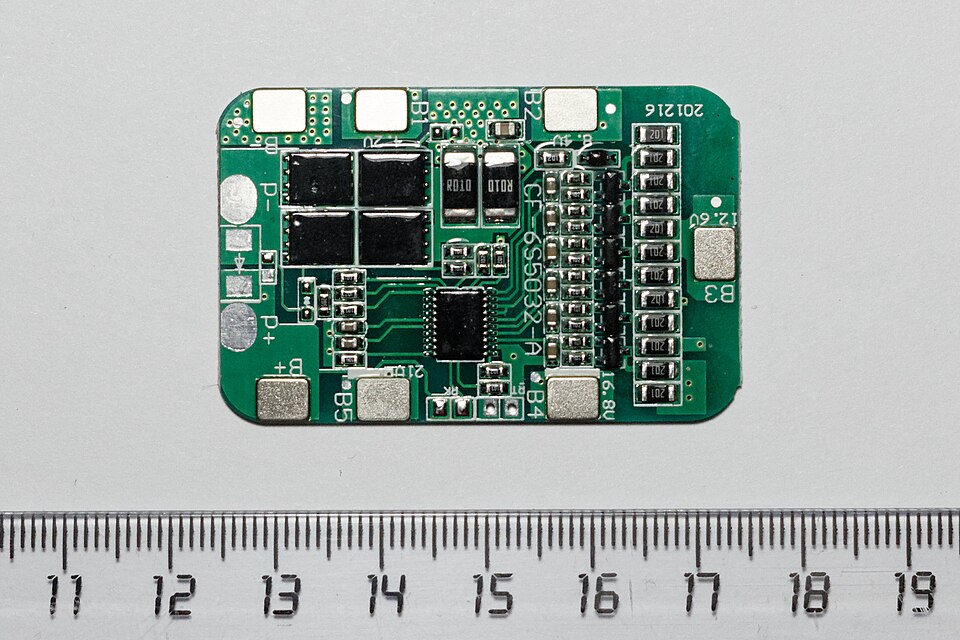
A generic battery management board, this one a six-cell unit, shown on a centimetre ruler that puts it near 8 centimetres wide. The silkscreen marking reads 6S, for six cells in series. The P-plus, P-minus, and B-minus pads are the pack terminals. The B1 to B5 pads are the balance taps that read each cell. A 48-volt pack runs a fifteen-cell version of the same board. It does the same three jobs of monitor, balance, and protect.
A management board sits at the heart of the pack. It reads the voltage of every one of the fifteen cells through a set of sense wires. It reads the current in and out through a shunt or a hall sensor. It reads the temperature at a few points in the stack. The sense wires run from each busbar junction back to the board in a small harness. The board is the part that turns fifteen loose cells into a safe pack.
The board runs three steady jobs the whole time the pack is in use. It monitors every cell voltage and the pack current. It balances the cells to the same level so none runs ahead of the rest. It protects the string by opening the circuit when a reading leaves safe limits. The three jobs run on charge and on load alike, second by second.
Protection is the board’s last word. It opens the circuit on an over-voltage, when a cell climbs too high on charge. It opens on an under-voltage, when a cell falls too low on load. It opens on over-current, on over-temperature, and on a short. The switch itself is a bank of MOSFETs, or a contactor on a larger pack, sat in the main current path. Each limit is a fixed number the board holds to. The pack shuts itself down before a cell is harmed.
The board also reports the pack to the world outside it. It tracks the charge that flows in and out, so it shows a state of charge as a percentage. It sends that figure, the cell voltages, and the temperature over a data line to a screen or an app. A reader follows the pack through the board. Only the board sees what every cell does at once.
The board draws a little power of its own to do all this. It runs on a trickle from the pack, so it stays awake to watch the cells. It sleeps deeper when the pack sits idle, so the drain stays small over a long store. A pack left for months wakes to find the board still on guard. The board is the one part that never fully switches off as long as the cells hold charge.
Nameplate and usable energy
The 5,040-watt-hour figure is the nameplate. It is the energy the cells hold between a full charge and a full discharge. The energy a user draws is a little less, because the board reserves a margin at each end of the range. The reserve keeps the cells off their hard limits and lengthens their service life. A pack delivers nearly all of its nameplate, with a slice held back for safety.
The usable figure follows from the depth of discharge the board allows. A pack set to use 95 percent of its range delivers near 4,800 watt-hours from a 5,040 nameplate. The board holds the rest in reserve. The nameplate stays the headline number on the case. The usable figure sits a little below it.
The nameplate also says what the pack will run. A 5,040-watt-hour pack feeds a 100-watt load for about 50 hours before losses. It feeds a 1,000-watt load for about 5 hours. It runs a 500-watt fridge through a long day with energy to spare. It powers a phone, a laptop, and a light for days between charges. The usable figure trims those hours by a small margin, because the inverter and the reserve each take a slice. The watt-hour number on the case is the figure a buyer plans around.
A 5040-watt-hour pack, built from fifteen 105-amp-hour LiFePO4 cells
Quantity
Figure
Cells in series
15
Cell nominal voltage
3.2 V
String nominal voltage
48.0 V
Full-charge voltage
54.75 V
Empty voltage
37.5 V
Cell capacity
105 Ah
Cell energy
336 Wh
Pack energy
5,040 Wh
Cell mass, approximate
32 kg
Reading the build from the spec
A pack’s spec sheet reveals its structure to a reader who knows the rules. The nominal voltage gives the series count, since the voltage divided by 3.2 is the number of cells. A 48-volt pack runs fifteen cells in series. The amp-hour figure gives the cell size, or the parallel grouping. The watt-hour figure is the two multiplied together. The full-charge voltage near 54.75 volts tells the charger where to stop. A reader who knows the rules needs no datasheet beyond those few figures.
The build also has a weight and a size that follow from the cells. The fifteen cells weigh near 32 kilograms together. The case, the busbars, the board, and the hardware add more on top of that. A 5,040-watt-hour LiFePO4 pack lands in a box a person can move, as a two-hand lift. The energy density of the chemistry sets the floor on the size, since the cells take the room they take. A smaller box would call for a denser cell. The wiring would stay the same.
Where a pack design goes wrong
A few faults follow from skipping the structural rules. The first is mixing cells that do not match. A string of cells at different ages or different capacities balances poorly, because the weakest cell ends every cycle for the rest. A sound pack uses cells from one batch, matched in capacity and in internal resistance. The match is set at the bench, before the busbars go on. A matched set ages together to the end of its service life.
The second is a weak current path. A thin busbar or a loose bolt heats up under load, because a small contact area wastes energy as heat. The fix is a busbar sized for the full current and a joint torqued to the figure the cell maker sets. A clean joint stays cool for the life of the pack. A hot joint is the first place a pack fails.
The third is a stack with no support. A prismatic cell left loose grows out of shape over the years, because nothing holds its layers flat. End plates and tie-rods hold the stack under set pressure, so the cells age in their proper shape. The mechanical design earns its place here. The pressure is what keeps the cell flat over the years.
The fourth is a board that cannot see the cells. A thin sense lead, a bad crimp, or a board with too few taps leaves the pack half blind, so a cell drifts without the board knowing. A fifteen-cell pack needs a fifteen-cell board and a clean sense harness. The board protects only the cells it can read. The sense wiring matters to safety as much as the switch does.
The fifth is a charger that does not match the pack. A charger set above 54.75 volts pushes the cells past their limit, so the board has to cut in to save them. A charger that stops too low leaves the pack part full. The right charger climbs to the pack limit and holds there, so the cells fill without strain. The charger is part of the pack design, since the pack limit sets what the charger must do. The two are matched at design time, long before the pack ships.
Common questions
How many cells are in a 5040Wh pack?
A 48-volt LiFePO4 pack runs fifteen cells in series, since fifteen cells at 3.2 volts make 48 volts nominal. Each cell at 105 amp-hours holds 336 watt-hours. Fifteen of them hold 5,040 watt-hours. The pack is one series string of fifteen prismatic cells.
Why is the pack 48 volts?
The voltage comes from the series count. Fifteen LiFePO4 cells at 3.2 volts each add up to 48 volts nominal along the string. The 48-volt class matches common inverters and chargers. A full string reads about 54.75 volts. An empty string reads about 37.5 volts.
What does the BMS do in the pack?
The battery management system monitors every cell voltage, the pack current, and the temperature. It balances the fifteen cells so they stay level. It opens the circuit on an over-voltage, an under-voltage, an over-current, or an over-temperature. The board turns fifteen cells into one safe 48-volt pack.
Is the usable energy the same as 5040Wh?
The usable energy sits a little below the 5,040-watt-hour nameplate, because the board reserves a margin at each end of the range. A pack set to use about 95 percent of its range delivers near 4,800 watt-hours. The reserve keeps the cells off their hard limits and lengthens their life.