AUA American Urological Association On Prostate Biopsy Ultrasound
The American Urological Association, the AUA, is the body whose guidelines American urologists across the country follow when they biopsy a prostate. Its recommendations set out when to biopsy a man, how to sample the gland, and how to keep the procedure safe. The AUA writes them with the Society of Urologic Oncology and updates them when the evidence moves. For a man having a prostate biopsy in the United States, the AUA’s guidance is the framework behind it.
The AUA and its guidance
The AUA is the professional body for urologists in the United States. It gathers the evidence on a topic, weighs it with a panel of experts, and publishes guidelines its members follow. On prostate biopsy, the relevant one is the Early Detection of Prostate Cancer guideline. It covers who to test, when to biopsy, and how to do it. The guidance carries real weight in American practice. A urologist who departs from it is expected to have a reason. The guideline is a long, referenced document, reviewed by a panel and opened to comment before it is final. It carries the weight of the field behind it. A urologist reads it as the agreed standard of American practice.
The AUA writes its prostate guidance with the Society of Urologic Oncology. The two bodies review the same evidence and agree a set of recommendations. Each recommendation carries a strength of wording, from a firm should down to a softer may. That grading tells a urologist how settled the evidence is, and how much room judgment has. The wording is read as carefully as the advice itself. The grading is the AUA’s way of being honest about the evidence behind each point. A conditional recommendation signals that the evidence is still settling. A urologist leans on it more lightly than on a firm one.
The guideline is freely available and widely read. A urologist can pull up the AUA’s recommendations at the point of care. Patient-facing summaries put the same guidance in plainer words for a man deciding about a biopsy. The AUA writes for the clinician and for the patient who wants to understand the plan.
The AUA position, and the numbers it sets
Topic
What the AUA advises
MRI before biopsy
a conditional option, to raise detection of significant cancer
Systematic cores
an extended set of about 12
Cores per MRI target
at least 2 from each suspicious lesion
Route
transrectal or transperineal, both accepted
Antibiotics
prophylaxis standard, tailored where resistance is a risk
The decision
shared between the man and his doctor
When the AUA advises a biopsy
The AUA does not send every man with a raised PSA straight to a biopsy. It frames the decision as a shared one between a man and his doctor. The guideline weighs the PSA, its trend, the man’s age, and his risk factors together. A biopsy follows when the picture points to a real risk of significant cancer. The aim is to biopsy the men who truly need it. The number on its own never settles the matter. A single high PSA is often repeated before anything follows. The AUA wants a real, held rise behind a biopsy decision. A figure that settles on a repeat may need no biopsy at all.
Shared decision-making runs through the AUA’s advice. The guideline asks the urologist to lay out the benefits and the harms of a biopsy. The man weighs them against his own values. A man who fears missing a cancer chooses differently from one who fears an unnecessary procedure. The AUA puts that choice with the man, informed by his doctor. The guideline asks for that conversation before any needle. The harms the AUA asks to be named are real ones. A biopsy can bleed, can become infected, and can turn up a harmless cancer best left untreated. A man hears these alongside the benefit of catching a dangerous cancer early.
Risk tools have a place in the AUA’s framework. The guideline supports markers and calculators that fold age and other factors into a man’s risk score. A borderline PSA can be sharpened by a risk score before the biopsy decision. These tools help sort the men who stand to benefit from a biopsy. The AUA reads them as aids to the decision, used alongside the clinical picture. The AUA does not lean on the bare PSA alone. A score that folds in age, gland size, and other markers reads the risk more truly. The guideline supports these where they help the decision.
Age and life expectancy weigh in the AUA’s view. The guideline is cautious about biopsying a man unlikely to benefit from finding a slow cancer. An older man with other serious illness may be steered away from a biopsy he would not gain from. The point is to match the biopsy to the man’s likely benefit. The AUA asks the urologist to weigh the whole man, his health, his years, and his wishes. A man’s own wishes weigh here too. The guideline asks the urologist to fit the plan to the man in front of him. A frank talk about benefit and harm is the heart of the AUA’s approach to the decision.
An MRI before the biopsy
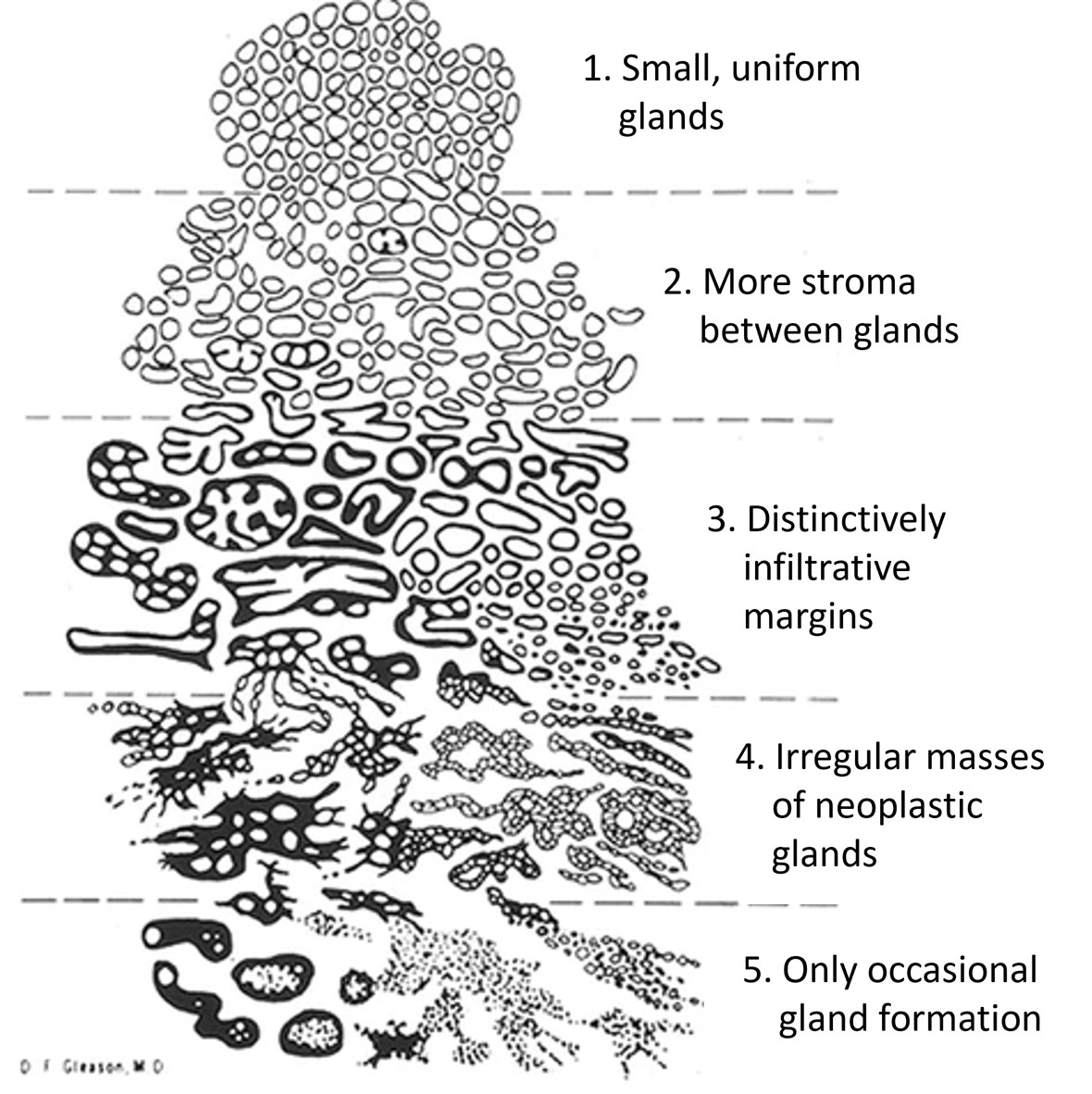
The Gleason grading of prostate cancer, the five patterns a pathologist scores from the biopsy cores. The AUA’s biopsy recommendations aim to get this grade right, since it drives the decisions that follow.
The AUA now points toward an MRI before the first biopsy. The AUA and SUO Early Detection of Prostate Cancer guideline supports a multiparametric MRI before an initial biopsy to raise the detection of significant cancer. The recommendation is a conditional one, given a moderate strength of wording. It rests on trials showing MRI-guided biopsy finds more of the cancers that matter. The AUA reads the MRI as a tool that sharpens the biopsy. The shift toward pre-biopsy MRI is recent in the AUA’s history. Earlier guidance leaned on the systematic biopsy alone. The trials behind MRI-targeted biopsy led the AUA to recommend the scan first.
The MRI changes what the AUA advises sampling. A suspicious lesion on the MRI, scored PI-RADS three or higher, calls for targeted cores into it. The AUA ties the sampling plan to the MRI result. A low score, read with the rest of the picture, helps decide whether a biopsy is needed at all. The picture from the MRI shapes the cores that follow it. The PI-RADS score is the common language the AUA leans on. A score of three or more marks a target the biopsy should sample. The score gives the urologist a clear threshold for adding targeted cores.
The AUA keeps its language measured on the MRI. The guideline supports the MRI as an option open to a urologist. A urologist without ready MRI access can still biopsy by the systematic plan. The AUA leaves room for practice that cannot get an MRI for every man. The recommendation offers guidance a urologist follows as access allows. The measured wording is deliberate. Not every American clinic has same-day access to a quality prostate MRI. The AUA writes a recommendation a community urologist can still meet. The systematic biopsy stays a sound path where no MRI is at hand.
The systematic set of cores
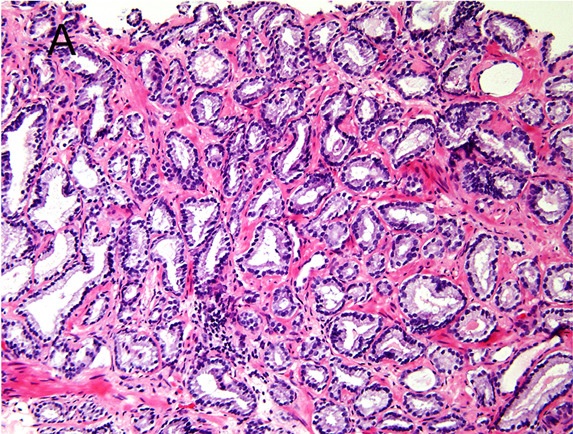
Prostate cancer under the microscope, a low Gleason pattern of small glands packed close together. A pathologist reads each biopsy core like this and scores its Gleason grade, the number the AUA’s plan turns on.
The systematic biopsy stays the backbone in the AUA’s guidance. Even with an MRI and targeted cores, the AUA supports a systematic set across the gland. The systematic cores guard against a cancer the MRI did not flag. The guideline treats the systematic biopsy as the foundation a targeted set builds on. Dropping it risks missing disease the MRI overlooked. The AUA learned this from the limits of the MRI. An MRI misses some significant cancers. A gland it marks clear can still hold a tumor. The systematic cores catch a share of those. The guideline keeps them for that reason.
The AUA backs the extended template of about twelve cores. The cores are spread from the base, the middle, and the apex on each side. The plan weights cores toward the peripheral zone and the lateral edges. The guideline follows the evidence that this extended scheme finds more cancer than the old sextant. Twelve cores is the systematic standard the AUA works from. The twelve-core figure came from trials weighing detection against the harm of more needles. Twelve sits at the balance the evidence pointed to. The AUA adopted it as the systematic baseline.
The number of cores has a ceiling in the AUA’s view. The guideline does not push routine saturation biopsies of twenty or more cores for a first sampling. More cores mainly raise the count of harmless cancers found. The gain in real disease shrinks. The AUA reserves heavier sampling for particular cases. Twelve well-placed cores answer the usual first biopsy. Saturation biopsies have their place in the AUA’s view. A man whose PSA keeps climbing after a clear first biopsy may need one. The guideline reserves the heavier sampling for that kind of case. Routine first biopsies stay at the twelve-core plan.
The AUA sets standards for how the cores are handled. Each core is labelled by the region it came from. The pathologist reads them region by region. The guideline expects the named, mapped reporting that lets a finding be placed on the gland. Careful labelling is part of the standard the AUA holds to. The mapped report is what makes the biopsy useful later. A cancer placed on the gland guides the choice of treatment. The AUA expects each core named and reported in order. A biopsy without that map gives far less to plan around.
The systematic plan reflects the AUA’s caution about missing cancer. A blind faith in the MRI alone could let a flagged-clear gland hide a tumor. The systematic cores are the safety net under the targeting. The AUA keeps both in the recommended biopsy. The whole gland is sampled, with the MRI target sampled harder. The combined plan is the AUA’s settled position. It takes targeted cores into the lesion and systematic cores across the gland. Each set guards against what the other could miss. The guideline holds both as the recommended biopsy for a man with an MRI.
Cores from the MRI target
The AUA sets a minimum for sampling an MRI target. The guideline calls for at least two needle cores from each suspicious lesion the MRI marked. Two cores give a fair sample of the target and a more reliable grade. Fewer than two risks missing or under-grading the cancer in the lesion. The AUA pairs those targeted cores with the systematic set across the gland. The minimum is a small, concrete rule inside a broader plan. The two-core minimum reflects how easily one pass can clip the edge of a lesion. A second core into the same target catches what the first might graze. The AUA sets the floor at two for that reason. More may be taken from a larger lesion.
The route the AUA accepts
The AUA accepts both routes the needle can take. A biopsy can go through the rectal wall, or through the skin of the perineum. The guideline recognizes the transperineal route for its lower infection risk. The AUA leaves the choice of route to the urologist and the setting. The AUA reviewed the evidence on both routes before settling here. It found no reason to forbid either one. The guideline leaves the choice with the urologist, read against the man and the clinic.
Infection has pushed the AUA toward the perineal route over time. The transperineal path keeps the needle out of the bowel, where the serious infections start. The guideline notes this benefit in its discussion of the route. The AUA frames the perineal route as a growing option for reducing infection. The direction of travel in the guidance points toward the perineum. The move is gradual in the AUA’s language. The guideline notes the perineal route’s benefit. Each clinic moves to it at its own pace. A clinic set up for the rectal route can keep using it under good antibiotic cover. The AUA points the direction of travel toward the perineum, at a pace each clinic sets for itself.
Antibiotics and infection
The AUA treats infection prevention as a core part of the biopsy. A transrectal biopsy carries gut bacteria toward the gland on the needle. The guideline calls for antibiotic prophylaxis before the procedure to lower that risk. Infection after a biopsy stays uncommon under good cover. The AUA holds prophylaxis as a standard step. The AUA treats a post-biopsy infection as a serious, preventable harm. A small share of biopsies once led to a dangerous bloodstream infection. Good prophylaxis brought that rate down. The guideline holds the line on it.
Resistant bacteria have sharpened the AUA’s advice on antibiotics. A rising share of gut bacteria resist the usual prophylaxis. The guideline supports tailoring the antibiotic to the man, sometimes from a rectal swab taken beforehand. Matching the drug to the bacteria lowers the chance of a breakthrough infection. The AUA reads antibiotic choice as a real safety question. The resistance problem is why a single routine antibiotic no longer satisfies the AUA. A drug that worked for years can fail against resistant bacteria. The guideline supports a swab or a targeted choice where the risk runs higher. Matching the drug to the man is the safer course.
The transperineal route is part of the AUA’s infection answer. A needle through clean skin avoids the gut bacteria a rectal needle carries. The guideline notes that this route can lower infection with less reliance on antibiotics. The AUA reads the route and the prophylaxis together as the infection plan. Both work toward the same goal of a safe biopsy. The AUA reads route and drug as two levers on one risk. A clinic can lower infection by the route it chooses and the antibiotic it gives. The guideline supports using both together to keep infection rare.
The man is told what to watch for after the biopsy. The AUA’s framework includes clear aftercare and warning signs. A fever, or trouble passing urine after a biopsy, needs prompt care. The guideline expects a man to leave knowing those signs. Safety runs from the prophylaxis through to the aftercare advice. The guideline closes the loop with what happens after. A man leaves knowing the signs of infection and who to call. Quick treatment of a brewing infection keeps it from turning serious. The AUA’s safety thinking runs from before the needle to days after it.
Repeat biopsy and what follows
The AUA gives guidance on when to biopsy again. A first biopsy that comes back clear does not always close the question. A PSA that keeps rising, or a suspicious MRI, can call for a repeat. The guideline weighs that risk against the harm of another procedure. The AUA frames the repeat as another shared decision. A clear first biopsy is reassuring. It is not the final word. A PSA that keeps climbing can mean a cancer the first set missed. The AUA weighs a repeat against the harm of another procedure, with the man’s wishes in the balance.
Active surveillance sits within the AUA’s broader prostate guidance. A low-risk cancer found on biopsy can be watched on a schedule. The man has repeat PSA tests, scans, and sometimes a repeat biopsy. The AUA supports surveillance to spare men treatment they may never need. The biopsy feeds the decision that puts a man on that path. Surveillance is the AUA’s answer to over-treatment. Many low-risk cancers grow so slowly they never threaten a man’s life. Watching them spares him surgery or radiation he may never need. The biopsy and its grade are what place a man on that careful path.
The AUA reads the biopsy as one step in a longer arc. The first biopsy gives a diagnosis and a grade. The follow-up depends on what that biopsy showed. The guideline ties the biopsy into screening, treatment, and surveillance as one framework. The AUA’s view takes in the whole pathway the biopsy sits in. Screening, the biopsy decision, the result, and what follows form one chain in the AUA’s framework. Each step feeds the next. The guideline keeps them joined into one coherent plan.
The AUA plan on a handheld probe
The AUA’s guidance shapes how a handheld biopsy is done. A slim transrectal probe run from a tablet can follow every part of the AUA plan. It takes the extended twelve-core set and guides targeted cores into an MRI lesion. The cleaning and the antibiotic cover follow the same standard. The handheld probe carries the AUA’s recommended biopsy into an ordinary clinic room. Nothing in the AUA plan needs a cart-sized machine. The recommendations speak to the sampling and the safety. A handheld probe meets them as well as a console does.
Following the AUA on a handheld machine is the same as on any other. The guideline speaks to the biopsy itself, whatever the size of the scanner. A urologist with a handheld probe samples the gland by the AUA plan, cleans the probe to standard, and covers the man against infection. The recommendations travel with the method. Good practice rests on the plan, wherever the scanner sits. A urologist on a handheld machine answers to the same guideline. The systematic set, the targeted cores, the clean probe, and the antibiotic cover are all within reach of a tablet and a probe. The AUA standard travels into clinics a console never reached. Good practice is the plan itself, whatever the scanner cost.
Common questions about the AUA guidance
What does the AUA recommend before a prostate biopsy?
A shared decision between the man and his doctor, weighing the PSA, its trend, age, and risk factors. The AUA supports an MRI before the first biopsy as a conditional option to raise detection of significant cancer. The guideline asks the urologist to lay out the benefits and harms before a man agrees to a biopsy. The number on its own does not settle the matter.
Does the AUA recommend an MRI before biopsy?
It gives the MRI a conditional recommendation. A multiparametric MRI before the first biopsy raises the detection of clinically significant cancer. When it marks a lesion at PI-RADS three or higher, targeted cores are taken from it. The AUA frames the MRI as an option for clinics that can get one.
How many cores does the AUA recommend?
The extended systematic set of about twelve cores, spread across the gland from base to apex on each side. For a lesion the MRI marked, the AUA calls for at least two needle cores from each target. The targeted cores are taken alongside the systematic set, on top of it. Twelve cores answer the usual first biopsy.
What does the AUA say about the biopsy route?
It accepts both the transrectal and the transperineal route. The guideline recognizes the transperineal path for its lower risk of serious infection. The needle on it stays clear of the bowel. The AUA leaves the choice of route to the urologist and the setting.
Does the AUA require antibiotics for a prostate biopsy?
It calls for antibiotic prophylaxis before a transrectal biopsy as a standard step. With resistant gut bacteria on the rise, the guideline supports tailoring the antibiotic to the man, sometimes from a rectal swab taken beforehand. The AUA reads the route and the antibiotics together as the plan for keeping infection rare.
About the Author
Julien Mercier
Senior R&D Engineer · Medical Ultrasound Transducer Development
Senior R&D Engineer with an M.S. in Applied Physics and over 15 years of experience in medical ultrasound transducer development, specializing in the design verification and performance testing of high-frequency imaging transducers. Currently leading the development and verification of the company’s next-generation high-frequency linear-array transducer, responsible for imaging performance evaluation and reliability analysis in preclinical testing. Brings extensive hands-on experience in piezoelectric element tuning, beamforming parameter optimization, and system-level performance testing.