An ectopic pregnancy is a pregnancy that has implanted outside the womb. It settles in the wrong place, often in a fallopian tube. Ultrasound and a pregnancy hormone test together find it. A scan reads the womb, then hunts the tube for a mass. An ectopic pregnancy is an emergency, since the tube can rupture and bleed. A scan reads the signs early, before the bleed turns dangerous.
What an ectopic pregnancy is
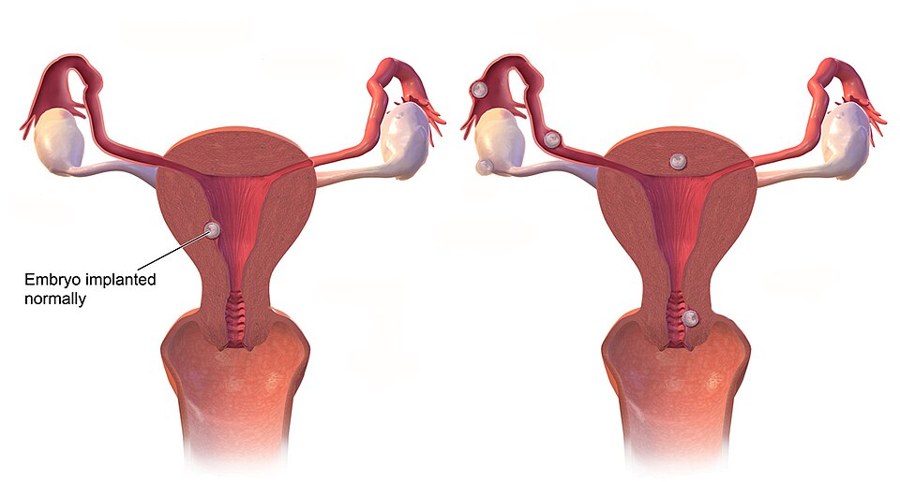
Where a pregnancy implants. On the left, an embryo settles normally in the womb. On the right, it implants in the wrong place: the tube, the ovary, or the neck of the womb. That is an ectopic pregnancy. The picture is an illustration, not an ultrasound.
A pregnancy begins when an egg is fertilised in the tube. The egg should travel down to the womb and settle in its lining. An ectopic pregnancy settles before it reaches the womb, in the wall of the tube. The tube is no place for a pregnancy to grow. The growing pregnancy has nowhere to go. The fertilised egg should reach the womb in a few days. A damaged tube slows or stops that journey. The pregnancy settles where it stalls, and a scan reads the place it has come to rest. An ectopic pregnancy often announces itself with pain low on one side. Light bleeding can come with it. A bleed into the belly can ache up to the tip of a shoulder. A faint or a dizzy spell warns of a heavy bleed.
The fallopian tube holds the great majority of ectopic pregnancies. A few settle in rarer spots. One can implant in the neck of the womb or the ovary. One can settle on the scar of an old caesarean. A scan reads each of these less common sites with care. An ectopic in the corner of the womb is the deadliest of all. It sits where the tube meets the womb, wrapped in muscle. It can grow large before it tears, and it bleeds hard when it does. A reader reads the corner of the womb with the greatest care of all. A pregnancy on a caesarean scar grows into the old wound, where it can bleed hard. A cervical ectopic sits low in the neck of the womb. A scan reads these rare sites by where the sac sits.
The danger of an ectopic pregnancy is the bleed. The pregnancy grows in a space too small for it. The tube stretches and then tears. A torn tube bleeds fast into the belly. A woman can lose a dangerous amount of blood before she knows. An ectopic pregnancy is not rare. It happens in around one in every eighty pregnancies. A woman with pain and a positive test is read for one every time. The number has climbed with the rise of tubal infection and fertility treatment. A pregnancy test comes before the scan. A woman of childbearing age with pain is tested for pregnancy first. A positive test turns a pain into a possible ectopic, and a scan follows it. The scan and the hormone test find an ectopic early, before the tube tears. An ectopic cannot move to the womb or grow into a baby, and the pregnancy has to be ended to save the woman. An ectopic pregnancy can present with little warning, and a woman can feel well until the tube tears. A reader reads for it even when the signs are mild, against the clock of a tube that can tear at any week. An ectopic pregnancy can end in more than one way. It can shed from the tube and clear on its own. It can stretch the tube until it tears. A reader reads which way an ectopic is heading. An ectopic pregnancy needs finding before it can harm, and a scan finds it while it is still small. A reader reads for it early in every pregnancy at risk. An ectopic pregnancy is read for in every early pregnancy with pain or bleeding. A scan and a test catch it before the tube tears.
Some women carry a higher risk of an ectopic pregnancy. A past infection that scarred the tubes raises it. A past ectopic raises it. A pregnancy that begins with a coil in place or after fertility treatment raises it. A scan reads a woman with these risks with extra care. A pregnancy can sit in the womb and the tube at once. This heterotopic pregnancy follows fertility treatment far more often than a natural cycle. A reader reads the tubes even when the womb holds a pregnancy in a woman who has had IVF. A woman is helped to lower her risk of another ectopic. An infection of the tubes is treated, and a partner with it. A reader reads the next pregnancy early to be safe.
The empty womb
An empty womb on the scan, in a woman whose pregnancy test is positive, sends a reader straight to the tubes.
What the scan looks for
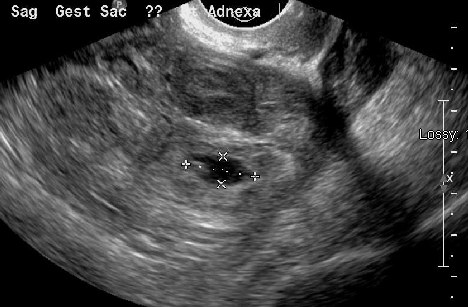
A suspected ectopic pregnancy on a transvaginal scan, a small gestational sac measured with calipers in the adnexa, beside the womb. The labels are the machine’s own.
A scan reads the womb first in a woman who might have an ectopic. An empty womb with a positive test points away from the lining. A reader then reads the tubes and the ovaries. A mass beside the ovary, sitting apart from it, is the find a reader hunts for. The transvaginal probe reads the pelvis for an ectopic best. It sits close to the womb and the tubes. A reader sweeps the womb, then each ovary, then the spaces between. The close probe draws the small early signs in fine detail. An empty womb has more than one meaning. A pregnancy may not yet show in the womb, or a miscarriage can have emptied it already. A reader reads the empty womb against the hormone and the dates. A reader finds each ovary before reading the tubes, since an ectopic sits beside the ovary. A true pregnancy sac sits deep in the lining of the womb, off to one side, and a reader reads its place and its wall for the marks of a real one. A reader reads the tubes even when they look normal, since an early ectopic can hide in a tube that reads near-normal. A reader reads the find against the woman’s dates, since an early pregnancy shows less than a later one. A clear pregnancy seen in the womb almost always rules an ectopic out. A sac with a yolk inside the womb ends the search for one. A reader reads the lining for that pregnancy first of all. A reader reads both adnexa, the womb, and the pouch on every scan, since the sign can sit on either side. A woman with a scarred tube or a past ectopic is read as high-risk from the start, and the history sharpens the reading of the scan.
What an ultrasound looks for in a suspected ectopic pregnancy
Sign
What it is
What it means
Empty womb
No pregnancy in the cavity
Look to the tubes (with a positive test)
Tubal ring or blob
A bright ring or solid mass in the tube
An ectopic until proven otherwise
Yolk sac or embryo outside the womb
A pregnancy seen in the tube
An ectopic for certain
Echogenic free fluid
Blood in the pelvis
A leaking or ruptured ectopic
Pseudosac
A fluid pool in the cavity
Mimics a true sac
An ectopic can show as a bright ring in the tube. The ring is the wall of the early pregnancy, and a reader knows it as a tubal ring. A solid blob beside the ovary is the same find in another form. A reader reads that ring or blob as an ectopic until the womb proves otherwise. Colour over a tubal ring shows a ring of flow around it. The early pregnancy draws a rich blood supply to its wall. A reader knows that ring of fire as a sign of an ectopic. The shape and the place name the ectopic on grey scale alone, and a reader adds the colour to be sure. The space behind the womb is read for blood on every scan, since blood from an ectopic runs down to settle there. A reader reads the place of the mass against the womb, since an ectopic sits outside the cavity, in the wall of the tube or beyond. A reader reads the scan to name the ectopic, the bleed, or both, the mass naming the pregnancy and the fluid naming the bleed.
The surest sign is a pregnancy seen outside the womb. A gestational sac with a yolk sac inside it, sitting in the tube, names an ectopic for certain. An embryo with a heartbeat in the tube is surer still. A reader reads that sac as proof. The ovary holds a corpus luteum in early pregnancy. It can look like a tubal ring and fool a reader. The corpus luteum sits within the ovary and moves with it, and a reader tells an ectopic from it by the gentle push that slides the ectopic apart. An interstitial ectopic shows an eccentric sac high in the corner, wrapped in a thin shell of muscle a reader reads as a warning. The lining of the womb thickens in any pregnancy. The hormone builds it wherever the pregnancy sits, so a thick lining around an empty cavity does not prove a pregnancy in the womb. A reader reads the lining with that in mind. An interstitial ectopic can show a thin line of lining running out to the sac, and a reader reads that interstitial line as a pointer to the corner. An ectopic can read as a plain complex mass beside the ovary, the blood and the pregnancy blurred into one lump. A reader reads a complex mass beside an empty womb as an ectopic until shown otherwise. The yolk sac is the first sure mark of a pregnancy. A yolk sac seen in the tube names an ectopic for certain. A reader hunts for the yolk sac to settle where the pregnancy sits. A beating heart in the tube marks a live ectopic, one that will grow and tear, and it leaves no doubt at all. A reader reads the wall of the tubal ring for its thickness, since a bold bright ring marks the early pregnancy clearly. A second ectopic is rare, and a reader sweeps the whole pelvis to be sure. The early sign can be small and easy to miss, and a careful sweep of the tube against the ovary finds it. A scan that cannot settle the question hands it to a camera. A keyhole look into the belly sees the tube directly. It names an ectopic the scan only suspected. A live ectopic with a beating heart needs care without delay, since the pregnancy is growing and the tube is at risk.
Free fluid in the pelvis is the sign of a bleed. A little clear fluid can be normal. Fluid full of echoes is blood from a leaking ectopic. A pool of blood behind the womb points to a tube that has torn. A tube full of blood swells beside the ovary. The blood of a leaking ectopic fills the tube and stretches it. A reader reads that swollen blood-filled tube as a sign of the bleed. A first scan that finds nothing is not the end. A reader scans again in a few days as the pregnancy grows, since a sign too small to see today can show by then. A repeat scan turns doubt into an answer. The blood behind the womb is read for how much there is, and a large pool points to a heavy bleed. An ectopic that has bled leaves a messy pelvis on the scan, with blood and clot filling the spaces around the tube. A reader reads through the mess for the source of the bleed. A reader reads the scan in the round for the small early ectopic. The sign can be a few millimetres across, and a reader hunts it against the bowel and the ovary. The size of the ectopic is recorded beside the signs to guide the plan. A reader reads the free fluid for its echoes as well as its amount. Fluid thick with echoes reads as blood from a bleed, and a reader reads the echoes to weigh how serious it is.
A trap waits in the womb itself. A small pool of fluid in the cavity can mimic a pregnancy sac. A reader reads that pseudosac apart from a true one by its shape and its place. A true sac sits deep and off to one side, ringed by a bright wall of its own.
The pregnancy test and the scan
The pregnancy hormone reads the scan alongside it. The level of bhCG rises week by week in a normal pregnancy. A scan should see a pregnancy in the womb once the level passes a set point. The StatPearls clinical reference holds that above that point, a womb still empty on the scan is an ectopic until proven otherwise. A reader reads the scan and the number together. An empty womb with no mass, in a woman whose test is positive, is a pregnancy of unknown location. The pregnancy is too early to place on the scan. A reader reads the hormone and repeats the scan to find it. A pregnancy of unknown location is watched until it declares itself. The set point sits around fifteen hundred to two thousand units. A pregnancy in the womb should show above it. A reader reads the number as a guide, since the scanner and the pregnancy both move the exact level. Early twins lift the hormone higher than a single pregnancy. A high level with an empty womb can mean twins as readily as an ectopic. A reader times the repeat scan to the rise of the hormone, since a scan too early sees nothing and answers nothing. The scan and the blood are read as one test, since neither alone names an early ectopic. A high level with an empty womb sends the search to the tubes at once, and a reader reads the adnexa hard when the number is high. A heterotopic pregnancy is the rare exception, more often after IVF, so a reader reads the tubes too in a woman who has had it. A reader reads the dates of the pregnancy beside the hormone, since the weeks since the last period set what a scan should see. A reader reads the woman’s story beside the numbers, the pain and the bleeding and the dates framing the scan. A clear high-resolution probe sees a pregnancy in the womb at a lower hormone level than an older machine, and a reader reads the number against the machine in the room. A woman with a possible ectopic is sent to an early pregnancy unit, which scans her and reads her hormone on a set path until the pregnancy is placed.
A single number rarely settles the question. The change in the hormone over two days tells more than any one reading. A pregnancy in the right place adds at least half again to its level in that time. A slower rise reads as a pregnancy that is failing or out of place. A low progesterone beside it points the same way. A reader reads the trend, then scans the womb again as the number climbs. A pregnancy of unknown location is followed to one of three ends: it shows in the womb, it shows in the tube, or it fades away. A falling hormone can mean a failing pregnancy in the womb or a fading ectopic, and a reader reads the scan to tell which. A high number above the line, with the womb still empty, is a warning the scan and the trend turn into an answer. A reader reads two or three levels before calling it. A reader reads the scan and the test as a pair. A scan with the hormone names an ectopic that neither could name by itself.
An emergency to manage
A ruptured ectopic is a surgical emergency. The bleed into the belly drops the blood pressure and races the pulse. A sudden severe pain and a faint point to a torn tube. A scan finds the free blood and its source in minutes, up around the liver and the spleen as well as in the pelvis. A scan that shows free blood in a shocked woman needs no second look, and a clinician moves her to theatre at once, since a torn tube bleeds with every minute. A scan reads the size and the bleed that guide the choice between the drug and the knife. A woman who has bled heavily is given blood to hold her up to theatre. A drip and a transfusion carry her there, and a scan tells the team how much blood has pooled in the belly.
A small unruptured ectopic can be treated with a drug called methotrexate, which stops the pregnancy growing. It suits one with a low hormone level and no heartbeat. The drug is given as an injection, and a woman goes home and returns for blood tests. A fall in the hormone by day seven shows it has worked, and a level that holds calls for a second dose or surgery. A pain that grows or a faint after the drug warns of a tube that has torn, and a scan reads the pelvis for a new bleed. A tiny ectopic with a low and falling hormone can be left to fade on its own, watched by the scan and the blood test. A larger ectopic or a bleed needs surgery, which takes the tube or opens it to lift the pregnancy out. A reader reads both tubes before the choice, since the other carries a woman’s fertility. Methotrexate is not for every woman, and a high hormone, a large ectopic, or a heartbeat rules it out. A reader reads the scan and the number that decide whether the drug can be used. A woman who has had an ectopic carries about a one-in-ten chance of another, and a scan early in her next pregnancy confirms it sits in the womb.
A handheld scanner reads an ectopic at the bedside. A woman with pain and a positive test is scanned where she lies, and the scan reads the womb, the tubes, and the free fluid in minutes. A handheld brings that reading to a clinic or an emergency room far from a hospital, and a bleed found early sends a woman on before the tube tears. A scan reads an ectopic the day a woman walks in with pain, and the find sets the path she takes from there, before the bleed grows. A reader reads the test and the scan as one answer to one question. A scan watches a treated ectopic to its end, as the mass shrinks and the hormone falls to zero. A woman with a certain blood type needs a protective injection after an ectopic, to guard a future pregnancy. An ectopic pregnancy is a loss as well as an emergency, and a woman is told what the scan shows in plain words, and a clinician treats the body and the woman both. An early pregnancy unit supports a woman through the loss, a nurse reading the scan with her and answering what she asks.
Common questions about an ectopic pregnancy on ultrasound
What does an ectopic pregnancy look like on ultrasound?
It shows as an empty womb with a mass beside the ovary, in a woman with a positive pregnancy test. The mass can be a bright tubal ring or a solid blob in the tube. A yolk sac or an embryo seen in the tube names it for certain. Echogenic free fluid in the pelvis points to a bleed.
Can ultrasound always find an ectopic pregnancy?
Not always at the first scan. An ectopic seen too early can leave only an empty womb to go on. A reader pairs the scan with the pregnancy hormone level and repeats both over days. A hormone level above the set point, with the womb still empty, is treated as an ectopic until proven otherwise.
What is the discriminatory zone?
It is the hormone level at which a scan should see a pregnancy in the womb. Above that level, an empty womb is a warning sign of an ectopic. Below it, the pregnancy may not yet show, so the test is repeated. The level pairs the scan with the blood test.
Is an ectopic pregnancy an emergency?
It can become one. A growing ectopic can rupture the tube and bleed fast into the belly. A woman with pain, a positive test, and free fluid on the scan is treated without delay. A handheld scan finds the bleed at the bedside in minutes.
About the Author
Julien Mercier
Senior R&D Engineer · Medical Ultrasound Transducer Development
Senior R&D Engineer with an M.S. in Applied Physics and over 15 years of experience in medical ultrasound transducer development, specializing in the design verification and performance testing of high-frequency imaging transducers. Currently leading the development and verification of the company’s next-generation high-frequency linear-array transducer, responsible for imaging performance evaluation and reliability analysis in preclinical testing. Brings extensive hands-on experience in piezoelectric element tuning, beamforming parameter optimization, and system-level performance testing.