Amniotic Fluid Index AFI Measurement Handheld Ultrasound
An amniotic fluid index measures the water a baby floats in, the pool a reader reads for what it says about the baby and the placenta. The fluid is the baby’s own, made by its kidneys and swallowed back, the amount a balance a scan can size. A handheld probe measures the pool at the bedside, the depth read in four corners of the womb and summed to a number. A pool too shallow or too deep is a sign to chase, the fluid a window onto the baby’s plumbing and the placenta that feeds it. The pool is the one thing in the womb the probe measures straight, a depth in plain centimetres.
The baby’s own water
The fluid is the baby’s water, made and renewed by the baby itself. The kidneys pass urine into the pool, the lungs add a little, the whole turned over every day. The fluid begins as water drawn from the mother across the membranes, the baby taking over its making once its kidneys come online, the water its own from the kidneys out by the later months. A baby drinks the fluid down and passes it again, the pool a river the baby keeps running, turned over again and again. The turnover is fast, the whole pool made fresh across a day or two, a baby of late pregnancy passing a cupful of urine into the water each day and swallowing the same cupful round again. The pool a reader measures is a snapshot of that river, caught at one moment. The fluid runs clear in a well baby, the pool a window the probe sees the baby through, a pool cloudy with what the baby has shed read for what it carries.
The amount sits at a balance between what is made and what is taken back. A baby making and drinking in step holds a steady pool, the fluid neither rising nor falling. A pool that has drifted from that balance is the sign of something pushing on the making or the drinking. The pool climbs from a few millilitres in the early weeks to near a litre by the middle of pregnancy, the water keeping pace with the baby it surrounds, a small pool early no alarm. The pool changes with the weeks, a reader reading the number against the age it belongs to, a figure normal at thirty weeks read with fresh eyes at forty. The pool reaches its fullest around the middle of pregnancy, near a litre of water by some weeks, the figure always read against the week it is taken in.
The fluid does many jobs at once. It cushions the baby from a knock, lets the limbs move and grow, lets the lungs draw it in and out to practise breathing, and keeps the cord from being pinched against the wall. A baby short of fluid loses those gifts one by one. The lungs grow by drawing the fluid in and breathing it out, the water a scaffold the airways build along, a baby that spent its growing in a dry womb breathing hard at birth for lungs never given the room to fill. A baby raised in too little water can come out with stiff joints too, the water it lacked written on the body it built. A reader learns the look of a healthy pool fast, the dark spaces between the baby and the wall plain at a glance, a womb crowded and short on water reading tight before any measure is taken.
Measuring it
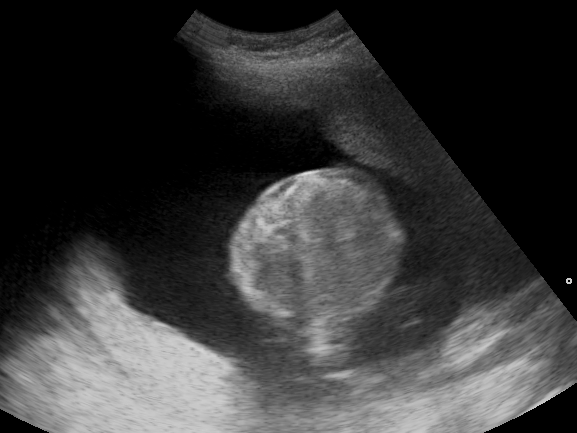
A fetus floating in its pool of amniotic fluid, the dark spaces around it the water a reader measures. The probe finds the deepest of these dark pockets and reads its depth in centimetres.
The pool is measured in one of two ways. The first divides the womb into four corners and finds the deepest clear pocket in each, the four depths added into a single number, the amniotic fluid index. A sum between five and twenty-five centimetres is the normal band, a number a reader reads against the weeks. The four corners are read with the probe held straight up and down, each pocket measured top to bottom clear of the cord and the limbs, the four added in the head or on the screen in seconds. The pocket must be clean, free of the cord and the limbs that would pad it falsely, a reader sweeping each corner for the deepest clear column and steering the cord around with a touch of colour. The probe works the womb in a set order, the upper right, the upper left, the lower right, the lower left, the deepest pocket of each found and held, a reader who keeps the order missing no corner. The old way took a sample by needle and dyed it, the dilution of the dye giving the volume in millilitres, the scan standing in for that with a measure in centimetres of depth. A reader holds the centimetres as a proxy, the true litres of water a thing only a needle could weigh.
The second way finds the single deepest pocket anywhere in the womb and measures it alone. A pocket between two and eight centimetres deep is the normal mark. This single measure is quick to take, reading the pool as well as the four-corner sum, the choice between them a matter of habit and the moment. The single pocket is favoured in a labour or a fast check, and it has gained ground for calling fewer babies low, sparing some pregnancies a needless alarm. The bands for low and high shift with the weeks, every pool read against the chart for the age it was taken at. The fluid is one of the four things a growth scan always checks, sized at every visit alongside the baby’s measurements, a reader who sizes the pool every time building the trend that catches it drifting. The reader logs the number with the date, the pool one figure in the record the next scan reads against.
Too little water
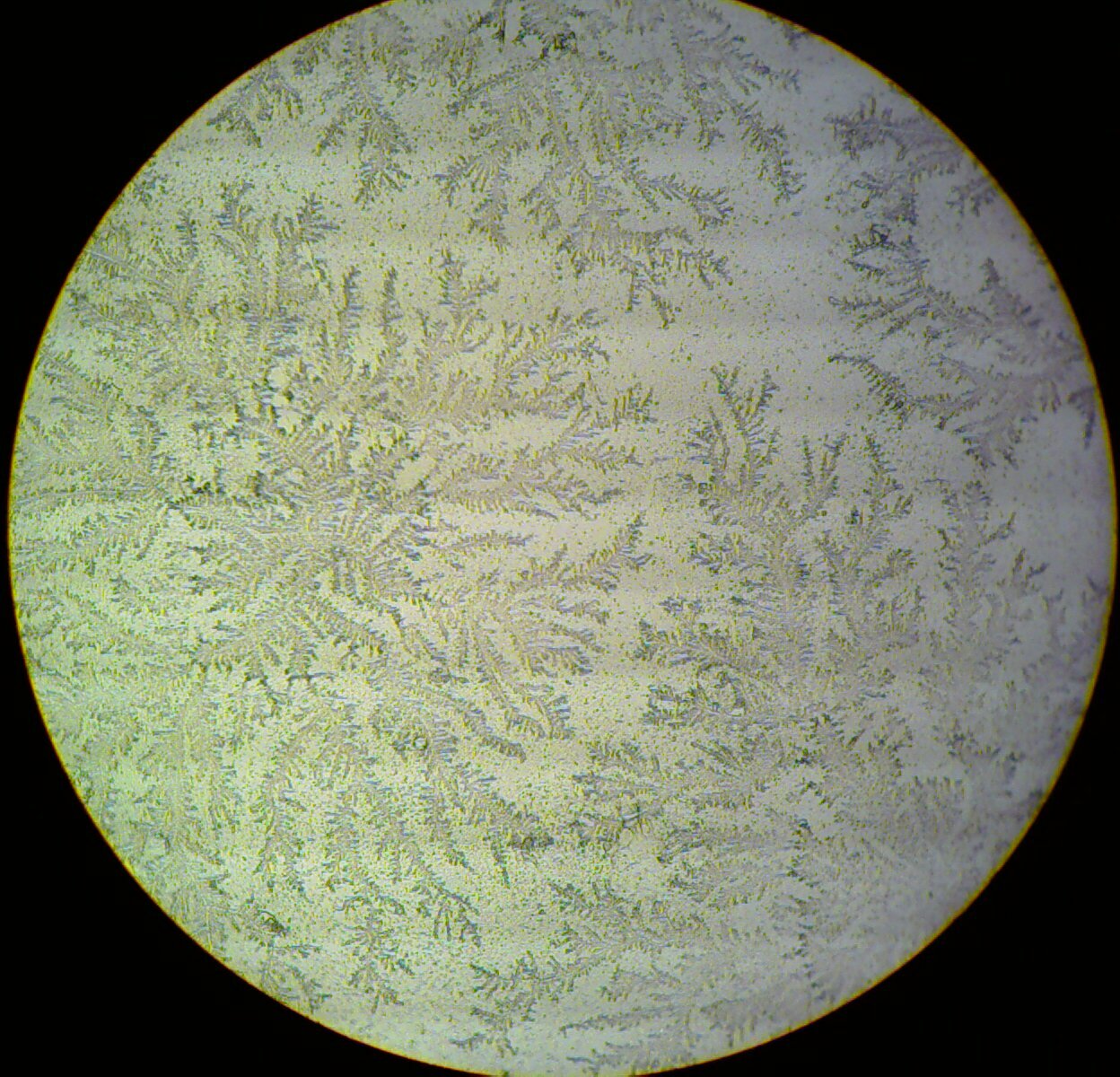
A positive fern test, the branching pattern amniotic fluid leaves when it dries on a slide. This is a microscope view, not an ultrasound, the lab’s way of confirming a leak in the membranes, one of the causes of a low pool.
Low fluid is the worry far more often than high.
A pool gone shallow, the index below five or the deepest pocket under two, is oligohydramnios, a baby short of the water it should float in. The shortfall points to one of a few places, and a reader reads the rest of the scan to find which. The first is the placenta. A placenta failing to feed a baby sends less blood to its kidneys, the kidneys passing less urine, the pool falling away. Low fluid on a small baby is the placenta’s shortfall shown in the water, a sign that rides alongside the growth and the cord flow. The second is a leak. The bag of membranes around the baby can break or weep, the fluid draining away faster than the baby can make it. A mother who reports a gush or a trickle of water, on a scan that finds the pool low, has likely sprung a leak, the membranes gone before their time. The third is the baby’s own plumbing. The kidneys make the fluid, and a baby born without working kidneys, or with the road from them blocked, makes little or none. A pool empty from early in the pregnancy, on a baby whose bladder never fills, points to the urinary tract itself. A reader reads the three apart by the company the low fluid keeps, the growth, the membranes, and the bladder each telling which door the shortfall came through. The order runs from the commonest cause to the rarest, the placenta and the growth first, the membranes next, the kidneys last and gravest. By the second half of pregnancy the pool is almost all the baby’s own urine, a low pool then speaking of the baby’s kidneys and the placenta that feeds them. The lowest pools, an index near zero, are an emergency of their own, a baby with almost no water around it in danger from the cord and the crowding, a reader who finds a near-dry womb moving fast. A low pool at term, the baby grown and ready, is read as a reason to bring it out, the dry womb a sign the placenta is near done.
Low fluid is a finding to act on. A baby in too little water is cramped, its cord at risk of a pinch, its lungs short of the fluid they need to grow. A pool that has fallen low brings the watching closer, the cause hunted and the baby followed toward a birth that may come early. Too little water is hard on a baby in ways beyond the cause, the walls pressing close, the limbs held still where they should move, the cord caught between the baby and the womb with no cushion of water to spare it. A reader reads the low pool as a danger of its own, on top of whatever drained it. A pool low on one scan is read again before it is trusted, the measure able to swing with the baby’s lie and the probe’s angle, a pool low on two careful scans a finding to believe. The cord is the part at greatest risk in a dry womb, no cushion of water to keep it off the wall, a pinch of it cutting the baby’s blood for a beat, the low pool raising the chance with every move the baby makes.
A pregnancy run past its date dries a little on its own, the placenta ageing and the pool thinning in the last weeks. A low pool on an overdue baby is one of the signs that the time has come, the pool thin in the last overdue weeks. The overdue pregnancy is watched in part for its water, the pool checked as the days run past the date, a pool fallen below the mark tipping the balance toward bringing the baby out. A leak found early, the pool low and the dates far from term, is watched for the infection that can follow, the baby held in as long as the womb stays safe and brought out at the first sign of trouble. A womb gone too dry can have fluid put back, warm salt water run in through a needle to give the cord room and a scan a clearer view, a trick used sparingly with the cause of the dryness the real thing to fix.
The reader reads low fluid never as a number alone. The same low pool can mean a strained placenta, a leak, or a kidney that never formed, the cause read from the company it keeps. The fluid is a clue read alongside the rest. A reader who reads only the number misses the story the rest of the scan tells. A baby that makes no fluid at all, its kidneys absent or its bladder never filling, is the gravest of the low-fluid babies. With no water to breathe in and out, the lungs cannot grow. A baby born from a dry womb struggles for breath from its first, a reader who finds an empty pool early looking hard at the kidneys and the bladder. A reader who finds a low pool tells the mother plainly what it may mean and what comes next, the watching set and the cause begun on, the low number the start of a plan.
Too much water
A pool gone deep, the index above twenty-five or the deepest pocket past eight, is polyhydramnios, a baby in more water than it should have. Often the cause is never found, the pool large and the baby well. The reader looks all the same, since a deep pool can carry a clue to catch. In twins sharing a placenta a reader reads the two pools for a gap between them, a wide difference the sign of blood shared unfairly, a pattern a specialist watches close. The anomalies behind a deep pool are the ones that stop a baby drinking, a gap in the gullet, a blockage high in the gut, a cleft too wide to seal a swallow, a deep pool turning a reader’s eye to the stomach and the face. The deep pool with no cause found is the commonest of all, a mild rise that comes to nothing, the baby healthy and the pool settling on its own, a reader naming it idiopathic and seeing it right itself more often than not. The deep pool is felt before it is measured, a belly that has swelled large for its dates sending a mother for a scan, the scan confirming the fluid and looking for the reason behind it.
A common cause a reader can name is the mother’s sugar. A mother with diabetes runs a high sugar through to the baby, the baby passing more urine and filling the pool deeper. A high sugar crossing to the baby makes it pass more water, the pool filling deeper week by week, a blood test on the mother often finding the cause a deep pool flagged, the sugar brought down and the pool settling once it is. A pool that has risen fast worries a reader more than one that crept up slowly, the speed of the rise a sign of how much is pushing on it, a deep pool that swells over days sending a reader looking harder. A baby in a deep pool has room to turn late in pregnancy, more likely to lie sideways or breech when the labour comes, a reader noting the lie on a deep pool. The water can stain dark when a baby passes its first stool early, the cloudy pool a sign a reader notes near term.
The other cause is a baby that cannot drink the fluid back. A baby with a block in its gullet or its gut, or a brain that cannot drive the swallow, takes in less than it makes, the pool left to rise. A deep pool on a baby points a reader to the swallow, a scan of the gut and the face often following. A baby’s stomach reads as a small dark bubble of swallowed fluid, low on the left, a bubble that never fills on a deep pool pointing to a gullet that does not pass the fluid down, a clue to chase. A block in the gullet, a gut that cannot pass the fluid on, a brain too quiet to drive the swallow, each leaves the water to gather, a deep pool the first sign of any of them. The cause of a deep pool, where one shows, is one to find, a treatable sugar caught or an anomaly named before the birth, a reader who chases the reason serving the baby past the measure itself. A pool too deep to bear can be drawn down by needle, some of the water taken off to ease the womb and hold off an early labour, the cause behind the pool still hunted, the pressure eased the meanwhile.
A deep pool is read for its cause and its load. A pool stretched large strains the womb, bringing on an early labour or a cord that washes down ahead of the baby when the waters break. The reader names the cause where one shows and watches the load whatever the cause. A deep pool eased and watched usually ends in a healthy birth, the water no more than a sign that asked to be checked. The deep pool asks for a look at the baby and the mother both, the water a sign that two paths lead away from. The womb stretched full can start a labour early. The great volume of water, when the bag breaks, can sweep the cord down ahead of the baby, a danger a reader watches a deep pool for even where no cause shows. The pool is one of the readings a wellbeing score leans on, the deepest pocket scored alongside the baby’s moving and breathing, a low pool dropping that score.
What the number cannot say
The number is a guide, never the whole story. A pool at the edge of the band, a little low or a little high, sits in a grey zone a single scan cannot settle, read again before it is acted on. The measure also swings with how the probe is held and where the baby lies, a careful reader taking it the same way each time. The fluid is read for its trend and its company, the number one line in a longer read, the pool one finding among the growth, the flow, and the baby’s own look. A single odd number proves little, the pool best read across scans for the way it moves, a pool falling scan on scan a finding the trend makes where one low reading alone might mislead. Two readers measuring the same pool can land a centimetre or two apart, the measure a soft one a reader reads with that slack in mind. The number is taken the same way each time or it cannot be trusted, the probe held upright and the deepest clear pocket found clear of the cord, a reader who measures sloppily reading a different pool each visit and losing the trend in the noise.
On a handheld
The fluid is made for a handheld to read. The dark pockets of fluid show plainly on the screen, easy to find and to measure, the four-corner sum or the deepest pocket read in a couple of minutes. A clinician who wonders about a baby’s water sizes the pool at the bedside, the answer there in the same visit. The fluid asks nothing fine of a probe, only a clear view of the dark pools around the baby, a pocket scanner finding them as well as any cart. The fluid check is the quickest of the obstetric measures, folded into any scan with the pool sized as a matter of course, the figure logged to set a mark the next scan is read against. In labour the pool matters for the cord above all, a baby in little water the likelier to pinch its cord with each squeeze, the trace watched the closer for it.
The reach carries the measure to where it is needed. A mother whose belly measures small or large is scanned where she lives, the pool sized and the worry answered without a journey. The number saves to the phone, the pool filmed, ready for a specialist to read from afar. A mother far from a hospital, her waters maybe broken, learns in minutes whether the pool has run low, the answer guiding whether she waits or travels, the fluid read at the bedside turning a frightening leak into a managed one. A handheld brings the fluid check to the bedside, no scanning room and no wait. A pocket scanner sizes the pool of fluid at any bedside, the check folded into the minutes a growth scan already takes.
Common questions about amniotic fluid measurement
What is a normal amniotic fluid index?
An amniotic fluid index between five and twenty-five centimetres is normal. The index is the sum of the deepest pocket of fluid in each of the four corners of the womb. A single deepest pocket of two to eight centimetres is the other normal measure, read in place of the four-corner sum.
What does low amniotic fluid mean?
Low fluid, called oligohydramnios, is an index below five or a deepest pocket under two centimetres. It points to a placenta failing to feed the baby, a leak in the bag of membranes, or a problem with the baby’s own kidneys. A reader reads the rest of the scan to find which.
What causes too much amniotic fluid?
Too much fluid, called polyhydramnios, is an index above twenty-five or a pocket past eight centimetres. The cause is often never found, the pool large and the baby well. When a cause shows, it is often the mother’s diabetes or a baby that cannot swallow the fluid back.
How is amniotic fluid measured?
The probe finds the dark pockets of fluid around the baby. One way sums the deepest pocket in each of four corners into the amniotic fluid index. The other measures the single deepest pocket anywhere in the womb. Both take a couple of minutes and read the pool well.
Can a handheld ultrasound measure amniotic fluid?
Yes, and it suits the task well. The large dark pockets of fluid are easy to find, and the measure takes only a couple of minutes. A clinician sizes the pool at the bedside, which brings the fluid check to mothers far from a scanning centre.
About the Author
Julien Mercier
Senior R&D Engineer · Medical Ultrasound Transducer Development
Senior R&D Engineer with an M.S. in Applied Physics and over 15 years of experience in medical ultrasound transducer development, specializing in the design verification and performance testing of high-frequency imaging transducers. Currently leading the development and verification of the company’s next-generation high-frequency linear-array transducer, responsible for imaging performance evaluation and reliability analysis in preclinical testing. Brings extensive hands-on experience in piezoelectric element tuning, beamforming parameter optimization, and system-level performance testing.