Automated B Lines Counter Comparison Handheld Ultrasound Devices
Counting bright lines on a lung scan sounds simple until two clinicians count the same clip and reach different numbers. One sees five, another seven, a third calls the field confluent and stops counting. The number that drives a treatment wobbles with the eye that reads it. Software now offers to count instead, watching the same clip and returning a figure that does not change with who is holding the probe. The promise is a steady number where a shaky one used to be, the same answer for every reader on every shift.
A machine counts the same clip the same way.
The appeal is plain in a field built on a count. If a B-line score guides how much fluid to pull off a patient, the score had better mean the same thing on Tuesday as it did on Monday, in one clinician’s hands as in another’s. Automation reaches for that consistency. The reach repays a close look before the number is trusted.
The trouble with counting by eye
A B-line count is a soft number dressed as a hard one. Where one reader draws the line between three beams and four, another draws it elsewhere. A field thick with merging beams defeats a clean count entirely, since the lines blur into a sheet that defeats any honest tally. Fatigue, haste, and the press of a busy department all nudge the figure. Two careful clinicians scoring the same lung can land a point or two apart, enough to shift a borderline patient from dry to wet on paper, from watched to treated in fact.
The trend matters more than any single count, and the trend is where the wobble hurts. A patient scored by one nurse on admission and another at midnight cannot be compared cleanly. The drift in the reading hides the drift in the lung, and the lung is the thing the clinician needs to follow.
What an automated counter does
An automated counter watches the live image and marks the B-lines for the clinician. It finds the pleural line, then hunts the bright vertical beams that drop from it, tallying them across the field or measuring how much of the pleural line they cover. Some tools return a plain count of separate lines. Others return a percentage, the share of the field lit by confluent beams, a measure that holds up where discrete counting breaks down. The number lands on the screen the moment the clip ends, before the probe has left the chest. On many tools the count appears as a coloured overlay laid over the live image, the detected beams highlighted as they are tallied, letting the clinician see what the machine chose to count and reject a clip that has caught the wrong thing.
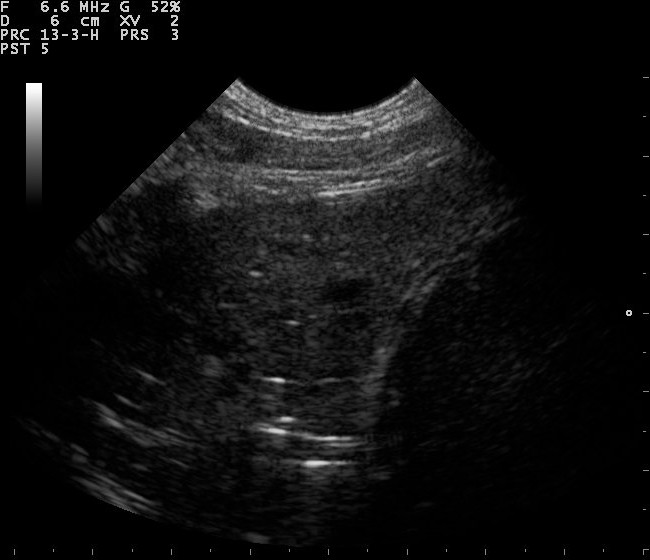
A wet lung on ultrasound: the B-lines an automated counter is built to tally. Wikimedia Commons, CC BY-SA 3.0
Inside the counter
The algorithm reads pixels, not lungs. Understanding that gap is the key to trusting it well. It begins by finding the pleural line, the brightest near-horizontal stripe in the upper image, the anchor everything else hangs from. From that line it looks downward for columns of bright pixels that run to the bottom of the screen without fading, the signature of a B-line. It measures their width, their brightness, how far they reach, sometimes how much they sway with the breathing. A discrete counter tallies how many separate columns it finds. An area-based tool instead measures what fraction of the pleural line has a beam hanging beneath it, a number that keeps climbing smoothly as scattered beams merge into a sheet, where a plain count would stall. Either way, the machine is matching a shape, never reading a disease. That shape-matching is its strength and its weakness in one. It never tires, never rounds up at the end of a long shift, never argues with the last reader. Fed a clean clip, it returns the same figure every time. Fed a poor one, it returns a figure just as confidently. That confidence is the danger. A rib shadow can split a field oddly. A reverberation that is no true B-line can be tallied as one. Motion from a restless patient can smear the image into false beams. The algorithm has no way to know the clip was bad; it counts what it is shown and prints a number that looks as solid as any other. Garbage in, garbage out, dressed in the authority of a clean decimal. The deeper limit is that the counter sees a single field through a keyhole. It knows nothing of the pattern across the chest, the smoothness of the pleural line, the patient gasping on the trolley beside it. It hands back a count. The meaning of that count stays the clinician’s to supply.
The gift it gives
Consistency is the real prize. The same clip scored by the machine returns the same number to every clinician, on every shift, without the drift a human count carries from reader to reader. That steadiness earns its value where the count is followed over time. A heart-failure patient scanned daily, a dialysis patient scanned through a single session: the trend in their score guides the treatment, and a trend is only as honest as the steadiness of each point along it. A reading that holds steady from one operator to the next turns a scattered set of guesses into a line that can be plotted, the lung drying or flooding traced as a curve instead of argued over as a clash of opinions.
A steady number makes a trend you can trust.
A number that does not travel
A score from one device does not carry to another, and forgetting that breeds quiet error. One maker’s tool counts discrete beams. Another measures the lit fraction of the pleural line. A third folds brightness and width into its figure by its own recipe. The same wet lung, scanned on two brands, returns two different numbers, each correct by its own rule, neither translating into the other’s scale.
The handheld field is a scatter of approaches. A whole-body single-probe device with an app-based counter scores one way. A cart-based machine with its own built-in algorithm scores another. The figure is meaningful inside one system, against that system’s own earlier readings, and close to meaningless carried across the gap between brands. A clinic that mixes devices and pools their scores into one chart builds a trend out of mismatched rulers, a line that looks smooth and tells little.
A compact handheld ultrasound device. Counters differ between such devices; a score does not carry across brands. Wikimedia Commons, public domain
Compare a patient to themselves, on one machine.
The rule that follows is plain. A patient followed over days is scanned on the same device each time, their trend read against their own baseline. A number quoted from another clinic, taken on another brand, is a rough hint at best. The scale lives inside the tool that drew it, and does not come along when the number is copied out.
Garbage in, garbage out
Automation does not rescue a bad scan. It launders one. The counter needs a clean clip at the right spot, the pleural line clear and square, the gain set true, the field free of rib shadow. Hand it that, the number is sound. Hand it a tilted, shadowed, over-gained clip, and it still returns a confident figure, now confidently wrong. The skill of acquiring the image matters as much with the machine counting as it ever did without it. If anything, the count raises the stakes of a sloppy clip, since a clean number invites a trust that a blurry picture alone never would.
The false precision is the trap. A hand-counted number wears its uncertainty on its face; a machine number hides the same uncertainty behind a clean digit. A clinician who trusts the digit over the picture trusts the wrong thing, fooled by the polish of the output into a confidence the clip never earned.
Where it shines and where it slips
The tool earns its keep in a few clear places. It steadies the hand of a novice, handing them a number where their own count would waver. It standardises scoring across a department. A score then reads the same from any clinician who runs it. It tracks a trend over time without the human drift. In these, it does real work.
It slips where the image turns hard. A confluent white lung defeats a discrete counter, the beams too merged to separate into a tally. A poor window, a restless patient, a heavy body: each feeds the algorithm the kind of clip it reads worst. The edge cases that need judgement hardest are the ones the machine handles worst of all.
It is surest exactly where a careful human already was.
The pattern of help is consistent. The machine adds the largest gain where the reading is easy and the value lies in speed or steadiness. It adds little, and risks much, where the reading is hard and judgement carries the day. A clinician who knows that boundary uses the tool for what it does well and sets it aside for what it does not.
Used inside its strengths, the counter is a steady second eye. Pushed past them, into the confluent and the unclear, it becomes a confident voice that can be flatly wrong. The art is knowing which lung is which before trusting the number that comes back.
The white-lung ceiling
Confluent flooding sets a hard ceiling on a count. When the beams merge into a sheet, a discrete counter saturates, returning a number that no longer climbs as the lung worsens beneath it. The sickest lung and a merely wet one can read the same on a tally that has hit its limit. Area-based tools handle this better, reading the lit fraction in place of the count, a figure that keeps rising as the white spreads across the field.
What it cannot supply
The counter gives a number and nothing else. It does not read the pleural line for the ragged thickening of fibrosis. It does not weigh the even spread of a failing heart against the patchy spread of pneumonia. It does not see the patient gasping, the pressure falling, the history that turns a count into a diagnosis. It hands over a figure stripped of the context that gives the figure its meaning. Two patients can carry the same count and need opposite care, the one drying out under a diuretic the other would be harmed by. The number alone cannot tell them apart.
The number is an input, never an answer.
Learning to lean on it
The tool is learned twice over. First the count itself, trusting the machine to tally a clean field faster and steadier than the eye. Then the harder lesson, knowing when to override it: the confluent lung, the poor clip, the pattern that whispers fibrosis where the count shouts edema. A clinician who leans on the number in the easy case and overrules it in the hard one has truly learned the tool.
Trust the count; never surrender the judgement.
What it changed
Before automation, a B-line count was a private number, true to the reader who made it and hard to hand on. Two clinicians, two counts, no clean way to compare a patient across a day or a ward. The machine made the count public, the same figure for everyone, steady enough to trend and to share between a team. That alone changes how a wet lung is followed through a treatment, from a string of private guesses into one running line. A score handed from a day nurse to a night nurse now means the same thing in both their hands, a small change that quietly steadies every decision built on it.
The number grew more reliable; the reading stayed human. The counter took the drudgery and the drift out of the tally, leaving the clinician the part that always mattered, the pattern and the patient. Used that way, automation sharpens the count without pretending to replace the judgement that reads it. The tool is at its best when it disappears into the workflow, a faster tally feeding a reading that stays wholly the clinician’s own.
About the Author
Julien Mercier
Senior R&D Engineer · Medical Ultrasound Transducer Development
Senior R&D Engineer with an M.S. in Applied Physics and over 15 years of experience in medical ultrasound transducer development, specializing in the design verification and performance testing of high-frequency imaging transducers. Currently leading the development and verification of the company’s next-generation high-frequency linear-array transducer, responsible for imaging performance evaluation and reliability analysis in preclinical testing. Brings extensive hands-on experience in piezoelectric element tuning, beamforming parameter optimization, and system-level performance testing.