Ultrasound Wand Miniaturization Technology Trend in 2026
The word people reach for has changed. A decade ago a clinician said probe, or transducer. Now they often say wand. The new word tracks a new object. A wand is small. It is single-handed. It holds everything it needs. Through 2026 the ultrasound wand keeps shrinking. The open question is no longer whether it can get smaller. The question is what each gram removed costs the picture it makes.
Smaller is not free.
Every reduction in size pulls against image quality, battery life, heat. The engineering of a 2026 wand is the art of giving up as little as possible on each front while the package keeps tightening. To read the trend is to read those trade-offs. The marketing word hides them. The buyer pays for them.
What counts as a wand now
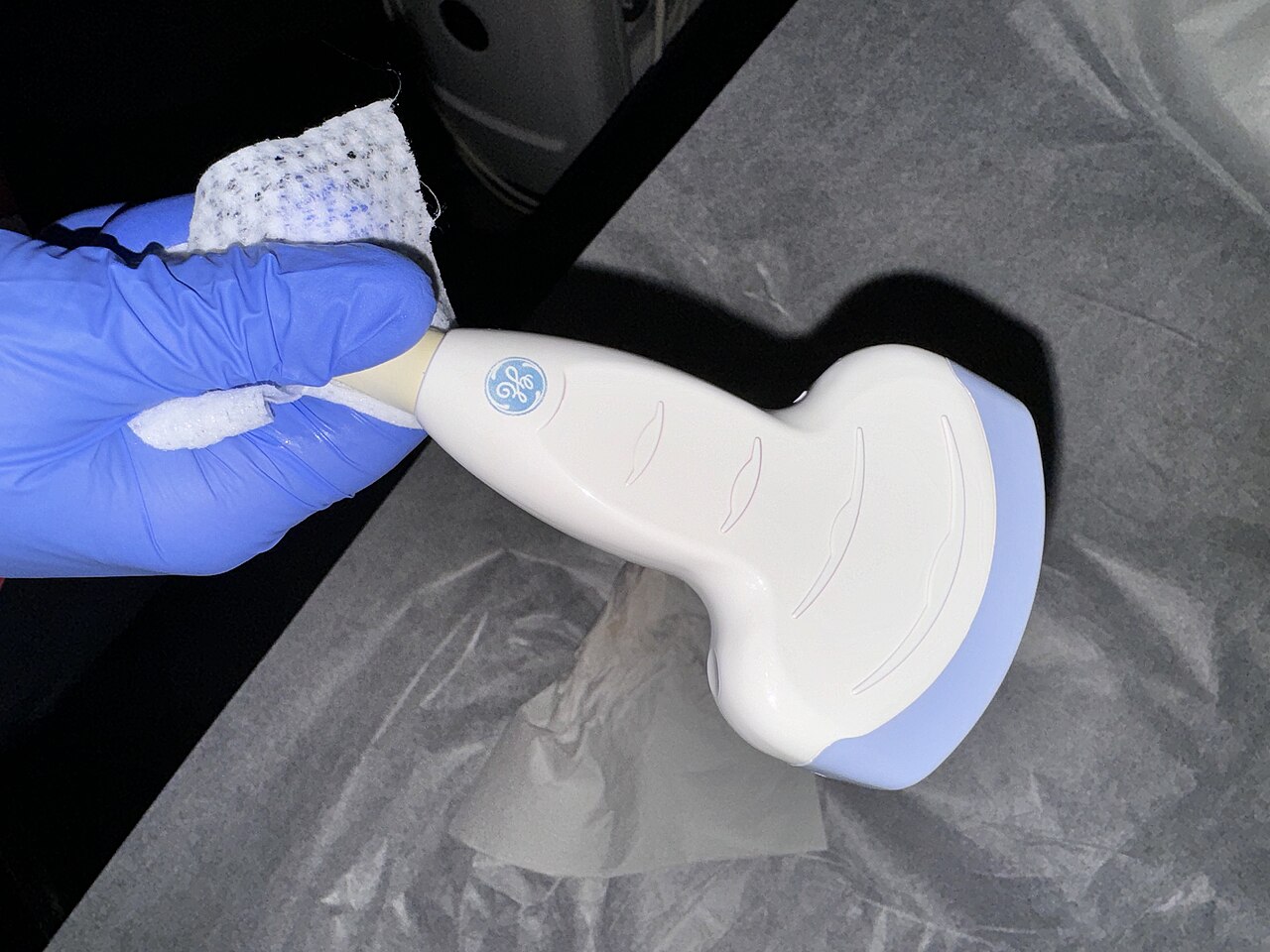
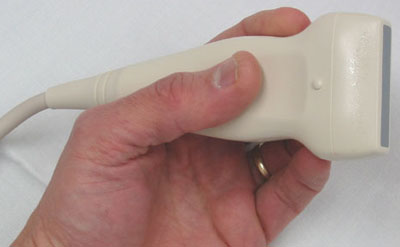
A handheld linear-array probe, scan head and electronics folded into one piece. (Harrison Keely, CC BY 4.0, via Wikimedia Commons)
A wand, in the loose sense the market uses, is a handheld scanner. Its whole imaging chain lives in the part the clinician holds. There is no separate box. There is no cart. Four parts share one housing. The transducer sends and receives sound. The electronics shape and time the beam. The processor turns echoes into a picture. A battery powers the lot. The housing is the size of an electric razor. The screen is borrowed from a phone or a tablet.
That definition sets the budget. Everything has to fit, cool itself, run on a charge, inside a volume a hand can close around.
Why the wand could shrink: the silicon underneath
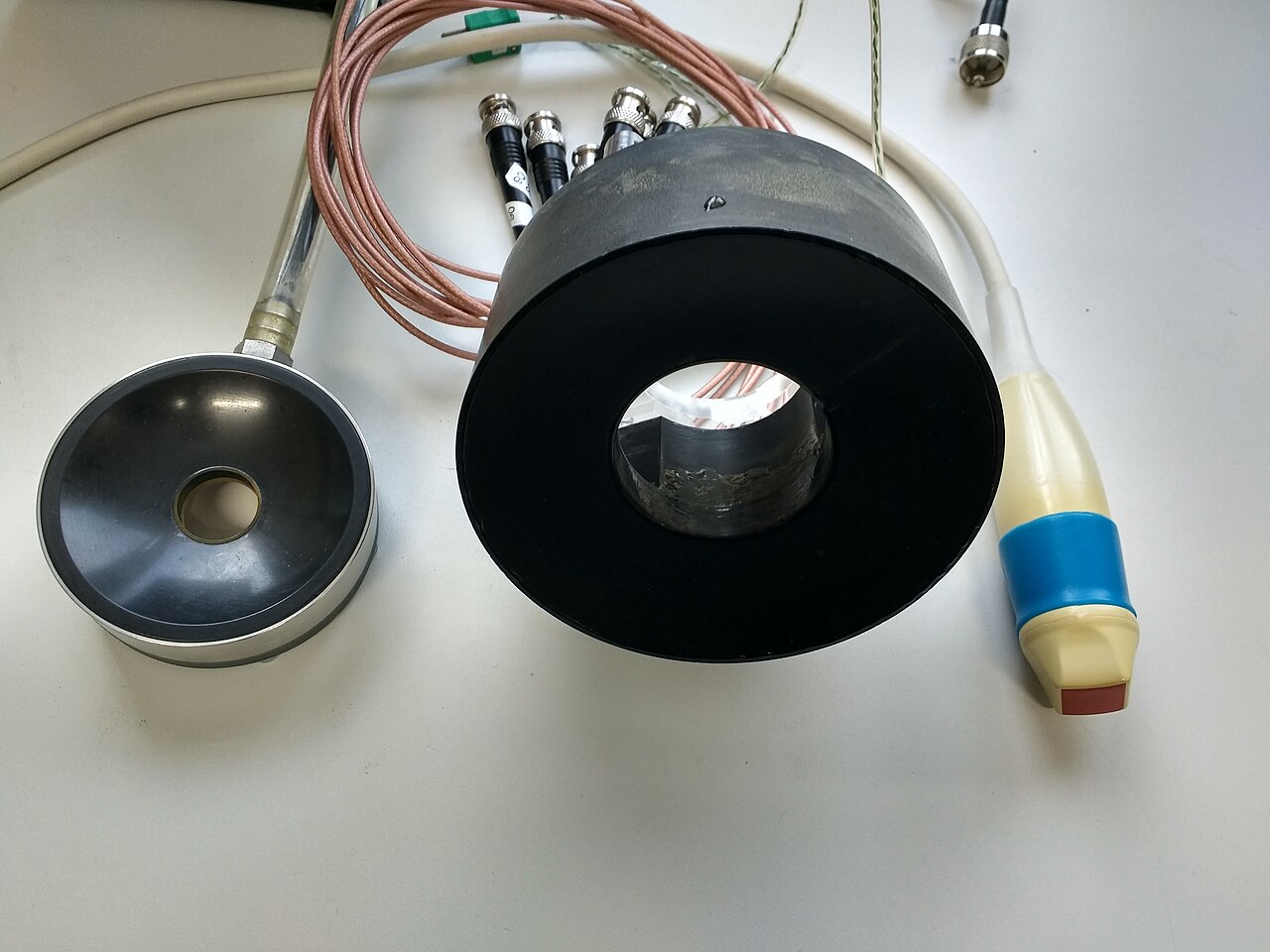
Transducer hardware: the physical array that turns electricity into sound and back. (Chris Adams, CC BY-SA 4.0, via Wikimedia Commons)
The trend rests on one technical story. It repays telling in full. The rest follows from it. For much of ultrasound’s history, the part that turned electricity into sound was a slab of piezoelectric ceramic. Engineers diced it into an array of tiny elements. Each element had its own wire. Each wire ran to a channel in a beamformer the size of a cabinet. The ceramic was capable. It was also rigid in what it allowed. Making it smaller meant dicing finer. Dicing finer made the elements fragile. It multiplied the wires. Those wires fed electronics too large for any handpiece. One change broke the ceiling. Designers moved the beamformer onto a custom chip. The newest designs go further. They build the transducer itself from micromachined structures, etched like silicon in place of cut ceramic. Such a transducer is a grid of microscopic drums on a wafer. It comes off the same line that prints integrated circuits. So it bonds straight onto the chip that drives it. The fragile bundle of coaxial lines disappears. The array and its electronics become one stacked object, a few centimetres across. A single chip can reach a wide band of frequencies. One wand then covers the shallow and the deep work that once took two or three ceramic probes. That convergence is the whole story. Transducer, beamformer, front-end fold into a sandwich of silicon. A complete scanner fits in a coat pocket. The limits that remain are no longer about size. They are about power and heat. Silicon density makes both worse, not better.
The chip solved space. It did not solve thermodynamics.
The trend through 2026
Where the wand stands now reflects that unfinished bargain. Devices reaching clinics in 2026 are lighter than their predecessors by meaningful fractions. They pair faster with a handset. They fold image processing that once ran on the phone back into the handpiece. The wand grows more capable as it loses mass. Single-chip wide-band designs that replace a drawer of probes are no longer rare. The gap between a pocket wand and a wheeled system, on a focused exam, keeps closing.
The pace is steady. Nothing about it looks explosive.
Each year trims a little weight. Each year adds a little processing. Each year stretches the scan time a charge allows. Across several years the small steps add up to a device that feels different in the hand. A clinician who set a wand down three years ago, then picked up a 2026 model, would notice the change at once. The warmth, the heft, the speed all read first. The picture reads second.
What the shrinking costs
The bill comes due in three currencies. The first is heat. A sealed handpiece concentrates the warmth its beamformer and processor make. A wand has no fan. It has little room to spread the heat. It leans on conductive paths through the casing. It leans on materials that soak up a burst of warmth, then release it slowly. Run the highest-output modes for a long study, and the wand grows warm in the hand. To stay within the limits set for skin contact, it pulls back its frame rate, or its transmit power. The clinician sees a softer picture. The device is protecting itself.
The second currency is the battery.
A handpiece that scans, transmits, processes drains a small cell fast. Shrinking the housing leaves less room for that cell. Endurance and size pull in opposite directions. The third currency is the picture. A smaller aperture and a tighter power budget cost some penetration. They cost some of the finest detail. Read these three costs against the questions a clinic needs answered, and the right wand stands out. Read only the weight on the spec sheet, and the purchase disappoints.
Wand, probe, transducer: one object, three words
The names overlap. The overlap confuses buyers. A transducer is the precise term for the part that turns electricity into sound. A probe is the older clinical word for the handpiece a clinician grips. A wand is the marketing word. It took hold once the handpiece became small and self-contained. In a 2026 handheld, all three words point at one object.
The word a listing uses hints at its age.
A device sold as a transducer often plugs into a larger system. It carries no screen of its own. A device sold as a wand almost always means the pocket-sized, phone-paired class this trend produced. Keep the three words straight, and a catalogue reads faster. A bare transducer never gets paired with a system it was never meant to feed.
How a 2026 wand sits in the hand
The whole imaging chain held in one hand, with no cart and no cable to a box. (The original uploader was Drickey at English Wikipedia., CC BY-SA 2.5, via Wikimedia Commons)
Form has settled around a few shapes. The common one is a stout bar, gripped like a marker. The scanning face sits at one end. A small status light or screen sits near the thumb. A second shape pairs a probe head with a clip-on phone cradle, so the picture rides on the same handpiece. The choice is ergonomic. The electronics stay the same either way. The choice decides how a long day of scanning feels in the wrist.
Weight has dropped to where it stops being the limit.
Balance now matters more than mass. A wand whose weight sits over the scanning face holds steady through a careful sweep. A wand that shaved a few grams at the cost of balance drags at the wrist. The better makers tune that balance with the care they once spent chasing raw lightness. Through 2026 the placement of the weight tells you more than the number on the scale.
Reading a wand’s real size
A spec sheet flatters a wand. It lists the weight of the handpiece alone. It lists the dimensions at their slimmest. It lists a battery figure measured in a gentle mode. A clinic that buys on those numbers meets a different object in daily use. The weight that matters includes the charged battery and any cradle. The size that matters is the bulk in a coat pocket, measured where the device is thickest. The endurance that matters is scan time in the modes the clinic runs. That figure drains a cell far faster than the standby number suggests. A wand rated for a long day in a brochure can fall short of a busy afternoon in a clinic. The gap is less deception than the distance between a measured ideal and a working reality.
The judgment that protects a buyer is simple. Read every headline figure as a best case. Ask what the same number looks like under the load the clinic will place on it. The trend toward smaller has made the brochure numbers prettier. It has not made the working ones automatic.
Size on paper and size in a pocket are different measurements.
The wand that wins a clinic over is the one whose real numbers still satisfy. The warm-handed numbers. The fully-charged numbers. The busy-afternoon numbers. Reaching them takes asking past the headline.
The modes that now fit inside a wand
Miniaturization reaches past the gray-scale picture. A 2026 wand carries the imaging modes that once justified a console. Color flow paints moving blood across the frame. Pulsed and continuous Doppler measure its speed. Harmonic imaging clears a cluttered view. Needle-enhancing modes make a fine tip glint against tissue. Folding these into a handpiece took the same chip integration that shrank the beamformer. Each mode is a different way of timing and reading one array. A programmable front-end switches between them in firmware. An older system needed dedicated hardware for the same trick. The clinician who once walked to the cart for color flow now thumbs a control on the wand.
The modes came along for the ride.
One thing a wand cannot yet equal is the cart’s reach in the hardest of these modes. A large aperture and a generous power budget still read faint, deep flow that a handpiece loses in noise. For the bedside questions color and Doppler usually serve, the wand answers cleanly. For a subtle vascular study deep in a large body, the cart keeps its edge. A clinic that runs both kinds of work plans for the pair.
The places a small wand reaches
Size is not the point. Reach is. A scanner that fits in a pocket goes where a cart cannot. It rides in an ambulance. It sits in a backpack on a home visit. It travels to a clinic an hour from the nearest hospital. The miniaturization trend matters because each gram shed widens that reach.
The wand follows the clinician. The cart waited for the patient.
A rural clinic that could never house a wheeled system can now own a wand. A field team can carry imaging into places that have none. A ward can keep a wand at every bedside. The question gets answered the moment it is asked. None of this needed a finer picture. It needed a smaller machine, ready to hand. The trend toward less mass is, underneath, a trend toward more places. The chip did not only shrink the device. It scattered ultrasound across settings a cabinet locked it out of. For a buyer the lesson runs past the spec sheet. The value of a wand is partly the picture it makes, partly the rooms and roads and bedsides it can finally enter.
Where the wand goes next
Regulation kept pace with the shrinking. A wand that performs a console’s work answers to the same medical-device rules a console does. The standards bodies folded the handheld class into the frameworks that govern acoustic output, electrical safety, data handling. A 2026 wand reaching a clinic has cleared the same bars its larger cousins clear. A buyer can read its clearances as a floor the size of the device does not lower.
The direction of travel is legible. More of the work moves onto the chip. The transducer and its electronics fuse tighter. The software that guides a novice through a sweep grows more capable. The wand asks less skill of the hand that holds it. The physical object may not shrink much further. A tool a hand must grip has a floor. A battery a study must outlast has a floor too.
The wand has nearly finished getting smaller.
What it has not finished is getting smarter. The trend through the rest of the decade reads as a handpiece that stays about the size it is now. The intelligence packed inside it keeps growing. So does the breadth of frequencies it covers, the guidance it offers, the heat and power it manages. For a buyer in 2026 the lesson is plain. Weigh a wand by what it does across a long working day. The number on the scale matters less. The grams stopped being the story. The silicon became it.
About the Author
Julien Mercier
Senior R&D Engineer · Medical Ultrasound Transducer Development
Senior R&D Engineer with an M.S. in Applied Physics and over 15 years of experience in medical ultrasound transducer development, specializing in the design verification and performance testing of high-frequency imaging transducers. Currently leading the development and verification of the company’s next-generation high-frequency linear-array transducer, responsible for imaging performance evaluation and reliability analysis in preclinical testing. Brings extensive hands-on experience in piezoelectric element tuning, beamforming parameter optimization, and system-level performance testing.