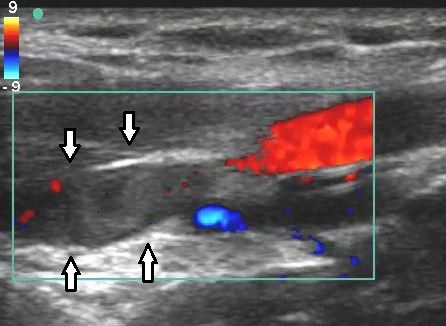
A color-flow vascular scan; in China the device is tested against the domestic adoptions of the international standards before registration.
The NMPA registration is the approval a wireless ultrasound probe needs before it can be sold legally in China, granted by the National Medical Products Administration after a process that looks familiar to anyone who knows the European or American routes and differs in ways that catch out the unprepared. A diagnostic ultrasound device sits in the second of China’s three risk classes, which means it cannot simply be notified and sold but has to be registered, and registration turns on a combination few other systems demand in quite the same form: mandatory type testing in an officially recognized Chinese laboratory, against the Chinese national and industry standards, before the dossier is even complete. For a domestic maker this is the home gate, and the registration certificate it produces, with a number anyone can verify, is the document that separates a probe legally on the Chinese market from one that is not.
The certificate number is public, and a probe without one is not on the market it claims to be on.
Type testing comes first
The feature that best distinguishes the Chinese route is that the device has to be tested by a recognized testing centre before the registration application is filed, rather than the maker submitting its own data for review. The test report from that centre is the spine of the dossier.
A maker sends physical samples to one of the testing institutes the administration recognizes, and the institute runs the device against the applicable Chinese standards, the national GB standards and the industry YY standards, producing a formal report that the registration cannot proceed without. Those Chinese standards are, in the main, the domestic adoptions of the international ones, so the general electrical safety standard, the particular standard for diagnostic ultrasound, and the electromagnetic compatibility standard each have a Chinese counterpart that mirrors the international text closely. The acoustic output ceiling the testing centre checks against is the same global figure the other major markets use, the derated intensity at or below the established limit, since China adopted that line as its own. The difference is procedural rather than substantive: the maker does not get to assert conformance and let a reviewer spot-check it, but has to hand the device to an independent Chinese institute that generates the evidence directly. A maker that has prepared well sends a device that passes cleanly, while one that has cut corners discovers the gap in the institute’s report rather than in the field, which is the point of putting the testing first. The institute has no stake in the maker’s success, and its report carries weight precisely because it was produced by a party with nothing to gain from a flattering result, which is the quiet strength of a system that tests before it reviews.
The device proves itself in an official laboratory before the paperwork even begins.
The technical requirements document
At the centre of a Chinese registration sits a document the other systems have no exact equal of, the product technical requirements, which is the maker’s own formal specification of what the device is and how its key characteristics will be verified.
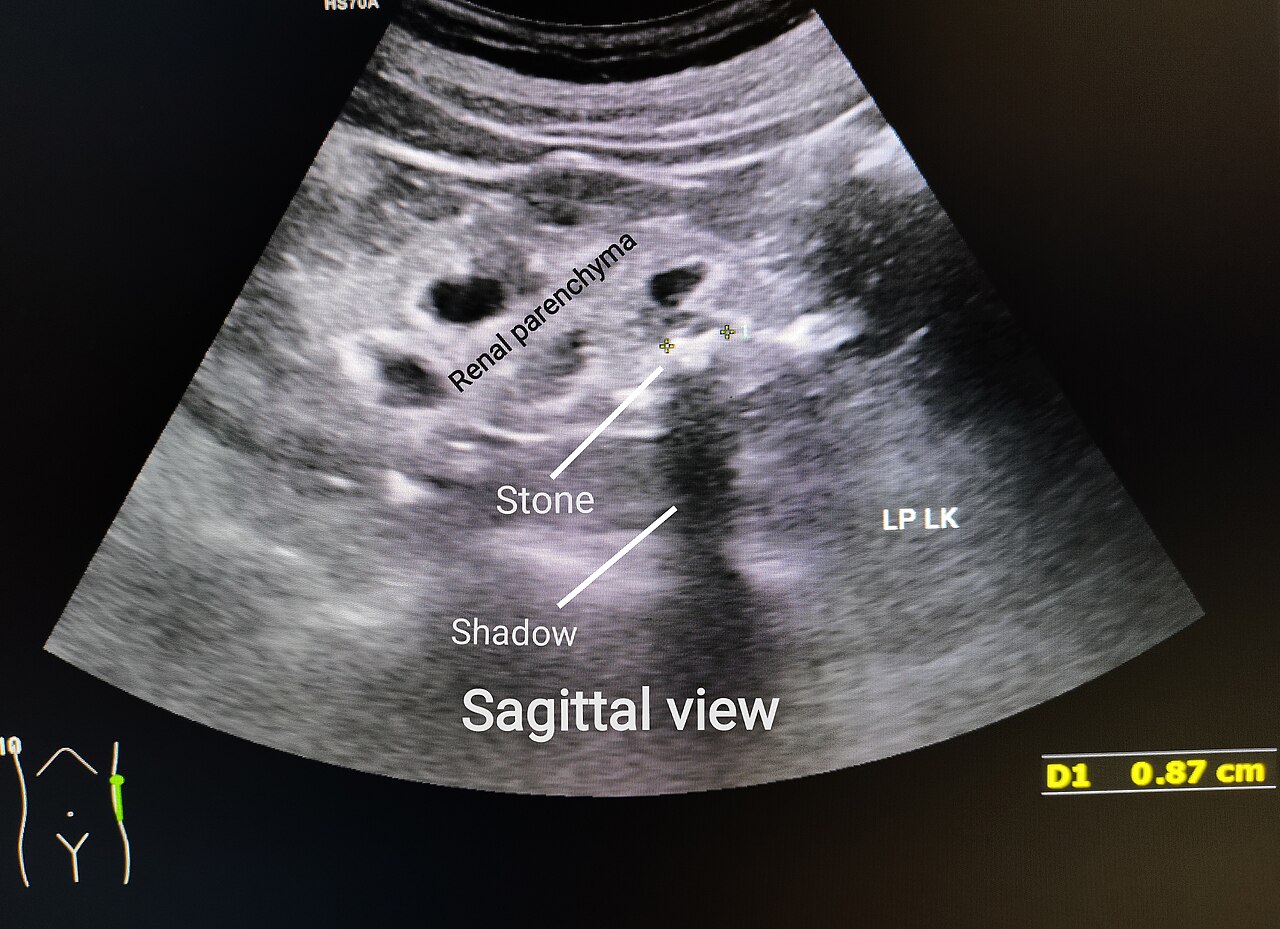
A renal scan; the registered technical requirements pin down the specifications the device is later held to.
This document pins down the performance specifications the maker commits to, the test methods by which each will be checked, and the standards the device claims to meet, and once it is approved it becomes the binding description against which the device is tested and later inspected. It is more than marketing copy and more than an internal spec, since the testing centre verifies the device against exactly these stated requirements, and a maker that writes them loosely either fails the verification or commits to claims it cannot defend later. The document forces a maker to be specific about the things a brochure leaves vague, the frequency range, the imaging modes, the acoustic output figures, the electrical characteristics, each stated as a verifiable requirement rather than a slogan. For a wireless handheld the technical requirements have to cover the parts that make it modern, the battery behaviour, the wireless image transfer, the software functions, since the administration expects the specification to describe the device that genuinely ships rather than a simplified ancestor of it. A reviewer reads the technical requirements against the test report to confirm the device met its own stated specification, and a buyer who can obtain this document is reading the maker’s binding self-description rather than its advertising. A specification written to be easy to pass is also a specification that promises the buyer little, since the figures it commits to are the floor the device has to clear, and a maker proud of its probe writes requirements that are demanding because the device can meet demanding ones. The discipline of the document is that it turns claims into commitments the maker is then held to.
What the maker writes here it is later measured against, so vagueness is a trap rather than a shelter.
The dossier and the quality system
Around the test report and the technical requirements the maker builds the registration dossier, the full body of evidence the administration reviews before granting the certificate.
The dossier brings together the product description, the technical requirements, the type test report, the risk management file, the clinical evaluation, and the instructions for use, each in the form and language the administration specifies, since a dossier in the wrong structure is returned before its content is even weighed. The clinical evaluation argues from clinical data that the device performs safely and effectively for its intended use, and for a device with well-established technology that argument can often lean on equivalence and published evidence rather than a fresh trial, though the administration decides how much is enough. Behind the dossier stands the quality management system, which has to satisfy the Chinese requirements that align with the international management standard, since a registration is granted to a maker whose manufacturing is controlled rather than to a sample that happened to pass. The administration can inspect the manufacturing site, and a maker whose production cannot reliably reproduce the device that was tested has a certificate built on a sample rather than a process. The dossier is where every other piece of work, the testing, the risk file, the clinical argument, and the quality system, is gathered into the single application the administration grants or refuses, and a gap in any one of them stalls the whole.
What it means for a domestic handheld maker
For a Chinese maker of wireless ultrasound probes this is the home market and the first serious gate, and clearing it well sets up much that follows.
The domestic maker files with the administration through the route its class and origin require, and the registration it earns is both the licence to sell at home and a credential it can show abroad, since a probe registered in its own demanding home market arrives in export conversations with evidence rather than promises. The same type testing that the Chinese institute performs generates measurements that feed the European technical file and the American submission, so a maker that does the home registration thoroughly has built much of the foundation for the other markets at the same time. A maker confident in its engineering points to a registration certificate whose number resolves in the administration’s public database to the exact device being sold, with technical requirements that describe the probe in hand. A maker that is vague about its registration, or that shows a certificate for a different model, or that leans on a testing report without the registration that should follow it, is telling a buyer who knows the system that the work is unfinished. The handheld market at home is crowded, and the registration certificate is the first hard line between a device that cleared the gate and one hoping the check never comes.
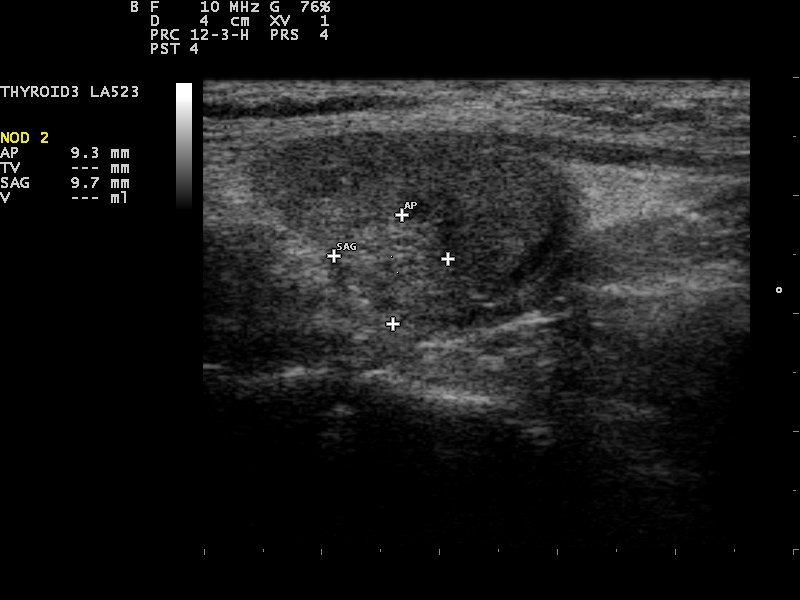
A thyroid scan; the acoustic output ceiling China checks is the same global figure the other markets use.
The home certificate is the foundation the export markets are built on, rather than a formality to be improvised later, and a maker that treated it as the first real engineering gate tends to be the one whose export files hold together.
How the home standards mirror the world
A maker meeting the Chinese standards is, in large measure, meeting the international ones under domestic names, and seeing how the two map onto each other explains why one body of engineering can serve several markets.
The Chinese system adopts the major international standards as its own GB and YY documents, so the general electrical safety standard, the particular standard for diagnostic ultrasound, the acoustic field measurement method, and the electromagnetic compatibility standard each appear in a Chinese edition that tracks the international text rather than departing from it. The acoustic ceiling is the same global figure, the derated intensity held at or below the established limit with the indices shown, since China took that line from the same international consensus the other markets did. The practical consequence is that a maker which built its probe to clear the international standards has, in large part, built it to clear the Chinese ones too, and the type testing in the domestic institute checks the same physics a European notified body or the American agency would expect. The gaps that remain are usually procedural, the language of the dossier, the format of the technical requirements, the requirement to test in a recognized domestic centre, rather than a different bar for the device itself. A maker that understands this treats the home registration and the export files as one engineering effort with several paperwork wrappers, while one that treats them as unrelated projects pays for the same testing several times and still risks inconsistency between the figures each file quotes. The reviewer in any of these markets is, at bottom, asking the same questions of the same measured device, and the maker that kept its numbers consistent across the wrappers has the easiest time everywhere.
The home standard and the world standard are mostly the same standard wearing different covers.
Reading an NMPA registration
The registration leaves a public record, and a buyer who knows where to look can confirm in minutes what a seller asserts.
Every registration carries a certificate number in the administration’s format, and that number can be checked in the public database, where the registered device, its maker, its class, and the validity dates appear. A buyer can confirm that the number is real, that it covers the model being sold rather than a sibling, and that the certificate is current rather than lapsed, since a registration has a finite term and a maker that lets it expire is selling on an authority that no longer holds. The registered scope matters as much as the number, since a certificate describes a particular device with particular specifications, and a seller stretching one model’s certificate to cover an unregistered variant has overreached in a way the record exposes. The technical requirements behind the registration state what the device was held to, so a buyer who can read them sees the binding specification rather than the brochure. A seller who produces a clean certificate number that resolves to the device, current and in scope, has answered the first question a Chinese-market buyer should ask, and a maker confident in its registration offers the number before being pressed for it. The check costs a buyer a few minutes against a public register and saves the far larger cost of discovering, after a purchase, that the authority behind the device was a model number that never matched. A registration is the one claim in the whole sales pitch that a stranger can verify without trusting the seller at all, and a careful buyer asks for it precisely because of that.
A live certificate number that resolves to the exact device is the difference between a registered probe and a hopeful one.
About the Author
Julien Mercier
Senior R&D Engineer · Medical Ultrasound Transducer Development
Senior R&D Engineer with an M.S. in Applied Physics and over 15 years of experience in medical ultrasound transducer development, specializing in the design verification and performance testing of high-frequency imaging transducers. Currently leading the development and verification of the company’s next-generation high-frequency linear-array transducer, responsible for imaging performance evaluation and reliability analysis in preclinical testing. Brings extensive hands-on experience in piezoelectric element tuning, beamforming parameter optimization, and system-level performance testing.