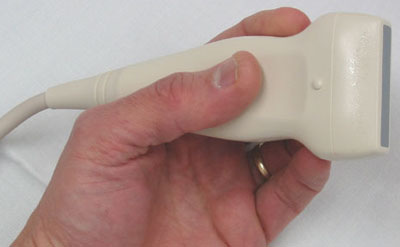
A probe head in the hand; the lens pressed to skin is the surface this standard evaluates.
ISO 10993 is the family of standards that asks a plain question with a complicated answer: is it safe for this material to touch a human body. A diagnostic ultrasound probe presses a lens and a housing against skin, sometimes for a few seconds and sometimes for a long study, and the polymers in that lens are not inert just because they feel smooth. They can shed traces of the chemicals used to make them, provoke an allergic response, or irritate the skin they rest against. This standard is the structured way a maker proves that the surface meeting the patient will not harm the patient through the material itself, separate from anything the sound does. It governs the stuff the probe is made of rather than the energy it emits.
A probe can be acoustically flawless and still fail here, on the chemistry of the lens alone.
Contact decides the testing
The standard does not ask for the same tests on every device. It first asks what kind of contact the device makes and for how long, because a tube that sits in the bloodstream for days raises questions a probe pressed to intact skin for minutes does not.
A surface ultrasound probe contacts intact skin, the gentlest of the contact categories, and the duration is usually short though a long study or a repeated series can push it into the prolonged band. That categorization, the nature of the contact crossed with its duration, decides which biological endpoints a maker has to address, and it keeps the testing proportionate rather than demanding blood-contact studies for a device that never breaks the skin. For skin contact of limited duration the core endpoints are cytotoxicity, whether the material poisons living cells; sensitization, whether it triggers an allergic reaction on repeated exposure; and irritation, whether it inflames the skin on contact. Those three carry the bulk of the weight for a probe, and a maker that addresses them with evidence has answered the questions the contact category truly raises. A maker that runs a longer and more invasive battery than the contact warrants has not been more careful so much as less precise, since the standard is built to match the test to the risk rather than to pile on tests for show.
Match the test to the contact, and the right evidence follows.
Chemistry first, biology second
The modern version of the standard pushes a maker to understand what the material is made of before reaching for a biological test. Chemical characterization comes first, and the biological tests follow only where the chemistry leaves a question open.
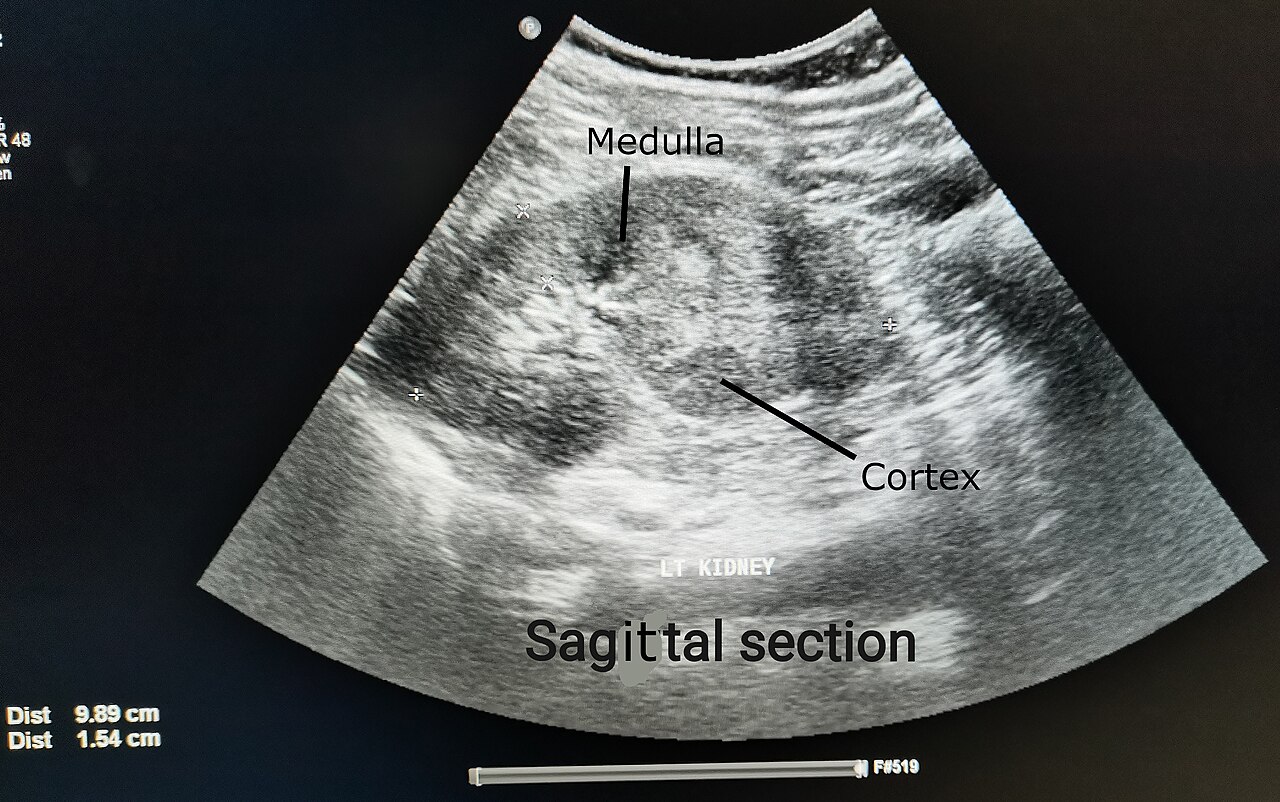
A renal scan; the material safety of the lens is judged separately from the image it helps produce.
The reasoning is that a material whose composition is fully known, whose extractables and leachables have been measured and assessed against toxicological limits, may not need an animal test to confirm what the chemistry already shows. A maker characterizes the polymer, identifies what can migrate out of it under conditions that mimic use, and weighs those substances against established safe exposures, turning a biological question into a measured chemical one wherever it can. This is the direction the whole field has moved, away from reflexive animal testing and toward chemical characterization paired with a toxicological risk assessment, since the chemistry is more repeatable and the ethics are better. The biological tests remain for the endpoints chemistry cannot settle on its own, sensitization in particular, where the body’s immune response is hard to predict from a list of compounds. A serious biological evaluation reads as a chain of reasoning rather than a stack of pass certificates: here is the material, here is what comes out of it, here is why that is safe, and here is the test that confirms the part the analysis could not. A report that is only a sheaf of pass results with no chemical characterization underneath has skipped the thinking the current standard is built around.
Knowing what the material sheds is more telling than a bare pass on a single test.
The material that has to be tested is the one that ships
A biological evaluation is only as honest as the link between the thing tested and the thing sold. The standard is strict that the sample which went through testing has to represent the device a patient finally meets.
The lens compound, the curing process, the colourants, the sterilization method, and even the supplier of a raw polymer all shape what the finished surface sheds, and a change in any of them can invalidate a biological evaluation that was honest for the old version. A maker that tests an early formulation and then quietly switches to a cheaper silicone for production has a file describing a probe it no longer ships, and the patient meets a surface no test ever covered. This is why the standard ties the evaluation to the final, processed, sterilized device rather than to a clean laboratory sample of the raw material, since processing and sterilization can change the surface chemistry as much as the base polymer does. A maker that re-runs or re-justifies the evaluation when it changes a material is doing the unglamorous work the standard demands, and one that treats the first pass as permanent is carrying a file that has quietly gone out of date. The reviewer who reads the evaluation checks that the tested article and the marketed article are the same thing, because a beautiful set of results on the wrong sample tells a patient nothing.
The three core tests, plainly
The three endpoints a skin-contact probe leans on are easy to state and rewarding to understand, since each answers a different way the material could go wrong.
Cytotoxicity is the broad screen: living cells are exposed to an extract of the material, and if the cells sicken or die the material is shedding something toxic, a result that stops the evaluation until the cause is found and removed. Sensitization asks a slower question, whether repeated contact teaches the immune system to react, the mechanism behind a contact allergy that may show nothing on first exposure and a rash on the tenth, and it is the endpoint chemistry struggles to predict because an allergic response turns on biology rather than dose alone. Irritation asks the bluntest question, whether the material inflames the skin on contact without any allergic mechanism at all, the simple chemical insult of a substance the skin objects to. A probe lens has to clear all three, since a material can be non-toxic yet sensitizing, or non-irritating yet quietly poisonous to cells, and the endpoints do not substitute for one another. Read together they describe whether the surface is biologically quiet, which is exactly what a clinician pressing it to a patient forty times a day needs it to be, and a maker that can show all three cleanly has answered the part of safety that has nothing to do with the picture on the screen. The three together are modest tests by the standards of medicine, and skipping them is less a matter of difficulty than of a maker hoping the lens is fine because it looks fine.
Non-toxic, non-sensitizing, non-irritating: the lens has to be all three at once.
How it feeds the larger safety case
Biocompatibility does not stand on its own. In the language of the risk management standard, it is the control measure for one specific hazard, the chance that the material itself harms the skin it touches.
The risk file names the tissue-reaction hazard, and the biological evaluation under ISO 10993 is the evidence that the hazard has been controlled, the answer the file points to when it claims the lens is safe against skin. Regulators in every major market expect that evidence as part of the submission, and a probe missing it cannot clear review regardless of how clean its acoustic output looks. The evaluation also connects to the cleaning and disinfection instructions, since the chemicals a clinic wipes across the lens between patients can degrade the surface over time, and a material judged safe when new can change once a year of harsh wipes has weathered it. A thorough maker considers that weathering as part of the evaluation rather than testing only the pristine surface, because the probe a patient meets in month eighteen is not the probe that left the factory. The biological evaluation, the cleaning validation, and the risk file are meant to tell one consistent story about the surface, and a reviewer reads them against each other to check that they do.
A safe material wiped with the wrong disinfectant for a year is no longer the material that was tested.
What a handheld changes
A wireless handheld probe meets more skin, more often, in more hands than a cart-based probe ever did, and that volume sharpens every question this standard asks.
A costly cart probe operated by a few trained sonographers contacts a predictable stream of patients under consistent cleaning; a cheap handheld sold by the thousand touches a far larger and more varied population, cleaned by whoever happens to hold it, with whatever wipe the clinic stocks. The same small surface-area lens that makes the device portable also means the material is in intimate contact with skin many times a day, and a sensitization risk that would be rare on a rationed device becomes a real exposure across a large user base. The handheld form also tempts a maker to economize on the lens compound to hit a price, exactly the kind of material substitution the standard is built to catch, and a buyer who knows the standard reads a vague material description as a warning rather than an oversight. A datasheet that calls the lens a medical-grade polymer without naming it has told a buyer almost nothing, since the grade label is a marketing phrase rather than a composition, and two silicones sold under the same loose description can shed very different things. The maker that names the compound and ties it to a tested, sterilized sample is making a claim that can be checked, while the one that hides behind a generic phrase is asking to be trusted on the single component pressed hardest against the patient. A maker confident in its materials states what the lens is, shows the biological evaluation tied to the shipping device, and accounts for the cleaning chemistry the device will in fact meet. One that hopes the question stays buried offers a glossy housing and a silent file.
The more skin a probe touches, the less a buyer can afford to take its materials on trust.
Reading a biological evaluation
A buyer rarely needs to read the raw test data, and a few structural checks separate a serious evaluation from a thin one.
The first is whether the contact category is stated and matched to the tests, since an evaluation that does not name the contact type and duration has skipped the step that decides what evidence is even relevant. The second is whether chemical characterization sits underneath the biological results, because a current evaluation reasons from the material outward rather than presenting bare pass marks. The third is whether the tested article is the finished, sterilized, marketed device rather than a raw sample, the single point on which an otherwise sound file tends to fail. The fourth is whether cleaning and ageing are considered, since a probe used for years meets disinfectants that a one-time test on a new lens never saw. An evaluation that addresses these reads as the work of a maker that understood the question rather than one that bought a set of certificates, and the difference shows in whether the document reasons or merely asserts. A buyer who cannot read the data can still read the shape of the argument, and a shape that moves from material to extractables to safe limits to confirming test is the shape of work that was done rather than bought. The handheld a buyer should trust is the one whose materials are named and whose evaluation follows the device into the real conditions it will live in.
The page that names the material and follows it into use is the page written by a maker with nothing to hide about it.
About the Author
Julien Mercier
Senior R&D Engineer · Medical Ultrasound Transducer Development
Senior R&D Engineer with an M.S. in Applied Physics and over 15 years of experience in medical ultrasound transducer development, specializing in the design verification and performance testing of high-frequency imaging transducers. Currently leading the development and verification of the company’s next-generation high-frequency linear-array transducer, responsible for imaging performance evaluation and reliability analysis in preclinical testing. Brings extensive hands-on experience in piezoelectric element tuning, beamforming parameter optimization, and system-level performance testing.