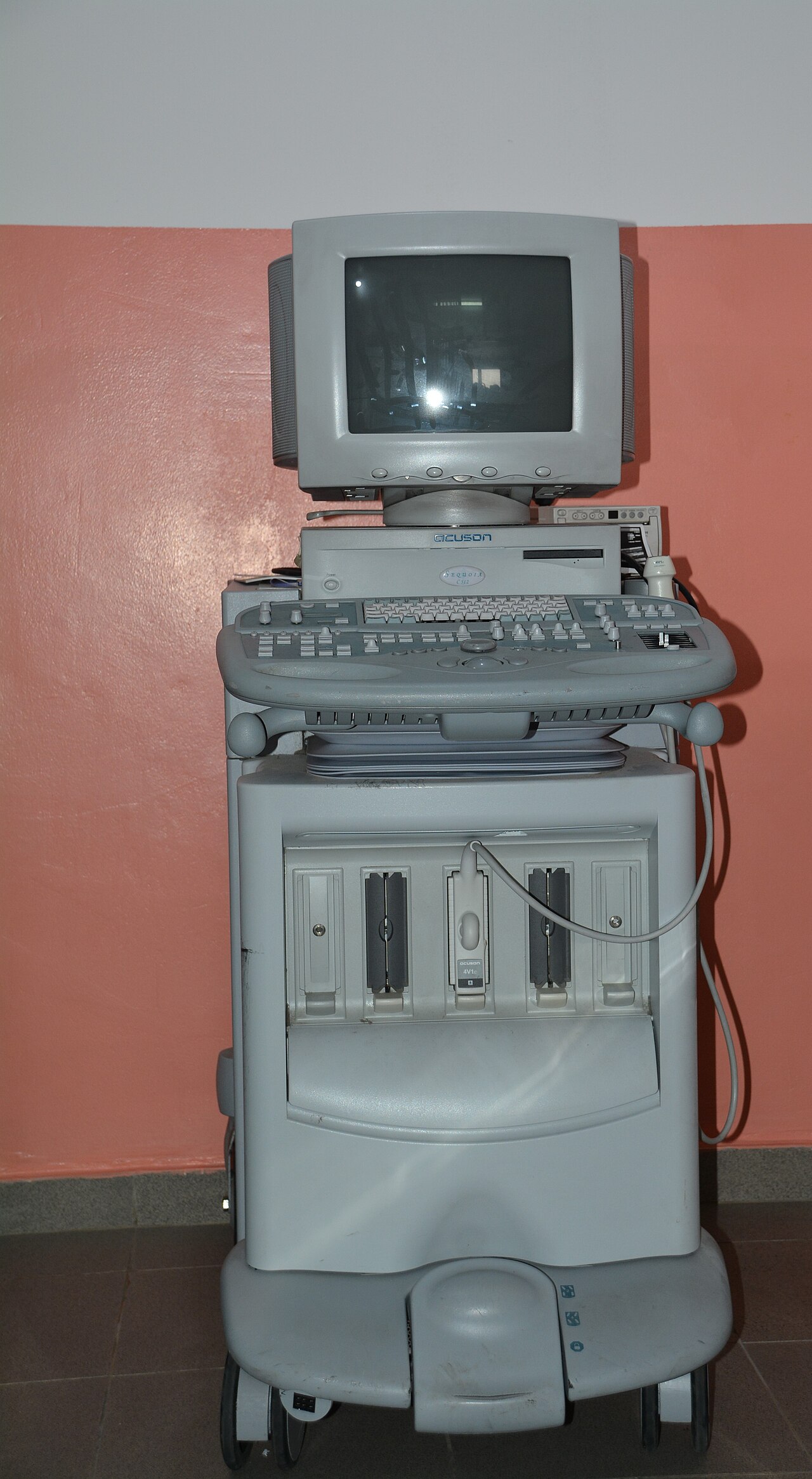
An ultrasound system console of the kind whose acoustic output is mapped point by point before any index reaches the screen.
IEC 62359 is the standard that defines how the acoustic field of a diagnostic ultrasound probe is measured and how the two indices that ride on the screen, the thermal index and the mechanical index, are calculated from that measurement. The particular safety standard says the indices have to be shown; the declaration standard says they have to be reported in a common form; this standard says exactly how they are produced in the first place. It is the method beneath the numbers, the agreed laboratory procedure that turns a beam in a water tank into a figure a clinician can rely on while scanning a patient who will never see the tank, the hydrophone, or the page of calculations that decided what the screen would say.
Without an agreed method, two laboratories measuring the same probe would print two different indices, and neither could be called wrong.
What the standard measures
The measurement happens in a tank of water, since water is a clean, repeatable stand-in whose acoustic behaviour is known to high precision. A tiny calibrated hydrophone moves through the beam on a precision stage, sampling the pressure waveform at thousands of points across a three-dimensional grid.
The hydrophone records pressure as a function of time at each point, and from that waveform the analysis pulls out every quantity the indices need: the peak rarefactional pressure, the pulse intensity integral, the temporal-average intensity, and the spatial distribution of each across the beam. The stage steps the hydrophone through the grid one position at a time, building a map of the field rather than a single reading, since the hottest point and the highest-pressure point seldom sit in the same place and the standard wants the worst of each captured separately. The raw water-tank values are then derated, scaled down by a fixed attenuation close to a third of a decibel per centimetre per megahertz, to estimate what the field becomes once a real body has absorbed part of it on the way to the focus. This derating is the bridge between the clean tank and the absorbing patient, and because the figure is fixed by the standard instead of chosen by the maker, two laboratories applying it reach the same derated value from the same raw scan. The procedure is exacting on purpose, since the indices that protect a patient are only as honest as the field map they are built from, and a loose scan with too coarse a grid or a hydrophone whose calibration has drifted produces a confident number that carries no real meaning. The grid spacing has to be fine enough to catch the peak rather than skip over it, the tank water has to be degassed so stray bubbles do not scatter the beam, and the hydrophone has to be small enough that it samples a point rather than averaging across a patch of the field it is meant to resolve.
The tank is clean, the body is not, and the derating is the rule that joins them.
From the field to the two indices
Once the field is mapped, the two indices follow from defined formulas rather than from judgement. The mechanical index and the thermal index each compress a different hazard into one number a clinician can read at a glance, and the standard pins down how each is computed so the glance can be believed.
The mechanical index is the derated peak rarefactional pressure divided by the square root of the centre frequency, a ratio that tracks the likelihood of cavitation, the violent collapse of gas pockets that can tear tissue mechanically. The thermal index is the ratio of the acoustic power the probe emits to the power that would raise the relevant tissue by one degree, and it splits into three forms because the tissue that matters changes with the exam: a soft-tissue form for a general scan, a bone-at-focus form for a fetal study late in pregnancy, and a bone-at-surface form for a scan through the skull. Each form rests on a simplified thermal model of how the beam deposits heat and how the body carries it away, and the standard specifies the model so every maker computes the same index from the same field. A thermal index of one on one probe then means the same physical thing as a thermal index of one on another, which is the whole purpose of standardising the calculation rather than leaving each maker to invent its own. A clinician reading the figure does not need to know the model; the clinician needs the figure to mean one thing everywhere, and that sameness is what the standard manufactures out of physics that would otherwise be a private matter between a maker and its laboratory. The split into three thermal forms is the part buyers overlook the easiest, since a probe that looks calm under the soft-tissue form can run far warmer under the bone-at-focus form a fetal scan demands, and a maker free to quote whichever form flatters the device would publish a number the obstetric clinic never meets. The standard forecloses that choice by tying each form to the application it guards, so the figure on the page is the one the exam in question produces.
The formulas are dull and fixed, and that dullness is exactly what lets the indices be compared.
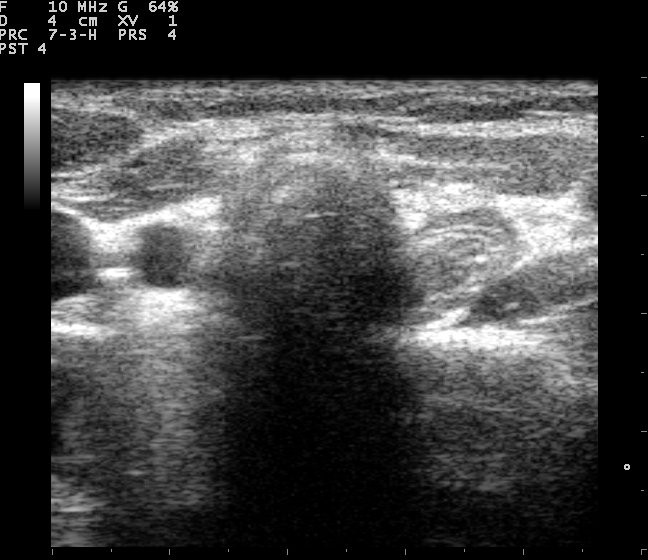
A grayscale scan; the mechanical and thermal indices that ride above it are computed from a measured field map.
Uncertainty is part of the answer
A measured number without its uncertainty is only half a result. The standard treats the error budget as part of the deliverable instead of an afterthought tacked on once the figure looks good.
The hydrophone carries a calibration traceable to a national standards laboratory, and that calibration itself has an uncertainty that propagates into every pressure reading taken with it. The positioning stage has a finite accuracy, so the hydrophone is never exactly where the analysis assumes it sits, and the gap matters where the field changes fastest, at the focus. The hydrophone’s own frequency response is not perfectly flat, so a broadband pulse is recorded a little differently across its spectrum, and the correction for that response carries an error of its own. The standard asks the laboratory to combine these contributions into a stated uncertainty that travels with the index, so a reader sees not a bare thermal index of one point two but the confidence band around it. A laboratory that reports a tidy figure with no band has either skipped the analysis or is hiding how loose the measurement had been, and a careful reviewer reads the missing band as the clearest signal on the page. Stating the uncertainty is not an admission of weakness; it is the mark of a measurement done honestly enough to know its own limits.
The band around the number is the part a serious reader checks first.
Reading a measurement report
A field report is not hard to read once a reader knows the few things that separate a sound one from a thin one. The checks do not require a physicist, only the patience to look past the headline figure to the conditions printed beside it.
The first thing to find is the grid: a report that names a fine sampling step and a scan that brackets the focus has gone looking for the peak, while one that quotes a single number with no map behind it has reported a reading rather than a measurement. The second is the derating: the figure has to be the fixed one the standard names, applied the same way every time, and a report that quietly softens it has dragged a hot mode under the line by arithmetic instead of by design. The third is the preset list: a probe sold with a dozen clinical modes should show indices measured across them, since the mode that drives the tissue hardest is the one the index has to bound, and a report that covers only a gentle preset has answered an easier question than the patient asks. The fourth is the calibration date on the hydrophone, because an instrument whose certificate has lapsed reports figures with a precision it can no longer back. A report that passes these reads as the work of a laboratory that went looking for the worst case and was willing to write down where it found it. None of the four checks asks the reader to redo the physics; each asks only whether the laboratory left enough of a trail to be followed, and a report that leaves that trail is one that expected a stranger to walk it. The maker that commissions such a report is buying more than a clearance, since a field map measured this carefully also tells the engineers where their own beam runs hottest and gives them somewhere to aim the next revision.
The page that shows its conditions is the page that expects to be checked.
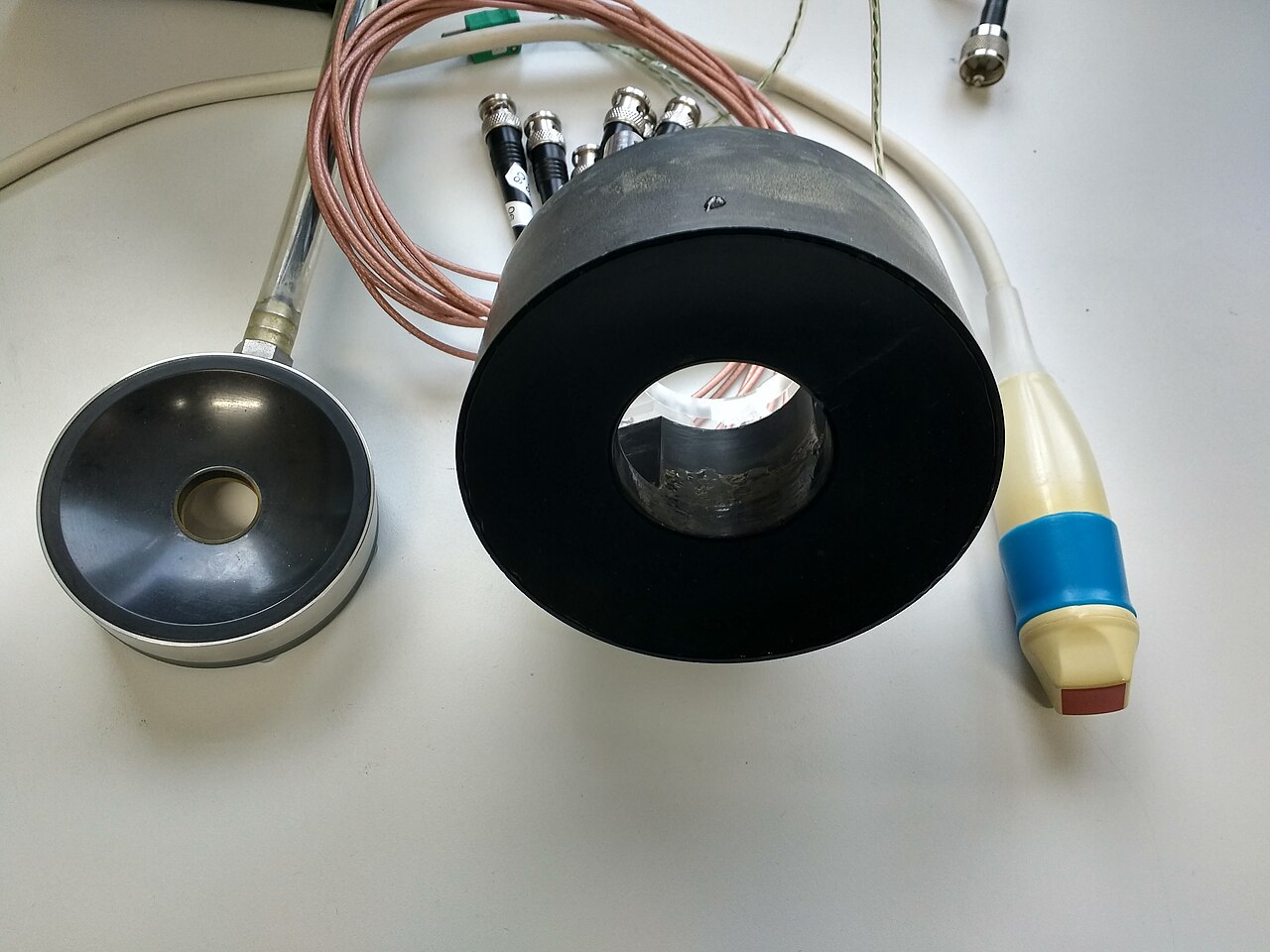
A transducer head, the source of the beam the method maps in a water tank.
How it underpins the other standards
This standard rarely appears on a brochure, and it sits underneath everything that does. The indices it defines are the ones the safety standard requires the device to display and the declaration standard requires the maker to report in a fixed form.
The chain runs cleanly when each link does its job. IEC 62359 measures the field and computes the indices; the declaration standard fixes the format in which those indices are stated so buyers can read one probe against another; the particular safety standard sets the ceilings the indices have to respect and requires them on the screen in real time during a scan. Pull this measurement standard out from under the other two and they fall over, since a displayed index that was never measured to a defined method is a number with no anchor beneath it, and a declared output resting on a private measurement is a comparison between things measured differently. The reviewer who reads a probe’s file checks that the indices in the declaration, the indices on the screen, and the indices in the safety case all trace back to one measurement done by this method, since a probe whose three documents quote three slightly different figures has measured itself three times and trusted none of the results. The measurement standard is the foundation precisely because it is the part the market never sees and the whole file leans on, the quiet layer that decides whether the confident number on the screen is a fact or a decoration.
The figure a clinician relies on is sound only because a method few people read made it so.
Why the method matters for a handheld probe
A wireless handheld probe makes the measurement harder in a quiet way.
The probe beamforms inside its own head and runs a dozen clinical presets, each a different blend of frequency, focus, and pulse, and each preset produces a different field that has to be measured and indexed on its own terms. A cabled cart carried the same burden, yet a handheld sold with a long list of presets multiplies the number of fields a laboratory has to map, and a maker tempted to measure only the gentle presets and infer the rest has skipped exactly the worst-case scans the standard exists to catch. The small sealed form also means the field can shift as the head warms through a long study, so a measurement that was honest while the probe was cold may drift once the electronics heat, and the worst-case condition the method demands includes the device at temperature rather than fresh off the bench. A probe whose indices were measured carefully across every preset, at temperature, with the uncertainty stated, is a probe a clinician can read the screen of and believe; one whose indices were measured loosely on a flattering preset is a probe whose reassuring figure is paint over an unknown. The buyer who asks to see the field report rather than the brochure is asking the one question that separates the two, and a maker that hands the report over without hesitation has usually earned the confidence the gesture invites.
The clinician reads one figure on a small screen, and a whole laboratory method stands behind whether that figure is true.
About the Author
Julien Mercier
Senior R&D Engineer · Medical Ultrasound Transducer Development
Senior R&D Engineer with an M.S. in Applied Physics and over 15 years of experience in medical ultrasound transducer development, specializing in the design verification and performance testing of high-frequency imaging transducers. Currently leading the development and verification of the company’s next-generation high-frequency linear-array transducer, responsible for imaging performance evaluation and reliability analysis in preclinical testing. Brings extensive hands-on experience in piezoelectric element tuning, beamforming parameter optimization, and system-level performance testing.