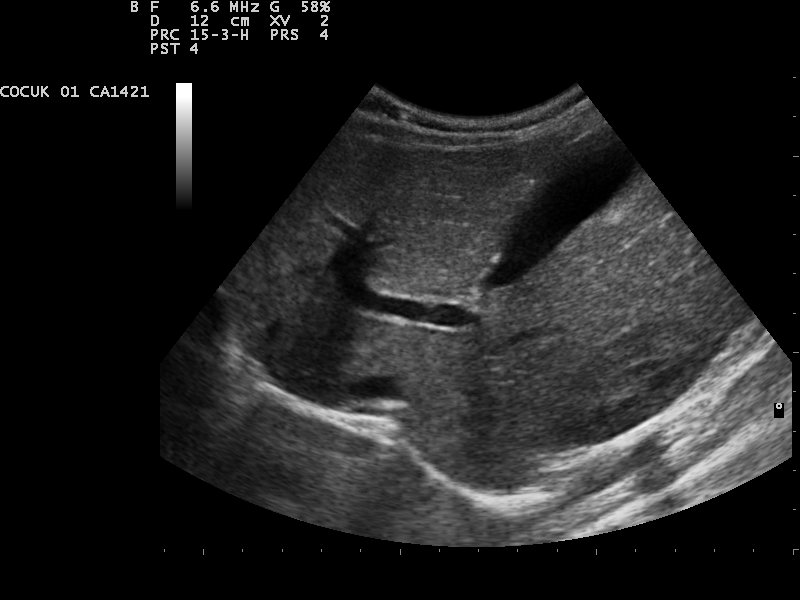
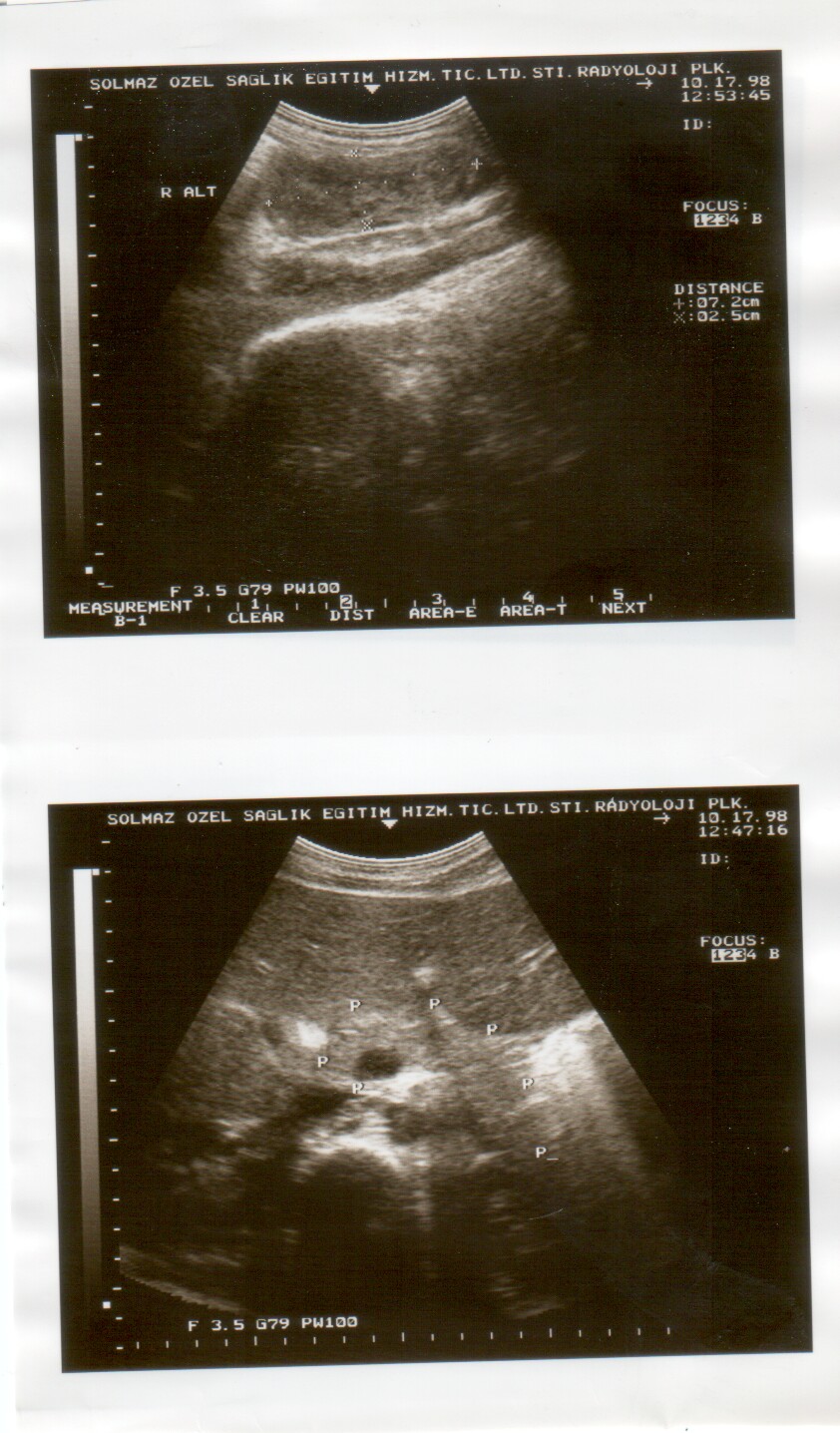
An ultrasound image; the beamforming channels decide how much of the array can be focused at once.
If the piezoelectric elements are the strings of the instrument, the beamforming channels are the fingers that play them, and the number of channels a wireless ultrasound probe carries decides how much of the array it can use at any single instant. A channel is one complete electronic path that can drive an element on transmit and read its echo on receive, with its own precise timing, and a probe with sixty-four channels can hold sixty-four of these conversations at once while one with thirty-two can hold half as many. The brochure tends to lead with the element count and stay quieter about the channel count, which is exactly backwards, because the channels are where the cost, the silicon, the power draw, and the heat all live, and they set the real ceiling on what the probe can do. Between a thirty-two-channel handheld and a sixty-four-channel one, the difference is not a marketing tier but a different engine under the same housing.
The elements decide what could be played; the channels decide how much of it is played at once.
What a channel carries
To see why doubling the channels matters, it helps to follow what one channel does on a single pulse. On transmit it fires its element at a precisely chosen instant, and on receive it captures the returning echo and hands it to the beamformer with its timing preserved, so the machine can add it correctly to the others.
The beamformer combines all the channels by delaying each one just so, lining up the echoes that came from the chosen focal point and cancelling the rest, and the more channels it combines, the larger the active aperture it can form and the tighter the focus it can build. A wider active aperture gathers more of the returning sound and focuses it more sharply, which improves both the resolution near the focus and the depth the probe can usefully reach, since a larger collecting area pulls a fainter echo out of the noise. With more channels the machine can also form several receive beams from a single transmitted pulse, a trick that lets the image refresh faster without firing more pulses into the patient, which feeds directly into frame rate. The channel count, then, is not a back-office detail but the figure that sets aperture, focus, penetration, and speed at once, four of the things a clinician notices most. Doubling the channels from thirty-two to sixty-four does not double one quality; it lifts the whole envelope of what the probe can do. A clinician may never read the channel count, yet feels its absence as a picture that softens at depth, narrows at the edges, and lags when the anatomy moves, three complaints that all trace back to the same missing electronics.
One channel is one voice; the beamformer is the choir master, and more voices make a fuller sound.
How fewer channels are stretched to cover more elements
A probe almost always has more elements than channels, and the gap between the two is bridged by switching, which is where a thirty-two-channel design shows both its cleverness and its limits.
A grayscale scan; a wider active aperture, formed from more channels, sharpens resolution and reaches deeper.
A multiplexer connects the available channels to a sub-group of elements, forms a beam, then shifts the connection along the array to form the next, sweeping a moving sub-aperture across the face of the probe to build a full image from a device that never drives the whole array at once. This is a sound and standard technique, and a well-designed thirty-two-channel probe can produce a genuinely useful image this way, so the lower count is not a flaw on its own. The limit appears at the edges of performance: a smaller active aperture focuses less tightly and gathers less echo, so resolution and penetration suffer where they are hardest won, at depth and at the margins of the image. Sweeping a small aperture also takes more transmit-receive cycles to cover the field, which costs frame rate, so a thirty-two-channel probe imaging a wide deep field updates more slowly than a sixty-four-channel one covering the same field. The switching itself adds complexity and a little signal loss at every hand-off, and a maker stretching too few channels across too many elements is pushing the technique past where it flatters the image. The sub-aperture trick lets a modest probe punch above its channel count, and it cannot make thirty-two channels behave like sixty-four where the physics of aperture and timing decide the result. A buyer who understands this stops reading the element count as the measure of a probe and starts asking how much of that array the device can hold in play at once, which is the question the channel count answers.
Switching lets few channels cover many elements, and the seams show exactly where imaging is hardest.
Why the handheld feels every channel
In a cart-based system the beamformer could be a board the size of a book, drawing mains power and cooled by a fan, so channels were comparatively cheap to add. A wireless handheld has to fold the same function into a sealed body in one hand, and there every channel is paid for in the three currencies the small form is shortest on: silicon, power, and heat.
Each channel is a slice of an integrated circuit that draws current whenever the probe is imaging, and sixty-four of them draw roughly twice the power of thirty-two, which the battery has to supply and the body has to dissipate. The heat that power becomes has nowhere to escape but the housing and the lens, so a higher channel count pushes against the same surface-temperature limit that the safety standard guards, and a maker adding channels has to win back the heat through efficient silicon and careful thermal design rather than simply spending more of it. This is why a genuinely high channel count in a handheld is a real engineering achievement and a more telling figure than the element count, since the channels are precisely the part the small sealed body fights hardest. A maker that has fitted sixty-four efficient channels into a probe that still runs cool and lasts a useful session has solved the central problem of the form, while one that quotes a high element count over a modest channel set has taken the path that prints well and costs little. The channel count is the figure that the handheld form makes both expensive and honest.
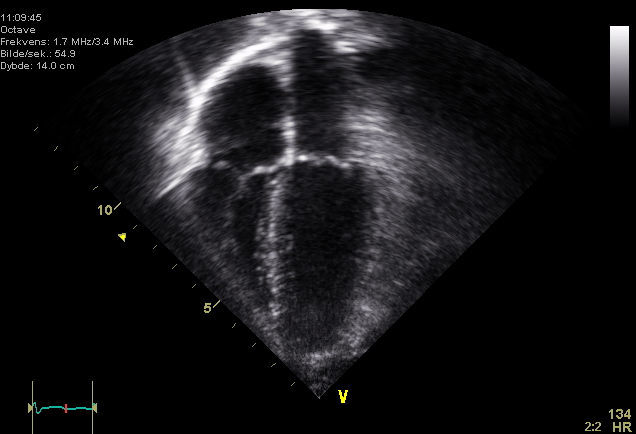
An echocardiogram; more channels form several receive lines per pulse, which lifts the frame rate of a moving study.
Channels and frame rate
The connection between channel count and frame rate is the part buyers least expect, since a number that sounds like static hardware turns out to govern how lively the moving image feels in the hand.
Every frame of an ultrasound image is built from many transmit-receive cycles, one for each line that makes up the picture, and the sound has to travel out to the depth and back before the next line can be fired, so the depth of the scan sets a hard floor on how fast lines can be gathered. A probe with more channels can form several receive lines from a single transmitted pulse, gathering two or four lines where a leaner design gathers one, which multiplies the lines per second without asking the sound to travel any faster. That parallel receive capability is why a higher channel count lifts frame rate, and frame rate is what separates a smooth moving study from a stuttering one, the difference a clinician feels immediately when tracking a beating heart or a pulsing vessel. A thirty-two-channel probe sweeping a deep wide field can fall to a frame rate that lags the motion it is meant to show, while a sixty-four-channel probe holds a livelier picture over the same field. The channel count, then, decides not only how sharp a still frame looks but how faithfully the image keeps up with a body that does not hold still, and a maker that quotes a frame rate without saying at what depth and width it was measured has given a number that the channel count quietly constrains.
More channels gather more lines per pulse, and more lines per pulse is what keeps a moving image from stuttering.
The honest engineering behind the number
It bears stating plainly that a higher channel count is not free performance a maker simply chooses to grant, but the visible tip of a great deal of hidden engineering.
Driving sixty-four channels in a thumb-sized probe means designing an application-specific integrated circuit that does the beamforming in a fraction of the power a general processor would burn, since a naive design would flatten the battery and cook the lens long before it finished a session. The signal from each channel has to be amplified, converted from analogue to digital, and delayed with picosecond precision, and doing that sixty-four times over in a sealed handheld is a problem of heat and power management as much as of signal processing. A maker that reaches a high channel count has usually invested in custom silicon and a thermal design that lets the probe run that silicon without breaching the surface-temperature limit, which is exactly the kind of work that does not show on a brochure and does show in the image and the battery life. This is why the channel count, read honestly, is a window onto how seriously a maker engineered the probe rather than how much it spent on marketing, and why two probes claiming the same element count can sit on opposite sides of a real divide once the channel count and the silicon behind it are known. The number is small and the work behind it is not.
The channel count is a quiet confession of how much real engineering went into the probe.
What the buyer should ask and weigh
The channel count rarely appears on the front of a brochure, so the first move is simply to ask for it, and the second is to read it against the element count rather than in isolation.
A buyer comparing two handhelds should ask each maker for the channel count alongside the element count, since a probe quoting many elements and few channels is describing an array it cannot fully drive, and the smaller of the two numbers is the one that limits the image. The ratio between them tells a story: a probe whose channels match or come close to its elements drives nearly all of the array at once, while one with a wide gap leans heavily on the sub-aperture switching and pays for it at depth and in frame rate. The channel count should also be read beside the frequency range and the intended depth, since the penalty for too few channels bites hardest in deep work and matters less in shallow, fast imaging, so the right count depends on what the buyer scans. A maker confident in its beamformer states the channel count plainly and explains how it is used, while one that buries it is usually hiding the figure that limits the flattering element number beside it. The buyer who has learned to ask one question, how many channels, has learned the question that does more than any other to separate a real imaging engine from a specification dressed to look like one.
Ask for the channels, read them beside the elements, and the probe that was hiding behind a big number comes into focus, since the two figures together describe the engine while either one alone describes only a part the maker chose to show.
About the Author
Julien Mercier
Senior R&D Engineer · Medical Ultrasound Transducer Development
Senior R&D Engineer with an M.S. in Applied Physics and over 15 years of experience in medical ultrasound transducer development, specializing in the design verification and performance testing of high-frequency imaging transducers. Currently leading the development and verification of the company’s next-generation high-frequency linear-array transducer, responsible for imaging performance evaluation and reliability analysis in preclinical testing. Brings extensive hands-on experience in piezoelectric element tuning, beamforming parameter optimization, and system-level performance testing.