A reorder of the same PIC part number can arrive from a different production lot. Each lot has its own date code, its own silicon revision, and its own measured numbers inside the datasheet window. A new lot can land far enough across that window to upset a design tuned to the old batch. Reading the markings and checking a new lot early catches the difference before it reaches the line. A few simple checks keep a new lot from surprising the line.
Why one lot differs from the next
A lot is one production run of a part. The wafers in it come from one fab on one process. The parts package and test together as a batch. A part number can run for years across hundreds of lots. The maker holds every lot to the same datasheet, so any lot meets the published limits. The behavior inside those limits is where one lot moves away from another. A datasheet states a minimum and a maximum for each parameter, with a typical value between them. The maker tests every lot to the minimum and the maximum. The typical is a guide, with no promise a given lot sits there. Two parts from the same reel read close together on a meter, all inside the spec. Across lots and across years the spread grows wider. The datasheet limits bound all of it. A design that wants a fixed number reads it from the datasheet, where the maker has guaranteed it.
Several things shift a lot inside its limits. The fab process drifts run to run within its control band. A wafer from one part of the line differs a little from another. The maker can move the part to a newer process or another fab over the years. Every one of these changes stays inside the datasheet limits. The measured numbers move within that window. None of this breaks the part number, since the datasheet is what the number means. A design built from the datasheet numbers rides every one of these changes without a stumble.
What can change between lots
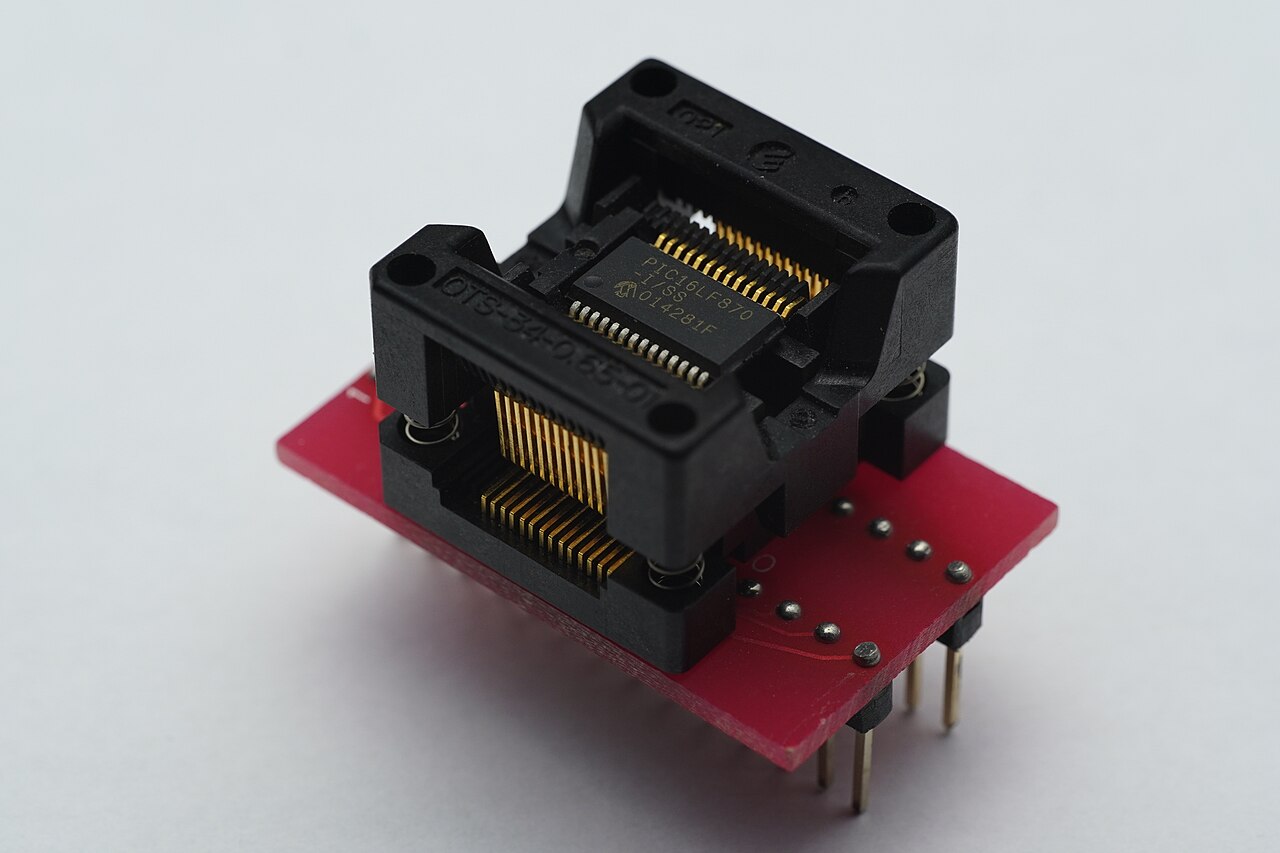
A PIC16LF870, an 8-bit PIC, in a test socket. The top marking carries the part number, a date code, and a lot or trace code that ties the chip to its production run.
The silicon revision is the first thing to read. A maker assigns a revision letter to each die version. An errata document lists what each revision fixes. A new lot can carry a newer revision with a different erratum. A design checks the revision against the errata for the part before it trusts a new lot. The revision shows in the marking or the trace code on many parts. A revision step that fixes an erratum can also change a register default or a timing the old code leaned on. A design re-reads the errata for the new revision and the migration note the maker ships with it. The work is small next to a field bug found after the run.
The internal oscillator is a common source of lot drift. The maker calibrates it at the factory to sit inside a band, often a percent or two wide. The band is wide enough that two lots can land at its opposite ends. Every lot in it meets the spec. A design that clocks a UART or a timing loop from the internal oscillator holds margin across the whole band. A part with a tighter clock need takes an external crystal instead. A crystal holds the frequency across lots and temperature. It costs two pins and the price of the part. A design that lives on the internal oscillator budgets the full band into its timing from the first line of code. The serial baud rate, the bit timing, and any delay loop all carry that margin. A design that needs an exact baud rate auto-bauds against the incoming line and holds across any lot’s clock.
Analog blocks drift the same way. The ADC offset, the comparator threshold, and the brown-out and power-on reset trip points each carry a spec range. A new lot can land at a different point in that range. A circuit that sits close to a threshold on one lot can cross it on another. A design leaves headroom against the spec limit itself. A comparator set near its threshold spec fires at a slightly different point on each lot. Every one of those points sits inside the range. A reset that releases near the brown-out limit can hold a part in reset on a lot at the edge. The headroom against the published limit covers every lot the part number can produce.
A process change shifts the part the furthest underneath. The maker can shrink the die to a smaller node or move it to another fab to cut cost or free capacity. The part keeps its datasheet, its pinout, and its part number. The timing, the analog, and the leakage can all shift inside the spec. A change like this comes with a product change notification. A subscribed buyer receives it ahead of the new lot. A die shrink is the change that often moves a design off its measured behavior, since a smaller transistor switches a little differently. The new die still meets every datasheet number. A design built on the limits never feels the move.
The package can change without the die. The maker can move assembly to another site, change the lead finish, or update the mold compound. The part stays electrically the same. An assembly change can move the solderability, the moisture sensitivity, and the markings. A board process tuned tightly checks a new assembly lot the same way it checks a new die. A switch from one lead finish to another can change how the paste wets and how the joint forms. A moisture-sensitivity step that moves can change the bake a reel needs before reflow. The assembly notice rides in the same product change notification the die change does.
What can shift from one PIC lot to the next, all inside the datasheet. Sources: Microchip device documentation and JEDEC change-notification practice.
What can shift
Inside the datasheet
What catches it
Silicon revision
Yes, per errata
Revision in marking, errata check
Internal oscillator
Yes, within the band
Bench frequency check, design to the band
Analog thresholds
Yes, within range
Board test against the limits
Process or fab
Yes
PCN subscription, requalify
Assembly, lead finish
Yes
Solder and AOI check, PCN
The trap of designing to typical
The deepest lot-to-lot bug comes from designing to the typical number. A bench measurement of one lot shows behavior near the typical, far from the spec limit. A design tuned to that reading has only the margin that one lot gave it. A later lot can arrive right at the spec limit, where the tuned design has no room left, and it fails in the field. The datasheet limit is the contract every lot meets, so a design keeps its margin to that limit. A bench reading describes one lot and makes a weak target for a design that has to take them all. A delay loop timed against one lot’s oscillator runs fast on a later lot and corrupts a serial frame. A sensor threshold set from a measured offset sits on the wrong side for a new lot. The pattern repeats each time: a number read once on the bench, then trusted as a constant.
Reading the date and lot codes
Every PIC carries a marking that traces its lot. The top line holds the part number and the package suffix. Another line holds a date code, usually four digits for the year and the week. A trace or lot code identifies the production run and the assembly site. A small part in a tiny package carries a shortened code. The maker maps that code back to the full record. A laser mark on a black package reads best under angled light. A part bought loose, with no reel and no label, carries only its marking as proof of what it is. A photo of the marking, logged with the build, keeps a record a buyer can check later. A magnifier or a bench microscope reads the fine print on a small package. The marking is the one piece of lot data printed on every part.
The date code marks when the part was made. A part with an old date code came from an older run. That run can carry an older silicon revision. A part bought years apart can hold two different revisions under one part number. A buyer logs the date and lot code of each build, so a field issue traces back to the run it came from. Traceability starts with reading and recording these codes. A spreadsheet that ties each build date to its lot code pays off at the first field return. A barcode or a data-matrix on the reel speeds the same record into a system. The record turns a vague field report into a list of the exact runs at risk.
The marking also guards against the wrong part. A counterfeit or a relabeled part often shows a date code, a lot code, or a font that does not match the maker’s record. A part bought from an authorized distributor carries a marking the maker can verify. A product change notification tells a buyer when the maker changes the die, the process, or the site behind a part number. Microchip and the other makers publish these notices. A subscribed buyer reads them ahead of the changed lot. The JEDEC standard sets out how a maker gives that notice, on its JESD46 page. A buyer that reads every notice for its parts sees each change coming, since the notice always lands before the lot.
Checking an incoming lot
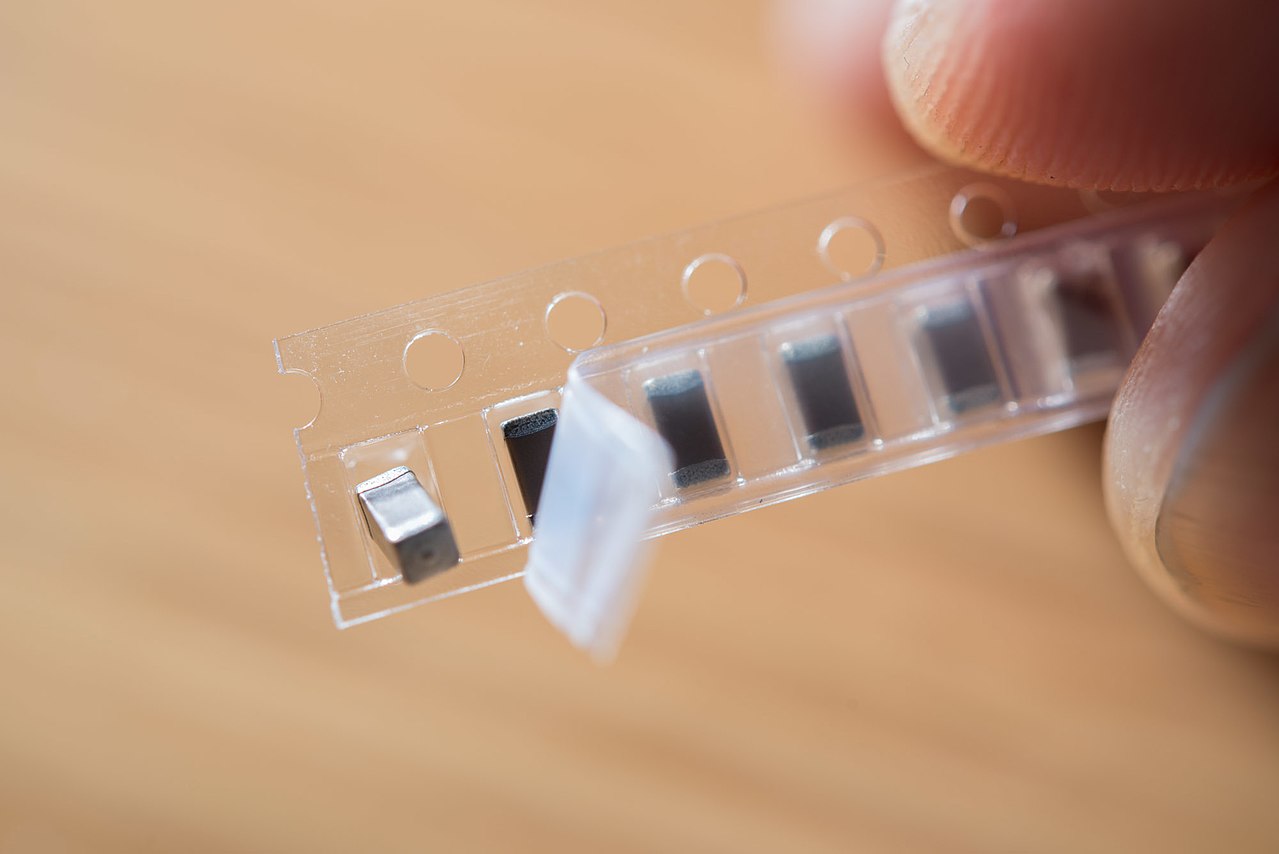
Surface-mount parts in carrier tape, the cover film peeled back (capacitors shown). An MCU arrives on a reel like this, with a date and lot code on the reel label that incoming inspection reads.
An incoming check catches a bad lot before the line. A buyer reads the date and lot code on the reel against the order. A quick measurement confirms the part against a few datasheet limits that matter to the design. A sample from the lot runs on a test board before the full reel goes to production. The check at receiving prevents a line stoppage later. A reel that fails the incoming check goes back to the distributor before it costs a build. A lot that passes goes to the floor with its code logged against the run. The incoming step is the cheapest place to catch a wrong or a drifted part.
A first-article inspection sets a baseline for a new lot. The team builds a few boards from the new lot and runs the full functional test. A golden sample, a board kept from a known-good lot, gives a reference to compare against. If a new lot matches the golden sample across the tests, it goes to production. If it drifts on a test, it gets a closer look first. The golden sample stays in a drawer for the life of the product, a fixed reference each new lot measures against. A photo and a datasheet printout go with it.
The test covers the parameters a lot can move. It checks the clock frequency the design runs on, the analog thresholds it sits near, and the timing of any tight loop. It runs across the temperature and the voltage range the product sees. A test that exercises the spec corners catches a lot at the edge of its window. The design knows which parameters matter and tests those hardest. A test that runs only at room temperature and nominal voltage misses a lot that drifts at the corner. A short script that sweeps the supply and soaks the board at temperature finds the weak lot on the bench. The test plan grows from the parameters the design sits closest to. If the design clocks tightly, the frequency check leads the plan. If it sits near an analog edge, the threshold sweep leads.
Traceability ties the whole check together. The build record holds the date and lot code that went into each batch of product. A field failure traces back to its lot and narrows a recall to the affected runs. A new lot qualified before production, with a code logged at build, turns a lot-to-lot surprise into a known and bounded event. The cost of the check is small against the cost of a recall. A recall scoped to three lots costs a fraction of one that has to assume every unit shipped. The lot code on the build record draws that line.
Working with the maker on changes
The maker tells a buyer about a change ahead of time. A buyer registers the parts it ships and subscribes to the change notices for them. The notice arrives weeks or months before the first changed lot, with the detail of what moves and an offer of samples. A buyer that reads it runs a requalification before the new lot lands. Ignoring the notice turns the change into a field surprise. The notice carries the date of the last old-revision lot and the first new-revision lot, so a buyer times a last-time buy or a requalification to those dates.
A change notice opens a window to qualify the new revision. The maker offers samples of the changed part ahead of the run. The team builds boards from the samples and runs them against the same tests a new lot gets. If the boards pass, the change is cleared. If they fail, the team takes the difference back to the maker.
A change that breaks a design leaves a few ways forward. The team can fix the design to take the new revision, which is the durable path. The team can buy a last batch of the old revision to bridge while it redesigns. The distributor and the maker’s field engineer help size that buy and plan the move. A high-volume product treats a breaking change like a small obsolescence event. The earlier the notice is read, the more of these paths stay open, since a notice caught late leaves only the scramble at the last-ship date.
Designing for any lot
The durable fix lives in the design. A design that holds margin to every spec limit takes any in-spec lot. It clocks its timing from the datasheet oscillator band and budgets for the whole band. It leaves the analog thresholds a guard band on each side. It avoids any behavior the datasheet does not promise. A design built this way meets no lot-to-lot surprise. The margin costs a slightly faster clock or a slightly larger part. A design pays that cost once. That cost is small against the cost of a field failure on a part that met its datasheet.
Some designs go further and measure the part at runtime. A product can calibrate its own oscillator against a known time reference at startup. It can read its analog offsets and correct them in firmware. A design that adapts to the part it runs on absorbs lot drift without a bench step. The technique costs a little code and removes a class of lot-to-lot failure. A product that already carries a real-time clock or a known reference gets the calibration nearly free. The firmware reads the reference once at boot and trims the rest of its timing to it.
Common questions about PIC lot-to-lot compatibility
Are different lots of the same PIC interchangeable?
Two lots of the same part number meet the same datasheet and interchange within those limits. Each lot has its own behavior inside the limits. A design that holds margin to the datasheet limits takes any lot without trouble. The trouble comes only when a design leans on one lot’s measured numbers.
What can change between two lots of the same part number?
The silicon revision can step to a newer die with a different erratum. The internal oscillator can sit at a different point in its calibration band. The analog thresholds, the ADC offset, the comparator, and the reset trip points can land elsewhere in their ranges. The maker can move the part to a newer process or another fab. The assembly site and the lead finish can change. Every one of these stays inside the datasheet.
What is a product change notification?
A product change notification, or PCN, is the notice a maker sends when it changes a part. The change can be the die, the process, the fab, or the assembly site that sits behind one part number. The JEDEC standard for customer notification sets out what the notice carries and when it goes out. A buyer subscribes to the notices for the parts it uses and reads them ahead of the changed lot.
How do I read a PIC date code?
A PIC marking carries the part number, a date code, and a lot or trace code. The date code is usually four digits: two for the year and two for the week. The lot code identifies the production run and the assembly site. A small package carries a shortened code that the maker maps back to the full record. The silicon revision shows in the marking or the trace code on many parts.
Why does my board work on one lot and fail on another?
A board tuned to one lot leans on that lot’s measured behavior. A later lot can sit at the edge of its spec, where the tuned design has no margin left, and the board fails in the field. The fix is to design to the spec limits, so any in-spec lot runs. A bench retest at the spec corners finds the weakness before a new lot ships.
How do I qualify a new lot before production?
Qualifying a new lot starts at incoming inspection, where a buyer checks the date and lot code and measures a sample. A first-article build runs the full functional test on boards from the new lot. A golden sample from a known-good lot gives a reference to compare against. The test exercises the spec corners and the parameters the design sits near. The build logs the lot code, so every unit traces back to its run.