A toy or an appliance ships in huge numbers and counts every fraction of a cent. The microcontroller in it is often the cheapest part that still does the job: an 8-bit chip that costs a few cents in volume. The lowest tier of the 8-bit market runs from the familiar PIC and 8051 parts down to sub-ten-cent chips and bare dies bonded straight to the board. Reaching that floor trades features and flexibility for unit cost.
What low-cost means here
Low-cost here means the bottom of the 8-bit price range. A mainstream PIC or AVR runs tens of cents in small quantity. A volume order drops that to a handful of cents. The cheapest dedicated parts, aimed at high-volume consumer goods, reach a few cents each. A bare die bonded to the board can fall below a cent at the scale a toy ships in. Each step down the price ladder trades something away. A design picks the step its product can live with. A cent saved on a part that ships fifty million times is half a million dollars on one product line. That arithmetic is what pulls a design toward the bottom of the ladder. The pull is strongest where the chip does the least work.
The product sets how low a design can go. A toy runs a melody, blinks an LED, reads a button, and gets thrown away within a year, so it reaches for the cheapest part that lasts that long. An appliance runs for a decade on a noisy mains supply under a safety standard, so it leans on a robust part it can trust. The same low-cost market serves both, at different points on the price ladder. The job and the lifetime of the product set the budget for the chip. A greeting card that plays a tune once needs a part that survives a year in a drawer. A washing-machine controller faces ten years of heat, vibration, and a switching motor on the same board. Each product reads the same price list and stops where its lifetime allows.
What makes an 8-bit part cheap
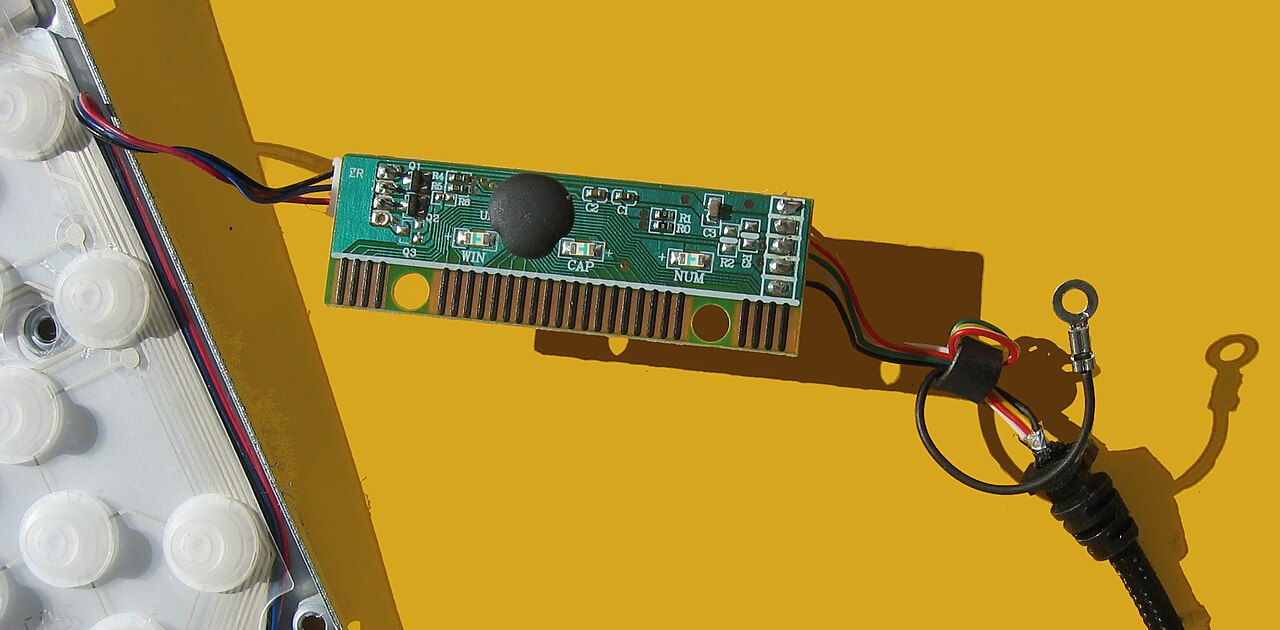
A chip-on-board build on a keyboard controller: a bare die under the round drop of black epoxy, wired straight to the board. This is the lowest-cost form a microcontroller takes.
The die is the biggest cost in a cheap part. A small core on an old, paid-off process takes a tiny area of silicon. A tiny die yields thousands of parts per wafer, so the silicon cost per part falls to almost nothing. The cheapest 8-bit cores carry a few hundred bytes of memory and a minimal instruction set, which keeps the die small. A part designed to be cheap starts with the smallest die that runs the job. Everything else on the chip is added back only where the job needs it. An old process of 180 nanometers or larger, long paid off, costs far less per wafer than a modern node. A simple 8-bit core needs nothing newer. The maker runs it on cheap, mature silicon and passes the saving down.
Memory type sets a large part of the price. Three kinds set three price points: flash that reprograms freely, OTP that programs once at the factory, masked ROM fixed in the silicon at the wafer stage. Flash carries the highest cost on the die. The cheapest parts ship with OTP or run masked ROM at high volume. The choice of memory follows how the product is built and updated. A frozen program on a high-volume product opens the door to the cheapest memory. Flash also wears out after a number of writes. A one-time part never counts that limit. OTP and masked ROM hold the program in cells that stay put for the life of the part.
The package adds its own cost. A leaded SOIC or DIP costs little and assembles on any line. A bare die skips the package altogether: the silicon bonds straight to the board under a drop of black epoxy. This chip-on-board build, the black blob in a cheap toy, is the lowest-cost form a microcontroller takes. It needs volume and a board house set up for die bonding. The saving comes from the package that is never made. A leaded part in a tube or on a reel still assembles on any line at a few cents, so a design that wants easy build stays leaded and saves. The package choice sets how much hands-on work the board needs. A SOP-8 or a DIP costs a cent or two more than a bare die. It places on any line with no die-bonder behind it. The package is cheap insurance for a product made in the hundreds of thousands.
A cheap part carries only what the job needs. It drops the ADC, the serial blocks, and the extra timers a general part includes. It runs on an internal oscillator with no crystal. It keeps a few I/O pins, one timer, and maybe a comparator. Every block left off the die is area saved and cost removed. The part does one class of job and nothing more. A toy melody chip carries a tone generator and a few outputs. A motor-control part carries a PWM and a comparator and leaves the serial blocks off. The peripheral mix on a cheap part is cut down to one application.
Volume drives the last of the cost out. A part made by the million amortizes its mask set and its test program across the run. A short test on a simple part costs little per chip. The maker prices the part against a market of other cheap parts, so the margin stays thin and the volume carries the business. A design that brings the volume gets the lowest price the part can reach. The order size is part of the price. A maker that wins a million-unit socket prices it to hold it, since the volume is the prize. The quoted price on a cheap part assumes the volume that earns it.
The parts and makers at the bottom
A handful of makers compete for the absolute bottom. Padauk builds parts that sell for a few cents, including one widely known as the three-cent microcontroller. These run an OTP memory and a small core, programmed once and dropped into a high-volume product. The toolchain and the documentation are sparse, so the parts suit a team set up to work with them. The price is the draw. The architecture is unusual, with a multi-channel core that interleaves a handful of tasks. A design that adopts it commits to the maker’s tools and its way of working. The reward is a bill-of-materials line measured in single cents. A team that ships at toy volume and counts every cent finds the saving large enough to justify the unusual flow.
Holtek, Sonix, and a few others fill the cents-each tier with OTP and flash parts. These carry a melody generator, an LED driver, or a touch front-end aimed at a toy or a remote. The parts come with a usable toolchain and a catalogue a designer reads. They sit a step above the absolute floor on price and a step above it on support. A toy that needs a little more than the cheapest die starts here. Sonix and EM Microelectronic sit in the same band with parts shaped for sound and touch. A talking toy or a capacitive button panel finds a ready peripheral in this tier. The catalogue runs deep enough that a designer matches a part to the product in an afternoon.
The 8051 core lives on in cheap parts from Nuvoton, Megawin, and others. A Nuvoton N76 part runs an 8051 at a few cents with flash, an ADC, and the robustness an appliance wants. Nuvoton documents its 8-bit 8051 line on its 8-bit 8051 MCU pages. These parts carry the 5 volt operation and the noise tolerance a mains-powered product runs on. An appliance often picks one of these for the robustness it adds.
Microchip holds a place at the low end with the PIC10 and PIC12 parts. A PIC10F in a SOT-23 runs a simple job at a low price with a mature toolchain behind it. At the lowest tier, a masked-ROM die bonded to the board carries the cheapest products of all. A music box, a greeting card, a simple remote: each runs a die under a black blob, made by the million. The part list at the bottom is wide. Price and support move together down it. A design walks down that list to the first part that meets the job and the volume. The cheapest part that does the job is the one it picks.
Low-cost 8-bit parts by tier. Prices are rough volume figures and move with the market. Sources: vendor data and distributor pricing.
Maker
Example
Rough volume price
Memory
Best fit
Padauk
PMS150C
3-10 cents
OTP
Throwaway toys
Holtek / Sonix
HT66, SN8F
10-30 cents
OTP, flash
Toys, remotes
Nuvoton
N76E003
15-40 cents
Flash, 8051
Appliances
Microchip
PIC10F, PIC12F
20-50 cents
Flash
Mixed
Chip-on-board
Masked-ROM die
under a cent
Masked ROM
Huge-volume toys
What you give up at the bottom
The bottom of the market takes back as much as it saves. OTP and masked ROM hold no field update, so a bug in shipped units stays there. Masked ROM adds a large minimum order and a wait for the wafer run, and it freezes the code before the first part ships. The sparse tooling on the cheapest parts asks for a team that knows them. Few pins and little memory cap what the part does. A second source is hard to find for an exotic cheap part, since the footprint and the code rarely match across makers. An end-of-life notice on a single-source cheap part can force a redesign on a product built to ship for years. The lowest price often comes with the largest supply risk. A design weighs each of these against the cents it saves.
Choosing a cheap 8-bit for a product
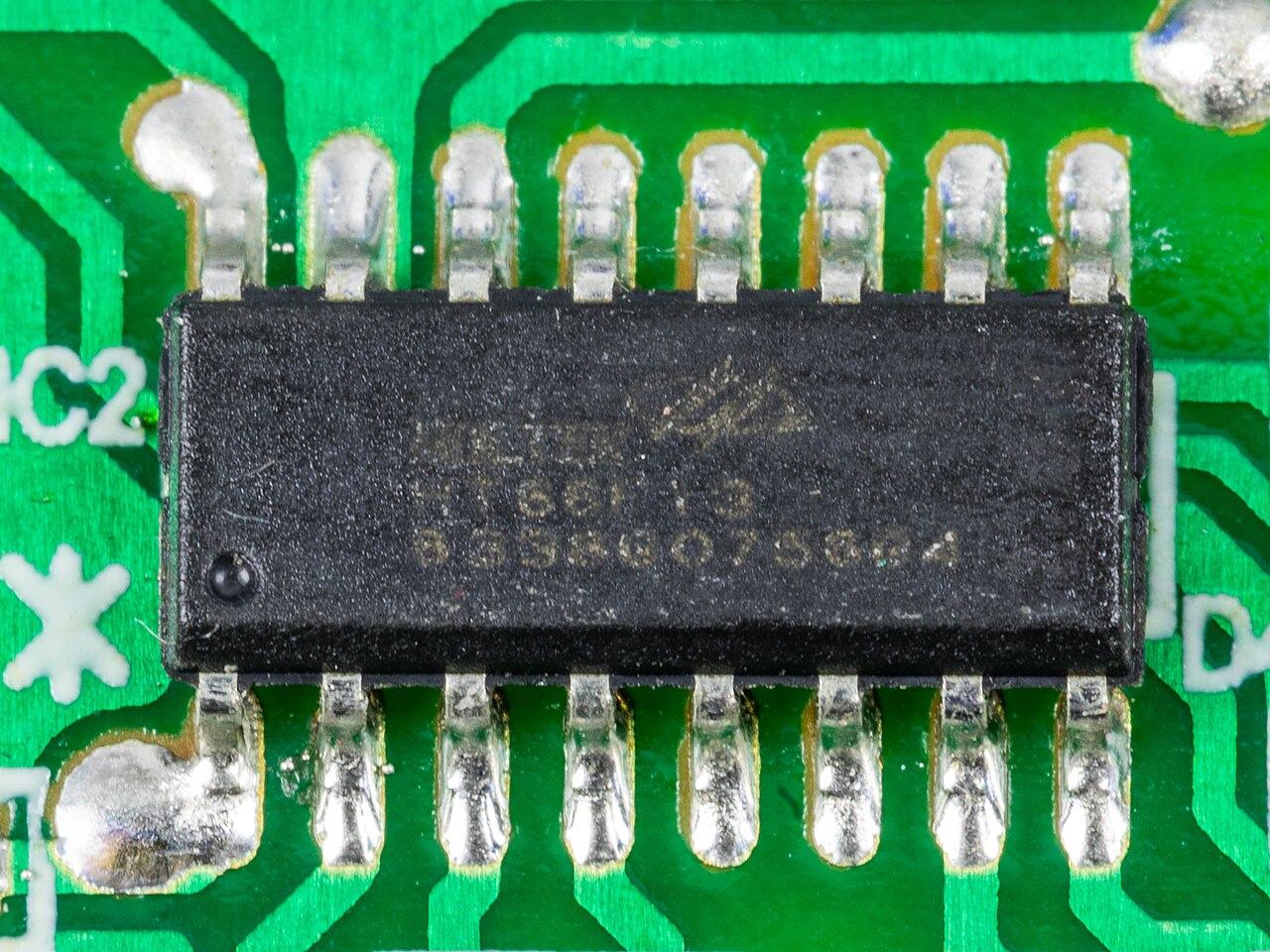
A Holtek HT66F13, a low-cost 8-bit microcontroller, on the board of a Logitech Z130 speaker set. Parts like this run the buttons, the display, and the timing in consumer products at a few cents each.
A few questions point to the right tier. If the product ships by the million and runs one simple job, the cheapest OTP part or a chip-on-board die fits. If it ships in the thousands and a bug would mean a recall, a flash part holds the safety of a field update. If it runs on mains power under a safety standard, a robust 8051 or PIC part fits the duty. If the team has no time to learn a sparse toolchain, a part with a full catalogue and a known compiler is the cheaper path overall. Many products land between the extremes, on a cents-each OTP or flash part with a real toolchain. The absolute floor is for the highest volumes and the simplest jobs. The right answer is the cheapest part that clears the job, the volume, and the team’s ability to build it.
Volume decides whether the bottom pays off. Masked ROM and chip-on-board carry a mask cost and a setup cost paid once. The higher the volume, the more units share that fixed cost, so the per-part saving grows. A run of millions is where the die-on-board build and the masked ROM pay for themselves. The break-even sits where the saved cents across the whole run cover the mask and the line setup. A product that clears that line reaches for the floor. A smaller run stays on a flash or OTP part in a standard package.
Supply matters as much as price at the bottom. The cheapest parts come from makers a buyer checks for stock, lead time, and a long-term commitment to the line. A second source in the same footprint guards a high-volume product against a shortage. The design confirms the part is in steady production before a mask is cut or a million units are planned. A cheap part chosen with care holds a product together for its whole run. A datasheet, a stock check, and a sample order come before the volume commitment, so a surprise turns up on the bench, early and cheap to fix. A long-term-supply commitment from the maker, where one exists, backs a product that will ship for years. Stable supply is part of what a cheap part has to deliver.
Programming and building at the bottom
Programming a cheap part fits the volume it ships in. An OTP part programs once at the factory, often in a gang programmer that loads many parts at a time before they reach the board. A flash part programs on the line through a few pins, or it arrives pre-loaded from the distributor. The program is locked after the write on an OTP part, so the firmware is final before the run starts. A flash part keeps the option to reload during the build, which a longer-lived product values. A gang programmer fills a tray of OTP parts in one pass, which keeps the per-part programming cost near nothing at volume.
Masked ROM follows a longer path. The maker turns the final program into a photomask and builds it into the wafer. The code is frozen at that point, since a change means a new mask and a new wafer run. A first batch comes back for a check before the full order runs. The lead time stretches to weeks. A high-volume product plans around it from the start. A change after the mask is cut means a new mask charge and another wait, so the code review before the freeze is thorough. The first masked parts get a full functional test against the frozen spec.
Chip-on-board skips the package and the part number both. The board house buys bare dies on a wafer or in a tray. A bonder glues each die to the board and wires its pads to the copper with fine gold or aluminum threads. A drop of epoxy, the glob top, covers the die and the wires for protection. The line that does this runs at volume. The product carries no visible chip at all, only the black blob. A repair shop cannot replace that die, so a fault means a new board. The build trades any field service for the lowest cost on the line.
Where these parts show up
The cheapest 8-bit parts hide in everyday products by the billion. A musical greeting card runs one on a coin cell to play a tune when it opens. A remote control scans a keypad and sends an infrared code from one. A kitchen timer, a blinking shoe, a novelty gadget: each carries a die that costs less than the battery beside it. The part does its one job and rides in the bin with the product a year later. None of these products would exist at their price without a chip this cheap. The microcontroller is the part that makes a singing card or a four-function gadget affordable at all.
Appliances run the sturdier end of the same market. A washing machine, a microwave, and an air conditioner each carry an 8-bit part for the control panel and the timing. The part reads buttons, drives a display, and switches the relays on a 5 volt rail beside the mains. It carries the noise tolerance and the temperature range a white-goods product lives with. The same low-cost market, one step up from the toy floor, runs the panel on the appliances in every kitchen. A smoke detector, a thermostat, and a battery charger each run one too. The reach of the cheap 8-bit part covers the whole house and the car in the driveway. Each of these reads a few buttons and runs a simple sequence, the kind of job an 8-bit part has done for forty years.
Common questions about low-cost 8-bit MCUs
What is the cheapest 8-bit microcontroller?
Padauk parts reach a few cents, with one widely known as the three-cent microcontroller. They run a one-time-programmable memory and a small core. Below even that, a bare die bonded to the board, the black blob in a toy, can fall under a cent at high volume. The exact floor moves with the part, the memory type, and the order size.
Why are some MCUs only a few cents?
A cheap 8-bit part starts with a small die on an old, low-cost process. It uses one-time-programmable or masked ROM in place of flash. It drops the peripherals a general part carries and keeps only a few pins and a timer. Volume in the millions spreads the fixed cost thin. Together these bring the price to a few cents.
What is the black blob on a toy circuit board?
The black blob is a chip-on-board build. A bare silicon die bonds straight to the board with fine wires. A drop of epoxy covers it for protection. The die usually runs masked ROM, the cheapest memory. This form skips the package entirely and reaches the lowest cost a microcontroller can, which a toy, a greeting card, or a calculator often uses.
What is OTP and why does it cost less?
OTP is one-time-programmable memory. The factory writes the program once. The part keeps it for life with no reflash. OTP needs less circuitry on the die than flash, so it costs less. A design that has frozen its code uses OTP to shave the part price, and a bug in shipped units stays there, since no field update reaches an OTP part.
Can I use a cheap toy MCU in an appliance?
An appliance asks for more than the cheapest toy part. It runs for years on a noisy mains supply and meets a safety standard. A robust 8051 or PIC part, with 5 volt operation and noise tolerance, fits that duty. The few cents saved by a bare toy part rarely cover a field failure in an appliance. The appliance pays a little more for a part it can trust.
What do I give up with the cheapest parts?
The cheapest parts give up the field update first, since OTP and masked ROM cannot be reflashed. Masked ROM adds a minimum order and a code freeze before the run. The sparse tools on the lowest parts ask for a team that knows them. Few pins and little memory limit what the part does. A design reads this list against the cents it saves and picks the tier that fits.