The NXP S08 is an 8-bit microcontroller family with a long history. Its line runs from Motorola’s 68HC08 through Freescale and into NXP. One day a design’s exact S08 part turns up marked not recommended for new designs. The part then moves toward end-of-life. A buyer has to find what takes its place. No second maker builds a drop-in S08. A replacement means a move: to a newer NXP part, to another 8-bit family, or up to a 32-bit core. Which path fits depends on how long the product still has to sell.
What the S08 was, and why it is fading
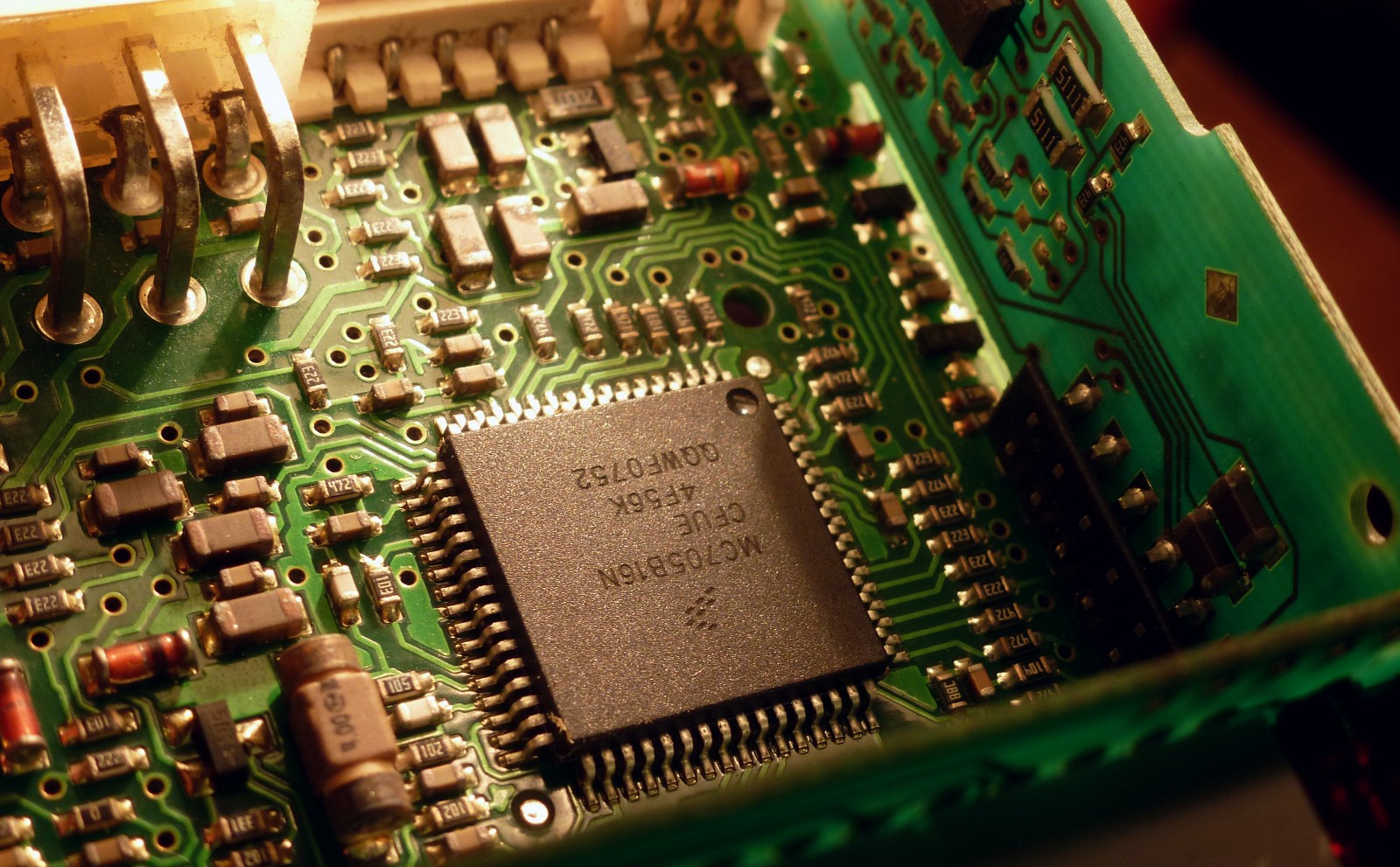
A Motorola MC68HC705 on a product board, a forebear of the S08 in the same long 8-bit line that began with the 68HC05. A mature part like this, fielded for years, is the kind an obsolescence notice eventually reaches.
The S08 core descends from a long Motorola line. The 68HC05 and the 68HC08 came before it. This is an 8-bit architecture. It has run in countless products since the 1990s. Freescale carried it after the split from Motorola. NXP took it on when it bought Freescale in 2015. The part is an 8-bit design, programmed and debugged over a background debug interface. Its code is written and built in CodeWarrior. A generation of S08 work grew up in that toolchain. A long record put the S08 into appliances, into industrial boards, into automotive bodies. The part stayed trusted across decades of designs. The HCS08 carries the number 9S08 in NXP’s catalogue. It gathered a wide spread of variants over the years: the small QG and SG parts, the USB-bearing JM, the later S08P with a pinout aimed at an easy step up. The RS08 cut the core down further for the cheapest jobs. The family ran from a handful of pins and a kilobyte or two of flash up to larger parts with the peripherals an appliance board wanted. The S08 found its place in cost-sensitive, high-reliability jobs: a motor control in an appliance, a body controller in a car, a sensor board in a factory. That kind of design runs unchanged for a decade. An obsolescence notice hits a design like that hardest. Such a product keeps selling for years after the part beneath it has started to fade.
The line fades for the same reason many an old part fades. NXP puts its new development into its Arm-based lines. The family gains no new parts now. NXP keeps the existing 8-bit S08 in production for the installed base. A part with no new development behind it drifts toward not recommended for new designs, then toward end-of-life. NXP sets that status on each part on its own schedule. NXP names the stages on its product lifecycle pages. A design reads the status of its exact part there before it leans on the part. The background debug module is a single-wire port. It programmed and debugged the part through one pin. The BDM pod and CodeWarrior made up the bench an S08 developer knew. S08 firmware still builds in CodeWarrior. NXP keeps that legacy tool alive for these parts. The newer NXP environments, MCUXpresso among them, leave the S08 out. NXP puts its money into Arm cores, like the other big makers. No new S08 part comes to refresh the family. The company’s energy goes to its 32-bit roadmap. A buyer reads that direction and plans away from the S08. The part still works as well as it ever did. Its future is the problem.
The fade is not a single day. Each part sits at its own point in the cycle. The count at each stage shifts over time. A design reads the live status of its exact part number. A design plans to leave a part whose line has no future. The buyer sets the timing. A design caught early reads the signs. The NRND mark tells it to start planning while the part is still in hand. A design that ignores the mark meets the end-of-life notice unready. The window to act is short. The choices are few.
Where an S08 design goes
A replacement runs in one of a few directions. The table below sets them side by side: each move and what it asks of a design.
Replacement paths for an S08 design. Effort is the rough scale of the move, not a fixed figure. Sources: NXP product lifecycle and Kinetis E documentation.
Path
Target
Core
Effort
When it fits
Keep running
The S08 itself, on a last-time buy
S08, 8-bit
None now, a redesign later
A shipping product with a near end-of-life date
NXP Kinetis KE
Kinetis KE02, KE04
Arm Cortex-M0+, 5 V
A port; KE02 shares the S08P pinout
Staying with NXP, a 5 V robust design
NXP entry today
LPC800, MCX A
Arm Cortex-M0+
A full port
A fresh NXP design with a long road ahead
Another 8-bit
PIC, AVR, STM8
8-bit, various
A full port
A design set on staying 8-bit
Entry 32-bit
An entry Cortex-M0+ part
Arm Cortex-M0+
A full port
Fresh designs leaving the S08 for good
The keep-running path is a delay. It carries the product on the S08. It leaves the redesign for later. A last-time buy stocks enough of the S08 part to reach a planned redesign. The parts go on a shelf. The team draws them down while it builds the new design. A lifetime buy goes further. It stocks all a product will ever need. The design then freezes on a part the catalogue has dropped. Either path buys time for the redesign that still has to come. The buy ties up cash in parts on a shelf. It leans on a forecast. A wrong guess on the quantity hurts on either side of the right number. A lifetime buy on a long-lived product can run to a large order. The team weighs that sum against the cost of the redesign it puts off. The parts also age in storage. A long hold has to mind the date code and the storage conditions. A last-time buy also ties the design to the part’s last revision. No errata fix or process change comes after it. The parts in the box are the final word. A buyer weighs the certainty of a known part against the cash it locks away.
The move to a newer part is the real replacement. Two questions set the direction: stay inside NXP or cross to another maker, stay 8-bit or move up to 32. A team that values one vendor and one toolset looks first at NXP’s own path. That path keeps the relationship, the distributor accounts, and the support the team already has. Its targets are the Kinetis or the newer entry parts. Dropping that tie opens the whole low-end field, where the entry 32-bit parts of several makers all qualify. The move is much the same work whichever it picks. Either way, the pull runs toward a 32-bit core. An entry Cortex-M0+ now costs about what the 8-bit part it replaces costs. The price gap that once made an 8-bit part the obvious choice has closed. An entry 32-bit part now lands near the S08’s price. The same money buys far more core. A design replacing an S08 today rarely saves money by staying 8-bit. Staying 8-bit makes sense only for an existing code base or a board it has to match.
The work of any of these is a port. None is a simple swap. The S08 core, its registers, and its CodeWarrior project do not carry to an Arm part unchanged. The firmware gets rewritten against a new core and a new peripheral library. A move to another 8-bit family asks the same. A new core and a new toolchain wait there too. The effort that lands a fresh 8-bit part lands a 32-bit one for much the same outlay. That sends many S08 replacements straight up to a Cortex-M core. The application code is the logic a product is built from. It carries across as C. The heaviest work sits in the peripheral layer. The timers, the serial, and the ADC all get set up anew against the target’s library.
The Kinetis KE, NXP’s own answer
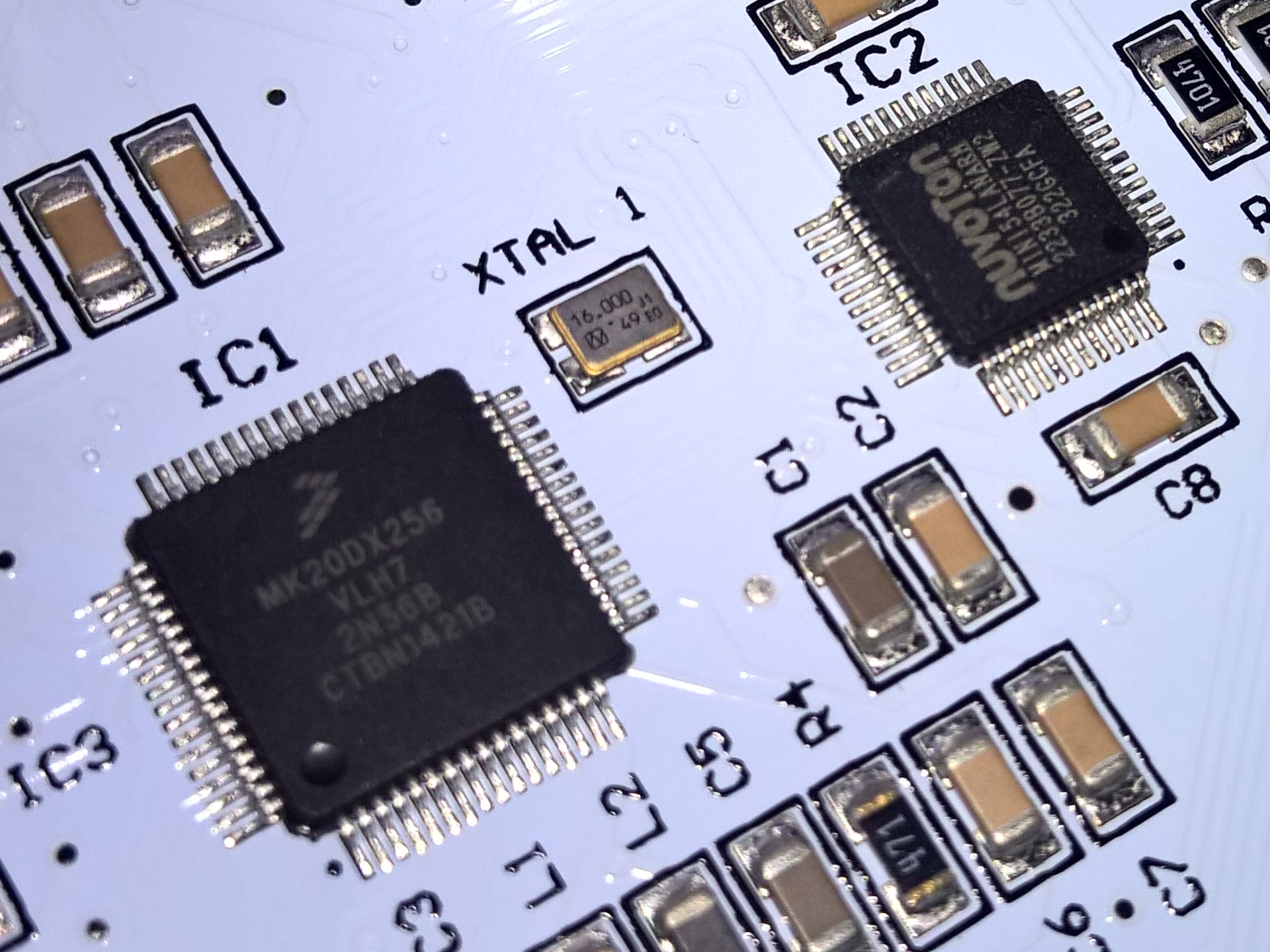
A Freescale Kinetis MK20, marked IC1 with the Freescale logo, an Arm Cortex-M part from the Kinetis family NXP offers as the move up from the 8-bit S08. The chip at IC2 is a separate Nuvoton part on the same board.
NXP positions the Kinetis KE line as the home for an 8-bit design moving up. The E series is an Arm Cortex-M0+ part. It runs on a 5 V rail and in a noisy environment. This is the same world the S08 lived in: high voltage, plenty of electrical noise. NXP aims the line at updating mid-range 8-bit designs. The Kinetis KE02 carries the move furthest. Its pinout matches the 8-bit S08P family. A board laid out for the old part can take the newer one in the same footprint. A design on an S08P steps onto a 32-bit core with less board work than a move to an unrelated part would ask. The KE02 runs an Arm Cortex-M0+ at a modest clock. The KE04 and the KE06 reach higher. The line spans the range an 8-bit design grows into. The 5 V rail is the tell. This is a Cortex-M part that lives where few 32-bit MCUs do: the noisy industrial and appliance supplies the S08 had always run in. A design keeps its 5 V world. It gains a 32-bit core in the one move. A Kinetis KE keeps the robustness the S08 had. That means the higher voltage, the tolerance for a noisy line, the qualification an appliance or automotive board has to pass.
The tools change too. Moving the firmware means a change of toolchain. CodeWarrior holds the S08. MCUXpresso holds the Kinetis line. The firmware moves to MCUXpresso. NXP holds the Kinetis KE as its 5 V robust entry line. It points new low-end work at its LPC800 and MCX parts as well. A buyer reads the lifecycle of the exact target before committing to it. NXP documents the E series and its place against the 8-bit parts on its Kinetis E series pages. The gain of the move is the Arm ecosystem: the libraries, the real-time kernels, the middleware that grew up around Cortex-M. An 8-bit S08 reaches none of it. A design that steps up trades a dead-end core for one with a long road ahead and a deep toolbox. The port is the price of that road. A team that has carried one S08 design onto a Kinetis part builds skill the rest of its parts reuse. The second move is lighter than the first. The MCUXpresso flow and the Arm habits are already in hand.
Managing the obsolescence
The first task is to know where each part stands. A design lists the S08 parts it uses. It reads the lifecycle status of each: the active ones, the ones marked not recommended for new designs, the ones with an end-of-life note. NXP carries that status on its product lifecycle pages, along with the change notices that move it. A buyer signed up for the notices on those parts catches an end-of-life call when it lands and builds the plan on it. Industries that field a board for fifteen or twenty years, automotive and medical and rail among them, run a formal obsolescence-management process. A standard such as IEC 62402 sets out how a program tracks part status, forecasts last-time-buy needs, and records the evidence behind each call. A design in one of those fields logs the S08 end-of-life as one entry in that running process, long before the last-ship date.
The end-of-life notice opens a window. A last-time-buy date sets the last day a part can be ordered. A last-ship date sets the last day it leaves the factory. The span between them is the time a design has to stock or to move. A buyer reads those dates against the product’s own life. Those dates size the stock to put away or the redesign to start. The earlier the end-of-life notice is caught, the more of a plan it becomes and the less of a scramble. The window can run months or a year or more. That is enough to redesign for a team that starts when the notice lands. Letting the window run down reaches the last-ship date with no part and no replacement ready.
The stock-versus-redesign call turns on how long the product runs. A product near the end of its own life takes a last-time buy. The parts get set aside to see it out. No redesign happens at all. The longer a product still has to sell, the more a redesign onto a part with a future pays off. The cost of the move gets paid once. A product in between weighs the two. A buy that bridges to a redesign is a common middle path.
The single source sharpens all of this. The S08 comes from NXP alone. No second maker can step in when the part runs short. The lifecycle of the exact part is the whole supply picture. A design carries that by watching the status, holding the stock its plan needs, and choosing a replacement early, ahead of the pressure of an empty shelf.
A design also looks past the one part. An end-of-life on a microcontroller often travels with the rest of an aging board. The memories, the support parts, and the analog around it near their own end. A buyer scans the whole bill of materials for the parts at risk. The redesign the MCU forces gives a chance to refresh the board’s other obsolescent parts in one pass. A move that starts with one part can clear three at once.
Sourcing through the change
A transition stocks the old part and the new one at once. A product ships on the S08 during the time its replacement is designed and proven. The two run side by side until the move is done. A distributor holds the S08 for the tail of the running product. It holds the replacement for the next one. The order book spans the overlap. A buyer who reads the end-of-life dates early places the last-time buy it needs. It ramps the new part on a schedule of its own making. A buffer of the S08 covers the gap between the last-time buy and the first run of the replacement. The two stocks overlap, so the line never stops. A distributor with both on its shelf carries the design through the handover. The order book is the bridge from the old part to the new. A cross-reference from the distributor or from NXP points an S08 part number toward its nearest replacement. The suggestion is only a starting point. A team checks it against the design before it trusts it. The replacement a design can commit to is the one proven on the bench and in the field. The cross-reference is only the first name on a list a team works through. A pin-compatible part such as the KE02 still gets the same proving. The matching footprint is no promise that the firmware behaves the same. The replacement lands a design on a part with a future. A part chosen early in its life, on a line a maker is still growing, is the foundation a long-running product needs. A buyer confirms the status, the stock, and the lead time of the target part. The package and the grade get pinned down before the redesign commits to the part. A planned move off the S08 comes ahead of any shortage. It costs less.
Common questions about replacing the NXP S08
Is the NXP S08 obsolete?
The S08 is a legacy family that NXP holds for its installed base. NXP adds no new parts to it now. The parts sit at different stages: some still shipping, some at not recommended for new designs, some at end-of-life. The live status of an exact part is read from NXP’s product lifecycle pages. The family-wide picture is only a guide.
Is there a drop-in replacement for an S08 part?
No second maker builds a drop-in S08, since the core is NXP’s own. The closest thing to a low-effort move is NXP’s Kinetis KE02. Its pinout matches the 8-bit S08P family, so a board can take the newer part in the same footprint. Even the KE02 needs its firmware ported to an Arm core.
What does NXP offer as a replacement?
NXP points 8-bit designs toward its Kinetis KE series. This is a 5 V robust Arm Cortex-M0+ line aimed at mid-range 8-bit designs, with the KE02 pin-compatible with the S08P. NXP’s broader entry portfolio holds the newer low-end work: the LPC800 and the MCX parts. A buyer reads the right target against its own lifecycle.
Do I have to change toolchain to migrate?
Moving off the S08 means swapping CodeWarrior for NXP’s MCUXpresso, which carries the Kinetis and the newer Arm parts. The firmware gets rewritten against a new core and a new peripheral library. The application logic carries across as C. The rewrite falls on the low-level code.
Should I last-time-buy the S08 or redesign now?
It turns on how long the product runs. A product near the end of its own life rides a last-time buy to retirement. The more selling life a product has left, the more a redesign onto a part with a future pays off. A buyer reads the end-of-life dates against the product’s life. Those dates size the stock to hold or the move to make.
What is the difference between NRND, EOL, and obsolete?
Not recommended for new designs means two things. A part still ships for existing products. The label steers a team away from putting it into something new. End-of-life means a last-time-buy date has been set, leaving a window to stock or to move before the part goes. Obsolete, or no longer manufactured, means the part is gone from the catalogue. NXP carries each status on its product lifecycle pages.