The 8051 is an eight-bit microcontroller core Intel drew up in 1980. It outlived its maker long ago and lives now as a core dozens of vendors wrap their own silicon around, the same instruction set running in chips designed last year. A few jobs still hand a fresh design to the 8051 in 2026, places where a cheap, deeply worn eight-bit core holds its ground against parts far newer. It wins those places on a low price the newer parts have not matched.
The name on a modern part
A core sold today runs close to one tick an instruction, near ten times the work the original got at the same megahertz on its twelve-tick machine cycle. The gain came from redrawing how the core runs each instruction, the modern part doing in one clock what the first one spread across twelve. A buyer who reads “8051” on a 2026 data sheet reads an old instruction set on modern silicon, little of the old speed left in it.
What came forward is the instruction set and the programmer’s model, the eight-bit accumulator, the four register banks, the bit-addressable memory, the special-function registers a coder reaches for by name. The same memory map carried over, the small pool of internal RAM, the sixty-four-kilobyte reach over code, the separate external data space a program pages through. Code written for the architecture across forty years compiles and runs on the new parts, the proven firmware a company keeps when it stays with the core. The original chip held masked ROM and a few hundred bytes of RAM. The part sold now wraps the same core in flash program memory, an on-chip ADC, hardware PWM, a clutch of timers and serial ports, some derivatives a USB engine or a capacitive-touch block. An internal oscillator spares the crystal, an on-chip debug port replaces the old emulator, a brown-out circuit watches the supply. The core stayed eight-bit and small. The silicon around it caught up with the century.
A modern derivative idles in microamps, wakes in microseconds, runs from a coin cell, figures the 1980 part never reached. A sensor node that sleeps between readings draws so little that one battery lasts the life of the product, a duty the old part could never hold. A part that wakes in microseconds, takes a reading, and drops back to sleep is awake for only a sliver of each second. The long sleep between readings is where the power budget is won. The name on the part promises code that ports and tools already in hand. The old 1980 timing is gone, the fast cores leaving it behind.
Where it still wins
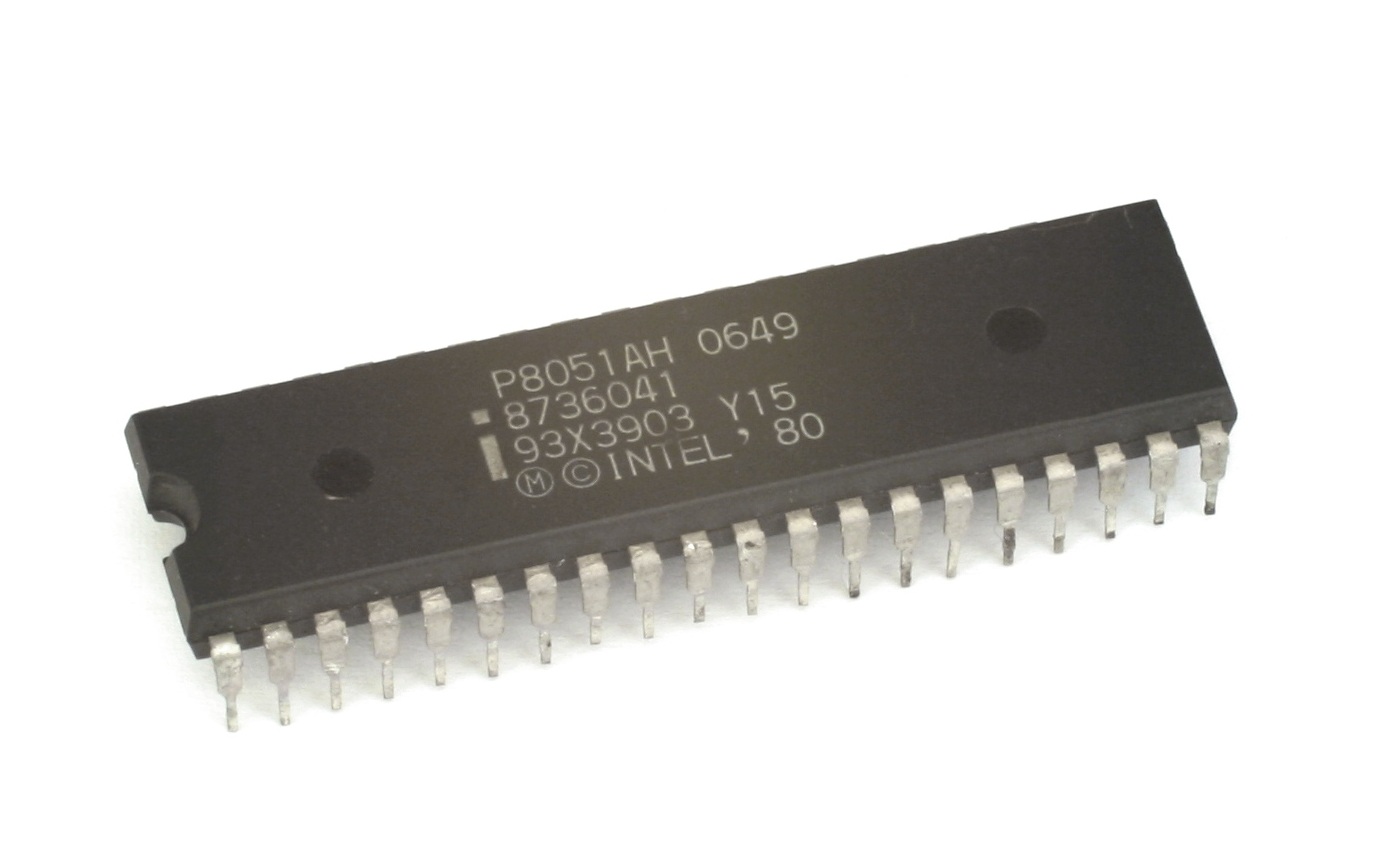
An Intel P8051 in a 40-pin plastic dual in-line package, marked with its own factory part number and Intel’s 1980 copyright. The original NMOS part, its instruction set the same one carried on the small fast cores sold today. Image: Konstantin Lanzet, CC BY-SA 3.0.
Price is the first niche, and the deepest.
A high-volume consumer good counts its parts in single cents, a toy, a charger, a remote control, an LED driver, a small appliance built down to a target a buyer holds the line on. A job that needs a handful of pins, a timer, an ADC, and a little control logic does not call for a thirty-two-bit engine to run it. The 8051 core fills that job from a tiny die. A small die is a cheap part. Vendors who serve the commodity floor, several of them Chinese houses such as STC, Nuvoton and Megawin, ship eight-bit parts at a unit price a designer counts in cents, the program in flash, the oscillator on chip, the pin count cut to the task. A part that carries its clock and its program memory on chip needs no crystal and no memory chip beside it, the board shrinking to the part and a few passives. Fewer components left off cut the cost again. Fewer parts to place and test lower the cost of building the board as well, the saving reaching past the price of the chip into the work of assembly. Across a run in the millions the saving turns into real money over a year of production, the place an eight-bit core still pays its way against a thirty-two-bit part that costs a little more on every board. A bill of materials squeezed to the cent is the clearest case the 8051 still answers, the saving plain where the volume is large and the function stays simple.
The second niche hides the core inside something else. A radio chip, a USB bridge, a touch controller often carries a small control core to run its housekeeping. For a long line of those parts that core is an 8051. A wireless part built around an 8051 runs its firmware on that core, written in the same C and flashed with the same kind of tool. A USB bridge that turns a serial port into a USB endpoint runs its protocol on an embedded 8051, the architecture chosen for the job for a small core, a low power draw, a toolchain already on every bench. A chip designer who needs a control core for housekeeping picks an 8051 for the little silicon area it takes, the tools a team already owns, and the decades it has run without trouble, the core small enough to tuck into a corner of a larger die. A designer who picks such a part inherits an 8051 design-in by way of the chip wrapped around it. The pattern runs through whole catalogues of radios, bridges, and controllers.
The third niche is a code base a company will not throw away. A product line carried on proven 8051 firmware, refined over many revisions and tested in the field for years, is an asset a maker protects. A new model built on a fresh 8051 part runs the same firmware on modern hardware. The cost of rewriting decades of working firmware for a different architecture buys little a customer would notice. The rewrite carries the risk of new faults in code that already works. A product in a regulated field carries the added cost of re-testing and re-certifying firmware that changes architecture, a weight that holds proven 8051 code in place long after a faster core appears. A move to a faster 8051 part keeps the asset and lifts the ceiling at once, the reason a mature product so often stays on the core it was born on.
A fourth niche is the merit of a plain core. An eight-bit part running a small loop is a thing an engineer holds whole in the head, its timing fixed, its behaviour the same on every run, with no cache and no deep pipeline to cloud the picture. A controller that has to answer an input in a set number of cycles, every time, is easier to build and to prove on a core this simple. A safety review of a small deterministic part asks fewer questions than a review of a complex one. A guard that has to cut power within a fixed number of microseconds of a fault, the same on every trip, is a job proven more easily on a core that hides no state. On some jobs a steady, repeatable answer counts for more than raw speed. There the eight-bit core’s plainness becomes the feature, a fixed task run in a fixed time with no surprise in it.
Why so many makers
The 8051 became a part many companies build because Intel let it spread. Intel licensed the core to other makers as second sources in its early years. The design passed into hands across the industry. It settled into a standard no one had to ask permission to build. Vendors drew their own versions, some cloning the core outright once the ground was open, each adding the peripherals and the process its market wanted. The result is an instruction set a crowd of makers serves.
That history is the buyer’s gain. A core with many independent makers carries a second source built into its past, a design able to step from one vendor to another when a part goes short or a price climbs. The architecture outlived Intel’s own interest in it because the crowd kept building, each maker with a reason to keep the parts flowing. Forty years of use left a deep store behind the core, reference designs, application notes, tested libraries, a generation of engineers who learned on it, a base a new design draws on from its first day. A buyer who weighs supply heavier than the newest core finds in the 8051 a part the market has kept alive for forty years with no sign of dropping it.
The vendors that keep it alive
No one company owns the 8051 now, the trait that keeps it stocked. Silicon Labs carries the modern flagship line in its EFM8 and C8051 families, single-cycle cores that run fast and pack real analog on board, an ADC, comparators, a precise internal oscillator. These are the parts that give the architecture without the old slowness, a modern eight-bit part with a debug port and a low-power mode on board. These run from a few volts. Many clock into the tens of megahertz. Analog Devices kept its own line of precision 8051 parts for the signal-chain jobs that suited them.
The low-cost end runs on a different set of names. STC built much of the commodity market across Asia, its parts the default in a wide swathe of consumer goods. Nuvoton fills the same floor with its N76 and ML51 families, single parts selling for a few cents in volume. Megawin and a long tail of houses add their own derivatives at the same level. These vendors compete on price down to the fraction of a cent, the floor where the architecture still wins the goods that count every part.
The core lives as licensable IP, beyond the finished chips that carry it. A chip designer who needs a small control block drops a soft 8051 into an FPGA or an ASIC, the design on hand as open cores and as commercial IP a vendor licenses. The architecture costs little in gate count, runs on tools a team already owns, and asks no royalty in its open form, drawing a system-on-chip team to it for the housekeeping beside a bigger core. A team building its own chip pairs the small core with custom logic on one die, the 8051 there to run the control. The 8051 spread this way into silicon that never wore Intel’s name, an IP block as much as a part on a reel. Open 8051 cores have sat in FPGA projects for years, free to drop in.
That spread is the sourcing case for the architecture. A shortage at one vendor does not strand a design that can move to a compatible part from another, the resilience a buyer learned to value through the lean years of allocation. The move is rarely free, the peripherals around the core needing rework for a new vendor. An exact analog block or USB engine can tie a design to one supplier even so, the feature to trace before the volume rests on it.
When eight bits is the wrong choice
The case for the 8051 is narrower than it was. Honesty about that line matters to a buyer. A thirty-two-bit Cortex-M0+ now sells at prices that lap into eight-bit territory. The newer core brings more speed, a flat memory map a compiler handles without banking tricks, a free modern toolchain in GCC, code that comes easier to write and to keep. For a design past plain control, the thirty-two-bit part is the better place to start, the eight-bit core no longer the cheap default it once was. The same money buys a core that runs rings around the eight-bit part, addresses its memory without paging, and carries the libraries a modern stack expects, all of it pulling a fresh design toward the newer core first.
The eight-bit core shows its age where a job grows. The single accumulator, the paged memory, the sixty-four-kilobyte ceiling on code, the cramped stack, the slow path through anything wider than a byte, each becomes a wall a larger program runs into. C on the part brings constraints with it, data laid out by hand across the memory spaces, functions that do not nest freely without care, arithmetic past a byte paid for in cycles. A control loop doing heavy arithmetic, a stack of connectivity, a buffer measured in tens of kilobytes, a task list that has outgrown a simple loop, each of these calls for a thirty-two-bit part. A green-field design with no inherited code and no extreme cost floor lands on thirty-two bits more often than not in 2026. The eight-bit core has its cases still, the ones that fit it and no other.
Reading the line keeps a design out of trouble. A few cents saved on a part turns into a poor bargain when the program grows past what the core can carry, the redesign onto a bigger part costing more than the saving ever returned. The cheapest part on the bill is a false economy where it costs a month of engineering time to fit the firmware into its cramped memory. The niches the 8051 still holds are the ones where the function stays small, the volume stays large, or the code is already written, the places a careful reader keeps it.
Sourcing and design-in cautions
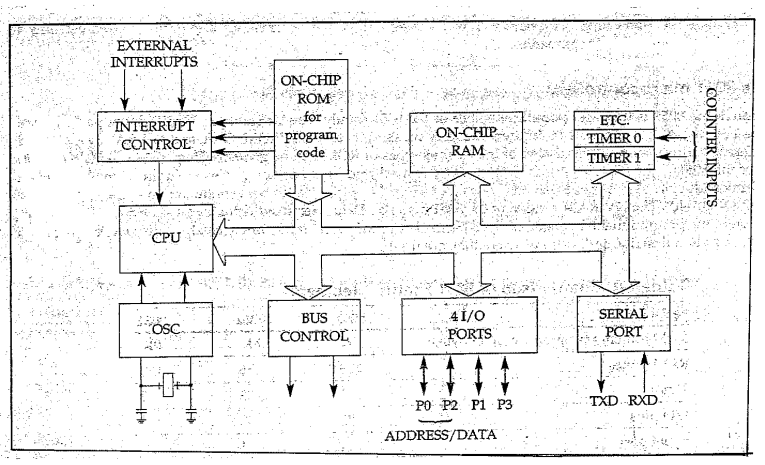
A block diagram of the 8051’s internal layout: the CPU, the on-chip program memory and RAM, the timers, the serial port, the interrupt and bus control, and the four I/O ports P0 to P3. A labelled schematic of the architecture, the kind of overview a data sheet opens with. Image: Aashish Ravi, CC BY-SA 4.0.
The toolchain is the first thing to settle. Keil’s C51 has stood as the standard commercial compiler for the architecture for decades, a paid tool a shop budgets for. SDCC covers the free open-source path, a capable compiler a team can build a product on without a licence. Code moves between 8051 vendors at the C level in the main, each maker drawing its own special-function registers and peripheral blocks, with its own header to match. A port from one house’s part to another’s is real work on the peripheral code, the core logic carried through unchanged, the register names around it rewritten. Few new projects drop to assembly on the part now, a C compiler carrying the work, the tight hand-tuned code the architecture once demanded no longer the rule on parts with memory to spare.
The part itself wants a closer look than its name gives. A core sold as an 8051 may run one clock to the instruction or the old twelve, a tenfold gap in real speed at the same megahertz. A buyer who sizes a design on the architecture alone can land a part too slow for the job. The on-chip oscillator’s tolerance, the flash endurance and retention, the true current in sleep, the exact peripheral mix, each sits in the data sheet of the specific part, the figures a designer reads off that part. A rock-bottom commodity part rewards a hard read of its real specification, the headline price sometimes carrying a coarse oscillator or a thin flash endurance. A part bought on price alone from an open market can come back a clone or a relabel, a die that falls short of its own markings, a risk a buyer heads off by tying a commodity 8051 to a known distributor and a real date code. How the part takes its code matters as much, whether it carries a serial or USB bootloader that loads code without a programmer, or needs a tool and a header on every board. The package and the temperature grade round out the read, the footprint and the rated range checked beside the headline specification. Stock and lead time close the check, a specific derivative confirmed available before a design leans its whole volume on it.
Common questions about the 8051 in new designs
Is the 8051 obsolete?
No. The core lives on in modern derivatives from several vendors and inside many radio, USB and touch chips. New designs still pick it for cost-driven consumer goods, for inherited firmware, and by way of the system chips that carry an 8051 core. Thirty-two-bit parts have taken much of its old ground. The eight-bit core holds the niches that still fit it.
Why would a new design choose an 8-bit 8051 over a 32-bit ARM?
Three reasons carry the bulk of the cases: a cost floor in high-volume goods where an eight-bit die saves cents that matter across millions of units, an existing 8051 code base a maker chooses to keep, and a chosen radio or USB part that already runs on an embedded 8051 core.
Is a modern 8051 as slow as the original?
No. The 1980 part ran twelve clock ticks to a machine cycle. Many parts sold today run close to one tick an instruction, near ten times the throughput at the same clock. The name carries the instruction set forward. The old timing is gone.
Can 8051 code move between vendors?
At the C level it ports in the main. Each maker draws its own special-function registers and peripheral blocks, so a move between vendors means rewriting the peripheral code. The core logic stays the same. Planning a second source means planning that port.
What tools does an 8051 design need?
Keil’s C51 is the standard commercial compiler. SDCC is a free open-source alternative. Flashing the part needs a vendor programmer or, on many modern derivatives, a built-in serial or USB bootloader that loads code without extra hardware.
What peripherals does a modern 8051 carry?
Beyond the timers and serial ports of the original, a modern derivative adds flash program memory, an on-chip ADC, hardware PWM, and an internal oscillator that spares the crystal. Some carry a USB engine, a capacitive-touch block, comparators, or a hardware multiply-and-divide unit. The exact mix sits with the specific part, the data sheet read for the peripherals a design needs.