Third Trimester Biophysical Profile BPP Handheld Ultrasound
A biophysical profile, or BPP, scores how well a baby is doing in the last weeks of pregnancy. It watches the baby on ultrasound for the signs of a baby coping well, breathing, moving, holding its tone, resting in enough fluid, and adds a reading of its heartbeat, each sign earning two points toward a score out of ten. A handheld probe runs the four ultrasound parts at the bedside, the test of fetal wellbeing done where the mother sits. The score tells, in one number, whether the baby is content or in want of a closer look.
Why the test is done
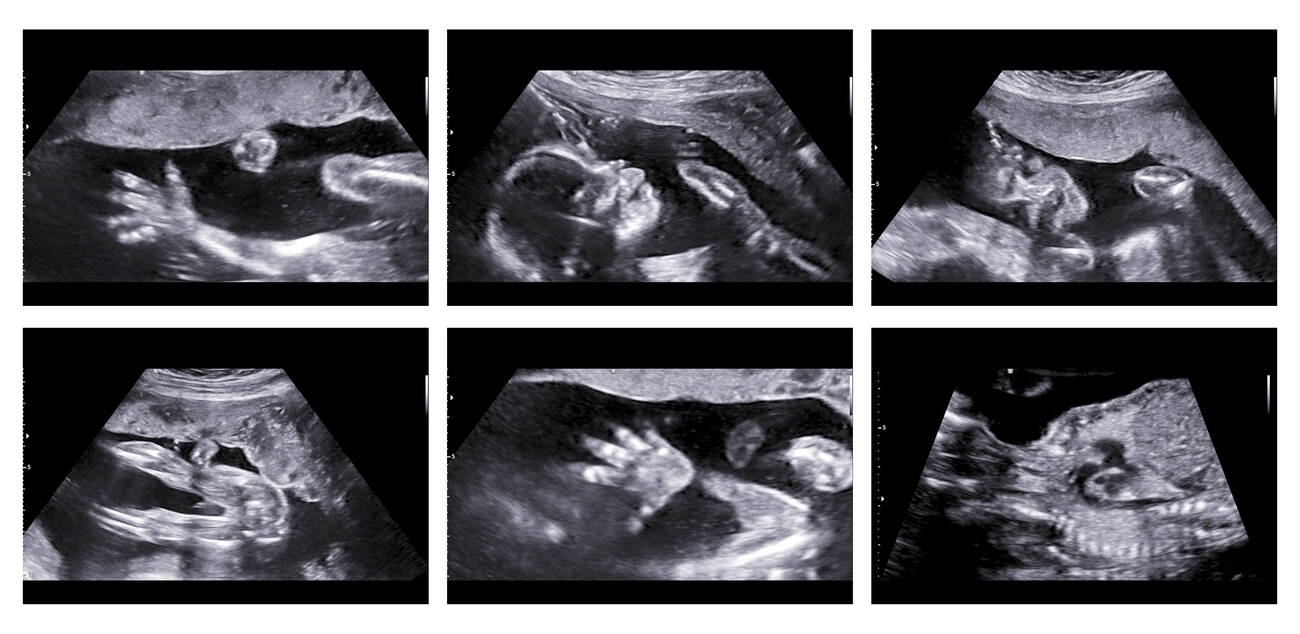
Six views of a fetus on ultrasound, the body, the face, the hands, and the limbs. The biophysical profile watches a baby like this through its window, scoring the breathing, the movement, and the tone it shows.
The BPP is a test for the babies a clinic worries about. A pregnancy gone past its date, a baby growing slowly, a mother with high blood pressure or diabetes, a woman who feels the baby move less, each brings the test into use. It is run in the last third of pregnancy, when a baby in trouble can be delivered if the test says it should be. A baby that moves less than its mother knows it should is the commonest reason the test is run, the quiet baby checked before any harm is done. A scan that finds a busy, breathing baby answers the worry on the spot, the score the reassurance the mother came for. The test fits the worry it answers, a quick read that settles the many and flags the few. Many reasons bring the test on. Behind them all sits one question: is the baby getting enough oxygen and food. The test costs little, a probe and a half-hour the whole of what it asks.
The test asks one question. Is the baby getting enough oxygen. A baby well supplied moves, breathes, and holds itself with tone, the marks of a brain and a body well fed. A baby short of oxygen goes quiet. The test reads that quiet as the warning it is. The brain that drives breathing and movement is the first to feel a shortfall of oxygen, the behaviour it controls the early sign of trouble. A baby still breathing and rolling is a baby whose brain is well fed, the activity the proof of the supply behind it. The body protects its core, a baby faced with less oxygen slowing the limbs and the chest first, the heart and the brain kept fed to the last. The test reads that slowing as the body’s own alarm, the quiet baby the one to watch.
The test buys time and tells when time is up. A reassuring score lets a pregnancy carry on under watch, the baby left to grow where it is safest. The BPP draws the line between waiting and delivering, the score the guide to which. The test is repeated as often as the worry needs, twice a week for some, daily for others, each scan a fresh look at a baby that can change from one day to the next. A reassuring score is good only for the days until the next, the watch kept up to the birth. A pregnancy watched by the BPP is held under a steady eye, the baby read again and again until it is safely born. A single good score is one in a run, the babies the test follows watched for weeks, the trend across the scans often telling more than any one.
The five signs of a well baby
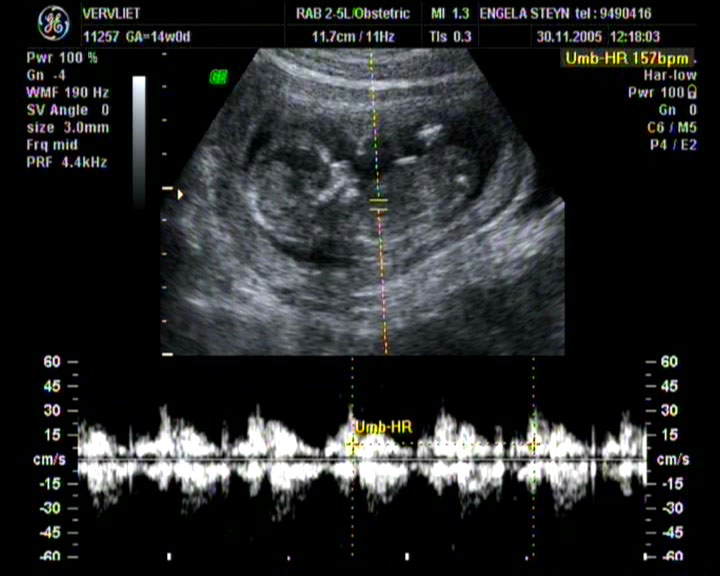
A fetal heart rate read on Doppler, the pulsing trace below the image and the rate, 157 beats a minute, read from it. The profile takes its fifth mark from the heart’s rate and its response, read on a trace of this kind. The scan shown is an early one.
The test watches five signs, four of them on the screen. The first is breathing. A baby in the womb practises breathing, the chest rising and falling in the rhythm of a breath, the practice of a lung not yet used. A run of it over half a minute earns the point. The second is movement. Three good stretches or rolls of the body in the watching window is a baby active enough to pass. A baby may breathe in long runs or not at all for stretches, the reader waiting out the quiet, a single good run of thirty seconds enough to score the point. Movement counts the body’s big motions, a roll, a kick, a stretch, and the breathing and the moving are the busy signs an eye catches first. The watching eye learns a baby’s habits fast, the breathing and the rolling and the curling of a well baby a pattern read in minutes. The four signs read in one window give a fuller word on a baby than any single one alone.
The third sign is tone. A baby with good tone holds itself curled and, now and then, extends a limb or a hand and draws it back, the spring of a healthy muscle. The fourth is the fluid. A pocket of fluid around the baby deeper than a set mark says the placenta has kept the baby watered, a sign read over a longer stretch of time than the rest. Tone is the baby held in its natural curl, the arms and legs drawn in, a hand that opens and closes. A floppy baby, limbs loose and slow, scores nothing for tone, the gravest of the four to lose. Tone is the slowest of the four to fail, the last sign a struggling baby keeps, a baby that still curls and springs its limbs holding reserve. The fluid is the one sign that looks back over weeks, a low pocket the mark of a placenta long tiring.
The fifth sign is the heartbeat, read on a heart-rate trace. A healthy baby’s heart speeds up when it moves, the quickenings a sign of a brain awake and well. This part of the test, the non-stress test, runs alongside the scan, the one of the five the probe does not read. The heart trace is read for the speed-ups that come with movement, a heart that quickens when the baby stirs the sign of a brain that answers. A trace that stays flat, with no quickening, scores nothing, a baby either deeply asleep or short of oxygen. The trace and the breathing are the two quickest to fade, the early signs a baby is short, a reactive trace and a breathing baby together clearing the early worry. An eight is a reassuring score, the one sign it lacks of the four often nothing more than a quiet spell.
The four the probe reads come and go together in a well baby, breathing in runs, limbs stretching, a hand opening and closing, all in the half-hour the test watches. A baby that shows them all is a baby whose brain is well fed, the signs the brain itself drives. The test waits the full window, since a baby asleep can pass once it wakes. A baby that breathes, rolls, stretches, and rests in good fluid in one half-hour has shown its brain is well, the four signs together a clearer word than any one alone. A reader watches for them in any order, ticking each off as it comes, the window run to its end before a low score is called. The window gives a baby every chance to show its four signs before the clock runs out. The reader scores as the window runs, each sign ticked the moment it shows, a baby that breathes in the first five minutes holding its point with the watch then free for the rest. Some clinics run a shorter version, the modified profile, the heart trace and the deepest fluid pocket alone, the two that carry the test between them, the full five kept for when the short test raises a doubt.
Reading the score
Each sign scores two points, or none at all.
There is no half mark. A sign is either there in full and scores two, or it is not and scores nothing, the five adding to a number out of ten. The number is read against a short scale. Eight or ten is a baby doing well, the test reassuring, the pregnancy free to carry on under its usual watch. Six is a maybe, a score that may mean a sleeping baby as easily as a struggling one, read again within a day or taken further the same afternoon. Four and below is a baby in trouble, the score low enough that birth is often the safer course, weighed each time with the whole picture in hand. The logic under the scale is the body’s own. A baby short of oxygen conserves it, shutting down the movements it can do without, the brain and the heart kept fed to the last. The signs fall away in a set order, the heartbeat trace and the breathing the first to go, the gross movements next, the tone the last to fail. A baby that has lost its tone has been short for longest, the gravest reading on the scale. The fluid sits apart from the rest, a slower hand, low fluid the sign of a placenta failing for weeks, a slower kind of warning. A reader reads the four on the screen, adds the heartbeat trace, and lets the total stand for how well the baby is fed, the score a number with a meaning the whole team understands at a glance. The scale is built to act early on the worst and to wait on the doubtful. A high score buys a week, a low one buys hours, the middle a careful repeat. The number is the same in every clinic, a language a midwife, a doctor, and a specialist all read the same way, the score handed on without a word of explanation needed. The score is quick to give once the window is run, a sum of fives no harder than counting on a hand. The scale leans toward caution at the bottom, a low score acted on before it is proven, the cost of an early look small against the cost of a missed one. The number carries its meaning without a chart, a clinician reading an eight or a four and knowing at once what to do.
The order the signs fail in is the test’s quiet cleverness. The parts of the brain that drive breathing and the heart’s response are the hungriest and the first to falter, their loss an early warning. Tone is driven by the oldest, hardiest part, the last to give way, its loss the mark of a baby short for a long time. A reader who knows the order reads the stage as well as the score. A baby that has lost only its breathing and its heart response is in early trouble, the kind a scan catches at the start. A baby that has also lost its movement and its tone has been short for longer, the deeper the loss the graver the state, the order a clock on the trouble. A baby down to its tone alone is caught early, the warning sounded with time still to act. A baby gone floppy has been short far longer, the chance to act narrower, the order reading how long as well as whether. A perfect ten and a bare eight are read alike, both reassuring, the two points of difference rarely changing the plan.
A low score is not always a baby in danger. A baby deep in sleep moves little and breathes little, scoring low for a half-hour that means only rest. The test guards against this with its full window and its repeat, a six read again after a meal or an hour often climbing to an eight. The reader reads the score with the baby’s state in mind. A sleeping baby is the commonest cause of a middling score. The test is built to forgive it. The window is long enough to catch a baby waking. A baby that slept through gets the repeat, a six on a quiet baby a reason to look again, the action held back until there is cause. A baby asleep at the start often wakes within the half-hour, its score climbing once it stirs, the reader who waits the window out reading the baby awake. The repeat is the test’s first answer to a doubt, a second window often turning a six into an eight once a baby wakes and stirs.
The score is read with everything else known about the pregnancy. A baby small for its dates, a mother whose pressure is high, a pregnancy weeks past its time, each tilts how a borderline score is read. The number guides the plan. How hard to lean on it depends on the rest of the picture. The flow can warn sooner than the score, a tiring placenta showing in the cord before the baby’s behaviour drops. A score read in a vacuum can mislead, a six read always against the dates, the growth, and the mother’s health before it is trusted.
After a low score
A low score sets the next step. A six earns a repeat, often within hours, the baby given a chance to show it was only asleep. A four or less moves faster, the baby watched closely or made ready to be born, the choice weighed against how early the pregnancy is. The number sets the speed of the response, a six and a busy clinic agreeing on a repeat, a two earning the operating room within the hour. The middle scores are where the judgement lies, read with the rest of the picture in hand. The decision weighs the score and the pregnancy together, an early baby weighed far more carefully than one near term, the cost of an early birth set against the danger of staying. The clinic that knows its scores knows which babies to act on and which to keep watching. The team that reads the score the same way every time acts on the babies that need it without delay. A score that stays low across two windows moves a team, a baby that does not wake on the repeat read as one that needs to come out. The team reads the score, the flow, the growth, and the dates as one picture, the BPP one voice in a chorus that settles when a baby comes.
The BPP rarely acts alone at the edge. A doubtful score brings in the blood-flow scan of the cord, the reading that tells how hard the placenta is working, the two together a fuller picture than either alone. A baby with a low score and a poor cord flow is a baby a team moves on, the decision to deliver made on the weight of both. The cord blood flow reads the placenta’s work, a different thing from the baby’s behaviour the score reads, the two together telling more than either alone. The two together catch the baby whose placenta is tiring before its score has dropped, the cord scan the first of the two to show it. The score and the cord flow read together are the closest a scan comes to a verdict on a baby’s wellbeing, the two leaned on hardest at the edge.
What the score cannot say
The BPP reads the baby as it is now, the hour ahead beyond its sight. A good score says the baby is well today, the risk of trouble in the next days a small one. A score is a snapshot, the baby read again on a set schedule for as long as the worry lasts. The test tells how the baby is today. Tomorrow is read by scanning tomorrow. A clear score is a reason to keep watching, the schedule held to the end. The watching does not stop at a good score, the next scan booked before the last one ends. The baby read well this morning can tire by the weekend, the test repeated to catch the change, a single score one frame of a film that runs to the birth. No test sees the future, and the BPP makes no claim to, reading the baby on the day, a good score the all-clear for now, the test earning its trust by being repeated, no single score the last word. The schedule is set to the worry, a high-risk pregnancy read twice a week or more, the gaps between scans the test’s weak point and the reason the watch never stops. The score has decades of use behind it, the babies it called well almost always born well in the days that followed, its rare misses the reason it is read beside the cord flow and the growth.
On a handheld
The four ultrasound parts of the BPP suit a handheld well. None needs fine detail, only patience and an eye for the baby’s behaviour, the breathing and the moving and the tone read by watching. A clinician with a pocket probe watches the baby through the window and scores what it shows, the heart trace added from a small monitor alongside. The BPP asks for a patient watcher above all, the skill in waiting out the window and in the eye for a baby’s habits. A pocket probe held over the belly for half an hour reads breathing and tone as well as any cart, what the test needs being time and a watchful eye. A handheld frees the test from the scanning room, run at a bedside, a chair, a mat on a floor, the mother lying back with the probe on her belly, the half-hour the same wherever it is spent. The test asks only a quiet room and a patient half-hour, a pocket probe enough to give it far from any hospital. The test takes up to half an hour, often less when a baby is awake and busy, the window closed the moment all four signs are in.
The reach carries the test to the pregnancies that need it where care is thin. A mother past her date in a rural clinic is read where she is, the baby scored and the answer given without a journey to a city. The score saves to the phone, the baby’s behaviour filmed, ready for a specialist to read from afar. The test that comes to her early catches the baby in trouble before the trouble is too far on. A baby scored well at a remote clinic stays where it is, the mother spared a journey she does not need, the score the thing that sorts the baby who can wait from the one who must travel. The reach turns the wellbeing test from a city service into a thing a rural midwife can run, the baby watched where it would once have gone unread. A handheld probe scores a baby’s wellbeing in minutes, the test done at the bedside in the same visit.
Common questions about the biophysical profile
What does a biophysical profile measure?
It scores five signs of a baby’s wellbeing: breathing movements, body movements, muscle tone, the amount of fluid around the baby, and the heart-rate trace. The first four are read on ultrasound, the fifth on a heart monitor. Each scores two points or none, for a total out of ten.
What is a normal BPP score?
Eight or ten out of ten is reassuring, a baby doing well. Six is equivocal and is usually repeated within a day, since it can mean only a sleeping baby. Four or below is abnormal and concerning. A critically low score often means the baby is safer delivered than left in the womb.
Why does a baby score low when short of oxygen?
A baby short of oxygen conserves it, shutting down the movements it can do without, the brain and heart kept fed. The breathing and the heart-rate response fade first, then the body movements, with the tone the last to go. A low score reads that shutting-down as the warning it is.
What happens after a low score?
A six is usually repeated within hours to see whether the baby was only asleep. A four or less is acted on faster, the baby watched closely or delivered depending on how early the pregnancy is. A doubtful score is often read alongside a blood-flow scan of the cord before a decision is made.
Can a handheld ultrasound do a biophysical profile?
Yes. The four ultrasound parts lean on patience and an eye for the baby’s behaviour, the kind of watching a handheld does as well as any machine. A clinician watches the baby through the window, scores the breathing, movement, tone, and fluid, and adds the heart trace from a monitor alongside.
About the Author
Julien Mercier
Senior R&D Engineer · Medical Ultrasound Transducer Development
Senior R&D Engineer with an M.S. in Applied Physics and over 15 years of experience in medical ultrasound transducer development, specializing in the design verification and performance testing of high-frequency imaging transducers. Currently leading the development and verification of the company’s next-generation high-frequency linear-array transducer, responsible for imaging performance evaluation and reliability analysis in preclinical testing. Brings extensive hands-on experience in piezoelectric element tuning, beamforming parameter optimization, and system-level performance testing.