
Who Are the Major Battery Manufacturers in the USA?
Panasonic opened its Nevada battery factory in 2017. Eight years later, Korean competitors finally caught up in capacity. But Panasonic had already banked something more valuable than gigawatt-hours: the institutional memory of ten thousand production problems solved.
Battery manufacturing punishes latecomers. Every coating defect, every contamination event, every yield collapse teaches lessons that cannot be learned from textbooks. Panasonic absorbed these lessons when mistakes cost thousands. Competitors entering today make the same mistakes at scales costing millions.
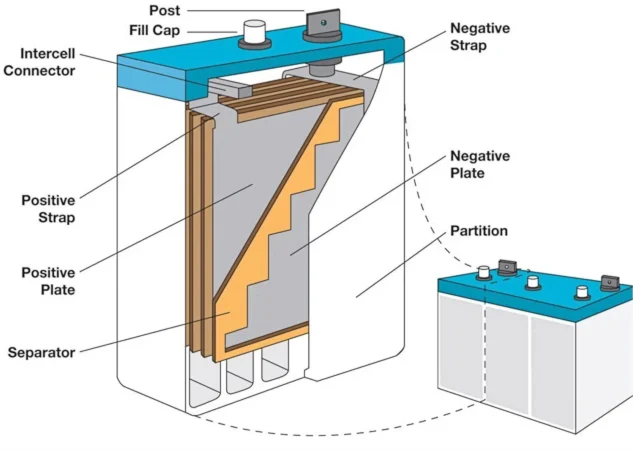
Battery Cells
The Nevada Gigafactory produces 39 GWh annually. Those cells power most Tesla Model 3 and Model Y vehicles worldwide. The partnership has survived Elon Musk's mercurial management, pandemic supply shocks, and Tesla's announcement that it would manufacture competing cells in-house. Lesser suppliers would have been discarded. Panasonic proved indispensable.
Kansas changed the equation. Panasonic spent $4 billion building the largest single battery factory on Earth in De Soto, targeting 32 GWh of annual capacity. Production began July 2025. Unlike Nevada, Kansas serves multiple automakers. Panasonic no longer needs Tesla. Tesla still needs Panasonic.
Combined North American capacity reaches 73 GWh. No competitor will match this figure before 2027.
The Korean Invasion
LG Energy Solution operates eight American facilities. This number requires emphasis. Eight. Spanning Ohio, Michigan, Tennessee, Georgia, and Arizona. No other battery manufacturer has attempted this geographic spread in America. LG bet that proximity to customers would matter more than consolidating production.
The bet has produced mixed results.
GM's Ultium partnership looked transformative when announced. Three factories totaling 125+ GWh would supply every GM electric vehicle. Warren, Ohio opened November 2022. Spring Hill, Tennessee followed March 2024. Then GM's EV sales disappointed. Warren and Spring Hill entered production pauses in January 2026. Over 2,000 workers lost their jobs. GM sold its Lansing plant stake to LG in December 2024, admitting that battery manufacturing exceeded its capabilities.
LG absorbed these blows because diversification provided cushions. Holland, Michigan supplies Ford. A Honda partnership in Ohio. A Hyundai partnership in Georgia. When GM faltered, other customers picked up slack.
The Michigan LFP plant opened May 2025 and signals strategic capitulation. LG built its reputation on premium NMC batteries. Lithium iron phosphate cells cost less, store less energy, and carry lower margins. But LFP now dominates global production. Chinese manufacturers proved that good enough at low cost beats excellent at high cost. LG swallowed its pride and built an LFP factory.
SK On suffered worse.
BlueOval SK was supposed to transform American battery manufacturing. Ford and SK On committed $11.4 billion for three plants producing 129 GWh. The Department of Energy offered $9.63 billion in loans. Construction began in Kentucky and Tennessee.
Ford's Model e division lost $5.1 billion in 2024.
The partnership dissolved December 2025. Ford took the Kentucky plants. SK On got Tennessee. The largest battery joint venture in American history collapsed in under three years.
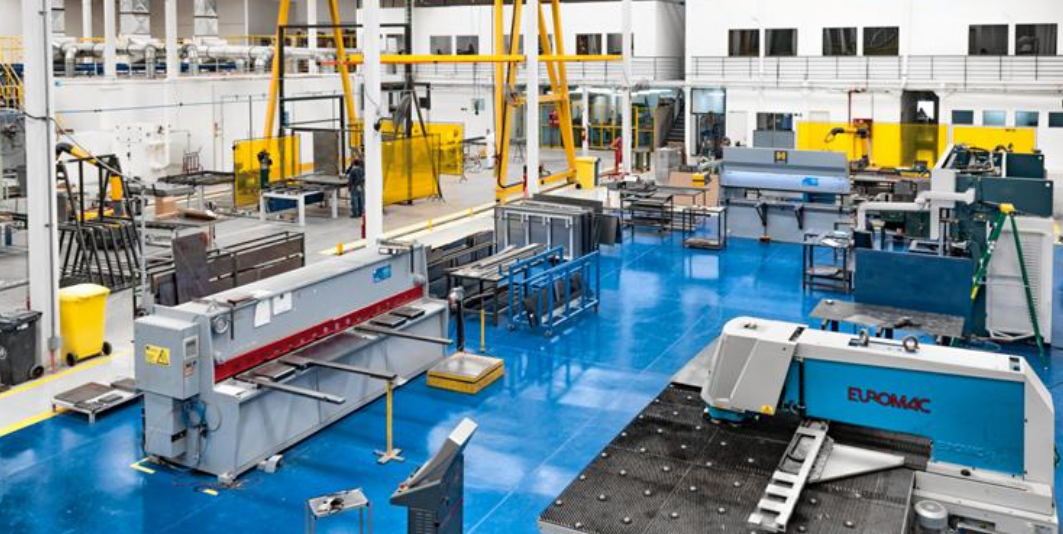
Factory Floor
SK On pivoted to energy storage. Grid batteries face none of the demand volatility plaguing electric vehicles. Data centers need power. Renewable installations need storage. These markets grow regardless of whether Americans buy EVs. The Kentucky facilities Ford retained will produce stationary storage systems rather than vehicle cells.
Samsung SDI watched LG and SK On overextend, then chose caution. The StarPlus Energy partnership with Stellantis comprises two Indiana facilities totaling 67 GWh. Modest compared to competitors' announcements. But Samsung SDI avoided the cancellations and restructurings that wounded rivals.
Samsung produces prismatic LFP cells, unique among Korean manufacturers. This chemistry dominates grid storage. While competitors scrambled to convert NMC lines, Samsung designed for LFP from the start.
Tesla's Gamble
Tesla attempts something no other American automaker dares: manufacturing its own batteries at scale.
The 4680 cell embodies this ambition. Larger than conventional formats at 46mm diameter and 80mm height. Tabless design eliminating components that create manufacturing headaches. Structural integration making cells load-bearing chassis elements.
Production has struggled.
Elon Musk admitted publicly that pursuing dry electrode technology was a mistake. The process promised cost reductions by eliminating solvent drying. Instead it caused years of delays. A November 2025 patent suggests breakthroughs using PTFE composite binders. Whether these translate to factory output remains unproven.
Tesla hedges through multi-chemistry sourcing. Panasonic NCA cells from Nevada power long-range models. CATL LFP cells from China supply standard-range variants. This pragmatism keeps production running while 4680 manufacturing matures.
The energy storage division offers an alternative path. Tesla Energy deployed over 30 GWh of Megapack systems in 2024, doubled from the prior year. Storage may ultimately prove more valuable than vehicles.
American Startups: Innovation Without Factories
QuantumScape has demonstrated solid-state battery cells that charge from 10% to 80% in 12.2 minutes. Energy density exceeds 800 Wh/L, double conventional lithium-ion.
The company has never manufactured batteries at commercial scale.
This gap between laboratory and factory has destroyed more battery startups than any technical failure. QuantumScape completed its Eagle Pilot Line in December 2025. Commercial production targets 2027 to 2028. Volkswagen holds a 16% stake. Cash reserves of $797.5 million provide runway into 2029.

Research Lab
Sila Nanotechnologies reached commercial production faster. Its Titan Silicon anode material shipped to Mercedes-Benz and Panasonic starting Q4 2025, delivering 20-40% energy density improvements. Form Energy produces iron-air batteries for 100-hour grid storage at one-tenth lithium-ion costs.
The failure list lengthens quarterly. iM3NY bankrupt January 2025. KORE Power cancelled its Arizona factory. FREYR abandoned Georgia. Microvast's Clarksville plant sits half-complete while the company hunts for $150 million.
The Absent Giant
CATL produces 38% of global EV batteries. Its factories manufacture cells in one second. Battery packs in 2.5 minutes. Capacity utilization exceeds 90%. LFP cells cost 56% less than American equivalents.
CATL owns no American factories.
Foreign Entity of Concern regulations bar Chinese battery manufacturers from federal subsidies. Ford licenses CATL technology for its Michigan LFP plant but owns the facility entirely. Congressional committees have investigated forced labor concerns and national security implications. Michigan provided $1.7 billion in incentives despite the controversy.
Excluding CATL creates the protected market that Korean and Japanese manufacturers exploit. Without FEOC restrictions, Chinese cost advantages would overwhelm competitors. American battery manufacturing exists because policy shields it from the world's dominant producer.
Grid Storage Saves the Industry
Electric vehicle demand softened. Factories built for optimistic projections now operate at half capacity. Several manufacturers face insolvency.
Grid storage absorbs the pain.
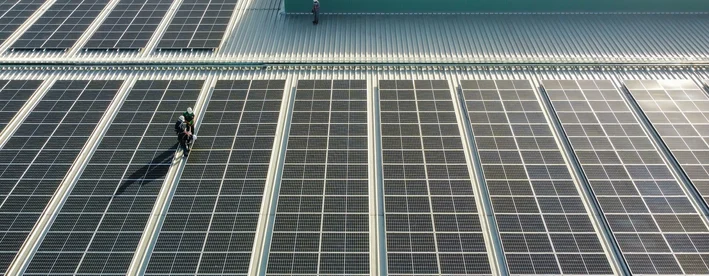
Solar Array
The United States added 10.4 GW of battery storage in 2024. Projections indicate 18-20 GW in 2025. Texas and California account for the majority. Renewable energy needs storage for intermittency. AI data centers need backup power. Aging grids need load balancing.
Battery pack prices for storage fell to $70/kWh in 2025, down 45% from 2024. LFP chemistry dominates with over 95% of utility installations. Manufacturers that pivoted to storage have found growth. Those that remained EV-focused struggle.
Policy Dependency
The Inflation Reduction Act created American battery manufacturing. Section 45X pays $35/kWh for domestically produced cells. Section 30D offers $7,500 per vehicle meeting content requirements. DOE loans exceeded $100 billion across 53 deals.
These subsidies make American production economically rational. Without them, manufacturing costs too much.
Section 45X credits phase out starting 2030. The One Big Beautiful Bill Act sunsets Section 30D in September 2025, seven years early. Policy continuity determines whether American battery manufacturing survives the decade.
Korean manufacturers can relocate production to European or Asian facilities if economics deteriorate. American workers cannot relocate to Korean factories.
Who Dominates
Panasonic and LG Energy Solution control American battery production today. SK On and Samsung SDI hold significant positions. Tesla pursues self-production with uncertain results. American startups innovate but do not manufacture at scale. Chinese companies remain excluded.
Korean and Japanese manufacturers possess the expertise, capital, and flexibility to dominate through 2030. American companies must develop these capabilities before policy support expires.
The factories exist. The jobs exist. American ownership and technological independence do not.