

Which is Better, a Home Battery vs a Generator?
In July 2024, Houston television station KPRC 2 reported that its newsroom had been "inundated with calls and emails" from viewers whose whole-home generators failed during Hurricane Beryl. One couple interviewed had purchased a Generac generator in 2022. The unit worked initially when Beryl struck, then shut down on July 8 around 11 a.m. and refused to restart. They had a seven-year warranty. They could not get the dealer to make repairs. Meanwhile, over 2.7 million CenterPoint Energy customers lost power across the Houston region, many for more than a week.
The same week, Houston Public Media photographed a man named Walter Lane standing next to his family's broken generator on July 16, eight days after Beryl made landfall. The caption read: "They've been in the dark since Hurricane Beryl hit Houston."
These were not isolated incidents. They were part of a pattern that rarely gets discussed in the glossy comparison articles about backup power options.
https://www.click2houston.com/news/local/2024/07/18/why-were-houston-residents-with-generators-during-beryl-still-experiencing-power-outages/
Source: Houston Public Media, "FEMA offering assistance to Houston-area residents who bought generators during Hurricane Beryl-related power outages", July 25, 2024
https://www.houstonpublicmedia.org/articles/news/hurricane/2024/07/25/494776/fema-assistance-houston-generators-hurricane-beryl/
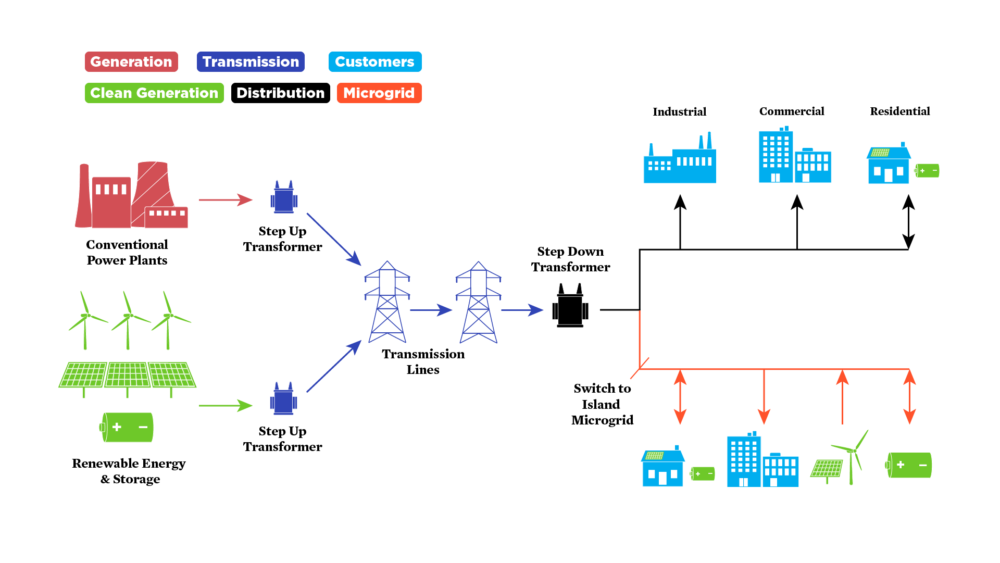
How to maintain power supply when the power grid fails.
The Failure Rate Question
The generator industry does not publish failure statistics. This fact alone should raise eyebrows.
Every other consumer product category has J.D. Power ratings, Consumer Reports reliability data, warranty claim frequencies. Generators have almost nothing. The companies know their numbers. They choose not to share them.
What exists comes from academic and government sources. The NREL study cited in the next section provides the most rigorous data, finding that poorly-maintained generators fail to start 16.5% of the time and have a mean time to failure of just 61 hours once running. Industry-sponsored sources claim 98-99% reliability, but these figures typically come from well-maintained commercial installations rather than residential units that sit idle for months between tests.
Installers tell a different story depending on who signs their paychecks. Those employed by generator dealerships insist failures are rare and almost always caused by owner neglect. Independent electricians who install both batteries and generators tend to say generator callbacks are a constant headache. Neither group publishes data. Both have incentives to shade the truth.
Battery failure rates are easier to track because the systems report data continuously to the cloud. Tesla publishes nothing official, but third-party analysts who track Powerwall forum discussions estimate that roughly 3% of units experience some kind of malfunction in the first three years. Most are software glitches fixed remotely. Hardware failures requiring replacement appear to be under 1%. These numbers come from self-selected forum users, so they probably skew toward people with problems. The true rate may be lower.
The comparison is imperfect. Generators fail dramatically and obviously when needed. Batteries degrade slowly and report their declining health through an app. A generator that fails during an outage is a crisis. A battery losing 2% capacity per year is an accounting problem. The failure modes are so different that direct comparison feels almost meaningless.
The Maintenance Burden
A 2019 study by the National Renewable Energy Laboratory (NREL), titled "Emergency Diesel Generator Reliability and Installation Energy Security," provides the most rigorous data available on generator reliability and maintenance.
The researchers categorized generators into three maintenance levels and found stark differences:
- Well-maintained generators (following NFPA 110 or DoD standards): 1.3% failure-to-start rate, mean time to failure of 1,662 hours once running
- Average maintenance: 6.6% failure-to-start rate, mean time to failure of 636 hours
- Poorly maintained: 16.5% failure-to-start rate, mean time to failure of just 61 hours
The study's most troubling finding: only about 25% of residential generators qualify as "well-maintained." Roughly 58% receive average maintenance, and 17% are poorly maintained. The authors note that "generators that provide grid services in addition to backup power are often run more frequently, which generally coincides with a lower FTS rate. Higher utilization can lead to lower failure rates, both because worn-out components are replaced more quickly and because conditions such as spoiled fuel are less likely."
For a 12-hour mission time (long enough to ride out most outages), the study calculated overall reliability as:
- Well-maintained: 99.15%
- Average maintenance: 97.47%
- Poorly maintained: 80.5%
That poorly-maintained figure means roughly one in five neglected generators will fail during an actual emergency. Since most homeowners do not follow rigorous maintenance schedules, real-world failure rates likely cluster between the average and poorly-maintained categories.
Battery maintenance amounts to checking the app occasionally. There is no oil, no filters, no fuel to degrade, no starter battery to die. The battery management system monitors everything and reports problems automatically.
https://docs.nrel.gov/docs/fy19osti/72509.pdf
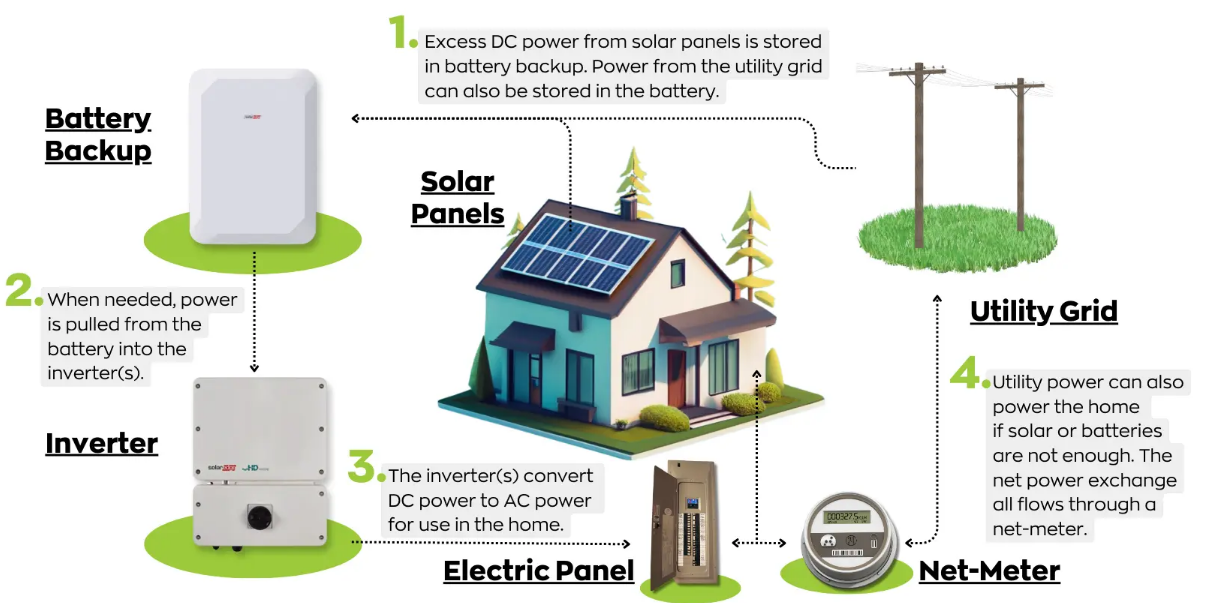
Solar panels paired with battery storage create an integrated system that can provide backup power while generating energy.
Money
The math looks simple until the actual numbers get pinned down.
A whole-home Generac or Kohler generator, installed with an automatic transfer switch and connected to natural gas, costs somewhere between $10,000 and $20,000 depending on capacity and local labor rates. That range is wide enough to be almost useless for planning purposes, but it is honest. Anyone quoting a tighter range is probably selling something.
A Tesla Powerwall 3 costs $9,500 before installation, and installation adds another $2,000 to $6,000 depending on electrical panel complexity and local permit requirements. Total: $11,500 to $15,500 for one unit. Most homes that want serious backup capability need two units, so double that. The federal tax credit knocks off 30%, but only if the installation happens before the end of 2025 and only if there is enough tax liability to use the credit.
Generators cost money to run. Fuel, obviously. Also annual maintenance at a few hundred dollars, plus occasional repairs. Over 15 years, figure an extra $5,000 to $10,000 depending on how often the generator actually runs and what breaks.
Batteries cost almost nothing to operate. They can actually make money through time-of-use arbitrage if the utility has the right rate structure. A Powerwall owner in San Diego with SDG&E's tiered rates can clear maybe $50 to $80 per month by charging cheap and discharging expensive. Over 15 years, that is real money, potentially $9,000 to $14,000.
The long-term math favors batteries in most situations. But "most situations" papers over a lot of individual variation. Someone in rural Alabama with $0.09/kWh flat-rate electricity and frequent multi-day outages from ice storms faces a completely different calculation than someone in suburban Phoenix with $0.35/kWh peak rates and outages that rarely last more than a few hours.
Personal finance articles love to declare one option the "clear winner." The reality is that the winner depends on location, electricity costs, outage frequency, and outage duration. No calculator can answer those questions.
The Noise Thing
A running standby generator at 23 feet sounds like a loud air conditioner. At closer distances, which is where many units end up due to setback requirements and lot sizes, it sounds like standing next to a running lawnmower. During a multi-day outage, the sound wears on people.
In December 2024, after a major power outage in San Francisco's Richmond District, PG&E installed temporary generators at a substation. KRON4 reported that resident Vahid Sattary measured the noise at 100 decibels and said: "This is so loud you cannot have a simple conversation." Another resident, Mi Zhou, told reporters he and his wife moved to a hotel because of the generator noise.
Noise tolerance is personal. Some people barely notice generator noise. Others find it unbearable. But the contrast remains absolute: batteries make no sound at all. None. The house can run on battery power for days without any audible indication that anything is different.
Neighbors factor in too. A generator running 24 hours a day for several days affects everyone within earshot. Post-hurricane neighborhoods become walls of overlapping mechanical drone. Code enforcement is lax during emergencies, but resentment builds.
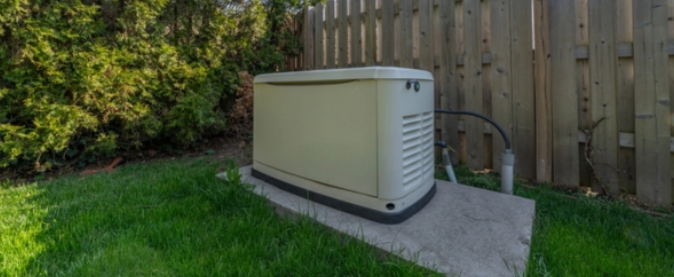
When severe weather strikes, the reliability of backup power systems becomes critically important.
Runtime
Here is where generators have an argument that batteries cannot fully answer.
A natural gas generator connected to a utility gas line can run indefinitely. As long as gas pressure holds, power flows. During extended regional disasters, gas pressure sometimes drops as demand spikes, but it rarely fails completely. The infrastructure is separate from the electrical grid.
A battery stores a fixed amount of energy and depletes during use. A single Powerwall holds 13.5 kWh. A typical home running essentials only, which means refrigerator, some lights, phone charging, and maybe one window AC unit, draws maybe 1.5 to 2 kW average. That battery lasts 7 to 9 hours before it is empty.
Solar panels change this calculation. A 7 kW rooftop array on a sunny day generates maybe 35 to 45 kWh, easily enough to run the house and recharge the battery. But solar production collapses during storms, which is exactly when outages happen. A hurricane brings clouds. An ice storm brings clouds. Post-disaster solar output might be 20% of normal for days.
The battery advocates' response is that most outages are short. This is true. Utility data shows that around 80% of residential outages last under 4 hours. For these events, a single battery provides plenty of capacity. The trouble is the other 20% of outages that last longer, some much longer. If someone is in that 20%, and the battery is empty, and the sun is not shining, there is no backup left.
The generator advocates' response is that unlimited runtime beats limited runtime. This is also true, but ignores the question of whether that runtime actually works when called upon. A generator that fails to start provides zero runtime.
Neither side fully acknowledges the other's best argument.
Transfer Speed
This matters less to most people than battery salespeople claim, but it matters a lot to some people.
Generators take 10 to 45 seconds to detect an outage, start up, and transfer load. During that window, the house has no power. Computers reboot. Clocks reset. Sump pumps stop briefly. Anything in the middle of a write operation risks data corruption.
Batteries transfer in under 20 milliseconds. The lights never flicker. Computers never notice. Sensitive medical equipment continues without interruption.
For a home office running critical tasks, or a house with medical equipment that must not lose power even briefly, this difference is decisive. For a typical suburban family whose worst inconvenience from a 30-second blackout is resetting the microwave clock, it barely matters.
The battery industry markets instantaneous transfer heavily because it is one of their unambiguous advantages. The generator industry mostly ignores the topic. Both responses make sense given each industry's position.
The Gulf Coast Problem
The Houston region illustrates a real bind that affects millions of homeowners.
According to Wikipedia's summary of Hurricane Beryl's effects, the storm "caused over 2.7 million households and businesses near the Gulf Coast, primarily in the Houston metropolitan area, to suffer from prolonged power outages during high temperatures and high humidity." A survey by Rice University found that one in eight Greater Houston residents still reported ongoing disruption from Beryl months after the storm. Around 40% of those surveyed expressed a desire to leave the region due to 2024 weather disasters.
Generators make sense in a way they do not elsewhere. The unlimited runtime advantage actually matters on day four of no grid power when the sky is still overcast. The higher failure rate is a problem, but a generator with a 75% to 80% chance of working beats a 100% chance of an empty battery when solar recharging fails for days at a stretch.
Most of the country does not face these conditions. California has frequent outages but abundant sunshine; batteries can recharge daily. The Northeast has occasional ice storms but short outages that rarely exceed battery capacity.
The narrow case for generators is real. It is also narrow. Both generator and battery advocates tend to argue as though their preferred technology is obviously correct everywhere, when the reality is geographic and situational.
https://en.wikipedia.org/wiki/Effects_of_Hurricane_Beryl_in_Texas
The Environmental Angle
A generator burns fossil fuel and produces exhaust. A battery stores electricity that may or may not have come from renewable sources. For homeowners who care about emissions, this distinction matters.
The carbon monoxide issue. According to the CDC and UL Standards & Engagement, at least 430 Americans die annually from unintentional carbon monoxide poisoning, and over 50,000 require emergency care. These numbers spike during and after storms, with portable generators responsible for the majority of deaths but standby units contributing cases as well.
A 2024 report by UL Standards & Engagement found 29 million generators in use across the United States, but 62% of owners did not realize they could result in CO exposure. Following Hurricane Beryl's July 2024 landfall, power outages led to at least two CO-related deaths in Texas.
Properly installed standby generators vent exhaust away from the house and pose minimal CO risk under normal operation. But "properly installed" and "normal operation" do a lot of work in that sentence. Atmospheric conditions can push exhaust toward windows. Homeowners sometimes open windows during outages for ventilation, especially in summer heat without AC, creating pathways for exhaust intrusion.
Batteries produce no exhaust, no combustion byproducts, no local emissions of any kind. For families with young children, elderly members, or anyone with respiratory sensitivity, this difference may override other considerations.
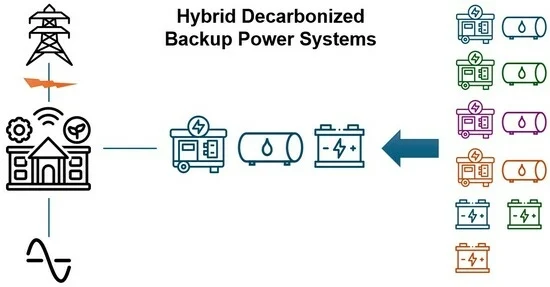
Economic benefits of backup power
The Industry Dynamics
The generator industry has institutional momentum that shapes how backup power gets sold.
Generac, the dominant U.S. manufacturer, has built a nationwide dealer network over decades. Kohler and other brands have similar distribution infrastructure. Installers who become authorized dealers invest in training, inventory, and service capabilities. This creates economic incentives to continue selling generators even as battery technology improves.
Battery distribution works differently. Tesla sells Powerwalls primarily through its own installation network and certified third parties. Enphase works through solar installers. The sales channels overlap less with traditional electrical contractors, meaning the installer a homeowner calls first may influence which technology gets recommended.
The generator business model includes recurring revenue from maintenance contracts. Annual service at several hundred dollars per visit, plus parts and repairs, creates ongoing income for dealers. Battery systems generate almost no service revenue because they require almost no service. From an installer's business perspective, generators are annuities; batteries are one-time sales.
This economic structure does not mean installers are dishonest, but it does mean the incentives point in one direction. Homeowners should seek quotes from both generator-focused and solar/battery-focused contractors to get a more balanced picture.
The Sizing Question
Both technologies require careful sizing, and the consequences of getting it wrong differ.
An undersized generator fails obviously. The load exceeds capacity, the unit trips its overload protection, and the house goes dark again. The homeowner learns within minutes that something is wrong. An oversized generator wastes money upfront but operates normally, just burning more fuel than necessary.
An undersized battery fails gradually. The system works at first, then drains faster than expected. The battery percentage drops, the app warns of impending depletion, and critical loads must be shed manually to extend runtime. The failure mode is manageable but stressful.
Generator sizing asks: what is the maximum simultaneous load, including startup surge from motors? A house that draws 8 kW average but spikes to 15 kW when the air conditioner compressor kicks on needs a generator rated at 15 kW or higher to avoid tripping.
Battery sizing asks two questions: what continuous power draw is expected, and how many kilowatt-hours of total energy are needed? A battery rated for 11 kW continuous output handles most residential loads comfortably, but a 13.5 kWh storage capacity may last only four hours under heavy use. Adding a second battery doubles both output and capacity.
Most homeowners underestimate their actual power consumption. The refrigerator draws 150 watts, the WiFi router draws 10 watts, the phone charger draws 5 watts, and suddenly the "essentials only" load hits 600 watts before anyone turns on a single light or fan. Running a single window AC unit adds another 1,000 to 1,500 watts. A well pump adds 1,000 watts or more. The numbers add up fast.
Professional load calculations before purchase can prevent expensive sizing mistakes. Both generator and battery dealers offer this service, though the quality varies.
Every home's backup power needs are different, shaped by location, lifestyle, and risk tolerance.
Decision Factors
Homes with solar panels or plans to install them should strongly favor batteries. The integration works naturally, and a generator ignores solar investment entirely during outages when panels could otherwise be generating free power.
Homes in utility territories with time-of-use electricity rates gain daily value from batteries regardless of whether outages ever occur. The arbitrage opportunity accumulates year after year.
Homes in hurricane zones with multi-day outages and access to natural gas face a genuine tradeoff. The generator's runtime advantage is real, and post-storm solar conditions are often too poor for adequate battery recharging. This is the strongest case for generators.
Homes with medical equipment requiring uninterrupted power need instantaneous transfer that only batteries provide. Adding a UPS to generator-backed medical equipment is a workaround, but an expensive and clunky one.
Homes in dense neighborhoods or with noise-sensitive family members will find three-day generator runtime far more unpleasant than the specifications suggest. The mechanical drone at 3 AM on night two of an outage tests patience.
Budget-constrained buyers may find generators more accessible at the point of purchase, though long-term ownership costs favor batteries. The federal tax credit narrows the upfront gap considerably.
None of these factors automatically dictates the right choice. They provide a framework for thinking through individual circumstances.
The Trend Line
Battery prices have fallen roughly 85% since 2010. They will continue falling. The technology sits on a learning curve that still has room to run. Sodium-ion chemistries coming to market in the next few years will push costs down further. Vehicle-to-home technology, which allows electric cars to power houses during outages, will add another option within five years.
Generator prices have barely moved. The technology is mature. A generator purchased in 2025 works the same way as one purchased in 1995. No breakthrough is coming. Manufacturing efficiency may trim a few percent off costs over the next decade; nothing more.
Whatever the right choice is today, the right choice in 2030 will almost certainly be batteries for more people and generators for fewer. The trajectory is clear even if the current crossover point is disputed.
For someone buying today, the federal tax credit deadline of December 31, 2025 matters. That 30% discount on battery systems disappears in 2026. The window for maximum battery value is open now and closing.
What Gets Left Out of Most Comparisons
The generator industry has institutional momentum. Dealers, installers, and service technicians have built businesses around generator sales and maintenance. Marketing budgets for Generac and Kohler dwarf those of battery manufacturers. Homebuilders have longstanding relationships with generator suppliers. The infrastructure favors generators through sheer inertia.
Battery technology arrived later and faces the disadvantage of novelty. Many homeowners, particularly older ones, have never seen a home battery system in operation. The technology feels unfamiliar and risky by extension. Generators, whatever their actual failure rates, feel proven because they have been around for decades.
This familiarity gap will close over time as battery installations proliferate and word of mouth spreads. But today, the gap influences purchase decisions in ways that have nothing to do with objective product merit.
Resale value shows a clear pattern for solar, with less data on batteries specifically. A 2015 study by Lawrence Berkeley National Laboratory, "Selling Into the Sun: Price Premium Analysis of a Multi-State Dataset of Solar Homes," analyzed nearly 22,000 home sales across eight states. The study found that homes with solar photovoltaic systems sold for an average premium of approximately $4 per watt of installed capacity, or about $15,000 for a typical system. Homes with solar sold for roughly 4% more than comparable non-solar properties.
Whether batteries attached to solar systems add additional resale premium beyond the solar itself remains unquantified in peer-reviewed research. Homes with generators do not appear to command any measurable resale premium in available data.
https://emp.lbl.gov/publications/selling-sun-price-premium-analysis
The Answer
Batteries are better for most households. The daily economic value, the zero maintenance, the silent operation, the instantaneous transfer, and the technology trajectory all favor batteries.
Generators are better for a minority of households in specific circumstances. Extended outages in cloudy climates, natural gas availability, and genuinely high continuous power demands create conditions where generator runtime advantages outweigh their drawbacks.
Neither product is obviously superior in all situations. Anyone who claims otherwise is either selling something or has not thought carefully about the edge cases.
The choice depends on location, utility rates, outage history, solar situation, noise tolerance, maintenance tolerance, and budget. No article can make that decision for a specific household. The best anyone can do is lay out the tradeoffs honestly, which the marketing materials from both industries conspicuously fail to do.