January 24, 2026
Where Does the US Get Batteries From?
China supplies somewhere between 82% and 84% of the lithium-ion batteries Americans buy. That single number contains most of what matters about this question. Everything else is detail, qualification, and increasingly frantic policy response.
The $13.1 billion worth of Chinese batteries that crossed into American ports in 2023 dwarfed imports from every other country combined. South Korea, the distant second, shipped roughly a tenth as much. Japan, once the leader in battery technology, has faded to minor player status. Poland and Hungary appear in the top five sources only because Korean companies built factories there to serve European automakers.
For grid storage batteries, the large units backing up solar farms and stabilizing power grids, the concentration runs even heavier. Chinese manufacturers captured 72% of American storage battery imports in 2024.
82-84%
Chinese Battery Share
$13.1B
Chinese Imports (2023)
CATL and the Scale Problem
One company in the coastal city of Ningde now shapes global battery supply more than any government policy or trade agreement. Contemporary Amperex Technology Limited, known everywhere as CATL, shipped 339 gigawatt-hours of cells in 2024 and held nearly 38% of the world market for electric vehicle batteries. To put that in perspective: the company added more production capacity last year than LG Energy Solution, the largest Korean manufacturer, operates in total.
CATL did not exist before 2011. Its founder, Zeng Yuqun, started by making batteries for consumer electronics before pivoting to electric vehicles just as the Chinese government began subsidizing EV purchases. The timing proved fortunate. Guaranteed domestic demand gave CATL years to refine its manufacturing processes, drive down costs, and scale production without worrying about quarterly earnings expectations. By the time Western automakers started taking electric vehicles seriously around 2018, CATL had already mastered high-volume battery production at costs no competitor could match.
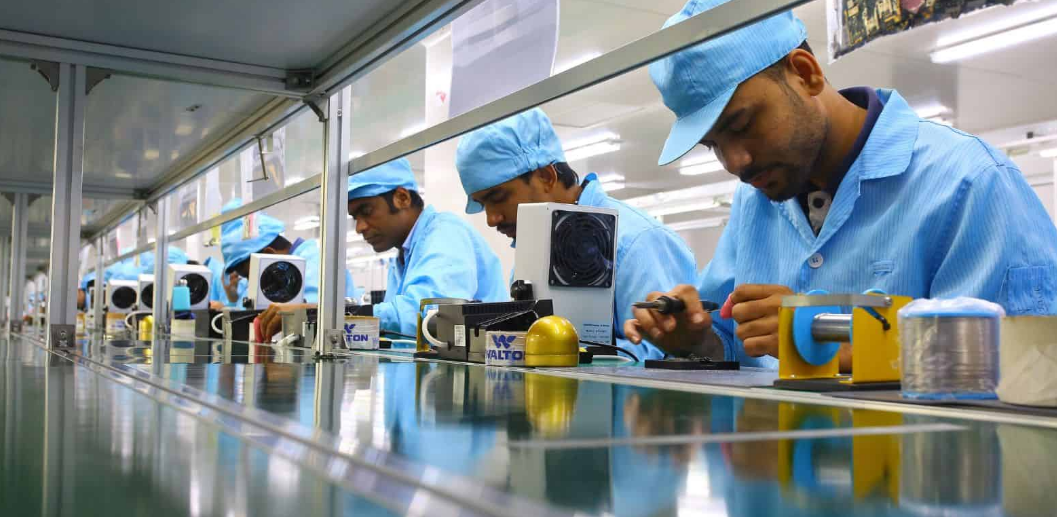
Factory Assembly
The company now supplies cells to Tesla, BMW, Mercedes-Benz, Volkswagen, Honda, Toyota, Hyundai, Ford, and Stellantis. It operates factories in Germany and Hungary. It holds more patents on battery technology than any other firm. Its manufacturing costs run roughly 20% below Korean prices and 30% below what American startups can achieve. Every year, that gap fails to narrow.
BYD, better known for its electric cars, claimed another 17% of global battery sales. Add these two Chinese companies together and their combined output exceeds everything produced by Korean and Japanese manufacturers.
The Korean manufacturers keep fighting. LG Energy Solution, Samsung SDI, and SK On have locked in contracts with General Motors, Ford, BMW, Volkswagen, Hyundai. They run factories on three continents. They specialize in high-nickel chemistries that premium automakers prefer for their energy density. They accept thinner margins than their Chinese competitors can tolerate. Whether any of this adds up to a viable long-term strategy remains an open question. Korean companies have bet their futures on American and European markets where Chinese competitors face political barriers. If those barriers erode, or if Chinese firms find workarounds, the Korean industry faces trouble.
Panasonic, Tesla's original battery partner, holds about 4% of the global market. The company built its reputation on quality and helped Tesla launch the Model S in 2012. It still supplies cells for Tesla vehicles manufactured in Nevada and Japan. But Panasonic moves cautiously, expanding capacity only when orders are firmly in hand, while Chinese competitors build factories on speculation. That caution preserved profitability. It also ceded market share.
"CATL added more production capacity last year than LG Energy Solution, the largest Korean manufacturer, operates in total."
The Mineral Geography
Five minerals make lithium-ion batteries work: lithium, cobalt, nickel, graphite, manganese. American mines contribute almost nothing to global supply of any of them. This matters less than it might seem. Mining is the easy part. Processing is where control concentrates.
Australia digs up 37% of global lithium, mostly from hard-rock spodumene deposits in Western Australia. Chile pumps another 30% from brine pools beneath the Atacama Desert, where lithium-rich water gets pumped into evaporation ponds and left to concentrate under the sun for months. Argentina contributes a growing share from similar brine operations near its border with Chile.
The United States operates exactly one lithium mine. Silver Peak in Nevada has extracted lithium from underground brines since 1966, making it the longest-running lithium operation in the country. It produces under 2% of world output. A second project, Thacker Pass, has been stuck in permitting and litigation since 2017. Lithium Americas, the company behind the project, secured a $2.26 billion Department of Energy loan commitment. Construction keeps slipping anyway. The Fort McDermitt Paiute and Shoshone Tribe filed suit arguing the mine would destroy sacred lands. Environmental groups raised concerns about water usage in the arid Nevada landscape. The current target date is 2027. That date has moved before.
Cobalt flows overwhelmingly from the Democratic Republic of Congo, which supplies 76% of global production. The mines cluster around Kolwezi in the southeastern provinces of Haut-Katanga and Lualaba. Industrial operations run by Glencore, the Swiss commodity trading giant, and CMOC Group, a Chinese state-linked miner, extract cobalt as a byproduct of copper mining. Artisanal miners work alongside them, sometimes legally, sometimes not, digging with hand tools in tunnels that can collapse without warning. NGOs have documented children as young as seven carrying sacks of ore. Cobalt sourced from these artisanal operations enters global supply chains despite corporate commitments to responsible sourcing. The boundaries between formal and informal mining blur in practice.
American importers largely avoid buying directly from Congo. They purchase refined cobalt from Norway, Finland, and Japan, countries that import Congolese ore and process it in their own facilities. This provides distance from the worst supply chain risks. It does not eliminate exposure to them.
Nickel supply shifted dramatically after 2020. Indonesia now dominates at 59% of global output, having built dozens of new processing facilities in just five years. The construction boom came with Chinese money. Tsingshan Holding Group, a Wenzhou-based steelmaker, led the way, pouring billions into Indonesian nickel smelters and refineries. Indonesian nickel now feeds Chinese battery factories. America sources its nickel mainly from Canada, whose mines cannot scale quickly enough to meet projected battery demand. Norway contributes smaller volumes.
Graphite presents the starkest situation. The United States imports every gram of natural graphite it uses. Zero domestic production. China mines 78% of world supply from deposits in Heilongjiang, Shandong, and Inner Mongolia. Mozambique and Madagascar have ramped up production in recent years, but their output remains modest.
Manganese rounds out the list. South Africa produces the largest share, followed by Gabon and Australia. The United States stopped mining manganese domestically in 1970.
None of this mining data captures where control concentrates.
Processing Is the Chokepoint
Lithium mined in Western Australia gets crushed, concentrated, and shipped to chemical plants in Sichuan Province. There it becomes battery-grade lithium hydroxide. Tianqi Lithium and Ganfeng Lithium, both Chinese, rank among the world's largest processors. They built refining capacity in Jiangxi, Sichuan, and Hubei provinces during the same years CATL was scaling cell production. Chilean lithium carbonate follows similar routes. About 65% of global lithium processing happens inside China.
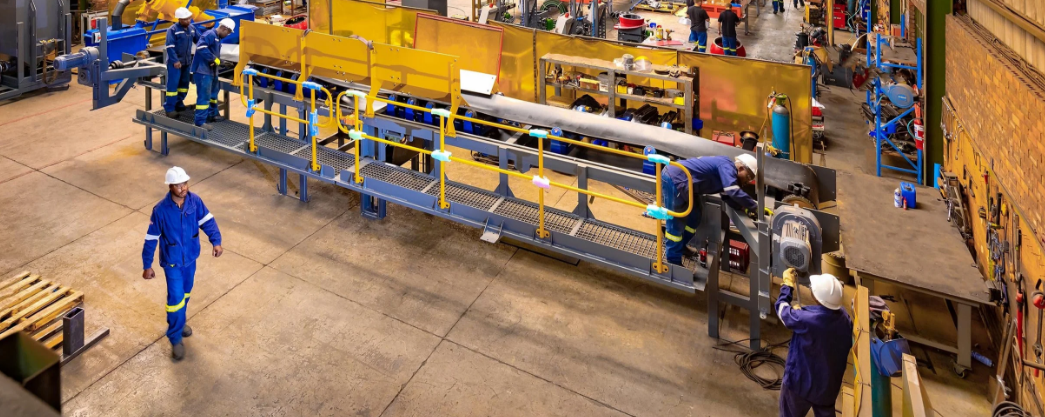
Processing Plant
Cobalt refining concentrates even more heavily. Chinese facilities handle 79% of global output. Huayou Cobalt, based in Zhejiang Province, processes cobalt from its own mines in Congo and from ore purchased on commodity markets. GEM, another Chinese recycler and processor, handles substantial volumes. Norway and Finland process a fraction of that.
Graphite processing shows the tightest grip. Battery anodes need spherical graphite, produced through acid leaching and precision milling of natural flake graphite. The process requires chemical expertise, specialized equipment, and years of optimization. Chinese companies control over 95% of global capacity for this conversion. They spent decades perfecting the techniques while competitors focused on other industries. Graphite mined in Canada or Mozambique frequently ships to processing plants in Shandong Province before becoming battery-ready.
In December 2023, China imposed export permit requirements on graphite products. Shipments to the United States dropped sharply in early 2024 as companies navigated the new bureaucratic requirements. The move demonstrated how quickly supply can be disrupted.
The geography of processing creates supply chain complexity that trade statistics fail to capture. A mineral can be mined in Australia, processed in China, fabricated into a cathode in Changsha, assembled into a cell in Ningde, shipped to Germany, installed in a BMW, and sold to a customer in California. Trade data would show a Chinese battery import. It would miss that five different countries touched that supply chain, with China appearing at three separate steps.
Components
Battery cells contain four main components beyond the minerals themselves: cathode materials, anode materials, electrolytes, and separators. This intermediate tier of manufacturing attracts less attention than mining or cell assembly. Chinese dominance here may prove the stickiest barrier to supply chain restructuring.
Cathode materials eat up about 40% of a battery cell's cost. They determine how much energy the cell can store, how long it lasts, and how likely it is to catch fire. Chinese plants produce somewhere between 85% and 90% of global cathode output. For lithium iron phosphate cathodes, the chemistry gaining market share due to its safety and longevity, Chinese production approaches totality. Rongbai New Energy Materials and Brunp Recycling, a CATL subsidiary, lead in various cathode chemistries.
Anode materials show even tighter concentration at 90% to 97% Chinese market share. BTR New Energy Materials and Shanshan Technology dominate. Anode production connects directly to graphite processing since synthetic and natural graphite form the primary anode materials. Same chokepoint, different product.
Electrolyte production clusters in China above 90% of global capacity. Tinci Materials and Capchem lead the market.
Separators show more diversity, with Japanese producers Asahi Kasei and Toray still competitive alongside Chinese leader Yunnan Energy New Material. Asahi Kasei began building a separator plant in Ontario to supply North American battery factories.
Korean battery makers import large portions of their cathode and anode materials from Chinese suppliers. A battery assembled in Seoul or Wroclaw using Chinese cathodes, Chinese anodes, and Chinese electrolyte counts as a Korean or Polish export in trade statistics. By value, it may contain more Chinese content than Korean content. Trade data misses this.
Redwood Materials, a Nevada company founded by former Tesla executive JB Straubel, has attracted attention for its plans to produce cathode and anode materials domestically using recycled battery feedstock. The company broke ground on a South Carolina facility and continues expanding its Nevada operations. Commercial-scale output remains years away. The gap between announcement and production has widened across the American battery industry.
Lead-Acid Works Differently
Lead-acid batteries, the technology still starting car engines and backing up data centers, work differently. Clarios, spun off from Johnson Controls in 2019, operates as the world's largest producer. East Penn Manufacturing runs a sprawling complex in Lyon Station, Pennsylvania. EnerSys supplies industrial and military applications.
Lead-acid recycling reaches 99% recovery rates, the highest of any consumer product. The infrastructure to collect, break down, and reprocess old batteries has existed for decades. Recyclers melt down the lead and cast it into new battery components. This closed loop reduces reliance on primary lead mining.
The American lead-acid market totals around $11.7 billion annually. Imports arrive from Vietnam, Mexico, and China, filling gaps in domestic production. Compared to lithium-ion, the supply chain looks distributed, boring, unremarkable. That boring quality is exactly what lithium-ion self-sufficiency might resemble in thirty years. Getting there requires replicating not just factory construction but the processing infrastructure, technical expertise, and recycling networks that took the lead-acid industry generations to build.
The Factory Announcements
The Inflation Reduction Act triggered over $112 billion in announced battery investments spanning mining, processing, and cell manufacturing. The money flowed toward a "Battery Belt" stretching from Michigan through Ohio, Kentucky, Tennessee, Georgia, and the Carolinas.
Industrial Scale
Toyota committed $13.9 billion to a sprawling complex in Randolph County, North Carolina, spread across nearly 2,000 acres. Production began in February 2025, with plans for ten manufacturing lines at full buildout. Panasonic opened a 30 GWh facility in De Soto, Kansas, in March 2025, built primarily to supply Tesla. Honda and LG Energy Solution expect volume production from their Fayette County, Ohio, joint venture by late 2025. Stellantis and Samsung SDI began commissioning their Kokomo, Indiana, plant in early 2025.
The Tesla-Panasonic Gigafactory in Sparks, Nevada, remains the largest operating American battery plant at 39 GWh, with expansions targeting 139 GWh. Ultium Cells, the LG-GM joint venture, runs facilities in Lordstown, Ohio, and Spring Hill, Tennessee. SK On operates two factories near Commerce, Georgia.
Korean companies participate in nine of fourteen major American battery factory projects. By 2030, Korean firms and their joint ventures may control 49% of U.S. battery production capacity. Japanese investment from Panasonic and Toyota adds another large share. Genuinely American-owned cell production remains thin. Tesla manufactures some cells at its Austin and Fremont plants. Startups like Our Next Energy in Michigan struggle to reach commercial scale.
Chinese manufacturers cannot participate directly. The IRA's Foreign Entity of Concern rules deny federal tax credits to batteries from companies with 25% or greater Chinese ownership. The rules extend upstream starting in 2025, covering minerals extracted or processed by covered entities. CATL, BYD, and the others must watch from the sidelines while Korean and Japanese competitors collect American subsidies.
"The first quarter of 2025 saw more American EV manufacturing project cancellations than 2023 and 2024 combined."
Ford found a workaround by licensing CATL technology for a Marshall, Michigan, plant while keeping ownership in American hands. The arrangement lets Ford produce lithium iron phosphate cells using CATL's expertise without giving CATL direct ownership that would trigger the Foreign Entity rules. Congressional Republicans criticized the deal as a back door for Chinese technology. Treasury approved it anyway.
Several announced projects have already stalled or shrunk. Ford cut its Michigan investment from $3.5 billion to $2 billion and reduced planned capacity by 43%. AESC paused a South Carolina expansion in February 2025. KORE Power canceled an Arizona factory entirely. Freyr abandoned plans for a Georgia facility. The first quarter of 2025 saw more American EV manufacturing project cancellations than 2023 and 2024 combined.
The pattern suggests a shakeout. Established players with automotive contracts and deep pockets continue building. Startups without guaranteed customers struggle to secure financing. Supply has outrun demand as electric vehicle sales growth slowed from the breakneck pace of 2021 and 2022.
America gets its batteries from China.