

When to Replace the Forklift Battery
If the capacity test result is less than 80% of the original rated value, the battery should be replaced.
The number traces back to how lead-acid batteries die. Not the simple version ("they wear out over time") but the actual electrochemistry. During each charge-discharge cycle, a small fraction of lead sulfate crystals fail to reconvert. They accumulate on plate surfaces, gradually blocking the active material underneath. In the early years, this sulfation proceeds slowly enough that annual capacity loss stays in the low single digits. But the process accelerates. Less active surface area means higher current density on what remains, which generates more heat, which causes more material to shed from plates and sink to the bottom as irrecoverable sludge.
Around 80% remaining capacity, this self-reinforcing degradation starts to dominate. A battery that took five years to decline from 100% to 80% might drop from 80% to 60% in eighteen months. The curve bends.
Lithium-ion cells degrade through completely different mechanisms (SEI layer growth, cathode particle fracturing, electrolyte decomposition) but the degradation curve has a similar shape. The lithium industry calls the acceleration point the "knee." It typically shows up somewhere between 75% and 85% SOH, varying with cell chemistry and usage patterns.
So 80% works as a rough marker for both battery types. Not because performance at 80% is unacceptable. Plenty of 80% batteries still run forklifts adequately. The point is that past 80%, remaining service life evaporates fast. Delaying replacement by three months might cost six months of remaining value.
Measuring Capacity Directly
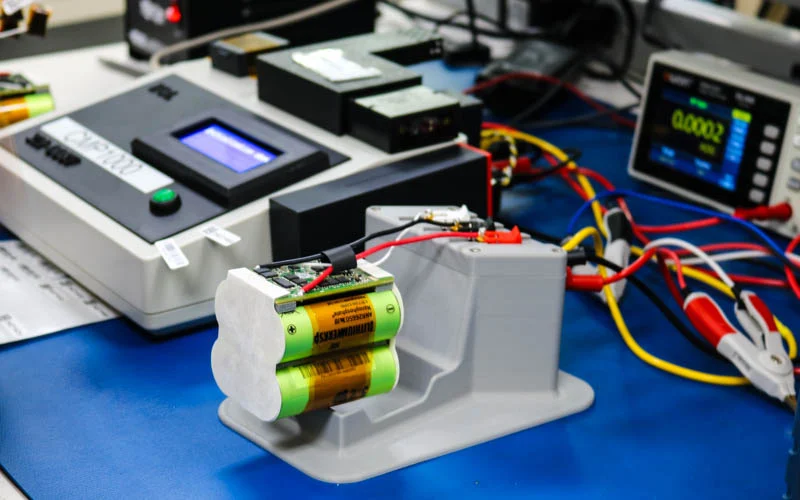
Standard test protocol for lead-acid: discharge at the six-hour rate (rated capacity divided by six) from full charge until voltage hits the cutoff. For a 36V battery, that's 31.5V; for 48V, 42V. Multiply discharge time by current to get actual amp-hours.
The test eats almost a full day between charging, resting, and the discharge itself. That battery and its forklift sit idle the whole time. Annual testing is ambitious for most operations. Many never test at all.
And even when testing happens, the six-hour constant-current discharge bears little resemblance to actual forklift duty cycles: 300A spikes during acceleration, 40A during coasting, constant start-stop patterns. A battery that scrapes through lab testing might buckle under real pulsed loads.
Lithium testing follows manufacturer specs, usually at 0.5C or 0.33C rates. The BMS reports an SOH figure, but these vary wildly in accuracy between manufacturers. Some track actual capacity reasonably well. Others just count cycles and call it health assessment.
Reading the Signs Without Formal Testing
Runtime shrinkage catches attention first. Same battery, same forklift, similar workload, shorter shifts before the low-battery warning. Rule out the obvious culprits: heavier loads lately, longer haul distances, mechanical drag from bad tires or sticky brakes. Cold weather knocks a few percent off capacity temporarily; that's normal, not degradation.
Baseline your runtimes early. Pick representative days in the first few months, note how many hours before the battery gives out. Later, compare against similar-intensity days. Down 15%, worth watching. Down 25%, schedule a real capacity test. Down 30%, start shopping.
Charging duration stretching indicates rising internal resistance. An eight-hour charge becoming nine-and-a-half hours means reduced charging efficiency. But charger condition, line voltage, ambient temperature, and starting depth-of-discharge all muddy this signal. Useful in combination with other indicators, unreliable alone.
Specific Gravity for Lead-Acid
Hydrometers cost almost nothing. The measurement takes fifteen minutes for a whole battery. Most maintenance crews dismiss the technique as obsolete, preferring voltage readings and digital diagnostics. This attitude throws away one of the best tools available.
Voltage tells you about the battery as a whole. A weak cell hides among strong ones; total voltage drops 5%, looks minor, but that one cell might be circling the drain, dragging everything else down, getting worse by the week. Specific gravity exposes individual cell states. Seventeen cells reading 1.270 and one reading 1.215 means that one cell has a problem. Spread exceeding 0.030 across cells signals serious imbalance.
A fully charged healthy cell should read between 1.265 and 1.285 (at 25°C; adjust about 0.007 per 10°C deviation). A cell that won't reach 1.240 even after full charging has permanent damage. Equalization won't fix it.
If all cells read low but close together, the battery has generalized sulfation, possibly improvable with conditioning. If just one or two cells read low, those cells have specific faults that conditioning won't touch.
BMS Data for Lithium
No electrolyte means no hydrometer. Lithium assessment runs through whatever the BMS reports: SOH percentage, cycle count, cell voltage balance, temperature logs.
SOH algorithms differ drastically between manufacturers. Some correlate reasonably with actual capacity. Others drift. The useful approach: track the trend over months. Stable decline of 1-2% monthly suggests normal aging. Accelerating decline (3% last month, 5% this month) signals approach to the knee point.
For expensive high-capacity packs, independent capacity verification every year or two makes sense. BMS numbers alone don't deserve blind trust.
Internal Resistance
Specialized equipment requirement here. But resistance measurement finishes in minutes, and rising resistance often precedes capacity decline by six to twelve months. Enough lead time to budget, source, and schedule replacement without emergency scrambling.
Healthy lead-acid cells run around 0.5-1 milliohms; new lithium cells around 0.2-0.3 milliohms. Absolute numbers depend on cell design and capacity. What matters is tracking change within the same battery. Resistance up 50% from installation baseline, even with acceptable capacity numbers, calls for closer monitoring.
Physical Inspection
Housing Problems
Deformation, bulging, cracks: any of these means immediate removal from service. No exceptions, no waiting to see what happens.
Lead-acid housing distortion usually indicates internal pressure buildup: severe overcharging, internal shorts, physical damage. Compromised sealing risks acid leakage and hydrogen accumulation. Hydrogen above 4% concentration becomes explosive.
Lithium swelling is worse. Gas generation inside the pack typically means electrolyte breakdown or electrode-electrolyte reactions. Thermal runaway precursor. Lithium thermal runaway reaches several hundred degrees, produces fire, sometimes explosion.
Immediate Action Required
Pull the battery. Move it somewhere ventilated, away from people and ignition sources. Don't charge it, don't discharge it, don't try to fix it yourself.
Terminals and Connections
Blue-green or white powder on terminals and connectors indicates corrosion. Light corrosion can be cleaned with baking soda solution, dried, and protected with petroleum jelly. Recurring corrosion means something else is wrong: leaking seals, overvoltage charging, housing damage. Fix the cause, not just the symptom.
Corrosion on intercell connectors is more serious. Elevated connection resistance creates local heating, which accelerates corrosion, which increases resistance further. The cycle can end with melted connectors or arcing during heavy current flow.
After charging or discharging, touch the connection points. All should be similar temperature. A hot spot indicates high-resistance connection requiring immediate attention.
Electrolyte Condition (Lead-Acid)
Pop the caps. Healthy electrolyte looks clear, colorless to pale yellow. Cloudy fluid or visible particles means active material shedding from plates. Dark brown or black electrolyte means severe shedding. This battery is dying.
Check for sediment at the bottom. More sediment, worse condition. Accumulated sediment eventually reaches plate bottoms, causing shorts.
Watch level variation between cells. Normal evaporation should be roughly uniform. One cell losing fluid faster than the others has a problem: overheating, internal shorts, seal failure.
Odors
Mild acid smell during late-stage lead-acid charging is normal. Strong rotten-egg smell means hydrogen sulfide: abnormal reaction, excessive temperature, potentially dangerous gas.
Lithium batteries shouldn't smell like anything. Sweet or solvent-like odor indicates electrolyte leakage. Housing seal failure. Stop using it.
Lead-Acid vs. Lithium: Different Replacement Rhythms
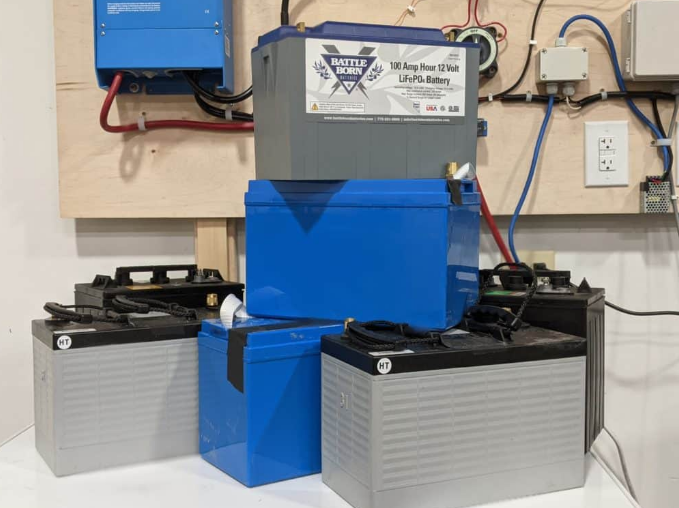
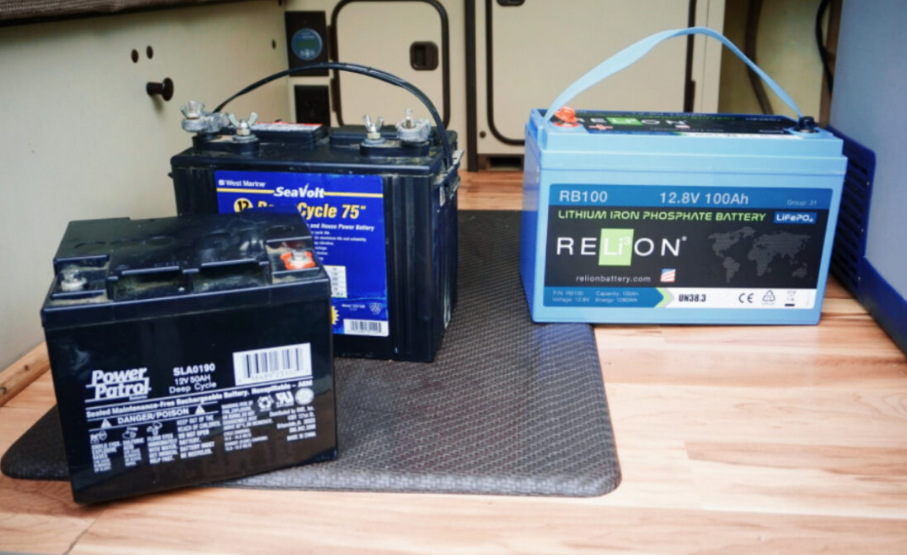
Both battery types use 80% as a reference point, but the decision-making process differs substantially.
Lead-acid degradation is gradual and observable. Symptoms appear slowly over years. Operators notice the forklift "losing power" incrementally. Charging takes a bit longer each month. Runtime shortens week by week. Plenty of warning, plenty of time to observe and respond.
The trap: gradual change breeds gradual acceptance. Three years ago, one charge covered a shift. Now it takes two charges, but everyone has adjusted. "That's just how this battery is." Recognition often comes after months of accumulated efficiency loss.
Lithium batteries feel fine until they don't. Performance stays stable across most of the service life, then drops off rapidly near the knee point. Last quarter everything seemed normal; this quarter the battery can't finish shifts. By the time symptoms become obvious, the battery may have only months left.
SOH dropping into the 88-90% range: start paying attention, shorten monitoring intervals. 83-85% range: begin procurement process. At 80%: new battery should already be on-site or incoming.
Temperature Effects
High temperatures accelerate every chemical reaction involved in battery aging. A commonly cited guideline: service life halves for every 10°C increase in operating temperature. The exact ratio varies, but the direction holds. Same battery model lasting six years in a climate-controlled warehouse might give three-and-a-half years in a hot manufacturing floor.
Low temperatures reduce immediate performance (higher internal resistance, lower available capacity) but slow aging reactions. Cold-storage forklifts underperform in winter but often outlast their counterparts working in heat.
Calendar age tells an incomplete story. Five years in air conditioning differs from three years in summer warehouse heat. Adjust expectations accordingly.
Temperature cycling causes additional stress. Repeated expansion and contraction fatigues housings and seals, loosens connections. Forklifts moving between freezers and loading docks face this constantly.
Charging Habits

Rated cycle life (1500 for a typical lead-acid battery, 3000 for lithium) doesn't distinguish between deep and shallow cycles. Draining to 20% and recharging counts as one cycle. Draining to 60% and recharging also counts as one cycle. Same ledger entry, half the useful work.
Opportunity charging (plugging in during lunch break, during afternoon break, whenever convenient) racks up cycle counts without proportional work output. Three opportunity charges per day exhausts the same cycle budget as one full charge-discharge, but delivers maybe a third of the transport capacity.
One charge per day, draining to 20-30% before recharging, maximizes work extracted per cycle consumed.
Deep discharge hurts too. Running below 10% accelerates sulfation. Running until the forklift stops can cause permanent damage in a single instance.
Charger Mismatch with Aged Batteries
Charger algorithms optimize for new battery characteristics. Current levels, voltage thresholds, termination conditions: all calibrated for fresh cells.
Aged batteries have higher internal resistance. Original charging currents now generate more heat. Aged batteries have lower capacity. The charger doesn't know this, keeps pumping in energy past the useful point, overcharging. Or terminates early, undercharging. Either outcome accelerates decline.
Smart chargers with adaptive algorithms adjust to actual battery response, monitoring voltage and temperature throughout, modulating output accordingly. Fixed-algorithm chargers continue treating old batteries like new ones, speeding their deterioration.
Many warehouses wonder why batteries age faster than spec sheets predict. Often the answer is charger mismatch. The original charger, never adjusted, never upgraded, applying new-battery parameters to batteries years past their prime.
Reconditioning and Cell Replacement
Reconditioning services promise capacity recovery through specialized treatment. The claim has some validity, but only for a narrow set of conditions.
If capacity loss stems mainly from reversible sulfation, deep equalization or pulse charging can sometimes reactivate blocked material. Recovery of 5-15% is possible. But if degradation involves plate corrosion, material shedding, separator breakdown, or internal shorts, reconditioning accomplishes nothing.
Hydrometer readings help predict outcomes. All cells low but uniform: possibly recoverable sulfation. Individual cells drastically lower: cell-specific faults, not recoverable. Visible sediment accumulation: material loss too advanced for reconditioning.
Batteries below 78% rarely recover enough to justify the cost, even when successful.
Reconditioned batteries don't handle high discharge rates well. Capacity numbers might improve, but peak power output stays limited. Suitable for light duty, problematic for heavy loads.
Replacing individual cells can work for isolated failures in younger batteries. But if the battery has several years of service, other cells will likely fail soon. Continuous cell replacement becomes expensive and disruptive. Generally better to replace the entire unit once failures begin appearing.
Multi-Battery Rotation
Two or three batteries per forklift, rotating through use and charging, maximizes equipment utilization. But batteries from the same purchase batch age at different rates. Minor production variations, different forklift assignments, different charger positions, accumulated randomness. After several years, one might be at 88%, another at 78%, another at 82%.
When the 78% battery crosses the replacement threshold, replacing only that one creates problems. New battery joins an old-battery rotation schedule. The schedule assumes lower capacity, calls for frequent charging. The new battery gets subjected to excessive shallow cycling, ages prematurely toward matching the old batteries' condition.
Better options: replace the whole rotation group together, or keep new batteries in separate rotation groups with appropriately spaced charging schedules. Mixing new into old without adjusting schedules wastes new-battery service life.
Deciding When to Pull the Trigger
80% capacity marks the technical threshold. Actual decisions involve economics, operational context, and practical constraints.
Direct costs: new battery price minus old battery residual or recycling value, plus labor and downtime for the swap.
Indirect costs: reduced runtime means less transport capacity per shift; degraded power means slower operations; frequent charging means more coordination overhead; reliability concerns mean contingency planning.
And ongoing depreciation: a battery at 80% today, past the degradation knee, might be at 70% in three months. Delay costs both the efficiency loss during those months and the accelerated value evaporation.
When monthly cost of running the old battery (efficiency losses, maintenance hassles, reliability risks, depreciation) approaches half the monthly amortization cost of a new battery, replacement makes economic sense.
Few operations run those calculations explicitly. More commonly, decisions follow accumulated friction: operator complaints increase, maintenance attention concentrates on problem batteries, schedules start bending around charging needs. These signals often trigger replacement before formal analysis would.
Early replacement might make sense before peak season, when other same-batch batteries are failing (suggesting this one will too), when technology upgrades make old and new incompatible, or when supplier pricing favors acting now.
Delayed replacement might make sense entering slow season, while evaluating alternative technologies, or when budget cycles require deferral.
Safety Has No Flexibility
Everything above assumes normal degradation: capacity declining, performance softening. Some conditions require immediate action regardless of economics or timing convenience.
Housing deformation or swelling: remove from service immediately.
Persistent leaking: remove from service immediately.
Abnormal heat during use or charging: remove from service immediately.
Unusual odors (rotten egg smell from lead-acid, sweet/solvent smell from lithium): remove from service immediately.
BMS alerts triggering power limits: investigate before resuming use.
No "wait and see." No economic analysis. These conditions carry fire, explosion, or chemical hazard risk. Pull the battery, isolate it in a ventilated area away from people and ignition sources, contact someone qualified to handle it.
Retired batteries require proper disposal. Lead-acid contains lead and sulfuric acid: hazardous waste, not regular trash. Lithium disposal has its own requirements; improper handling creates fire risk. Most suppliers offer take-back programs or can arrange certified recycling.