
What is the Best Lithium Battery for Marine Use?
Dakota Lithium for most people. Battle Born if you need phone support. RELiON RB100-HP if you insist on lithium for starting.
Dakota 100Ah runs $500-550 with an 11-year warranty. Make sure it has low-temperature charging protection and you're done.
LiFePO4
NMC batteries burned enough boats between 2019 and 2022 that nobody sells them for marine use anymore. Tesla uses NMC because cars have sophisticated cooling systems managing cell temperatures constantly. Active liquid cooling. Thermal management integrated into vehicle architecture from the ground up. Engineers designing electric vehicles understood NMC chemistry runs hot and built accordingly.
Boats sit in hot engine rooms with salt air corroding everything. No active cooling. No temperature management beyond whatever ventilation hull design happens to provide. Ambient temperatures climb past 120°F on summer afternoons. Corrosion works at monitoring circuits over months of exposure, degrading sensing accuracy that protection systems depend on. Vibration from hull pounding loosens connections. Batteries sit unused for weeks between trips while corrosion accumulates and problems develop unnoticed.
When NMC fails in these conditions, it fails violently. Cell shorts internally from corrosion damage or manufacturing defect that slipped past quality control. Temperature spikes. Heat transfers to adjacent cells. Adjacent cells cascade into thermal runaway. Fire burns hot enough and fast enough to overwhelm any marine fire suppression equipment. Fiberglass burns readily once ignited. People sometimes get hurt when they can't abandon ship quickly enough.
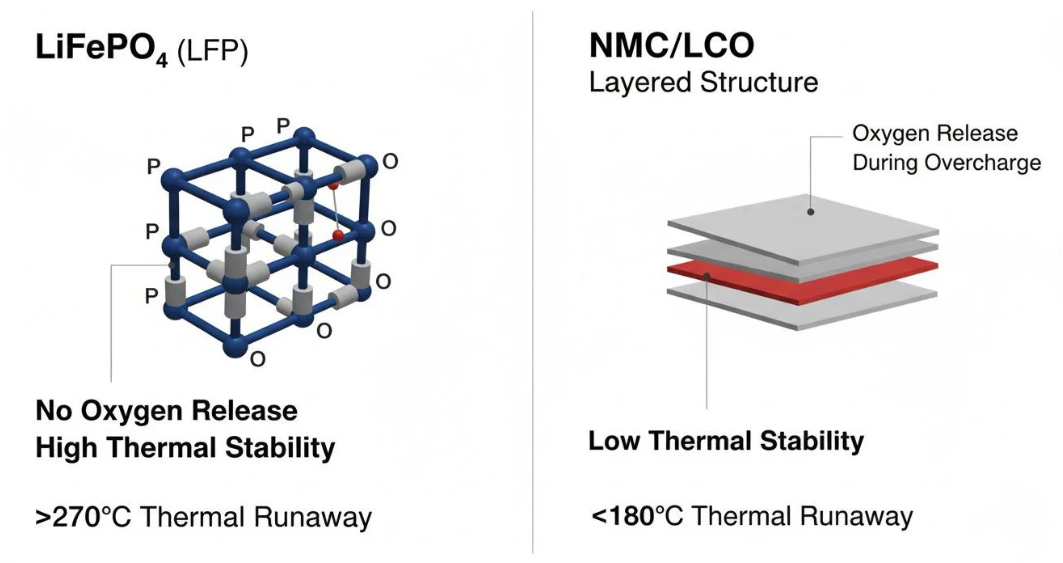
LiFePO4 battery chemistry
Nobody at the Coast Guard publishes convenient statistics on battery fires by chemistry type. Incident reports scatter across regional offices and insurance company files without central aggregation. But word gets around through insurance adjusters and marine surveyors when investigators identify causes. Industry people talk at conferences. Email chains circulate. Enough yacht fires traced back to NMC thermal events that manufacturers quietly pulled NMC marine batteries from their catalogs. No announcements. No recalls. Products just disappeared from shelves and websites.
LiFePO4 won't burn. Different crystal structure called olivine with phosphate-oxygen bonds refusing to release oxygen under abuse conditions. Puncture tests with sharp objects. Overcharge tests pushing voltage far past normal limits. External heating tests applying blowtorches directly to cells. LiFePO4 chemistry holds together. Won't cascade into thermal runaway.
Weight penalty exists. LiFePO4 runs about 28 pounds per 100Ah. NMC would be around 22 pounds. Six pounds heavier per battery. Against burning to the waterline miles from help. Easy choice.
Lithium Titanate shows up in commercial ferry applications where vessels run multiple charge cycles daily for years. 10,000+ cycle life. Fast charging capability. Wide temperature tolerance. Premium pricing and lower energy density acceptable for commercial operators optimizing total cost of ownership over vessel lifetimes. Overkill for recreational boats.
AGM lead-acid still works fine for boaters who don't care about weight or replacement frequency. 70 pounds per 100Ah versus 28 for lithium. 300-500 cycle life versus 2500-5000 for lithium. Only 50% of rated capacity actually usable without accelerating degradation versus 80% for lithium. Voltage droops continuously through discharge instead of holding flat.
Stock charging systems on most boats handle AGM without modification. Mechanics everywhere understand lead-acid without special training. Replacement batteries available at any chandlery or auto parts store. If three-year battery replacement fits your maintenance routine and 70-pound batteries don't bother you, AGM avoids the whole lithium learning curve.
Voltage behavior catches people switching from lead-acid. Lead-acid dims gradually as it depletes. Electronics get dimmer, trolling motors slow down, you know the battery is getting tired before it quits. Lithium holds full voltage until nearly empty then drops fast. Full brightness until sudden darkness. Takes some adjustment.
Dakota Lithium
Bassmaster sponsorship. That matters more than spec sheets.
Tournament bass fishing runs equipment harder than anything recreational boaters do. Professional anglers competing for prize money and sponsorship deals run high-thrust trolling motors at 50+ amps for eight-hour competition days. No babying batteries to preserve capacity. Fish move, boats follow at full speed. Overnight charging between tournament days pushes batteries through rapid charge cycles. Highway vibration between tournament venues as the circuit moves lake to lake through the season. Texas heat in summer events. Cold northern mornings in early season.
Bassmaster cares about their broadcast image. Sponsors whose equipment fails visibly on television become former sponsors. Nobody wants cameras capturing a tournament contender dead in the water because a battery died. Dakota has held Bassmaster sponsorship through multiple complete seasons. If failures happened at rates affecting competition outcomes, that deal would have ended.
Tournament conditions approximate worst-case abuse for marine batteries. Lab testing uses new batteries under controlled conditions. Tournament fishing uses batteries with hundreds of accumulated cycles in real-world conditions throughout a competition season.
Cells inside Dakota batteries come from the same Asian manufacturers supplying Battle Born. Independent teardown comparisons show performance within 5%. Same supplier tier. Similar BMS functionality. Different colored cases. Different prices.
Eleven-year warranty. Longer than Battle Born's ten years. Roughly half Battle Born's retail price.
Support runs through email. Submit questions through the support portal, wait for responses. Complex integration questions bounce back and forth over multiple exchanges, each response arriving hours or days later. Busy periods stretch response times longer.
If you're anchored somewhere with a charging problem and need help right now, Dakota email support won't solve it today. If you can figure things out from forum archives and YouTube videos, or wait for email responses, the $400 savings over Battle Born buys other equipment.
Forum documentation built by Dakota users over years covers most common questions. Troubleshooting threads archive solutions to integration problems. Video tutorials walk through installations step by step.
The DL+ line handles both deep-cycle and starting duties. 1000 CCA rating. Forum threads show owners successfully starting various outboards and diesel auxiliaries. Real owners reporting real starts, not just manufacturer claims from lab conditions. Small boats benefit from eliminating separate starting batteries. Larger boats with space for dedicated banks should look at RELiON for starting or just keep an AGM starter.
$550-600 for heated DL+ versions handling cold weather operation.
Battle Born
Same cells as Dakota. $400 more.
Independent teardowns confirm this over and over. Same Asian suppliers. Performance differences within 5%. Active cell balancing instead of passive, which helps long-term health marginally but doesn't change daily performance noticeably. The electrochemistry matches.
$400 buys customer support and warranty confidence.
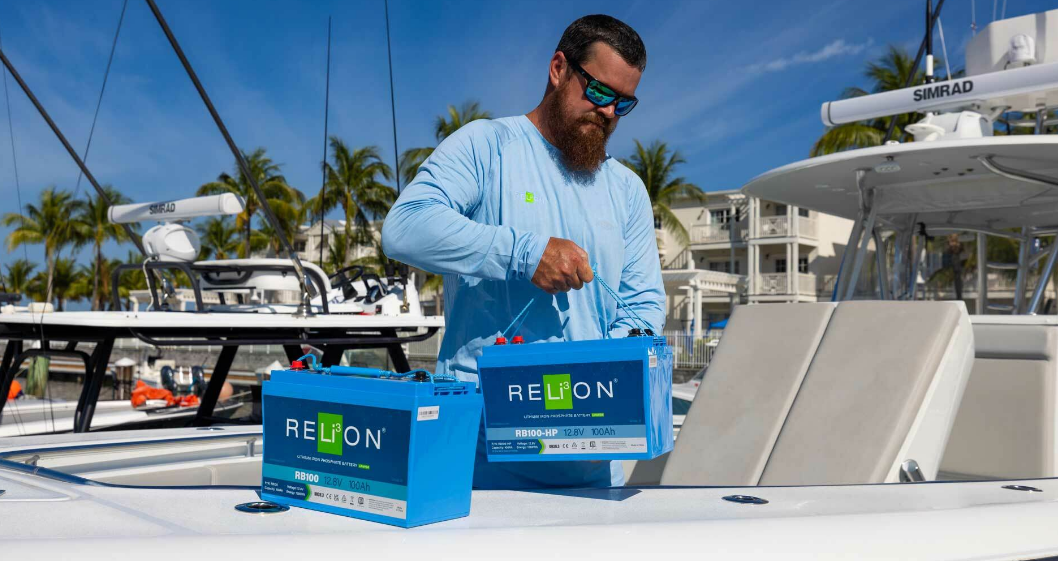
Offshore cruisers benefit most from premium battery support
Phone lines staffed from Reno headquarters by technicians who've configured marine electrical systems. Call with alternator integration questions and talk to someone who understands the question and has worked through similar problems. Different from scripts and department transfers and giving up to search forums.
Ten-year warranty coverage. Forum documentation accumulated over years shows Battle Born honors claims without excessive resistance. Warranty value depends entirely on companies actually paying claims.
Offshore cruisers heading to remote anchorages for extended periods should probably pay for phone support. Getting stuck with a charging fault in Georgetown without local expertise, calling Battle Born and troubleshooting with a technician who knows what they're talking about could save an entire cruising season. Prevents wrong diagnoses leading to expensive equipment shipped to remote locations. Prevents dangerous workarounds rigged from whatever parts the local chandlery has.
Weekend fishermen keeping boats on trailers within driving distance of marine service shops are paying for insurance against problems they can solve other ways. Drive to a marine electrician Monday morning. Post in forums and wait for responses. $400 toward other equipment.
Heated versions warm cells before accepting charge in cold weather. Necessary for northern climates with winter operation. Unnecessary expense in Florida.
RELiON RB100-HP
Mercury Marine certified it for starting their outboard engines. Nobody else has achieved Mercury certification for lithium starting batteries.
Mercury engineering cares about their reputation. Certifying products that strand customers with boats that won't start damages that reputation. When Mercury puts their name on a certification, they've tested under conditions exceeding normal recreational use and satisfied themselves it works.
Regular lithium deep-cycle batteries can't start engines. Starter motors pull 600+ amps for half a second during cranking. Deep-cycle batteries optimize for sustained moderate loads, running refrigerators and electronics for hours. Different internal design for different purposes.
Under starting current, deep-cycle lithium voltage sags below what starters need. Or BMS current protection trips because 600 amps looks like a fault condition to protection circuits expecting normal house loads. Either way the engine doesn't start. Battery works fine for house loads. Won't crank the engine.
RELiON built a battery specifically for starting. Cell selection prioritizing current delivery over energy density. Bigger connections between cells handling brief high current without voltage drop. BMS tuned to permit starting pulses that would trip conventional protection.
$1000-1200. IP67 environmental sealing. Ten-year warranty.
But most boat owners should keep an AGM for starting while converting house banks to lithium.
$200 Group 31 AGM starts engines without any special considerations. Standard alternator charging. Standard battery switches. No DC-DC isolation needed. Mechanics understand it without training. 70 pounds.
Lithium house bank saves 200+ pounds depending on configuration. Net weight savings of 130+ pounds while keeping dead-simple starting reliability working exactly like boats have worked for decades.
The RELiON makes sense for owners who absolutely cannot tolerate 70 pounds of lead-acid anywhere aboard. Weight-obsessed racers. Specific hull layouts without space for separate banks. Everyone else saves money and complexity with hybrid setups.
Budget Batteries
LiTime Trolling Motor Edition at $330-400 is where quality becomes acceptable for boats.
350,000+ units sold. Volume manufacturing at scale smaller competitors can't match. Component costs drop ordering millions of cells instead of thousands from suppliers. Assembly efficiency improves through repetition and process optimization. Per-unit overhead spreads across larger production volume. Quality control systems mature through scale. Prices drop while margins hold and quality improves.
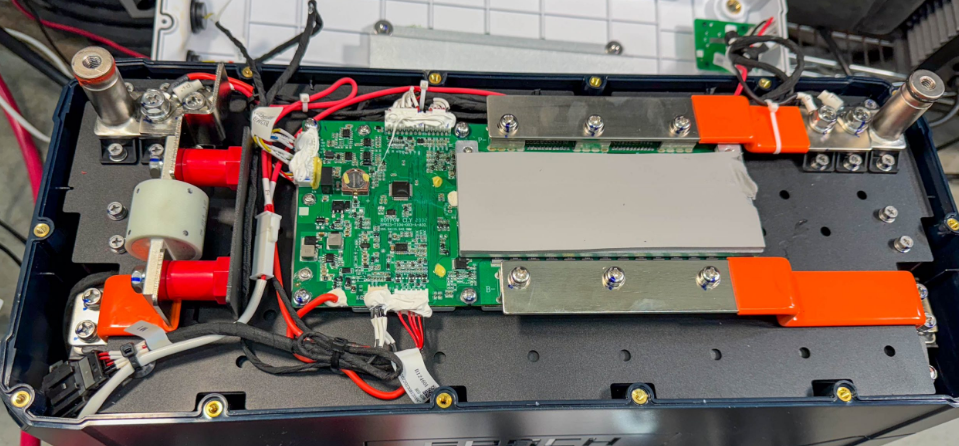
Budget lithium batteries have found wide adoption in marine and RV applications
ABYC E-13 certification meets compliance requirements mandatory for American recreational boats since July 2023. Budget batteries without E-13 certification create compliance problems during insurance claims when adjusters look for exclusions, during marina inspections when facilities check installations, during boat sales when buyers or surveyors ask questions. E-13 certification eliminates those problems.
Independent capacity testing by third parties measured 104Ah from nominally 100Ah units. Conservative specs rather than optimistic inflation common among budget brands padding numbers to look competitive. When independent testing shows capacity exceeding claims, other specs become more believable. Manufacturer not exaggerating.
Critical detail that trips up buyers comparing prices: only the Trolling Motor Edition includes low-temperature charging protection. Standard LiTime 100Ah appearing in the same search results does not. Both batteries look similar in listings. Prices similar. Names similar. But standard version lacks temperature monitoring blocking cold charging.
Cold charging destroys lithium cells permanently. One winter mistake eliminates the battery. $50 more for the Trolling Motor Edition prevents total battery loss from one cold charging event. Worth the premium many times over. Buy the Trolling Motor Edition specifically. Not whatever appears cheapest in search results. Not the confusingly similar standard version. The Trolling Motor Edition with low-temperature protection.
SOK batteries attract owners who enjoy understanding equipment and performing maintenance. Removable covers allow internal inspection of cells and connections. BMS replacement runs $150 instead of discarding entire batteries when protection circuits fail. Bluetooth apps show individual cell voltages and balance status, letting owners monitor cell health over time.
DIY solar forums document SOK extensively with user-developed troubleshooting guides, modification instructions, component sourcing information. Company staff participate in community discussions answering questions and incorporating feedback into product improvements. Different relationship than traditional brand dynamics where communication flows through marketing and customer service scripts.
SOK appeals to owners who find satisfaction in understanding how equipment works, monitoring performance trends, performing maintenance rather than replacement. Not everyone wants that engagement. Owners preferring batteries they install and forget should buy something sealed. SOK rewards technical engagement. Penalizes neglect.
Redodo, CHINS, Weize, Power Queen, Enjoybot, user feedback accumulated across forums and review platforms suggests legitimate quality from some units. Other users document premature failures. Warranty service headaches. Inconsistent quality between batches. Companies too new to have established track records.
Will any of them exist in five years to honor warranty claims? Nobody knows. Maybe companies grow, improve, establish reputations. Maybe companies disappear when competition tightens or economics shift. Warranty coverage only has value when companies exist and choose to honor claims. Aggressive warranty terms from unproven companies warrant skepticism.
Saving $100 over LiTime while losing cold temperature protection, losing quality environmental sealing for marine moisture exposure, accepting unknown company viability, questionable value for marine applications where salt spray, temperature extremes, vibration, and extended storage stress equipment beyond typical consumer electronics environments.
Trolling Motors
Bow-mounted motors put heavy batteries where weight affects handling most.
Three AGM batteries for a 36V tournament trolling motor system weigh 210 pounds positioned at the bow. Boat squats under that load. Bow digs in during acceleration instead of lifting cleanly onto plane. Takes more throttle and more time to get up. Burns more fuel at cruising speeds because the hull sits bow-heavy pushing extra water. Bow tracks downwind in crosswinds. Slow-speed maneuvering feels different with all that mass forward. Docking gets trickier.
Three lithium batteries weigh 84 pounds. 126 pounds less up front. Difference noticeable immediately off the trailer. Bow rides higher at rest. Planes faster with less throttle. Uses less fuel at cruise when hull sits in better trim. Handles crosswinds better with improved balance between bow and stern. Dock maneuvering improves. Benefits accumulate trip after trip, season after season. Fuel savings alone offset meaningful portions of lithium premium over years of regular use.
Voltage matching: 12V systems power motors up to about 55 pounds thrust. 24V using two batteries in series handles 70-80 pounds. 36V using three batteries drives 100+ pound motors on tournament bass boats covering big reservoirs fast.
100Ah capacity runs roughly three hours at continuous full throttle. Six to eight hours at variable fishing speeds mixing repositioning runs with working structure at lower power settings. Tournament anglers facing eight-hour days install 200Ah for insurance against running short at critical moments late in competition.
Lead-acid voltage sag reduces motor thrust progressively through the day. Full power at dawn, noticeably reduced by afternoon as voltage droops. Lithium holds full thrust until nearly depleted then cuts abruptly. Some tournament anglers consider consistent power essential. Others adapted to gradual decline long ago and find sudden cutoff more jarring.
Dakota dominates tournament circuits. Proven reliability under competition conditions, reasonable pricing fitting competitor budgets, Bassmaster endorsement lending credibility. LiTime Trolling Motor Edition works for recreational anglers prioritizing cost savings over tournament-validated pedigree.
House Loads
Refrigerators consume 50-100Ah daily depending on ambient temperature, insulation quality, door opening frequency, thermostat settings. Well-insulated units in moderate climates run toward 50Ah. Marginal coolers in tropical heat with frequent access run double that or more.
Navigation electronics draw modest continuous current while running. LED lighting draws modest current during evening hours. Chart plotters. AIS. VHF radios on standby. Phone chargers. Tablet chargers. Laptop chargers. Individual loads look small. Totals accumulate faster than guesses predict.
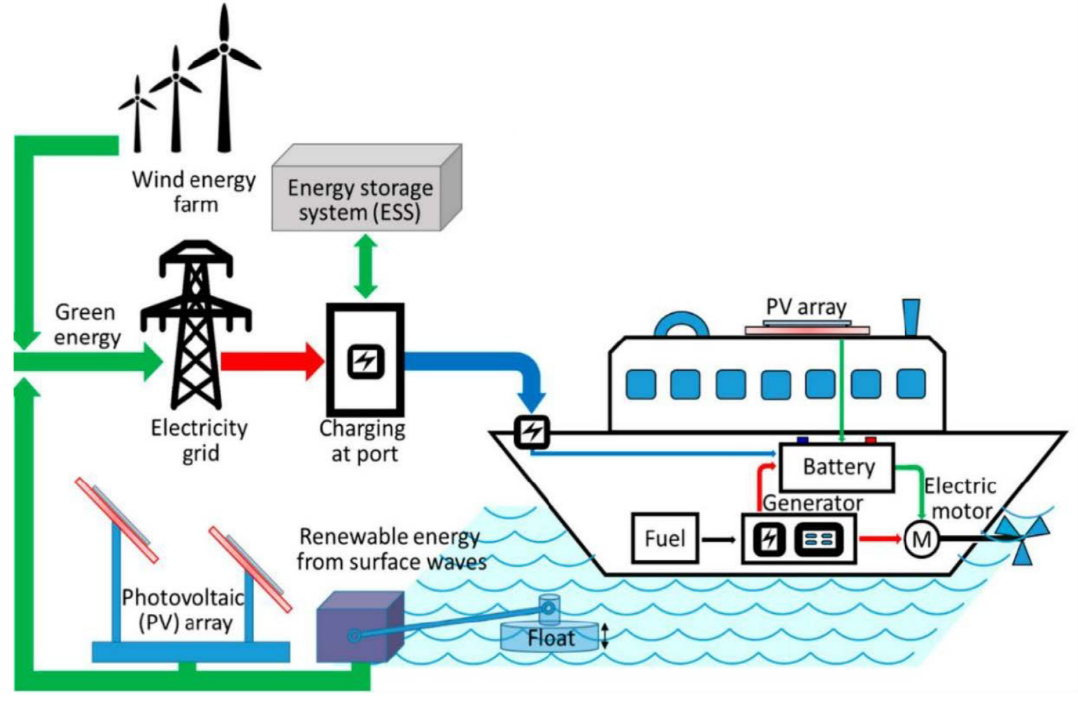
boat electronics and amenities demand reliable power systems
List devices. Find wattage ratings from labels or spec sheets. Estimate realistic daily operating hours based on actual patterns, not optimistic assumptions. Multiply watts by hours for watt-hours per device. Sum across devices. Divide by 12 for amp-hours. Add 50% margin because actual consumption exceeds calculations once real use patterns emerge.
Lithium capacity sizing uses actual calculated needs because 80% of rated capacity remains usable. Lead-acid sizing doubles calculated needs because only 50% is usable without accelerating degradation.
Boat needing 200Ah daily requires 400Ah lead-acid capacity, roughly 280 pounds of Group 31 batteries. Same boat needs 250Ah lithium capacity, roughly 75 pounds. Over 200 pounds eliminated from locations typically positioned high affecting stability.
Alternators and Charging
Lead-acid batteries naturally reduce charge acceptance approaching full. Depleted banks might accept 60 amps initially from high-output alternators, dropping to 20 amps as voltage rises, dropping to 5 amps near full. Alternator workload decreases through charging cycles. Heat accumulation stays manageable because batteries limit demand automatically through chemistry. Alternators have worked this way with lead-acid for decades. Engineers designing marine alternators expect this load pattern.
Lithium pulls maximum alternator output continuously until BMS hits termination voltage and cuts current instantly. 100-amp alternator delivers 100 amps the whole time. No taper. No gradual reduction. Full output until sudden stop. Continuous high output accumulates heat in windings and rectifiers without relief periods. Alternators designed expecting lead-acid charge taper overheat driving lithium banks through extended cycles. Bearings fail. Diodes fail. Regulators fail. Expensive repairs.
BMS disconnection creates separate problems. When lithium reaches termination or detects faults, BMS opens circuits instantly. No gradual reduction. No warning. Just open circuit. Alternator delivering 80 amps suddenly has nowhere to send current. Alternators resist instantaneous current changes because of inductance in their windings. Energy stored in magnetic fields has to go somewhere. Voltage spikes across terminals, propagates through electrical systems, finds paths through connected electronics. Alternator diodes blow. Regulators blow. Chart plotters blow. VHF radios blow. Expensive damage from a protection event working exactly as designed.
DC-DC chargers fix both problems. Sit between alternator and battery, regulate current flow, isolate circuits.
Current limiting caps charge rate below alternator continuous rating regardless of what batteries demand. Battery wants 100 amps, DC-DC charger configured for 30 amps, alternator only sees 30-amp load. Thermal stress stays within design limits.
Circuit isolation contains BMS disconnection events. BMS disconnects, DC-DC charger input side keeps alternator current flowing into the charger. Output side disconnects. No spikes propagate back to alternator. No damage to charging system.
Victron Orion-Tr Smart at $200-400 has become default for lithium marine conversions. Well-documented. Widely used. Troubleshooting help available in forums. 12/12-30 model handles most single-engine recreational installations at around $250. 12/12-50 handles larger systems needing higher charge rates at around $350.
Shore charger compatibility gets missed during conversion planning. Older marine chargers designed for lead-acid use different voltage profiles. Lithium wants 14.2-14.6V absorption, 13.4-13.8V float. Chargers programmed for lead-acid voltages overcharge lithium cells, trigger BMS protection events, accelerate degradation over time. Check existing shore charger settings and profiles. Budget for replacement if needed. Modern multi-stage chargers with selectable profiles often include LiFePO4 settings.
Battery monitoring becomes essential because lithium voltage tells almost nothing about remaining capacity through most of discharge range. Lithium holds 13.0-13.4V from 90% down to 20% charge, then drops fast toward cutoff. Can't estimate remaining capacity from voltage until battery approaches empty. With lead-acid, dimming electronics warn of depletion. With lithium, first warning might be everything shutting off.
Victron BMV-712 at roughly $200 tracks current flowing in and out instead of inferring state from voltage. Shunt sensor monitors all current passing through battery circuit. Accurate readings through entire discharge range. Historical logging identifies unexpected consumption patterns from parasitic loads or inefficient equipment.
Many lithium batteries include basic Bluetooth monitoring through manufacturer apps. Voltage display. Rough state of charge estimates. Adequate for casual checking. Insufficient for detailed system management or troubleshooting consumption problems.
Budget 1.5-2x battery cost for complete charging integration. DC-DC charger. Monitor. Potentially new shore charger. Fusing sized for lithium current capability exceeding lead-acid. Possibly cable gauge upgrades handling higher currents without excessive voltage drop. Labor if not doing work yourself.
Cold Weather
Discharging lithium in cold weather works fine. 70-80% capacity remains available at 0°F. Performance decreases somewhat with cold slowing chemical reactions, but no permanent damage occurs. Battery recovers normal capacity when temperature rises. Use the boat in cold weather. No problem.
Charging below freezing destroys cells. Permanent damage. Irreversible. Different situation entirely.
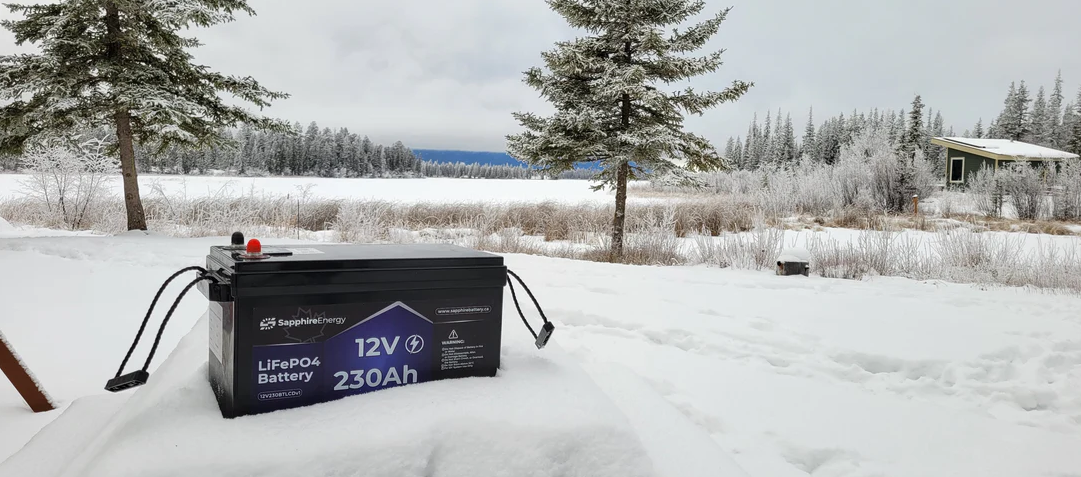
Cold weather charging requires special consideration for lithium batteries
Below 32°F, lithium ions can't go where they belong during charging. Instead of inserting into electrode material, ions plate onto anodes as metallic lithium. Metal accumulates on surfaces. Doesn't dissolve away when temperature rises. Capacity drops because those ions no longer participate in normal charge-discharge cycling. Resistance increases. Dendrite growths form that can eventually create internal shorts between electrodes.
Single cold charging event eliminates 10-20% of capacity depending on how cold and how long charging continued. Batteries working perfectly in October become noticeably degraded or completely dead after winter storage with trickle chargers attached in unheated garages. Temperature dropped below freezing during a cold spell. Charger kept trying to push current. Battery accepted charge it shouldn't have. Permanent damage accumulated over hours or days.
Owners don't understand what happened. Damage invisible from outside. Battery looks fine. Charger indicator showed green. Everything seemed normal. Cause not obvious at the time. Spring arrives, battery capacity noticeably reduced or gone entirely. Frustrating and expensive lesson.
Quality BMS monitors cell temperature through integrated sensors, blocks charging current below safe thresholds regardless of what connected chargers attempt. Chargers try to deliver current. BMS refuses. Battery won't accept charge until cells warm above protection threshold, typically set around 32-35°F depending on manufacturer. Protection automatic without owner awareness or intervention. Forget about temperature, charger connected during cold snap, BMS protects battery anyway.
Batteries without temperature protection rely entirely on owners remembering not to charge cold. Owners forget. Connect chargers during unexpected cold snaps without checking thermometer readings first. Leave maintenance chargers attached through winters without thinking about garage temperatures dropping below freezing during cold spells. Life gets busy. Boats sit. Chargers run. Temperature drops. Damage happens.
Predictable human error destroys batteries that proper BMS design would protect automatically. Temperature protection worth the small premium over batteries lacking it. One protected winter covers the price difference many times over.
Heated versions from Battle Born, Dakota, Renogy incorporate warming elements using battery reserves to raise cell temperature before accepting charge. Temperature sensors detect cold cells. Heating activates using stored battery energy. Cells warm. Once temperature rises above safe threshold, normal charging proceeds. Draws some capacity during warming cycles, typically a few amp-hours depending on how cold and how long heating runs. Necessary for boaters in cold climates operating or storing boats without heated facilities.
Winter storage without heated batteries: discharge to 50-60% state of charge rather than storing fully charged, disconnect all loads eliminating parasitic drain from monitoring equipment or slow leakage, store above freezing if practical. Lithium tolerates cold storage disconnected and partially discharged without damage. No special maintenance. No trickle charging needed. Just disconnect and wait. Spring requires only normal charging. No recovery procedures. No conditioning cycles.
Insurance and Compliance
ABYC E-13 became mandatory for lithium installations in American recreational boats July 2023. Pack-level testing certification through UL, IEC, or SAE protocols required. Functional BMS with overcurrent, overvoltage, undervoltage, thermal protection required. System disconnect accessible to operators required. Proper labeling indicating lithium chemistry required.
Before July 2023, lithium installations existed in regulatory gray area. No specific standards applied. Installations varied wildly in quality and safety. Some careful owners and professional installers did excellent work. Others threw batteries in without understanding integration requirements. Fires happened. Insurance claims accumulated. Industry recognized the need for standards.
Non-compliant installations void hull insurance. Not just lithium-related claims. Hull insurance entirely. Adjusters investigating any fire claim look for coverage exclusions justifying denial. Non-compliant lithium installation provides clear justification to deny claims regardless of whether lithium actually caused the fire. Engine fire? Sorry, non-compliant lithium installation voids coverage. Galley fire? Sorry, non-compliant lithium voids coverage. Adjusters have strong incentive to find exclusion justifications. Non-compliant lithium hands them one.
Manufacturers claim E-13 compliance with varying honesty. Marketing language gets creative. "E-13 compliant cells" might mean individual cells passed testing while assembled pack including BMS and enclosure lacks pack-level certification. "Designed to E-13 standards" might mean nothing was actually tested. "Meets E-13 requirements" might refer to some requirements but not all.
Pack-level certification means the complete assembled battery as sold was tested and certified, not just components. Request actual certification documents showing pack-level testing. Not marketing copy. Not website claims. Actual documents from certifying bodies showing the specific model you're buying passed pack-level testing. If companies can't or won't provide pack-level certification documents, assume they don't have pack-level certification.
Some insurers now ask specifically about lithium during policy applications and renewals. Questions appearing on forms: "Does vessel have lithium battery installation?" "Was lithium installation performed by ABYC-certified electrician?" "Do lithium batteries have E-13 certification?" Answering incorrectly voids coverage. Answering honestly might affect premiums or availability.
Some insurers require professional installation certification from ABYC-qualified marine electricians with documentation. DIY installations don't qualify regardless of quality. Some insurers exclude lithium fire damage from standard hull coverage unless specific safety requirements documented in writing and verified by surveyor. Some insurers decline lithium-equipped boat coverage entirely pending more industry experience with the technology.
Terms vary between insurers, between policy types, between regions. What one insurer accepts another declines. What works for one boat type doesn't work for another. Check coverage terms before committing to lithium conversion. Don't discover exclusions or requirements after filing claims following incidents.
Summary
Dakota Lithium 100Ah at $500-550. Tournament-proven, 11-year warranty, half the price of premium brands.
LiTime Trolling Motor Edition at $330-400 for budget. Specifically that variant for low-temp protection.
Battle Born BB10012 at $900-1100 for phone support and warranty confidence.
RELiON RB100-HP at $1000-1200 for lithium starting, though keeping AGM for starting with lithium house bank usually makes more sense.
Check for low-temp protection, IP65+ sealing, E-13 certification, five-year minimum warranty from established companies. Budget 1.5-2x battery cost for charging system integration.