What is EV Charging Station BatteryEnergy Infrastructure
What is EV Charging Station Battery
Marcus ChenDecember 4, 202518 min read
Charging station batteries exist because of a timing mismatch that nobody in the EV industry likes to talk about directly.
Utilities plan electrical infrastructure over decades. A distribution transformer gets installed, serves its location for thirty or forty years, gets replaced. The engineers who size that equipment use load projections based on whatever exists nearby: a strip mall, a rest stop, an office park. They add some margin for growth. They do not anticipate that the rest stop will someday need as much power as a small factory, because in 2005 or 1995 or 1985 when that transformer went in, the idea of a rest stop needing a megawatt of electrical service would have seemed absurd.
Fast chargers changed that math completely. A 350kW charger draws more power than a hundred homes. Put four of them at a highway location and peak demand approaches 1.5 megawatts. The infrastructure serving most potential charging locations was never designed for anything close to this. Not even in the same order of magnitude.
350kW
Single Charger Power Draw
1.5MW
Four-Charger Peak Demand
100×
More Than Average Homes
The obvious solution would be for utilities to upgrade their infrastructure. New transformers, extended distribution lines, possibly new substations. This is what utilities do. They receive interconnection requests, conduct engineering studies, procure equipment, obtain permits, schedule construction. The process works. It has worked for decades. It takes three to five years in cooperative territories where utilities prioritize the work. It takes longer where they have other priorities or where the upgrades require crossing private land or triggering environmental review. It costs seven figures per megawatt of additional capacity, sometimes more.
Charging network operators discovered between 2018 and 2022 that they could not build networks at the pace EV adoption required if every station had to wait for utility upgrades. A company identifying a prime highway location in 2020 and following the conventional grid upgrade path might finally open that station in 2024 or 2025. By then, a competitor who found a different solution would have captured the market. The competitive pressure was intense. Whoever built stations first in a given corridor owned that corridor for years, maybe permanently. Second movers faced stations already in place with established customer patterns.
Battery storage systems enable rapid deployment of high-power charging infrastructure
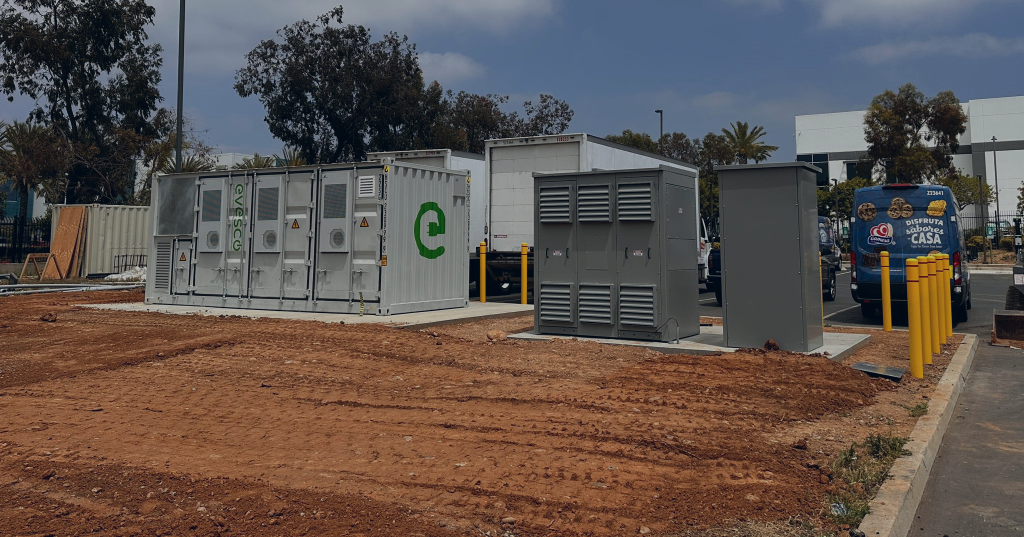
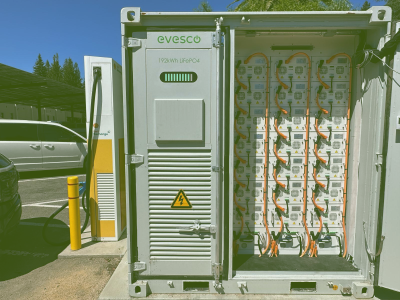
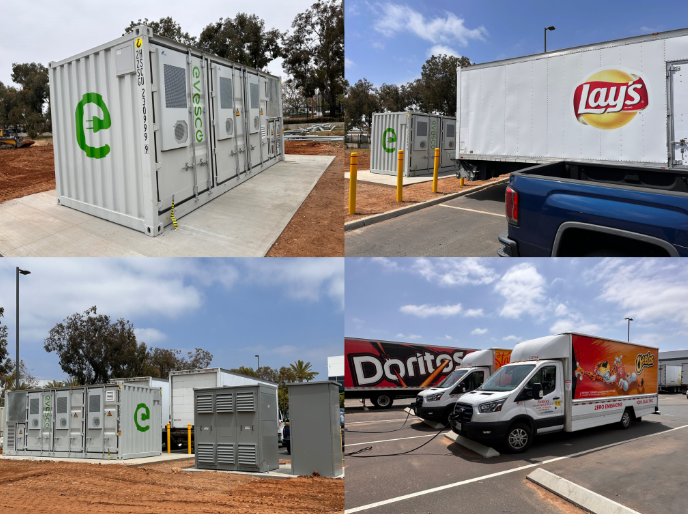
Batteries offered the different solution. Instead of requesting grid capacity matching peak charging demand, an operator could install a smaller grid connection sized for average demand and use batteries to buffer the peaks. The grid delivers 200kW continuously, hour after hour. The battery stores that energy. When a vehicle arrives expecting 350kW, the battery and grid combine to deliver it. When the vehicle leaves, the battery refills. The grid never sees the demand spike. The driver never experiences a capacity constraint.
NREL analysis found that battery-buffered systems reduce required grid capacity by 50 to 80 percent while delivering identical charging experiences. That reduction is the difference between a grid upgrade that takes years and costs millions versus a battery installation that takes months and costs hundreds of thousands.
Battery-buffered systems reduce required grid capacity by 50 to 80 percent while delivering identical charging experiences.
Tesla demonstrated what this approach enables at Lost Hills, California. The station opened in November 2025 with 164 charging stalls, 39 MWh of Megapack storage, and 11 MW of solar generation. Construction took eight months from start to opening. A grid-only approach at that scale, with 164 stalls capable of simultaneous high-power charging, would require dedicated substation infrastructure. The permitting and construction timeline would stretch years beyond what Tesla accomplished with batteries.
Lost Hills is not a typical station. It is the largest Supercharger installation in the world, sized to handle holiday traffic on Interstate 5 between Los Angeles and the San Francisco Bay Area. But the principle scales down. A four-stall highway station that would require an 18-month grid upgrade can open in four months with batteries. An eight-stall urban station that would require utility coordination across multiple property owners can open on existing service. The timeline compression applies at every scale.
This timeline advantage, more than any technical consideration, created the market for charging station batteries. Operators did not install batteries because they wanted batteries. They installed batteries because batteries let them move faster than competitors who waited for utilities. The technology solved a coordination problem between two industries operating on incompatible timescales, and that coordination problem was the binding constraint on network deployment.
The technical details matter less than this dynamic. Lithium iron phosphate chemistry dominates because it survives more charge cycles than alternatives and tolerates heat well enough to work with passive cooling in most climates. Fine. The batteries use LFP cells, they achieve 6,000 to 8,000 cycles before meaningful degradation, they cost something like $150 to $200 per kilowatt-hour installed depending on scale and configuration. These specifications matter for procurement decisions. They do not explain why the market exists.
The market exists because utilities move slowly and charging networks needed to move fast.
There is a second dynamic that reinforces the first, and in some markets it matters even more than deployment speed.
Commercial electricity rates include demand charges based on peak power consumption measured in fifteen-minute intervals. Utilities record the highest demand during any quarter-hour period in a billing cycle and apply a charge based on that peak, regardless of average consumption, regardless of how typical or atypical that peak was. The demand charge then applies to the entire month.
For most commercial customers, demand charges constitute a minor portion of electricity costs. A restaurant draws power relatively steadily: refrigeration runs continuously, cooking equipment cycles on and off, HVAC maintains temperature. Peaks exceed averages by maybe 50 percent, maybe double in unusual circumstances. The demand charge structure barely registers.
Charging stations have the opposite load profile. Zero consumption for hours while no vehicles are present. Then sudden, massive spikes when vehicles arrive. Four vehicles arriving simultaneously at a station designed for sequential charging can produce demand peaks ten times higher than average utilization. The ratio between peak demand and average demand at a charging station can exceed 20 to 1.
This load profile interacts catastrophically with demand charge rate structures.
The Demand Charge Problem
California utilities charge over $30 per kilowatt of demand in some service territories. A charging station that experiences 1.4 megawatts of peak demand during a single fifteen-minute interval, four vehicles charging simultaneously at 350kW, faces demand charges exceeding $42,000 for that month. It does not matter if that peak occurred during a holiday weekend when unusual traffic patterns clustered arrivals. It does not matter if the station operated at 10 percent average utilization the rest of the month. The demand charge reflects only the peak.
A battery sized to cap grid demand at 300 kilowatts changes this equation completely. When vehicles cluster, the battery supplements grid power to meet charging demand while grid draw stays within the capped limit. The same station that faced $42,000 in monthly demand charges now faces $9,000. The annual difference exceeds $396,000.
Battery systems capable of this demand limiting cost roughly $150,000 to $200,000 installed at the scale required for a typical highway station. Payback on demand charge savings alone arrives in under six months. After that, the savings flow directly to operating margin, year after year, for the remaining life of the system.
This arithmetic explains why charging stations in high demand charge territories almost universally include batteries regardless of whether deployment speed is a concern. An operator who builds without batteries transfers hundreds of thousands of dollars annually to the local utility. A competitor who builds with batteries keeps that money. The competitive disadvantage compounds over time. The operator without batteries either installs them retroactively, accepts permanently inferior economics, or exits the market.
California stations figured this out early because California has both high demand charges and aggressive EV adoption. The lesson has spread to other high-rate territories. In regions with lower demand charges or more favorable rate structures for EV charging, the economics look different and battery adoption is less universal.
Some policy advocates argue that utilities should reform their rate structures to accommodate EV charging rather than forcing station operators to install batteries as expensive workarounds. The argument has merit. A distribution system designed for EV charging from the start would probably not include demand charges structured to punish the exact load profile that charging creates. Utilities could offer EV-specific rate schedules, time-of-use structures that align charging economics with grid conditions, or alternative demand measurement approaches that do not penalize occasional peaks so severely.
This reform has not happened at meaningful scale. Utility rate changes require regulatory proceedings that take years. Utilities have limited incentive to reduce revenue from a growing customer class. The proceedings that do occur tend to produce incremental modifications rather than structural overhaul. An operator facing demand charges today cannot wait for rate reform that might arrive in the next regulatory cycle, or the one after that. The operator installs batteries.
Beyond demand charge management, batteries can generate revenue by selling services to grid operators. Frequency regulation, where batteries respond within milliseconds to balance supply and demand fluctuations. Demand response, where batteries reduce consumption during grid emergencies in exchange for capacity payments. Energy arbitrage, where batteries charge during low-price periods and discharge during high-price periods.
Electrify America enrolled its battery network in some of these programs. The company disclosed in 2021 that it had deployed Tesla Powerpacks to more than 140 stations and completed over 190 demand response events, shifting more than 125 MWh from peak to off-peak periods. This represents real revenue beyond the demand charge savings that justified the battery installations in the first place.
Most charging station operators do not participate in grid services markets. The capabilities exist. The batteries sit there with unused capacity during off-peak hours. The revenue opportunity is documented. But running a charging network and trading in wholesale electricity markets require different expertise, different systems, different regulatory relationships. Station operators know how to site locations, install equipment, process payments, maintain chargers. They do not know how to bid into PJM frequency regulation markets or respond to CAISO dispatch signals.
Aggregation platforms have emerged to bridge this gap. These companies enroll distributed batteries into virtual power plants, handle the market bidding and dispatch coordination, manage the regulatory compliance, and distribute revenue to participating sites. The aggregator takes a cut, typically 15 to 30 percent, but enables revenue capture that would otherwise require capabilities most operators lack.
Adoption appears limited to larger networks with resources to evaluate and implement these arrangements. Smaller operators and single-station deployments rarely participate. The revenue they leave uncaptured is impossible to quantify because the industry publishes almost no data on grid services performance. Station operators do not disclose this revenue. Aggregators do not publish participation statistics. Whether the uncaptured opportunity amounts to thousands of dollars per station or tens of thousands per station annually is genuinely unclear.
Fleet charging depots face different constraints than public stations, and battery integration there has become effectively mandatory rather than economically advantageous.
A transit agency electrifying forty buses faces a nightly requirement to deliver 12,000 kilowatt-hours to those vehicles between when routes end in the evening and when routes begin the next morning. The buses must be charged by 5 AM. There is no flexibility. Morning routes cannot wait. Passengers cannot be told that the bus did not charge overnight.
Spread over a seven-hour overnight window, that 12,000 kWh averages 1.7 megawatts of continuous demand. But buses do not arrive at the depot on a schedule optimized for grid constraints. They return from routes throughout the evening. Without managed charging, they would all begin charging immediately upon connection. Peak demand could exceed 3 megawatts for the hour when the most buses are plugged in and actively charging.
The depot's electrical service was probably sized for office buildings and maintenance bays. It might handle a few hundred kilowatts. The gap between available capacity and required capacity spans an order of magnitude.
Battery storage combined with managed charging software closes this gap without proportional grid upgrades. Batteries charge continuously from whatever grid capacity exists. Software schedules vehicle charging based on departure times, battery state, and available power. Vehicles with early morning departures charge first. Vehicles with later departures charge later. Peak grid draw never exceeds infrastructure limits. The fleet can grow without waiting for utility upgrades that would take years to complete.
Fleet electrification requires sophisticated charging management to work within grid constraints
Montgomery County, Maryland built a transit facility along these lines: 2.25 MW of bus charging capacity, 4.8 MW of solar generation, 2 MW of battery storage, configured as a microgrid capable of operating indefinitely during grid outages. The facility will serve over 200 zero-emission buses by 2035. The resilience requirement, meaning continued operation during extended outages, drove design decisions beyond pure cost optimization, but the basic pattern of battery-buffered fleet charging would apply even without resilience requirements.
UPS's Kentish Town depot in London grew from 65 to 170 electric trucks using the same grid connection through energy management rather than infrastructure investment. The depot did not receive a grid upgrade. It received smart charging controls and battery storage. The 162 percent increase in fleet capacity came from using existing infrastructure more efficiently.
These fleet examples matter because they show battery integration becoming infrastructural rather than optional. A transit agency planning bus electrification cannot assume grid capacity will be available when needed. It must plan for battery-buffered charging from the start. The technology has moved from competitive advantage to baseline requirement in this segment.
The European and American regulatory environments both push toward battery integration, though through different mechanisms.
EU Alternative Fuels Infrastructure Regulation requires charging pools with 350kW chargers every 60 kilometers along major corridors. The regulation specifies charger power levels and spacing but says nothing about how operators should obtain the grid capacity to support those chargers. European grid infrastructure along highway corridors generally cannot support 350kW charging at the required density without substantial buffering. Operators face a choice: wait years for grid upgrades that may or may not be prioritized by national utilities, or install batteries and meet the deployment timeline. Most choose batteries.
EU Battery Regulation imposes sustainability requirements on the batteries themselves: digital passports starting February 2027, recycling efficiency targets phasing in through 2031, minimum recycled content requirements. These rules add compliance burden but do not change the basic logic favoring battery deployment.
In the United States, the Inflation Reduction Act made standalone energy storage eligible for investment tax credits for the first time. Combined federal incentives can exceed 50 percent of system cost for installations meeting domestic content, prevailing wage, and location requirements. This subsidy substantially improves battery economics for operators who can navigate the compliance requirements.
NEVI corridor funding imposes 97 percent uptime requirements on funded stations. Battery backup helps meet this standard by maintaining charging capability during grid outages. Hawaii's NEVI plan goes further, mandating battery storage on Kauai specifically to avoid overwhelming the island's constrained grid with demand spikes from high-power charging.
None of these policies explicitly require batteries at charging stations. All of them create conditions where batteries become the practical path to compliance or the economically rational choice.
What batteries accomplished was solving a coordination failure between industries operating on deeply incompatible timescales.
Charging station batteries do not represent a technological breakthrough. The lithium-ion cells are commodity products manufactured at enormous scale for electric vehicles and grid storage. The battery management systems are mature. The power electronics are standard industrial equipment. Nothing about the technology is novel or particularly interesting from an engineering perspective.
What batteries accomplished was solving a coordination failure between industries operating on deeply incompatible timescales. Utilities plan and build infrastructure over decades. Charging networks needed to deploy stations within months to capture markets before competitors. Those timescales could not align through normal utility interconnection processes. Batteries let charging operators route around the bottleneck by bringing their own capacity in shipping containers.
Whether this arrangement makes sense as permanent infrastructure policy is a question nobody in the industry seems interested in asking. Utilities could probably serve charging loads more efficiently than distributed batteries if they reformed their interconnection processes to move faster and their rate structures to not punish the load profiles that charging creates. That reform would require regulatory action that has not happened and shows limited signs of happening.
In the absence of that reform, batteries remain the practical solution. Operators who install them deploy faster, pay lower demand charges, and optionally capture grid services revenue. Operators who do not install them wait for utilities, pay demand charges to utilities, and leave grid services revenue uncaptured. The competitive pressure has made batteries standard equipment regardless of whether they represent the optimal long-term solution to the underlying coordination problem.
The infrastructure being built now will operate for decades. The choices being made now, with batteries at every high-power station while utility rate structures remain unchanged and grid upgrade timelines unaccelerated, will shape how charging networks function through the 2040s and beyond. Whether anyone will revisit those choices once the infrastructure is in place seems doubtful. The industry has found a solution that works well enough. It has moved on.