

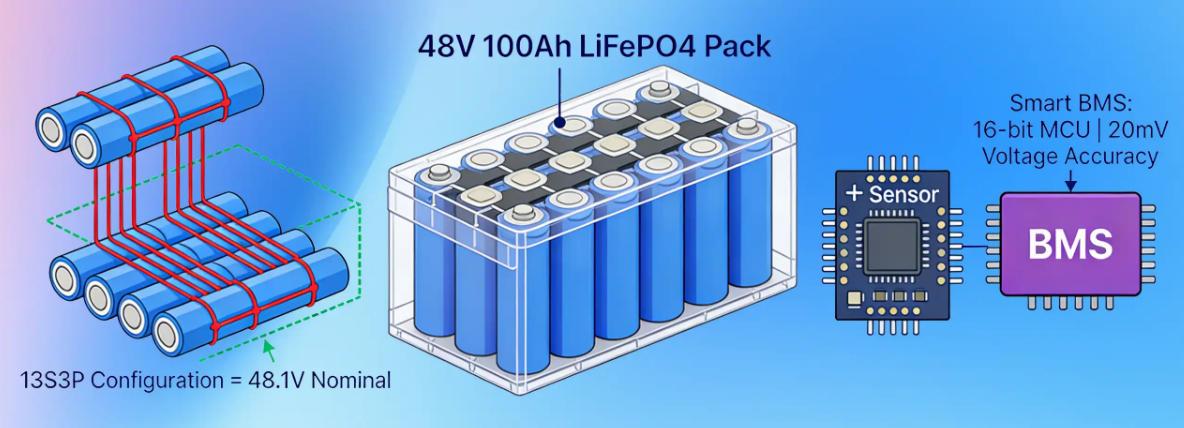
Go ahead and search for "best lithium battery suppliers" online. You'll find the same recycled list on fifty different websites: CATL, BYD, LG, Panasonic, Samsung SDI, arranged in slightly different orders, decorated with the same press release quotes. These lists get published because they're safe and because somebody needs content for their B2B marketing funnel. They're useless for anyone trying to make an actual purchasing decision.
The Real Numbers
CATL sits at 38% global share for EV batteries. One company. Thirty-eight percent. The runner-up, BYD, holds about 17%. Third place, LG Energy Solution, has dropped to 9% and falling.
Put those three together and you're looking at nearly two-thirds of every EV battery installed worldwide. The remaining third gets split among a dozen companies fighting for scraps while pretending they're still in the race.
The China story is even starker. Six Chinese manufacturers now control 69% of global installations. Not Chinese companies selling to Chinese automakers. Chinese companies supplying Tesla in California, BMW in Bavaria, and Volkswagen everywhere. Korean suppliers have collapsed from 35% share to under 17% in five years. Japanese suppliers are marginal players outside their Tesla partnership. European suppliers? Northvolt filed for bankruptcy in March. That experiment is over.
CATL Deserves Its Position
This needs to be said plainly: CATL earned its dominance. The company is not a beneficiary of industrial policy luck. It's a manufacturing operation executing at a level that competitors have tried and failed to match for over a decade.
Ningde, where CATL headquarters sits, runs with an intensity that surprises even visitors from demanding industries. The production discipline is Japanese. The iteration speed is Chinese. Quality monitoring happens in real-time across every line. Problems get solved fast because problems that don't get solved fast become expensive.
The product portfolio has no gaps. Lithium iron phosphate, NCM, NCA, and now sodium-ion cells shipping commercially before anyone else got close. The Qilin pack hits 255 Wh/kg. The Shenxing cells charge 400 kilometers of range in ten minutes. Three thousand patents protect this stuff, and most of them represent genuine technical work rather than defensive filing.
The customer list reads like a directory of the global auto industry. Tesla, BMW, Mercedes, Volkswagen, Toyota, Hyundai, NIO, Li Auto, Xiaomi. When that many sophisticated buyers converge on a single supplier, it tells you something the marketing materials don't need to.
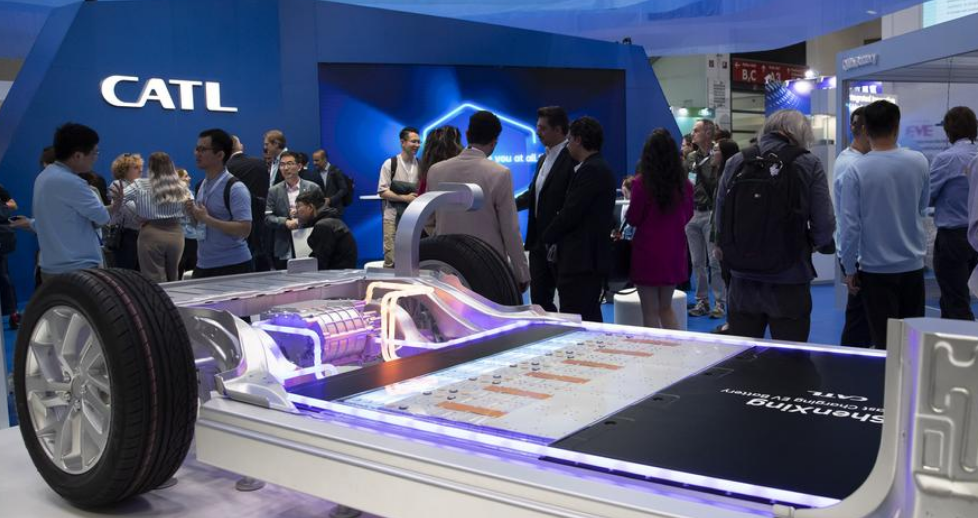
Contemporary Amperex Technology Co., Limited (CATL) — the world's largest EV battery manufacturer
But here's what CATL's sales team won't mention in the pitch meeting.
Getting allocation from CATL requires volume that most buyers can't offer. Minimum orders start in the hundreds of megawatt-hours for standard products. Want custom cell development? Bring a commitment that would exhaust a mid-sized company's entire battery budget for three years. Payment terms favor CATL because CATL doesn't need the cash flow.
The customer hierarchy operates exactly how you'd expect. Tesla gets what Tesla wants. BMW and Volkswagen have long-term agreements that guarantee capacity. Chinese national champions get prioritized for domestic political reasons. Everyone else fights for whatever's left, and "whatever's left" varies based on market conditions that buyers can't predict or control.
Quality variance across CATL's factory network is real despite corporate claims otherwise. Cells from the mature Ningde lines differ from cells produced at the new Erfurt facility. Procurement teams who specify production location in contracts discover fewer surprises than those who assume the brand name means consistency.
The geopolitical exposure keeps growing. IRA exclusions, European threats, licensing workarounds that add cost without eliminating risk. CATL supply means accepting that some politician somewhere might create problems next quarter.
For buyers with volume and sophistication, CATL remains the obvious choice. For everyone else, the situation gets complicated fast.
One thing that rarely gets discussed publicly: CATL's relationship with smaller customers has a reputation problem inside the industry. Stories circulate at trade shows. A startup gets quoted competitive pricing during the sales process, then discovers the actual terms once contracts get drafted. An established buyer places an order during a supply crunch, watches the delivery date slip twice, receives no explanation beyond "market conditions." A quality issue surfaces, gets escalated, vanishes into a bureaucracy that never quite resolves it.
These stories may be exaggerated. Unhappy customers talk more than satisfied ones. But the pattern appears too consistently to dismiss entirely. CATL's size means it can afford to disappoint customers who don't matter strategically. Most customers don't matter strategically.
The contrast with how CATL treats its top-tier partners is stark. Tesla reportedly has dedicated engineering teams, priority capacity access, and rapid issue resolution. The gap between Tesla's experience and a 200 MWh annual buyer's experience is not a matter of degree. It's a different relationship entirely.
BYD Is Not What It Appears to Be
The story on BYD usually goes like this: vertically integrated cost leader, Blade Battery breakthrough, safety champion, rising export star. All true. All incomplete.
BYD makes vehicles. BYD also makes batteries. BYD sells those batteries to other vehicle manufacturers who compete directly with BYD vehicles. Sit with that for a moment.
The Blade Battery is legitimately impressive. LFP chemistry in a cell-to-pack design that eliminated modules, cut costs, and improved safety to the point where competitors who dismissed the needle penetration test as a gimmick had to scramble to match it. The vertical integration across lithium extraction, cathode, anode, cell, pack, and vehicle creates cost advantages that standalone battery suppliers cannot approach. When lithium prices tripled, BYD's margins held. When prices collapsed, BYD started a price war that wrecked less integrated competitors.
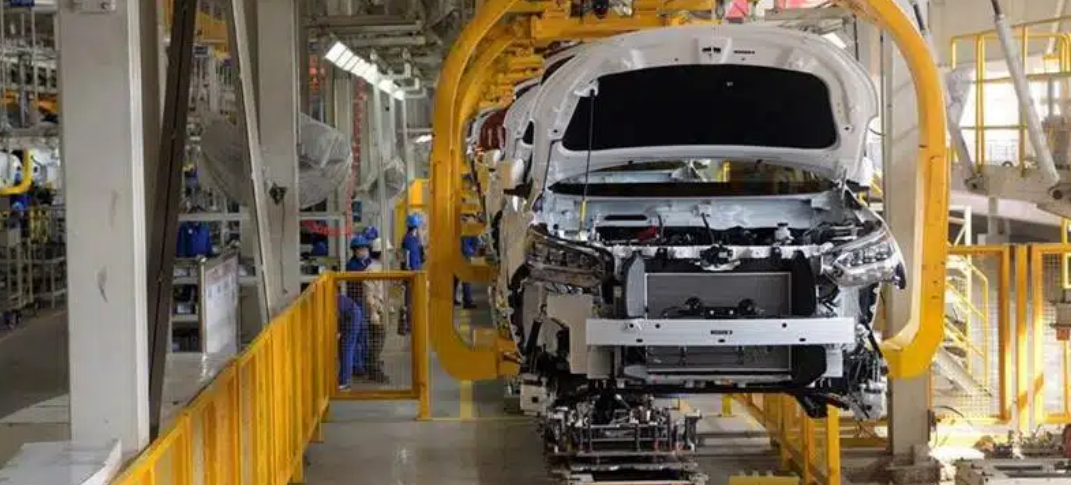
BYD — China's vertically integrated EV and battery manufacturing giant
External sales have grown. Toyota, Ford, and a bunch of Chinese automakers now buy BYD cells. European installations jumped 216% in the past year. The company wants this business.
But every external customer should understand the structural position they occupy.
When BYD faces capacity constraints, which programs get priority? Internal vehicles or external sales? The answer is obvious. When new technology matures, where does it appear first? BYD's own cars, then everyone else. When engineering resources face allocation decisions, which projects win? The ones that help BYD sell more cars.
This isn't conspiracy. It's incentive alignment. BYD's management has obligations to maximize enterprise value. Enterprise value increases when BYD vehicles outperform competitors. External battery revenue helps absorb fixed costs during expansion phases. It does not represent strategic commitment to becoming an arms dealer for the auto industry.
The quality question haunts every external buyer who thinks carefully about the situation. Do cells shipping to Toyota undergo identical screening to cells going into BYD's own vehicles? BYD says yes. Incentive structures say maybe not. Independent verification requires access that external customers rarely get.
BYD's engineering culture also prizes standardization over customization. The Blade Battery works because a single geometry serves passenger cars, trucks, and stationary storage with minimal changes. Customers wanting different dimensions or unusual BMS integration encounter friction. BYD's typical response is explaining why the standard product meets requirements, not adapting to stated needs.
For cost-sensitive applications using LFP chemistry where standard configurations suffice and China supply concentration is acceptable, BYD delivers compelling value. For applications requiring customization, guaranteed priority, or deep partnership, the structural conflicts get difficult.
There's another dimension to the BYD question that procurement teams rarely discuss openly: face. Chinese business culture runs on relationships and mutual obligation. When a buyer sources from BYD and then competes against BYD vehicles in the same market, it creates awkwardness that both sides handle carefully. Some automakers have concluded that the complexity isn't worth the cost savings. Others have decided the savings justify the discomfort. Neither position is wrong. But the decision involves factors that spreadsheet analysis misses entirely.
The timing question also matters. BYD's external sales grew rapidly during a period when the company was building capacity faster than its internal vehicle demand could absorb. That calculation may shift. If BYD's vehicle sales continue growing at current rates, the surplus capacity available for external customers could shrink. External supply agreements that looked secure during the expansion phase might feel less secure during a tightening phase.
LG Energy Solution Is Running Out of Road
Third place sounds respectable. The trajectory tells a different story.
LG's share dropped from 11% to 9% in one year. The year before, it dropped too. Chinese competitors have achieved cost structures that LG cannot match through any operational improvement that doesn't involve relocating factories to different countries.
Polish labor costs three to four times what Chinese labor costs. European energy prices remain volatile and high. Raw material procurement lacks the scale that CATL's volume enables. These are facts of geography and industrial ecosystem, not management failures that a new CEO could fix.
Customer relationships have weakened. Tesla diversified toward CATL and BYD, cutting LG's Tesla-related volumes by 15%. General Motors provides steadier demand through Ultium but not enough to drive the cost reductions LG needs. Volkswagen and Hyundai-Kia maintain relationships without the growth that would suggest strengthening commitment.
Pouch cell expertise that once differentiated LG products has commoditized. Energy density has converged with Chinese competitors. Fast charging shows no clear LG advantage. The technical gap that justified premium pricing has closed.
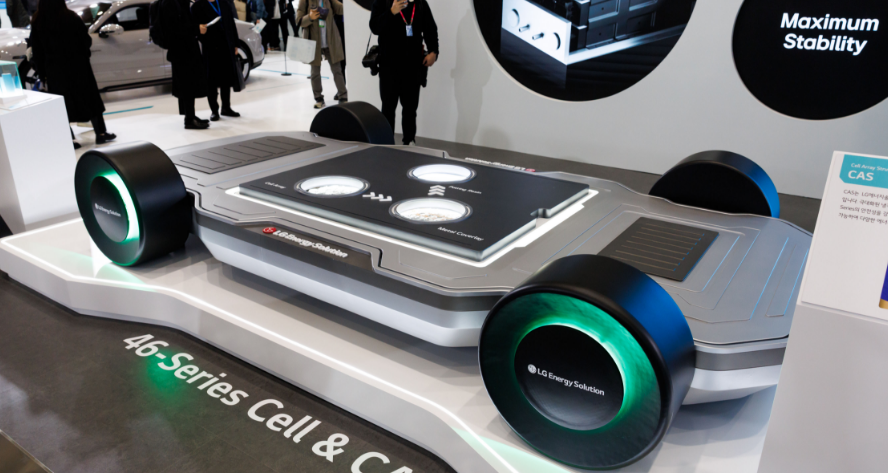
LG Energy Solution — South Korea's leading battery manufacturer facing intense pressure from Chinese competitors
What LG still offers is Western production capacity. Factories in Poland, Michigan, Ohio, and Tennessee enable compliance with local content requirements and provide supply alternatives for buyers facing board mandates to reduce China exposure. The 15-30% cost premium over Chinese suppliers reflects real structural factors. Some buyers will pay that premium for supply chain resilience. Others will pay it reluctantly because options have shrunk.
Whether LG can sustain this position long-term is a question that careful buyers should factor into their planning. The competitive trajectory points in one direction, and hope is not a strategy.
Panasonic Is Trapped
Panasonic makes excellent batteries. Consistency refined over decades, defect rates extraordinarily low, safety records outstanding. The Nevada and Kansas gigafactories produce cylindrical cells that represent format leadership. The 4680 program with Tesla positions the company at the leading edge of large-format cylindrical development.
The problem is that Panasonic is a Tesla supplier pretending to be a diversified battery company.
Tesla accounts for the vast majority of Panasonic's EV battery revenue. The concentration gives Tesla negotiating power that it exploits continuously. When Tesla decided to develop in-house 4680 production, Panasonic's position weakened regardless of partnership rhetoric. When Tesla diversified toward CATL and BYD for standard-range vehicles, volume disappeared that other customers haven't replaced.
Diversification has yielded minimal results. Toyota and Honda electrify slowly. European automakers established Korean and Chinese relationships before Panasonic's sales efforts gained momentum. The cylindrical format specialty limits addressable market because most automakers have standardized on prismatic or pouch.
Panasonic — Tesla's long-standing battery partner
The format bet itself carries risk. Tesla endorses 4680. Tesla is one automaker. Industry standardization has moved toward prismatic and pouch. Panasonic's cylindrical excellence might prove to be a shrinking niche rather than a growth platform.
For applications requiring U.S.-manufactured cylindrical cells or deep Tesla ecosystem integration, Panasonic works. Outside those specific contexts, the relevance dims.
The Rest of the Field
Below the top four, the picture fragments.
CALB has grown fast, reaching about 5% global share through aggressive pricing and rapid capacity expansion. A Portugal gigafactory bets heavily on European access. Quality and consistency have improved but remain below tier-one benchmarks based on field performance. Good for cost-focused buyers. Not a substitute for CATL in demanding applications.
Gotion benefits from Volkswagen's investment, which provides capital and credibility. LFP expertise positions the company for storage and commercial vehicles. Execution has been uneven. Announced capacity and delivered capacity have repeatedly diverged. Construction timelines have slipped.
EVE Energy built a distinct position in stationary storage rather than competing head-to-head with CATL and BYD in automotive. The 560Ah LF560K cell leads large-format storage applications. Storage customers report satisfaction levels that automotive-focused suppliers rarely achieve in that segment. Smart differentiation.
SK On and Samsung SDI persist through Korean industrial policy support. SK supplies Hyundai-Kia, Ford, and Volkswagen competently while struggling toward profitability. Samsung maintains BMW business while share erodes. Both will survive. Neither shows a path to competitive cost structures.
SVOLT emerged from Great Wall Motors with independent ambitions. Short-blade technology shows technical creativity. Performance outside the captive relationship remains unproven.
The Difference Between Good Suppliers and Good-on-Paper Suppliers
Specifications and market share rankings miss what determines outcomes in practice.
Cpk data for critical parameters reveals quality system maturity. Suppliers who can't provide this data don't track it. Untracked parameters are uncontrolled parameters.
Ask for histogram distributions on capacity, internal resistance, and weight. Suppliers with tight processes will show you bell curves that look like bell curves. Suppliers with loose processes will show you distributions with long tails, multiple modes, or suspicious gaps where rejected cells got pulled. Some will refuse to show you anything, citing confidentiality. That refusal is itself data.
New production lines produce problems that mature lines solved years ago. Higher variance, lower yield, failure modes that haven't surfaced yet. Supplier capacity expansion announcements simultaneously celebrate growth and introduce risk. Specifying production facility and line in contracts matters.
The factory tour tells you less than you think. Every supplier cleans up for visitors. The clean room looks clean. The workers wear proper gear. The equipment appears modern. None of this predicts how that factory runs on a Tuesday night in month fourteen of a production ramp when the line supervisor is managing three problems at once and the quality inspector is covering two stations.
Customer hierarchy determines everything that specifications don't. Suppliers direct best capacity slots and strictest quality screening toward customers with strategic value. A buyer representing half a percent of supplier revenue will not receive Tesla-level attention. Understanding position in supplier priority ranking prevents mismatched expectations.
Payment terms signal power dynamics. Suppliers demanding large deposits and quick payment operate from strength. Suppliers accepting extended terms operate from necessity. Neither directly indicates quality, but the dynamics shape every interaction.
Engineering change responsiveness reveals culture. Products evolve. Suppliers treating changes as problems to deflect differ from suppliers treating changes as opportunities to deepen relationships. Early evaluation should include change scenarios.
Test this during the qualification process. Request a minor specification change after the sample run. Something small: a different tab length, a label modification, a packaging adjustment. The speed and attitude of the response tells you more about working with that supplier than any capability presentation.
Warranty processing exposes character that sales presentations hide. Sales commits. Manufacturing delivers. Finance and legal handle claims. The distance between commitment and claim resolution often proves substantial. Reference conversations should specifically probe warranty experiences.
The reference call itself requires technique. Don't ask "Are you satisfied with Supplier X?" Everyone says yes because everyone fears retaliation and everyone wants to stay polite. Ask specific questions. "How long did it take to resolve the last quality issue you raised?" "What happened when you requested a specification change?" "If you had to do it over, would you select them again?" The pauses tell you as much as the words.
The Uncomfortable Reality
Chinese suppliers have won. The cost gaps, scale advantages, and capability differences that Chinese manufacturers accumulated will not reverse through Western industrial policy within this decade. Buyers requiring non-Chinese supply for regulatory or strategic reasons will pay premiums. Buyers without such constraints who select non-Chinese suppliers on technical grounds are making objectively worse choices.
Second-tier suppliers are not smaller versions of tier-one suppliers. CALB is not a smaller CATL. Gotion is not a cheaper LG. The differences span quality systems, engineering depth, supply chain maturity, and institutional knowledge. Second-tier suppliers serve certain customers adequately. Assuming they substitute for tier-one in demanding applications creates failures.
Cell prices have fallen 90% since 2010 and continue dropping. Most industry participants lose money. Suppliers maintaining margins possess structural advantages. Suppliers losing money depend on patient capital that may exhaust. Some suppliers currently accepting orders will not exist in 2030.
Technology cycles move faster than supplier relationships. The best battery technology of 2020 is mediocre now. The best technology of 2025 will be mediocre by 2030.
The consolidation wave hasn't finished. Dozens of suppliers launched during the EV boom years, funded by venture capital and government subsidies, convinced they could carve out niches through better chemistry or smarter pack design or cheaper manufacturing. Most of these companies will fail. The survivors will be acquired at distressed valuations. A few will find protected niches in specialty applications. The tier-one suppliers will absorb whatever's worth absorbing and ignore the rest.
Names that appear in "Top 20 Battery Suppliers" lists today will disappear from those lists within five years. Some will go bankrupt. Some will exit the business. Some will merge into larger entities. Procurement teams selecting suppliers should consider not just current capability but survivability. A supplier relationship is a multi-year commitment. Starting over because your supplier failed is expensive in ways that go far beyond sourcing cost.
The technology question runs in the background of every supplier decision. Solid-state batteries have been "five years away" for fifteen years. Eventually they'll arrive, and the arrival will reshuffle competitive positions. Sodium-ion chemistry is shipping commercially now and will expand. Silicon anodes will increase energy density. Dry electrode processing will reduce manufacturing cost.
None of these technologies will make current lithium-ion suppliers obsolete quickly. The installed base is too large. The capital investment is too deep. But they will create opportunities for repositioning. Suppliers investing in next-generation technology will have options that current-generation-only suppliers lack. Evaluating R&D portfolios and roadmap credibility matters for long-term relationships.
Practical Guidance
Large automotive manufacturers should maintain multiple sources across Chinese and non-Chinese suppliers. Single-sourcing at scale is negligent.
Mid-volume buyers in the 100-500 MWh range occupy the most competitive segment. CALB, Gotion, EVE, and emerging suppliers actively compete for this business. Price discovery through competitive processes is essential. Quality verification through facility audits is mandatory.
Small buyers below 50 MWh cannot attract tier-one attention and should stop trying. Distributors and system integrators aggregating demand provide appropriate service levels.
Storage integrators should focus on BYD, EVE, and storage-specialized suppliers rather than fighting automotive buyers for CATL attention.
Buyers requiring non-Chinese supply face limited options. LG, SK On, Samsung SDI, and Panasonic are the realistic choices. Premium pricing reflects structural factors. Negotiation reaches limits when alternatives are scarce.
The Answer That Isn't an Answer
The question "What are the best lithium battery suppliers?" wants certainty that doesn't exist.
By market share: CATL, BYD, LG Energy Solution. Every measurement confirms this.
By technology: CATL leads broadly, BYD leads in LFP integration, Panasonic leads in cylindrical.
By value for most buyers: Probably CATL or BYD, with the political exposure that implies.
By availability to your specific organization: Depends entirely on volume, application, geography, and how much bargaining power you bring to the table.
The rankings provide a starting point. They don't provide an answer. The work of determining which supplier fits which buyer happens through factory visits, sample testing, reference calls, contract negotiations, and the accumulated judgment that comes from doing this more than once.
The battery supply industry rewards buyers who do that work. It punishes buyers who substitute rankings for analysis.