

How Many kWh to Run a House
The average American home consumes 10,380 kWh annually. Monthly, that lands around 865 kWh. Daily, about 30 kWh.
But that number deceives. Louisiana homes devour nearly 15,000 kWh per year while Hawaiian households scrape by on 6,000. Same country, same appliances available at the same Home Depot, yet consumption differs by a factor of 2.5. The national average describes nobody's actual home.
Climate Runs the Show
Climate determines more than any other factor. Where a building sits on the map predicts its electricity consumption better than size, age, or appliance choices.
Southern states dominate the consumption rankings for reasons that compound on each other. Louisiana, Tennessee, Mississippi, and Alabama all exceed 13,000 kWh annually. Hot summers demand air conditioning from April through October. Humid air forces those air conditioners to work overtime removing moisture, not just heat. The dehumidification load in Houston or New Orleans adds 30 to 40 percent to cooling energy compared to the same temperature in Phoenix.
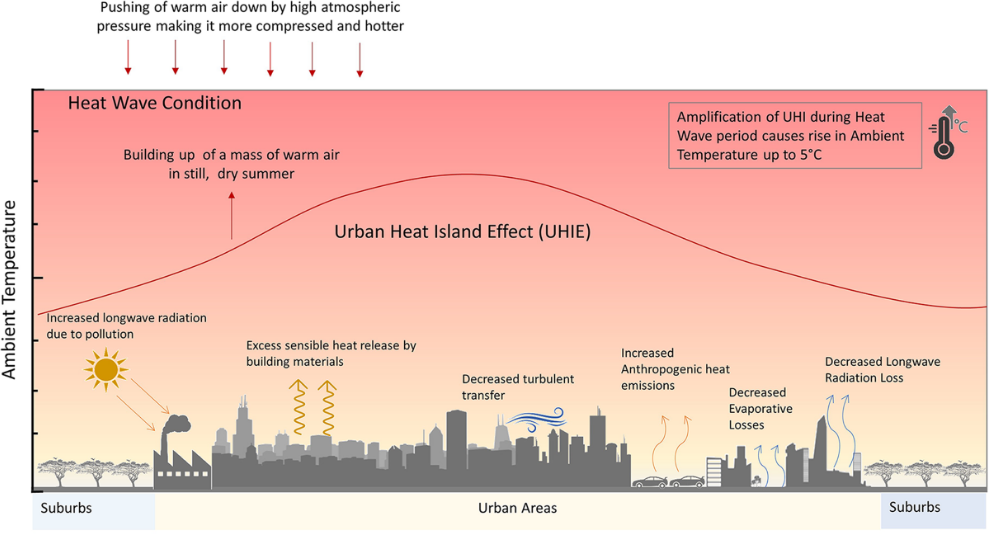
Southern homes face unique energy challenges due to extreme heat and humidity
The South's consumption lead comes equally from what happens in winter. Natural gas pipelines never penetrated large swaths of the rural South the way they did the Midwest and Northeast. Homes without gas service default to electric resistance heating, which converts electricity to warmth at a 1:1 ratio. A 10 kW electric furnace running through a Tennessee winter can consume 8,000 to 10,000 kWh for space heating alone.
The infrastructure story runs deeper than most realize. Gas pipeline networks spread through the industrial Midwest and population centers of the Northeast between 1940 and 1970. Southern rural areas, with lower population density and less industrial demand, never justified the capital investment. By the time those regions grew, electricity had become cheap enough that utilities promoted all-electric homes instead of building gas distribution. The legacy persists. A homeowner in rural Alabama cannot simply choose to switch to gas heating. The pipe does not exist and never will.
A homeowner in rural Alabama cannot simply choose to switch to gas heating. The pipe does not exist and never will.
California sits at the opposite extreme with just 6,000 kWh average consumption. Mild coastal weather explains part of it. San Francisco needs neither air conditioning nor much heating. Three decades of strict building codes matter just as much. Title 24 standards have pushed California housing stock toward efficiency while most states let builders do the minimum.
The California approach drew criticism as regulatory overreach when enacted. Building costs rose. Developers complained. But those Title 24 homes now consume 40 percent less energy than equivalent construction in states with minimal codes. Californians pay high rates per kWh but use so few kWh that total bills land near the national average. The upfront construction cost paid for itself through decades of lower utility bills. Whether this constitutes good policy depends on values and time horizons, but the energy data leaves no room for dispute about effectiveness.
Hawaii consumes even less despite tropical location. The explanation lies entirely in price signals. At 43 cents per kWh, Hawaiian electricity costs nearly triple the mainland average because island grids burn imported petroleum rather than cheap natural gas. Residents respond to those prices by turning off what they can turn off. Economics works.
The cold climate states present a different puzzle. Minnesota, Wisconsin, and Maine endure hard winters yet report moderate electricity consumption. The resolution lies in heating fuel. Northern states built their housing stock around oil furnaces and gas boilers. Those fuels carry the heating load; electricity handles only cooling, lighting, and appliances. Eliminate electric space heating and consumption numbers drop regardless of climate severity.
The HVAC Question Dominates Everything
Roughly half of residential electricity feeds the heating and cooling system.
Air conditioning has become nearly universal in American homes, with central systems installed in three quarters of the housing stock. These units pull 3,000 to 5,000 watts when the compressor runs. In cooling-dominated climates, that compressor might cycle 2,500 hours between spring and fall, adding up to 7,500 to 12,500 kWh for cooling alone.
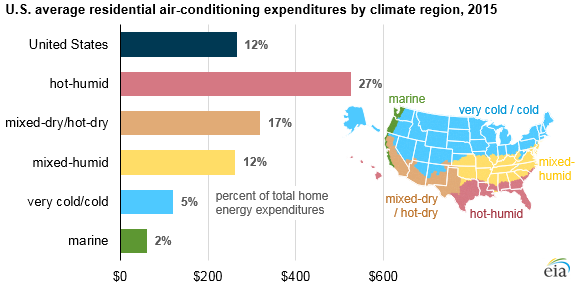
HVAC systems are the largest consumers of residential electricity
Heat pumps have changed the calculus. Traditional air conditioners move heat in one direction only. Heat pumps reverse the cycle, extracting warmth from outdoor air even in cold weather. Modern units achieve coefficients of performance between 2.5 and 4.0, meaning each kWh of electricity delivers 2.5 to 4.0 kWh worth of heating. A home switching from electric resistance to heat pump cuts winter electricity consumption in half.
Heat Pump Efficiency
The industry understates how well heat pumps now perform in cold climates. Units rated for operation at minus 15 degrees Fahrenheit have reached the market. The old objection that heat pumps fail in northern winters grows less valid each year. Minnesota and Maine present no technical barrier to heat pump adoption, only market inertia and installer unfamiliarity.
Water Heating Hides in Plain Sight
Electric water heaters often get overlooked. These tanks draw 4,500 watts and cycle three to five hours daily, accumulating 3,500 to 5,500 kWh over a year. For homes with electric water heating, the water heater alone may consume more electricity than lighting, refrigeration, and electronics combined.
The physics leave no room for efficiency gains in conventional electric tanks. Water has high heat capacity. Raising 50 gallons from inlet temperature to usable 120 degrees requires a fixed quantity of thermal energy, and resistance elements deliver that energy at exactly 100 percent efficiency. The only losses come from heat bleeding through tank insulation as hot water waits for use.
Heat pump water heaters break this constraint entirely. By extracting thermal energy from surrounding air rather than generating heat directly, these units achieve efficiency multipliers of 2.5 to 3.5. Annual consumption drops from 4,500 kWh to 1,500 kWh. A $2,000 federal tax credit currently applies. The payback period often falls under three years.
Square Footage Matters Less Than Expected
The relationship between house size and electricity consumption proves weaker than intuition suggests. Larger homes do consume more, but not proportionally more.
A 3,000 square foot house does not use twice the electricity of a 1,500 square foot house. Baseline loads remain constant regardless of floor area. The refrigerator draws the same power whether surrounded by 1,000 or 4,000 square feet. Water heating requirements track occupant count, not room count. Electronics and lighting scale somewhat with size but not linearly.
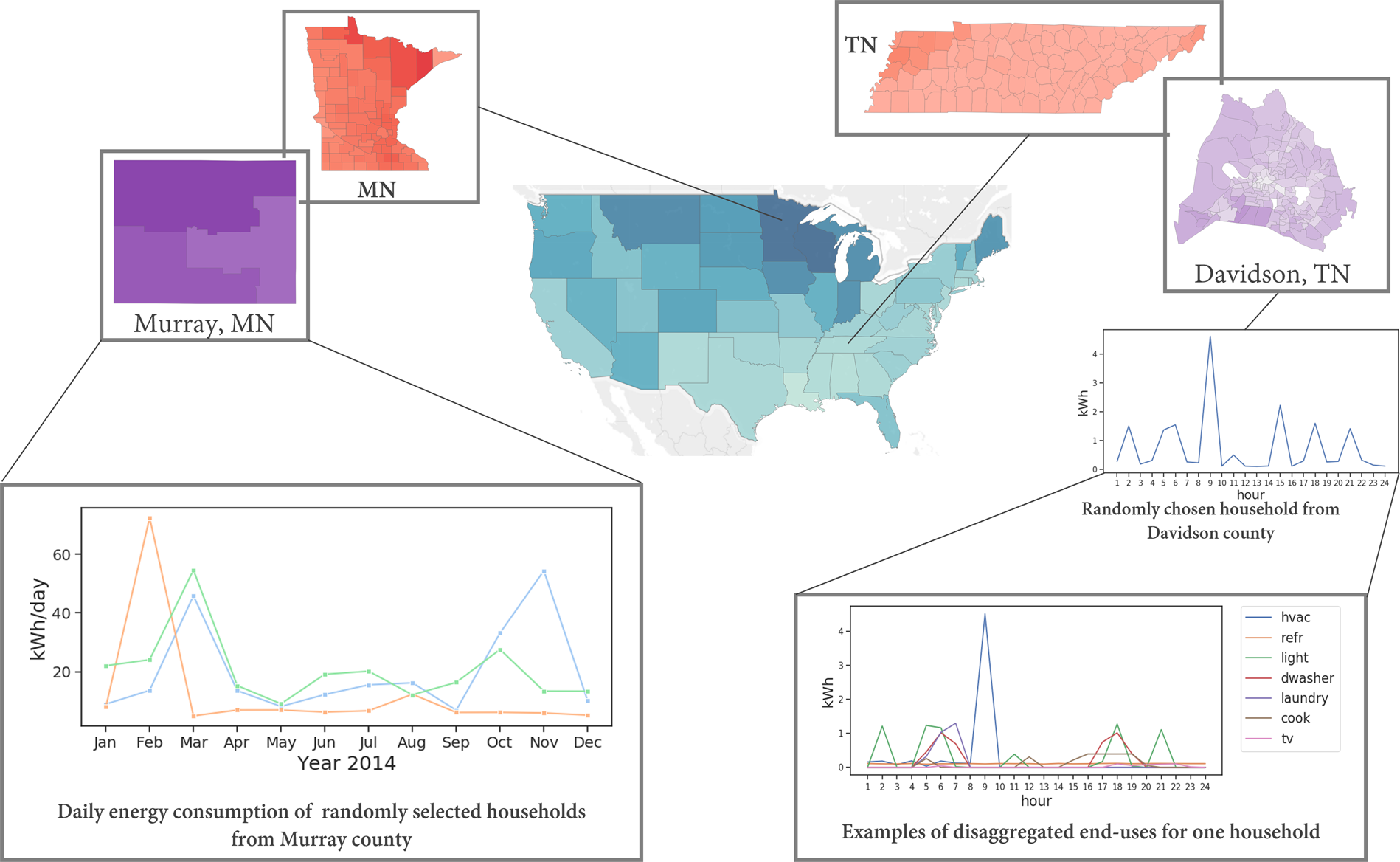
Home size is less predictive of energy consumption than construction quality and climate
The relationship runs roughly 0.5 kWh per square foot monthly, but this figure contains wide variance. A tight, well-insulated 3,000 square foot home in San Diego may consume less than a leaky 1,500 square foot home in Houston. Construction quality and climate swamp the size effect.
Building vintage predicts efficiency better than size. Homes constructed before 1980 typically contain R-11 wall insulation where current codes require R-13 to R-21. Attic insulation in older homes often sits at R-19 versus the R-38 to R-60 now specified. Single-pane windows still common in pre-1990 construction leak heat at three times the rate of modern double-pane units. Older homes of any size consume 25 to 40 percent more for heating and cooling than equivalent new construction.
Air leakage compounds the insulation deficit. Older homes lose conditioned air through gaps around electrical outlets, plumbing penetrations, recessed lights, and the rim joist where foundation meets framing. Professional air sealing costs $500 to $1,500 and typically cuts HVAC consumption by 15 to 25 percent. Few upgrades deliver better returns.
Electric Vehicles Change the Equation
Adding an electric vehicle reshapes household electricity consumption. At average driving distances of 13,500 miles annually and typical efficiency of 0.32 kWh per mile, home charging adds 4,300 kWh per year.
That increase approaches 45 percent over pre-EV baseline consumption. A household previously using 10,000 kWh annually now needs 14,300 kWh. Solar installations sized for the old baseline fall substantially short. Electrical panels in older homes may lack capacity for Level 2 charging circuits.
The EV charging load concentrates overnight, which creates opportunity under time-of-use electricity rates. Utilities increasingly charge double or triple rates during evening peak hours compared to overnight off-peak periods. Programming the vehicle to charge at 11 PM rather than 6 PM can reduce charging costs by 40 percent without changing total consumption.
For households considering solar, the EV question demands attention during system design. Adding vehicle charging later often requires costly system expansion. Planning for electrification from the start avoids paying installation costs twice.
What No Longer Matters Much
Refrigerators and lighting once dominated residential consumption. Not anymore.
Refrigerators show what efficiency standards can accomplish. These units run around the clock in virtually every home yet now contribute only 7 percent of household consumption. The share stood at 15 to 20 percent through the 1980s. Federal efficiency standards forced manufacturers to redesign compressor systems and improve insulation. Contemporary units consume 400 to 600 kWh annually versus 1,000 to 1,400 kWh for 1990s models.
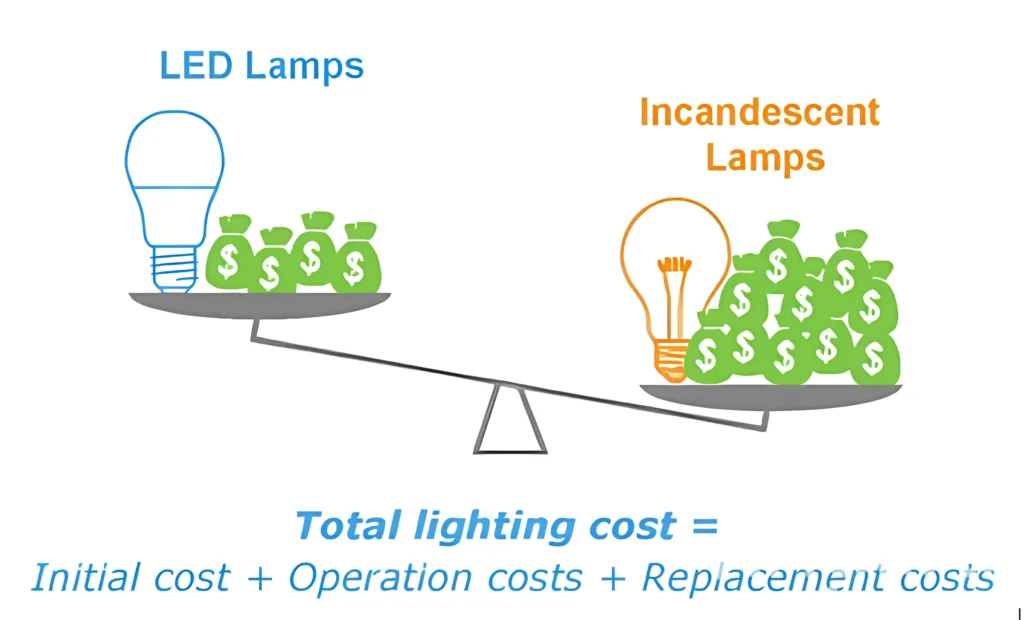
LED adoption has dramatically reduced the share of lighting in household energy consumption
Lighting followed a similar path. LED adoption has collapsed that share from 15 percent to around 6 percent. Incandescent bulbs convert only 2 to 3 percent of electrical input to visible light; LEDs achieve 15 to 20 percent.
Standby power consumption still adds up. Any device with a remote control, clock display, or network connection draws power continuously even when nominally off. A typical home contains 40 or more such devices. At an average standby draw of 5 watts each, these phantom loads accumulate 1,750 kWh annually. Smart power strips that cut power to idle equipment can eliminate much of this waste.
Calculating Requirements for a Specific Home
Twelve months of utility bills provide a solid consumption baseline. Add up all monthly kWh figures for annual consumption. Divide by 12 for monthly average. Divide monthly average by 30 for daily average.
Most utilities now provide 13 months of usage history on bills or through customer portals. Smart meter data permits daily or hourly resolution, revealing consumption patterns that monthly totals hide.
For new construction lacking historical data, consumption must be built from component loads. Base consumption covering lighting, refrigeration, and electronics runs 250 to 400 kWh monthly. Air conditioning adds 0 to 800 kWh depending on climate. Electric water heating adds 300 to 450 kWh. Electric space heating during winter months adds 0 to 1,200 kWh. Electric vehicle charging adds 350 to 400 kWh. Sum the applicable components and multiply by 12 for annual projection.
A rough estimation formula serves for quick sizing: monthly kWh equals square footage multiplied by 0.5, plus adjustments for climate and major equipment. Add 300 kWh monthly for hot humid regions. Add 400 kWh monthly for cold regions with electric heat. Subtract 150 kWh monthly for mild coastal climates. Add 350 kWh monthly for EV charging. Add 350 kWh monthly for electric water heating.
Solar System Sizing
Annual consumption directly determines photovoltaic requirements. The core formula: system size in kW equals daily kWh divided by peak sun hours, multiplied by 1.15 for system losses. Peak sun hours vary by location: 6 to 7 daily in the Desert Southwest, 3.5 to 4 in the Pacific Northwest.
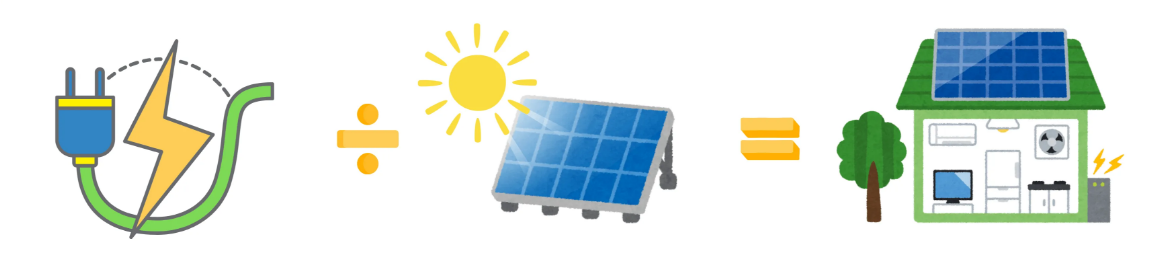
Solar system sizing depends on annual consumption and local peak sun hours
A household consuming 10,800 kWh annually in a location with 5 peak sun hours needs roughly 7 kW of panels. Net metering policy affects sizing strategy in material ways. States with full retail-rate net metering reward systems sized to offset 100 percent of consumption. States that have gutted net metering, California under its 2023 NEM 3.0 rules being the prime example, make battery storage and self-consumption more valuable than maximum generation capacity.
The Range
The national average of 10,380 kWh annually serves as starting point only. Hot humid regions add 3,000 to 5,000 kWh. All-electric homes add 4,000 to 8,000 kWh versus those using gas. Electric vehicles add another 4,000 to 5,000 kWh.
Real requirements span from under 5,000 kWh for compact homes in mild climates to over 25,000 kWh for large all-electric homes with EVs in Louisiana or Arizona. A Louisiana household with electric heat, electric water heating, and nightly EV charging might consume 22,000 kWh annually. A California apartment dweller with gas appliances and no car might consume 4,000 kWh.
The averages published by government agencies describe populations, not individual homes. Any specific home falls somewhere in a wide range determined by climate, construction, fuel mix, and equipment choices.