

Yes.
The technology exists. The math can work. Thousands of Americans already live this way. None of that means off-grid solar suits most people asking this question.
The fantasy: install panels, add a battery, cut the cord, never pay another electric bill. Spend tens of thousands upfront, become intimate with weather forecasts, accept that running a hair dryer on a cloudy January morning might drain enough power to leave the refrigerator dark by evening. Off-grid life demands a relationship with electricity that grid-connected households cannot imagine.
Whether that relationship sounds like freedom or exhaustion determines everything.
One Calculation Decides Everything
How far does your property sit from existing power lines?
Utility companies charge by the foot to extend service. The exact rate varies so wildly by region and terrain that quoting a national average misleads more than it helps. Call your local utility for a site-specific estimate. What matters: the cost scales linearly with distance, and it adds up fast.
A rancher in eastern Montana told an interviewer from Backwoods Home Magazine that his utility quoted $78,000 to run lines three-quarters of a mile to his building site. He installed a complete off-grid system for under $30,000. A cabin owner profiled on the DIY Solar Forum faced $45,000 for half-mile extension in rural Oregon; his solar setup cost $18,000.
These are not unusual stories. They are the reason off-grid solar exists as a market. Most adoption has nothing to do with environmentalism or survivalism. People look at utility quotes, look at solar prices, and pick the cheaper option.
For properties already served by grid power, the calculation flips. Off-grid systems cost roughly double what grid-tied installations cost for the same household. Going off-grid with power lines running past the mailbox requires motivations beyond economics.
What Off-Grid Actually Requires
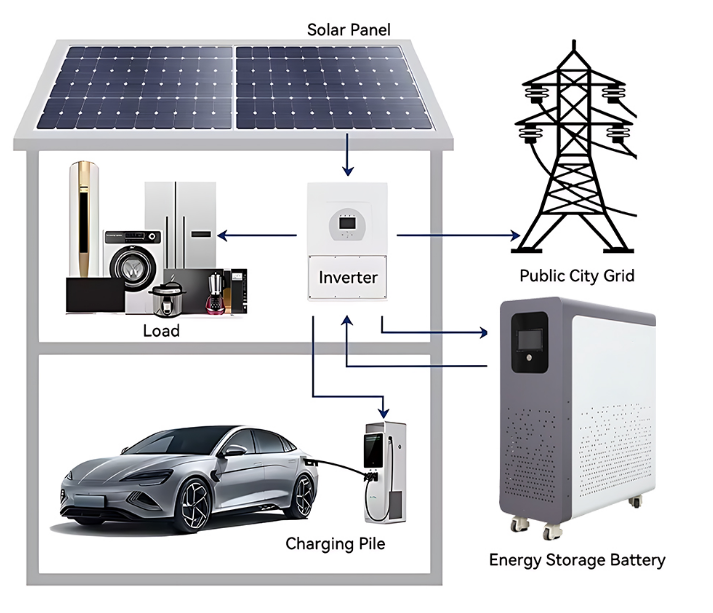
Grid-tied solar treats the utility as an infinite battery. Panels generate power during the day. Excess flows backward through the meter for credit. After sunset, electricity flows back.
Off-grid has no backstop. Every watt consumed must be generated and stored on the property. When reserves run out, lights go off.
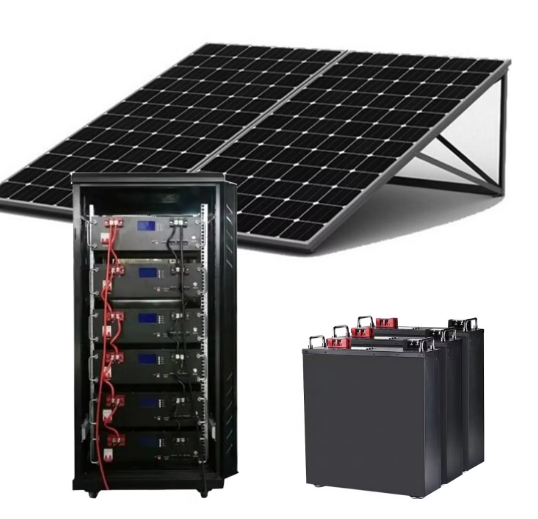
A grid-tied system might need panels and an inverter, nothing more. The equivalent off-grid installation adds substantial battery storage, a charge controller, and usually a backup generator.
Batteries Matter More Than Panels
Panels are easy. Prices dropped roughly 90% between 2010 and 2020 according to the National Renewable Energy Laboratory. They last decades. They work.
Batteries remain the hard part.
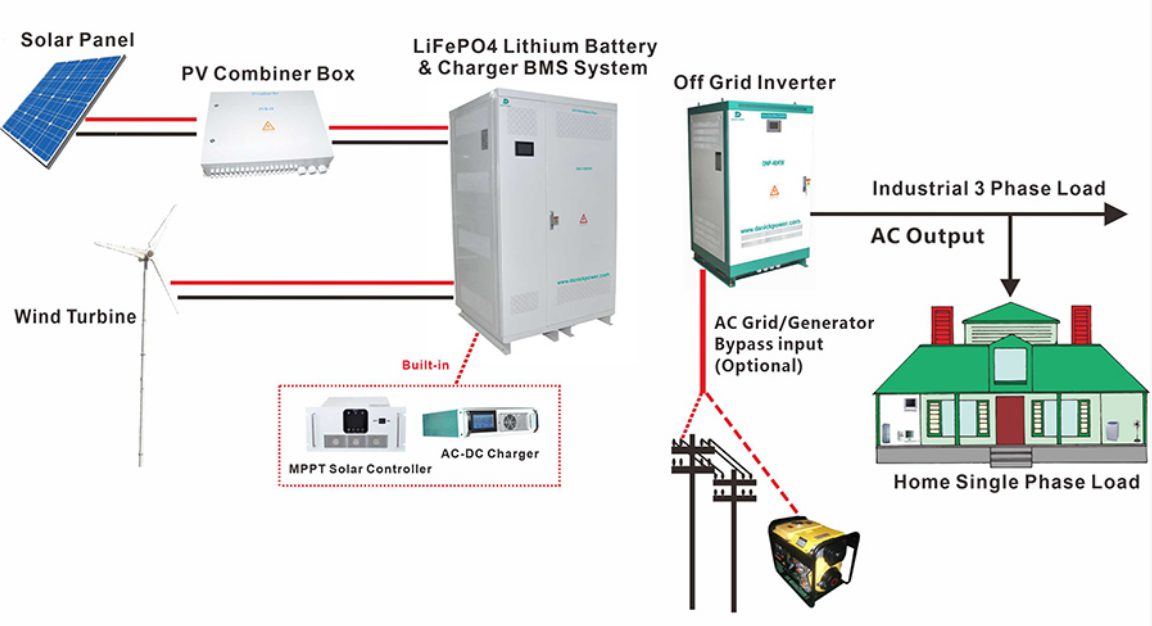
Off-grid energy storage using lithium iron phosphate battery packs
Lead-acid chemistry dominated off-grid storage for decades. Users on long-running forums like Northern Arizona Wind & Sun consistently report three to five year replacement cycles with careful maintenance, shorter with neglect. The 50% depth-of-discharge limit is not a recommendation but a physical constraint: discharge deeper and capacity degrades permanently.
Lithium iron phosphate changed the equation. Manufacturers like Battle Born and SOK warranty their cells for 3,000 to 5,000 cycles at 80% depth of discharge. Real-world users on DIY Solar Forum report approaching a decade of service from early LFP installations with no measurable degradation. The efficiency advantage is measurable: LFP recovers over 95% of input energy versus roughly 80% for lead-acid, a difference that compounds across thousands of cycles.
Pricing has dropped sharply. Current retail for LFP cells runs roughly $400 per kilowatt-hour from established brands, under $300 from newer Chinese manufacturers selling direct. Five years ago, $800 to $1,000 per kilowatt-hour was typical. The trajectory continues downward.
The Propane Question
Successful off-grid homes run most energy-intensive loads on propane, not electricity.
Electric resistance heating devours power. Anyone who has watched a Kill-A-Watt meter on a space heater knows the draw: 1,500 watts continuous for a single room. Whole-house electric heat multiplies that by every room. Electric water heaters cycle on and off all day at similar draw.
Propane sidesteps the problem entirely. A tankless propane water heater consumes only a few watts for electronic ignition. Propane furnaces need electricity only for the blower. Propane ranges use no electricity at all beyond the clock display.
The sizing implications are dramatic. An off-grid system designed to handle electric heating might need 15 or 20 kilowatts of panels and 60 kilowatt-hours of batteries. The same house with propane handling thermal loads might need 5 kilowatts and 20 kilowatt-hours. Installation costs scale roughly proportionally.
Anyone serious about off-grid should budget for propane infrastructure from the start. Fighting this costs money and reliability.
Sizing for the Worst Month
The error that destroys most off-grid installations: designing for summer.
The National Renewable Energy Laboratory publishes solar resource maps showing average daily irradiance by location and month. Phoenix receives about 5.5 peak sun hours even in December. Seattle drops to 1.5. The ratio between summer and winter production can exceed 3:1 in northern latitudes.
Systems sized for summer production fail every winter. Forum archives overflow with posts from first-year off-gridders discovering their batteries never fully charge between November and February.
Proper sizing starts with the worst month. Take your expected daily consumption. Divide by the peak sun hours available in January at your location. Add margin for system losses and cloudy streaks. That number determines array size.
Ground-mounted panels beat roof mounts in snowy climates. Panels three stories up stay buried until spring. Ground panels clear with a push broom.
Regulatory Geography
Off-grid living is legal everywhere in the United States. Practical viability varies wildly.
The website Off Grid Permaculture maintains a state-by-state database of relevant regulations. Some highlights: multiple Missouri and Tennessee counties have essentially no building codes beyond septic permits. New Mexico actively encourages rainwater harvesting and alternative construction. Texas allows private microgrids.
New Jersey requires functioning electric service for occupancy permits. Several Arizona counties require grid connection despite abundant sunshine.
County rules often supersede state guidance. Call the building department before buying land.
Generator Backup
Even perfectly designed systems face extended shortfalls. Week-long storms happen. Equipment fails.
A propane or diesel generator bridges these gaps. Quality units from Honda, Generac, or Westinghouse start reliably for a decade or more with basic maintenance. Propane models start in cold that leaves gasoline engines dead.
Modern charge systems can trigger generator start automatically when battery voltage drops below a threshold. The generator runs until batteries recover, then shuts down. Owners may never flip a switch manually.
Lifestyle Adaptation
Successful off-gridders relate to electricity differently.
They check battery voltage every morning. They know the weather forecast and plan consumption around sunny days. Laundry happens when batteries are full, not when the hamper overflows.
They own efficient appliances, LED bulbs throughout, chest freezers instead of uprights. They air-dry clothes when possible.
Many find deep satisfaction in this awareness. The relationship with energy becomes mindful.
Those who find such considerations exhausting will find off-grid frustrating. No amount of spending eliminates the need for attention.
Who Should Do This
Off-grid solar makes sense for rural properties far from utility lines, where extension quotes exceed system costs.
It makes sense for people interested in energy independence as a lifestyle.
It makes sense for those with technical aptitude or budget for professional support.
It makes sense for those willing to use propane, wood, and other non-electric sources alongside solar.
It does not make sense for grid-connected properties seeking only to reduce bills. Grid-tied solar works better for that.
It does not make sense for those expecting the same experience as grid power.
The technology has matured. Complete solar independence has never been more achievable. Whether it suits any particular household depends less on technology than on temperament.