Achilles Tendon Rupture Ultrasound Diagnosis Handheld Linear Probe
An Achilles tendon ruptures with a sudden snap at the back of the ankle. The leg loses its push-off in the same moment. Ultrasound confirms the tear in minutes at the bedside. The scan finds the gap where the tendon has parted, measures it, and follows the torn ends as the ankle moves. Watching the tendon work tells a complete tear from a partial one. It points the way the injury will be treated. A handheld probe does all of this on the spot, the day the injury happens.
The tendon and its job
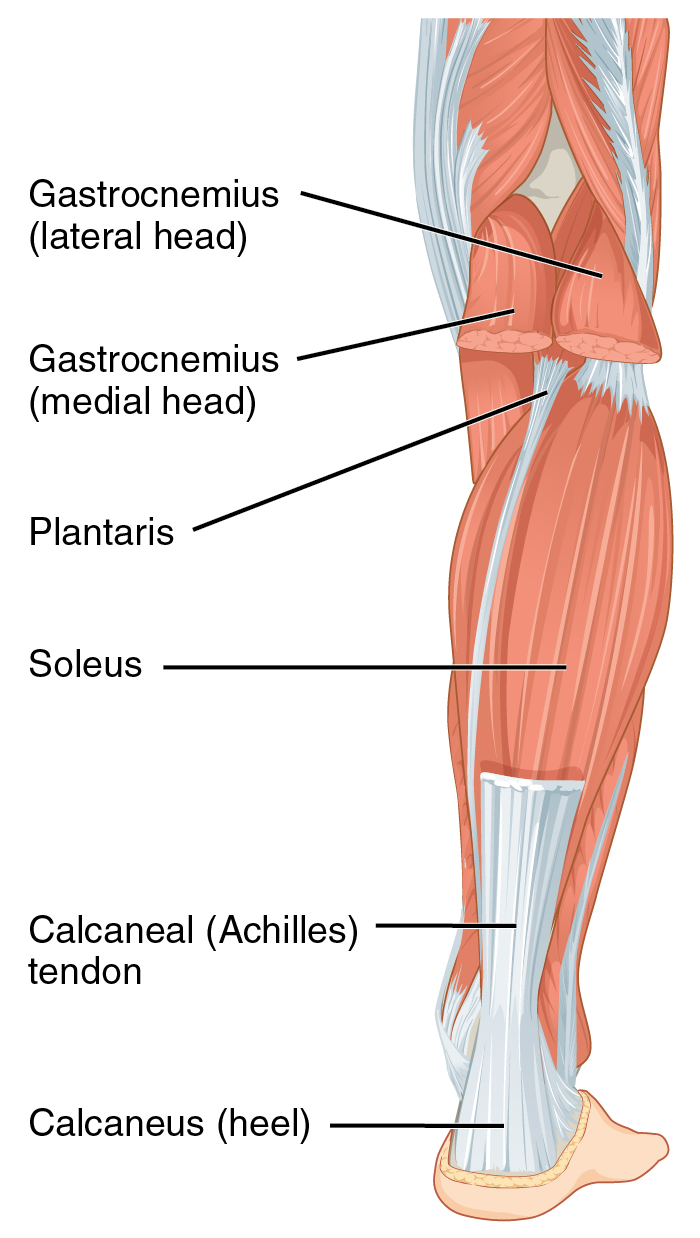
The back of the lower leg. The gastrocnemius and the soleus gather into the Achilles, or calcaneal, tendon, which runs down to the heel bone. The thin plantaris tendon runs alongside on the inner side. Diagram: OpenStax, CC BY 4.0.
The Achilles is the thickest and strongest tendon in the body. It gathers the two muscles of the calf, the gastrocnemius and the soleus, into one cord and carries them down to the heel bone. Every step onto the toes runs through it. The force it bears at a push-off reaches several times the body’s weight.
The tendon lies just under the skin along the back of the lower leg, with only a thin layer of fat over it. A high-frequency linear probe reaches it without effort and shows it in fine detail. The whole cord, from the calf muscle to the heel, sits in the range the probe reads best.
The tendon has no sheath of the usual kind, only a thin covering called the paratenon. This matters on the scan, since fluid and swelling gather in and around that covering when the tendon is hurt. The shallow, exposed run of the Achilles is what makes it both easy to injure and easy to scan.
Who tears it and how
The classic Achilles rupture strikes a middle-aged athlete in the middle of a game. A hard push-off, a jump, or a sudden change of direction loads the tendon past what it can bear. The tear comes with a snap that the patient can hear, and with the feeling of a kick or a blow to the back of the leg. Many turn to look for who struck them.
After the snap the foot loses its push. Walking turns flat-footed and weak, and rising onto the toes on that leg becomes impossible. A soft dent can often be felt in the line of the tendon where the ends have parted. Swelling and bruising fill in over the hours that follow.
The diagnosis is missed more often than it should be. A patient who can still walk, and who keeps a weak push-off through the other muscles of the calf, can be sent home with a sprain. A tendon that is only thickened and sore raises the same doubt from the outside. A rupture missed at the start and left to heal on its own often knits long and slack, the calf left weak at the push-off for good. The scan removes the doubt early by looking straight at the tendon and at the gap.
The tear can also come on quietly, without a game or a fall. A tendon worn down over years can give way under an ordinary load, in a step off a kerb or a stumble. These tears reach the scanner late, the snap half-forgotten, the swelling settled. The same reading applies, with more healing tissue to read through.
Where the tendon tears
A complete rupture usually falls in one stretch of the tendon, a few centimeters above the heel bone. This stretch carries the poorest blood supply along the tendon’s length, a watershed that mends slowly and gives way first under a hard load. Real tears often sit a little higher than the textbook level, so the scan reaches well up the calf to be sure of catching them. A scan for rupture looks hardest along this whole stretch.
A smaller number of tears pull the tendon off its anchor at the heel bone, an insertional rupture, sometimes with a flake of bone torn away with it. These sit at the lowest reach of the tendon, where it meets the bone. They trouble an older patient with a long-worn insertion more than the young athlete caught in mid-stride. The scan follows the cord all the way down to its footprint on the bone so a low tear is not run past.
The scan begins on healthy tendon and tracks it toward the injury. Above the break and below it the fibers run in their normal bright, parallel bands. The break shows as the place where those bands stop. A clear picture of the normal pattern is what makes the break plain to call.
Scanning the tendon
The patient lies face down with the feet hanging off the end of the couch. The position relaxes the calf and leaves the ankle free to move for the dynamic part of the scan. The probe sits lengthwise along the back of the ankle, in line with the tendon.
In long axis the healthy tendon shows as a band of fine, parallel lines, the fibrillar pattern of sound collagen. The band is a few millimeters thick and holds an even thickness along its run. The probe travels from the calf muscle down to the heel, the whole tendon kept in view the whole way. High on the calf the tendon broadens and blends into muscle. That junction is read with care, since a tear can sit at the point where muscle gives way to tendon, away from the watershed lower down. A panoramic sweep, where the machine stitches the moving views into one long image, lays the whole tendon end to end in a single picture for the record.
Turned across the tendon, in short axis, the probe shows an oval of fine dots. This view measures the tendon’s width and catches a tear set to one side of the band. Both planes are run on every scan, since a defect plain in one can be quiet in the other.
The probe is held square to the tendon throughout. The fibrillar pattern dims when the beam tips off the right angle, the artifact a beginner’s page covers in full. A dark patch from this tilt can pass for a tear. Rocking the probe to brighten the fibers separates the artifact from a real break.
Settings are set before the reading begins. The depth is set so the tendon fills the screen, the focus placed at its level, the gain set so the fibers read in clear, even brightness. A tendon read at the right depth and gain shows its pattern clearly.
What a complete rupture looks like
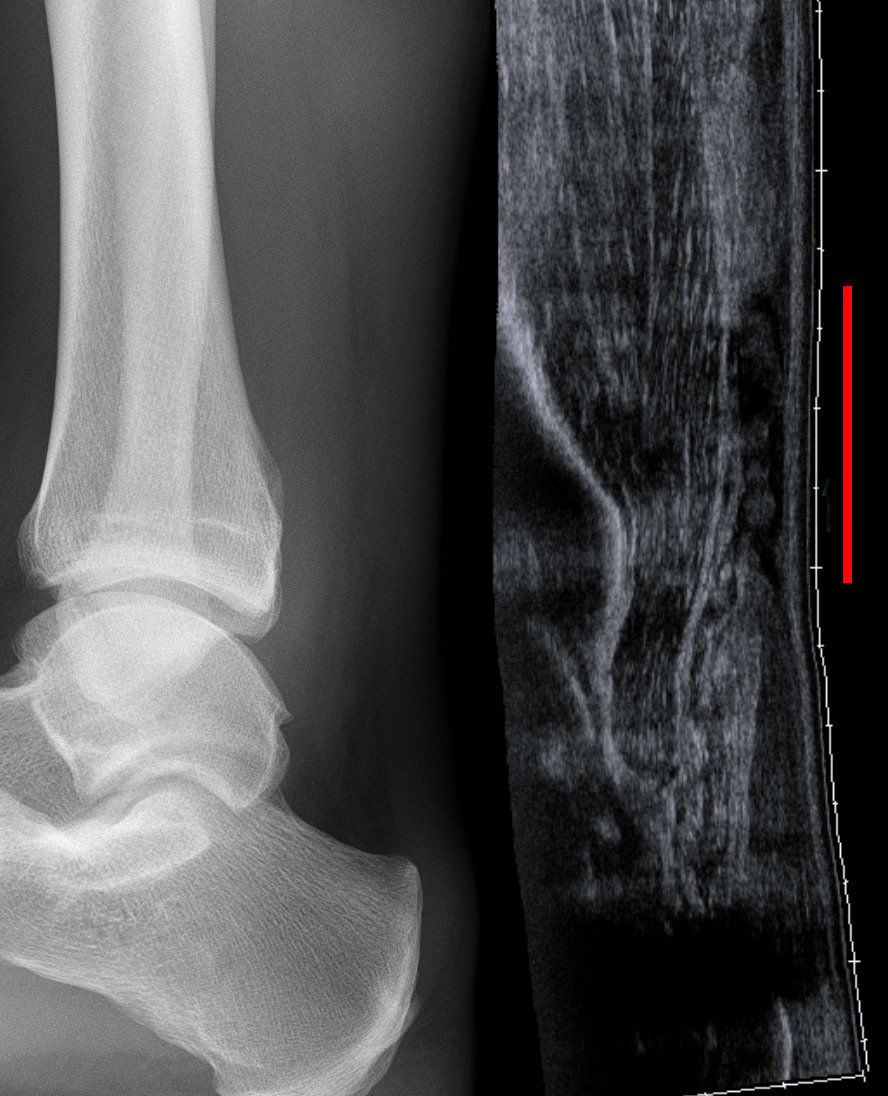
A complete Achilles rupture. The left panel is a lateral X-ray, which rules out a flake of bone torn from the heel. The right panel is the ultrasound run along the tendon: the red line marks the span of the gap where the tendon has parted, with the depth scale down the edge. Image: Hellerhoff, CC BY-SA 3.0.
A complete rupture breaks the tendon clean across. The fibrillar band stops at the torn edge and starts again past the gap. Between the two lies a space where tendon should run, the defect the scan is built to find.
The torn ends draw apart and curl. Each end thickens and frays where the fibers have snapped. The cut surface throws back a bright, ragged echo. A retracted end can cast a shadow behind it, a clue to the break before the gap is even measured. The calf muscle, freed from the heel, draws its end of the tendon up the leg. The higher it rides, the wider the gap it leaves behind.
The gap fills with blood. Fresh hematoma reads as a dark, mottled pool between the torn ends. It can make the gap look larger than the tendon defect alone, so the true ends are sought out within the pool. The blood clears over days, the space taken up by early healing tissue.
An acute tear is the clearest tear to read. The gap is open, the ends are sharp, and fresh blood marks the level of the break. A few days on, healing tissue begins to bridge the space. The picture grows harder to read. An early scan catches the injury at its plainest.
Moving the ankle
The still image shows a gap. The moving image shows what that gap means. This is what ultrasound adds in an Achilles injury. With the patient prone and the foot free, the examiner presses gently on the calf and works the ankle up and down through a small range. A healthy tendon moves as one piece, the calf muscle pulling the heel through it in a single line. In a complete tear the two ends move on their own. Push the foot down into plantar flexion and the upper end, towed by the calf muscle, slides down toward the lower one. Let the foot come back up and the ends draw apart once more. The gap opens and closes under the eye, in time with the ankle. That motion is the proof of a complete tear. It also answers the question that decides treatment: do the torn ends come together when the foot is pointed down. The examiner pushes the foot into full plantar flexion and watches the gap. Ends that meet, or nearly meet, can be held in contact by a cast or a boot in the pointed-down position. That holding is the basis of treating the rupture without surgery. A gap that stays open even at full plantar flexion is one a cast cannot close. It brings an operation into the picture. The number is read at this position and recorded. A partial tear behaves in its own way under the same test. Some fibers still bridge the tendon, so the two parts move together, dragged as one by the calf muscle. No gap opens between them. The dynamic test sorts the three pictures the still image can leave in doubt: a complete tear whose ends part and meet with the ankle, a partial tear that holds together, and an intact tendon that glides. The calf squeeze does the same job by hand, the Thompson test, where pressing the calf bends the foot down if the tendon is whole. The squeeze fails when the tendon is torn. It cannot say on its own whether the tear is partial or complete, the question the moving probe answers. The probe shows the same event from the inside, the tendon itself seen to pull or to fail. Reading a torn Achilles takes this moving look. The gap, the ends, and the way they answer the ankle are read together. From them comes both the diagnosis and the first turn in its care.
Complete or partial
A complete tear parts the whole width of the tendon. Nothing crosses the gap. The torn ends move on their own when the ankle works, and the calf squeeze fails to bend the foot. On the screen the defect runs edge to edge across the band of fibers.
A partial tear keeps a bridge of fibers across the break. The intact strands hold the two parts in line, so the tendon travels as one under the ankle and the calf squeeze still bends the foot. The scan shows a band thinned and disrupted on one surface, with sound fibers carrying through on the other. The reading notes how much of the width has gone. A tear through more than half the tendon is watched as closely as a complete one, since it can give way the rest of the way under load.
Telling the two apart matters because their care diverges. A partial tear with the ends in line often heals in a boot. A complete tear opens the harder choice between a cast and an operation. The reading from the probe feeds straight into that choice.
The dynamic test settles which it is. A still picture of a thick, disrupted tendon can leave the question open. Moving the ankle answers it. A tendon that travels as one piece is partial or intact. A tendon that comes apart at the gap is complete.
Measuring the gap
The gap is the number that guides care, and it is read with the ankle pointed down. The examiner holds the foot in full plantar flexion, the position that brings the torn ends as close as they will come, and measures the space left between them along the tendon.
A gap that closes in this position tells the team the ends will meet inside a cast or a functional boot. Many such ruptures mend without an operation, held foot-down through the weeks of healing. A gap that holds open at full plantar flexion marks ends a boot cannot bring together. An operation to stitch them becomes the stronger option.
The same gap is measured the same way at each visit, so the healing can be tracked over the weeks in a boot. A gap that shrinks shows the ends drawing in and the repair taking hold. The number, read in plantar flexion every time, lets one scan stand against the next.
A rupture or a worn tendon
Not every painful, thickened Achilles is torn. A tendon worn by overuse swells and aches without ever parting. The scan separates the two with care.
A worn tendon, the picture of tendinopathy, thickens into a spindle and loses some of its bright fibrillar order, the fibers dulled and swollen. The band stays whole. No gap crosses it. Color Doppler often lights the swollen tendon with the new vessels of a long irritation.
A rupture breaks that order outright. The fibers stop at a torn edge. A gap, a hematoma, and ends that move on their own under the ankle mark the tear. The dynamic test settles any doubt. A worn tendon still travels as one piece. A torn one comes apart at the gap.
The two can sit together. A long-worn tendon is the one that tends to snap, so a thickened, degenerate stretch can hold a fresh tear within it. The scan reads the chronic swelling and the acute gap as two findings in the same tendon.
The plantaris and other traps
A thin tendon runs alongside the Achilles on the inner side, the plantaris. It often survives when the Achilles tears. A strand of intact plantaris can look like a few intact Achilles fibers laid across the gap. A complete tear can then read as partial if the plantaris is taken for the main tendon. Tracing the plantaris as the separate, slender structure it is keeps it from being counted as Achilles.
The curve of the tendon toward the heel is the other trap. Where it bends to its insertion the beam falls off square. The fibers there darken into a patch that mimics a tear. Rocking the probe to square the beam brightens true fibers and clears the false shadow. A patch that stays dark through the rock is a real break, not an artifact.
Acute, old, and healing
The age of the tear changes the picture on the screen. A fresh rupture is sharp and open, easy to read in the first days. An old tear has filled with healing tissue, a thick and jumbled band that bridges the gap and reads far less cleanly than a clean break.
A repaired or healing tendon is followed by scan over the weeks that follow. Early healing tissue bridges the gap as a thick, ill-defined band, darker and more disordered than mature tendon. The fibrillar order returns slowly as the repair matures and the tendon firms up.
The follow-up watches for the gap to close and the band to firm. A gap that fails to bridge, or one that widens after treatment, raises the question of a repair that has not held. The dynamic test is run again, the ankle worked to see whether the tendon now pulls as one. A tendon that draws taut and moves the heel under the calf squeeze has knit. A tendon left slack under the same squeeze has not, the sign to send the patient back for a fresh decision.
The recovered tendon often stays thicker than its mate for good. The other leg gives the yardstick, the healthy Achilles scanned alongside the injured one to judge how far the repair has come.
A second snap after healing is a re-rupture until the scan proves otherwise.
How sure the scan is
Ultrasound reads an acute Achilles rupture with high accuracy in trained hands. At the point of care it finds the tear in about nineteen of twenty acute cases and almost never marks a sound tendon as torn. It returns the answer in minutes. A scan booked into the imaging department takes the better part of an hour, a delay that counts when a fresh injury needs a decision the same day. The probe also goes to the patient, to the trolley or the bench at the side of the pitch.
The scan leans on the operator. Its weak point is the anisotropy artifact, the dark patch from an off-square beam that can pass for a tear. A finding is confirmed at more than one angle, the probe rocked over the spot, before a tear is called. A gap seen in both planes, with torn ends and motion under the ankle, is a tear no artifact can fake.
Magnetic resonance imaging is the other route. It maps the tendon in fine detail and answers the harder questions in a worn or partly torn tendon. For a clear acute rupture it adds little over a careful scan, at more cost and more waiting. The bedside probe carries the acute injury on its own.
Achilles ultrasound on a handheld unit
An Achilles injury suits a handheld scan. The tendon sits just under the skin, well within reach of a linear probe. The patient lies prone with the feet off the couch, a position any clinic or training room can manage.
This brings the scan to the place and the moment of the injury, the sports field, the clinic, the emergency room on the day of the snap. The probe reaches the tear early, before swelling and healing blur the picture. A scan in the first hours catches the injury at its plainest.
The dynamic test runs the same on a handheld probe as on a department cart. Moving the ankle and watching the gap needs only the probe and a free foot. The judgment lies in the hand on the foot and the eye on the screen.
What the small unit asks for is a careful, ordered scan: the tendon followed end to end in both planes, the beam kept square, and the ankle worked to test the gap. A handheld probe used this way gives the bedside the same answer a department scan would.
Common questions about Achilles rupture ultrasound
How does ultrasound show an Achilles rupture?
It shows a gap in the fibrillar band of the tendon, with the torn ends drawn apart and a pool of blood filling the space between them. Moving the ankle makes the ends slide and the gap open and close. This confirms a complete tear and tells it from a partial one.
Where does the Achilles usually tear?
A complete rupture usually falls a few centimeters above the heel bone, in a stretch with the poorest blood supply along the tendon. A smaller number pull the tendon off its anchor at the heel. The scan follows the whole cord to the bone so a low tear is not run past.
What is the dynamic test for an Achilles rupture?
With the patient prone and the foot free, the examiner moves the ankle up and down, watching the tendon. A complete tear lets the two ends move on their own and the gap open and close. Pointing the foot down brings the ends together. How far they close guides whether the tear is treated in a cast or with surgery.
Can ultrasound tell a complete tear from a partial one?
Yes, mainly through the dynamic test. A complete tear comes apart when the ankle moves, with a gap that no fibers cross. A partial tear keeps a bridge of fibers, so the tendon travels as one piece and no gap opens. The still image alone can leave this in doubt.
How does the scan help decide surgery or a cast?
The gap is measured with the foot pointed down in full plantar flexion. Torn ends that meet in this position can be held in a cast or boot to heal. That favors treatment without surgery. A gap that stays open marks ends a cast cannot close. That moves the decision toward an operation.
Can a handheld ultrasound diagnose an Achilles rupture?
Yes. The tendon is shallow and within easy reach of a linear probe. The patient lies prone with the feet off the couch, and the dynamic test runs the same as on a large machine. It works on the sports field, in the clinic, or in the emergency room on the day of the injury.
About the Author
Julien Mercier
Senior R&D Engineer · Medical Ultrasound Transducer Development
Senior R&D Engineer with an M.S. in Applied Physics and over 15 years of experience in medical ultrasound transducer development, specializing in the design verification and performance testing of high-frequency imaging transducers. Currently leading the development and verification of the company’s next-generation high-frequency linear-array transducer, responsible for imaging performance evaluation and reliability analysis in preclinical testing. Brings extensive hands-on experience in piezoelectric element tuning, beamforming parameter optimization, and system-level performance testing.