Bulk Capacitors
Electrolytic and Polymer Caps by ESR and Life
Where a ceramic capacitor runs out of capacitance, the bulk job falls to an aluminum electrolytic, a tantalum, or a polymer part, each holding up a rail and smoothing its ripple in its own way. Choosing among them means weighing two numbers a ceramic rarely brings into the open: the equivalent series resistance, which sets how well the part filters and how hot it runs, and the rated life, which sets how long it lasts before it fades or drifts. The selection reads those two against the rail voltage and the ripple current the part carries, then picks the family and the grade that hold up under them.
The aluminum electrolytics
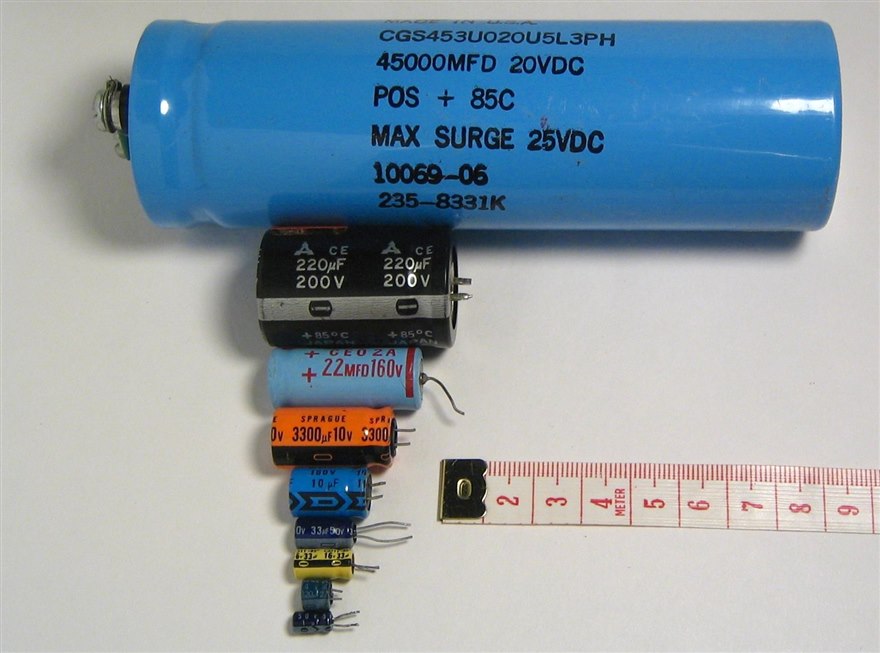
The aluminum electrolytic is the cheap way to get a lot of capacitance, built from an etched foil and a wet electrolyte that gives it density at a low price. The electrolyte is also its limit, since it carries a higher ESR than the other families and slowly dries out in service, so the part is read on its ESR for the job and its rated life for the temperature it sits at. The capacitance comes from an oxide layer grown on a roughened foil, which gives it far more value per volume than a film or a ceramic part reaches, so it is the part a design turns to when a rail needs hundreds or thousands of microfarads. The same wet chemistry that buys the density sets the clock on the part, since the seal slowly loses electrolyte to evaporation, and the value sinks and the ESR rises as the years pass. The part is polarized, so it has a marked negative terminal and goes into the board one way, and a reversed electrolytic heats, vents, and can burst, which is why the can carries a stripe and the footprint a polarity mark. The voltage rating leaves headroom for the spikes a rail throws, so a part on a 12-volt rail is rated for 16 or 25 volts, both to survive the transients and to slow the aging that runs faster near the rated voltage. These habits, the polarity, the voltage headroom, and the temperature margin, are the price of the cheap density, and a design that respects them gets a part that holds for years.
Long life costs money up front. The Nichicon long-life aluminum price premium buys a part rated for many more hours at temperature, which a product that has to run for a decade pays back over its years in the field. The longer life comes from a better seal and a more stable electrolyte that resists drying, and the maker proves it with a longer endurance test at the rated temperature. A consumer gadget that runs an hour a day does not need it, and an industrial controller or a server that runs for years without a service call justifies the premium by not failing where a technician has to be sent. The same maker grades its lines by endurance, so a designer reads the part number for the hours and the temperature it promises before reading the value, since two parts that look alike on capacitance can sit a decade apart on service life. The choice is a reliability decision dressed as a component pick, and a board built for a long life carries the long-life grade in the spots that run hot.
Low ESR is its own grade. The low-ESR Rubycon ZL and ZLH applications cover the switching-supply output where the part has to pass a sharp ripple without heating, and the Panasonic FM and FR in switching supplies fill the same role as a default low-impedance electrolytic on a converter rail. A standard general-purpose electrolytic carries an ESR in the hundreds of milliohms, and a low-ESR grade brings that down to tens, which is the difference between a part that heats on a converter output and one that stays cool. The low-ESR construction uses more and wider tabs and a lower-resistance electrolyte, so the grade costs more and a design pays for it only where the ripple makes it count. On a slow input rail behind a rectifier the standard part does fine, and on the high-frequency output of a buck converter the low-ESR grade is worth it. The ESR also sets how much the output ripples, since the ripple voltage on a switching rail is roughly the ripple current times the ESR, so a lower-ESR part cuts the ripple the load sees as well as the heat the capacitor makes. A design that misses this puts a high-value but high-ESR general part on a converter output, sees more ripple than the budget allows, and adds parts to fix what the right capacitor would have handled. The transient response leans on the same number, since the bulk capacitor has to hold the rail up through the microseconds before the converter’s loop reacts, and a high ESR turns that hold into a step the load feels.
The life rating is read as a pair of numbers, and the physics behind them decides whether a product lasts its warranty or fails in year three. How 2000h and 8000h electrolytics differ in service life turns on the hours the part is rated for at its top temperature, usually 105 degrees, and the rule that the electrolyte’s evaporation, like any chemical rate, roughly halves for every ten degrees the part runs cooler. A 2000-hour part rated at 105 degrees and run at a 65-degree internal temperature sees its life stretch by a factor of two raised to the fourth power, sixteen times, to something past 30000 hours, where the same part run at 95 degrees gains only one doubling. The internal temperature is the number that drives it, and it is the ambient plus the rise the part’s own ripple current makes in its ESR, so a capacitor on a hot board near a switching regulator can sit ten or twenty degrees above the air around it. That self-heating is the reason the ripple-current rating and the life rating are read together, since a part pushed to its full ripple runs hotter, dries faster, and reaches a shorter life than its hours alone suggest. The end of life arrives as a slow drift, where the capacitance falls as the electrolyte leaves and the ESR climbs as what remains grows more resistive, until the part no longer filters the ripple it was placed to handle and the rail it supports starts to misbehave. A design that has to run for a decade does the arithmetic in reverse: it starts from the hours the product must last, works back through the temperature derating to the internal temperature it can allow, and from there to the ambient and the ripple and the grade of part that hold the math together. The maker prints an endurance-life formula for exactly this, multiplying the rated hours by two raised to the temperature margin over ten, and a careful design runs that number for the worst-case ambient before it commits the part. Skipping that calculation is how a supply that passes every bench test fails in the field a few years in, with a row of bulged cans that were under-rated for the heat they took. A 2000-hour part is fine for a tool that runs a few hours a week, and equipment that runs around the clock reaches for the 8000-hour or the 10000-hour grade and keeps it cool on top of that.
An aluminum electrolytic also draws a small leakage current that the oxide layer needs to hold itself together, and a part stored for years can see that oxide soften, so a long-shelved board may need its electrolytics reformed by bringing the voltage up slowly before full use. The leakage counts on a low-power rail or a battery-backed node where every microamp shortens the runtime, and a part chosen there is read on its leakage spec as carefully as its value. The same oxide gives the part a soft knee at turn-on, where it draws an inrush as it charges, so a large bank behind a switch is sequenced or current-limited to keep that surge from stressing the rail.
A bulk capacitor behaves as a pure capacitance only up to a point, since the value, the ESR, and an equivalent series inductance form a network whose impedance bottoms out at a self-resonant frequency and climbs again above it. A large electrolytic resonates low, often in the tens of kilohertz, so it handles the slow energy and the low-frequency ripple and does little for the fast edges a digital load throws. That is the reason a rail pairs a bulk electrolytic for the low end with a spread of small ceramics for the high end, each covering the band the other cannot reach. A design that leans on one big capacitor for everything finds the high-frequency noise passing straight through, since the part went inductive long before that frequency. The lead length and the trace add inductance of their own, so the bulk part is placed with short, wide connections and the ceramics sit right at the load. Reading the impedance-versus-frequency curve, beyond the printed value, is what separates a clean rail from one that rings, and it is why the bulk and the decoupling parts are chosen as a set.
The failure is visible. Understanding how ripple current causes capacitor bulging traces the bulge to the heat the ripple makes in the ESR, which boils the electrolyte to a gas that lifts the vent on the can, so a part sized short on ripple current swells and fails where a part with margin runs cool. A bulged can is the visible end of a slow process, where the heat speeds the drying, which lifts the ESR and feeds still more heating until the part runs away to its vent. The ripple-current rating on the datasheet is the number that heads this off, and it is read at the ripple frequency the converter runs, since the rating falls as the frequency and the temperature climb.
The tantalums
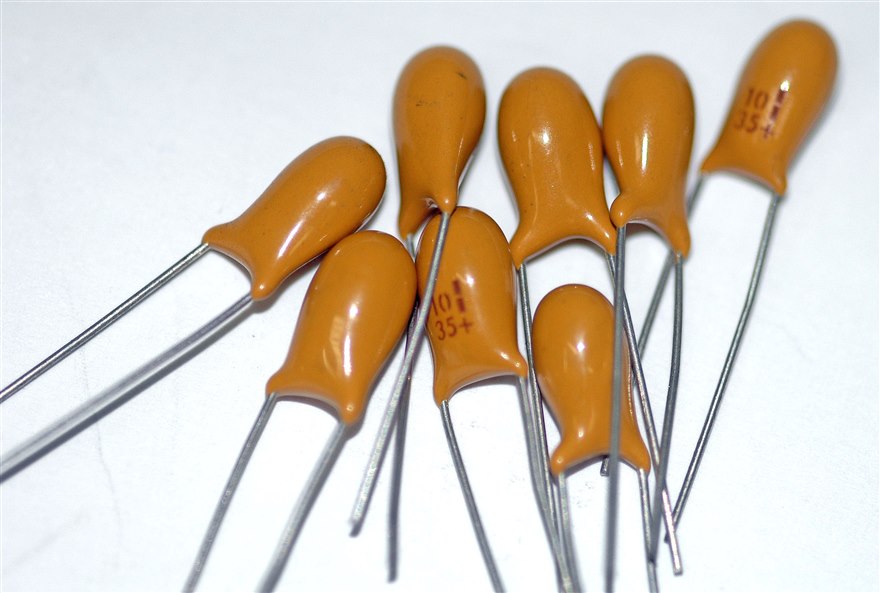
The tantalum packs a large capacitance into a small case and holds it stably, with a low ESR and none of the slow evaporation an aluminum part suffers. The downside is a failure mode that has to be designed around, so the part is derated hard on voltage and chosen with its failure behavior in mind. The density comes from a sintered tantalum pellet with an enormous internal surface, which is why a tantalum holds more capacitance in a given case than an aluminum part of the same height. The stability is the upside a design buys: the value holds across temperature and the part does not dry out, so it suits a place that has to read the same for the life of the board. A tantalum holds its capacitance within a few percent across its temperature range, where an aluminum part can swing far more, so a timing or a filter rail that cannot tolerate drift reaches for the tantalum even at its higher price. The part also comes in low profiles that fit under a board-to-board connector or inside a thin product, which is part of why phones and tablets carried so many of them before the polymer parts arrived. The penalty that rides with the density is a voltage rating that has to be derated by half, so a tantalum on a 5-volt rail is rated for 10 volts or more, and that derating eats into the capacitance-per-volume advantage the part started with.
The grade splits by the cathode. Choosing between the Kemet T491 and T520 tantalum is a choice between a standard manganese-dioxide part and a polymer-cathode part that brings a lower ESR and a softer failure, so a rail that needs the low impedance or the safer behavior pays for the polymer grade. The manganese-dioxide part is the long-established choice and costs less, and the polymer-cathode part trades a higher price for a lower ESR and a benign failure that tends to go open rather than into a hard short. A design reads the two against the rail it sits on, since a low-current, well-derated signal rail does fine on the standard part and a high-current point-of-load leans toward the polymer. The two share a case and a footprint, so a board can carry the cheaper manganese part in the ordinary positions and drop the polymer grade into the few that need the lower ESR or the safer failure, which keeps the cost down without splitting the layout. The polymer part also tolerates a softer derating, near 80 percent of its rated voltage against the manganese part’s 50, so it recovers some of the capacitance-per-volume the hard derating costs.
Some designs call for a screened part. Knowing when DLA-certified AVX TPS tantalum is needed covers the low-ESR tantalum on a defense or a high-reliability board, where the certification and the surge testing the part has passed are part of what the design buys. The surge screen matters because the worst stress on a tantalum is a fast inrush into a low-impedance source, and a part proven against that step carries a known margin a commercial part does not document. The paperwork and the lot traceability ride along, which is the reason a defense or an aerospace build specifies the grade even where a commercial part would meet the electrical numbers. The certified parts also carry a tighter voltage derating in their application rules, often to a third of the rated voltage in place of a half, since the cost of a failure on a fielded system dwarfs the cost of the larger part. A commercial program borrows the same habit where it can, since a tantalum derated harder fails far less often, and the board area a larger part costs is cheaper than a return.
The supply story is part of the tantalum picture too, since the metal comes from a small number of mines and the market has seen real squeezes, so a design heavy in tantalum keeps an eye on availability and holds a polymer or a ceramic fallback for the values it can move. Tantalum also sits on the list of conflict minerals that sourcing rules track, so a maker documents where its ore came from, and a design inherits that paperwork along with the part. That sourcing caution, on top of the derating and the failure care, is why many designs reach for tantalum only where its density and stability are the deciding factor and stay on aluminum or polymer everywhere else.
The hazard deserves a clear head. Reading the real tantalum capacitor fire risk separates the myth from the mechanism, since a manganese-dioxide tantalum driven past its voltage or hit with a surge into a low-impedance source can short and ignite, so the part is derated by half on voltage and kept off a hard low-impedance rail, where a polymer tantalum lowers the risk in the first place. The mechanism is a self-heating breakdown: a flaw in the oxide leaks, the manganese dioxide around it turns conductive and heats, and the heat spreads until the pellet ignites. The polymer cathode does not feed that runaway the way manganese dioxide does, so the move to a polymer part, helped by a generous voltage derating and a soft turn-on, is the standard defense on any rail that can deliver a hard surge.
The polymers
The polymer capacitor replaces the wet or the manganese cathode with a conductive polymer, which drops the ESR to a few milliohms and holds the capacitance for a long, stable life. The price is higher than an aluminum part of the same value, and the part is read on the ripple and the transient it has to handle. The low ESR is the main reason to reach for it, since a polymer part of a few milliohms passes a sharp ripple and answers a fast load step without the heating an electrolytic shows. The part also holds its value and its ESR across temperature far better than a wet electrolytic, so it suits a rail that has to behave the same on a cold morning and a hot afternoon. The conductive polymer is self-healing in a small way, since a fault point heats and the polymer around it turns insulating and isolates the flaw, which is part of why a polymer aluminum part fails more gently than a tantalum. The long life follows from there being no liquid to evaporate, so a polymer part rated for thousands of hours holds its value where a wet electrolytic would have given out, and a design that wants both a low ESR and a long life without the tantalum’s fire risk lands on the polymer aluminum part. The cost is the limit, since the polymer parts run several times the price of a plain electrolytic of the same value and top out at lower voltages, so they stay on the low-voltage, high-current rails where the ESR is what you pay for. The polymer aluminum and the polymer tantalum split that ground by voltage, the aluminum version reaching a high capacitance at low voltage and the tantalum version holding up on the higher rails.
One family suits the dense, high-current rail. Knowing when to choose Panasonic SP-Cap polymer covers the low-profile aluminum-polymer part that sits under a processor and carries the fast load step its core rail throws, where the low ESR and the low height pays its way. A processor core rail draws a current that jumps in nanoseconds, and the bank of bulk capacitors has to hold the voltage until the converter catches up, so a low-ESR polymer part close to the load does the work an electrolytic could not. The rail runs at a low voltage and a high current, often a volt or so at tens of amps, where a milliohm of ESR turns into millivolts of droop the core cannot afford, so the design counts the milliohms and places the parts to keep them low. The SP-Cap and its kin sit in that niche because they pair a low ESR with a flat case and a stable life, which is the combination a dense, hot, fast rail asks for. The flat package fits under a module or behind a socket where a tall can would not, which is part of why the dense boards moved to it. The part sits in a bank of several, spread around the processor so each one carries a share of the load step and the inductance to the die stays low, since a single large capacitor far from the load cannot answer a fast edge through the trace between them. The choice of how many and how close is a power-integrity question on top of a capacitance one, and the polymer part wins there because its low ESR lets a handful of them do the work a row of electrolytics could not.
The choice often ends in a head-to-head. Weighing the tradeoffs between polymer and aluminum electrolytic sets the polymer’s low ESR and long life against the aluminum’s low price and high voltage range, so a cost-driven input rail keeps the aluminum part and a tight, hot, high-current output moves to the polymer. The aluminum part still wins where the voltage is high or the cost matters more than the ESR, since polymer parts top out at lower voltages and cost more per microfarad. A hybrid part splits the difference, pairing a polymer cathode with a wet electrolyte for a middle ground in ESR and life at a price between the two, which a design reaches for where neither pure family fits. The hybrid brings a higher voltage rating than a pure polymer part and a lower ESR than a wet electrolytic, so it has found a home on automotive rails that need both the ripple performance and the surge tolerance. The selection across the three families ends up as a map: cheap bulk and high voltage to the aluminum, low ESR and long life to the polymer, density and stability to the tantalum, and the hybrid where a rail wants two of those at once.
How bulk capacitors get chosen and sourced
A bulk capacitor is read on the ESR it brings and the life it holds at the temperature and ripple of the rail, so a substitution that matches the value and voltage can still cook or dry out early if its ESR or its rated hours fall short. A broad-line distributor that carries the aluminum, tantalum, and polymer families across the ESR grades and the full span of voltage and life ratings lets a design source the part its rail needs and a checked equivalent when a value runs short. The ESR and the rated life are the constants the choice answers to, since a part that filters cool and lasts the life of the product is the one the rail depends on. These families age and fail in their own ways, so a board that has to run for years carries a derating note on every electrolytic and a voltage margin on every tantalum, written into the part choice at design time. A second source is qualified on the same ESR and life grade, since two parts at the same value and voltage can carry far apart an impedance and a rated-hours figure. The supply picture differs by family: aluminum electrolytics come from many makers and rarely go scarce, the polymer parts come from a shorter list and cost more, and tantalum runs tightest of the three on its raw-metal supply, so its second source is the one a design lines up earliest and revisits at every cost review. A part chosen near the edge of its ratings is the one most likely to fail in service, so the derating on voltage, the margin on ripple, and the headroom on temperature are written into the part choice and checked at the review rather than left to the first hot day in the field.
The two numbers that decide
Read the ESR against the ripple and the filtering the rail asks for, read the rated life against the temperature the part will sit at, and derate the tantalums hard on voltage. Reach for the aluminum part where cheap bulk is the point. The polymer suits a low-ESR hot rail, and the tantalum is worth its cost where its density and stability repay the care it takes. Read the ripple current against the part’s rating and its self-heating, since the heat the ripple makes is what sets the life, and the value on its own says nothing about it. Leave voltage headroom on every family, more on the tantalum than the rest, and keep the hot parts away from the hot regulators so the temperature math comes out in years. A capacitor chosen this way disappears into the design and holds for the life of the product, and one chosen on its value alone is the part a field return traces back to.
The ten pages below take the aluminum, tantalum, and polymer parts one at a time, each by the ESR and the life that decide whether it holds.