Diode Selection
Choosing Diodes by Their Role
A diode is a semiconductor that passes current in one direction and blocks it in the other. The role a circuit gives it sets which kind fits, since the rectifier that turns AC into DC, the Schottky that drops little in a converter, the transient-voltage suppressor that clamps a surge, and the Zener that holds a reference are all diodes built for different jobs. The selection starts from the job: the voltage the part blocks, the current it carries, the speed it switches, and the heat its forward drop makes at that current.
Rectifiers and Schottkys
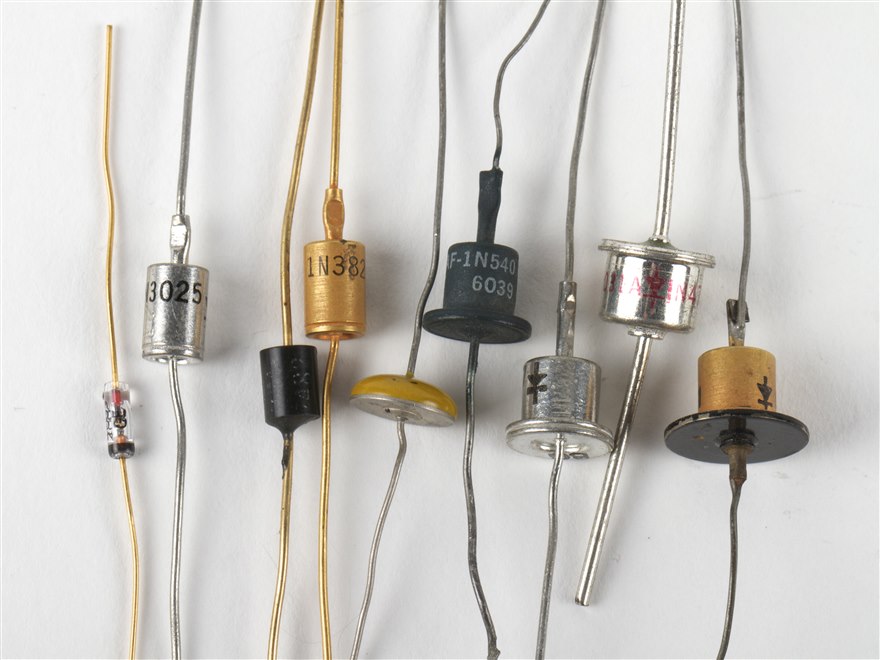
The rectifier is the workhorse, turning alternating current into direct by passing only one half of the cycle, and it is chosen on its blocking voltage, its average current, and the heat its forward drop makes. The standard silicon rectifier drops close to a volt, which a Schottky cuts to a few tenths, so the question of when a Schottky beats a standard rectifier comes up on any low-voltage rail where that drop is a real share of the output and the heat it saves counts. On a 5 V rail a one-volt rectifier drop wastes a fifth of the energy as heat, and the Schottky’s few tenths cut that to a fraction, so a high-current low-voltage output almost always uses one. The reverse-voltage rating is where the Schottky gives ground, since its blocking voltage tops out lower than a silicon rectifier’s, so the part is held to the rails its rating covers.
Speed is the other axis. Knowing when diode reverse recovery matters separates the slow rectifier from the fast one, since a standard part takes time to stop conducting when the voltage reverses, and in a switching converter that recovery dumps a current spike and a loss each cycle. A line-frequency rectifier ignores it; a part in a high-frequency node is chosen for a fast or a Schottky recovery. The recovery charge sets two losses at once, the loss in the diode as it clears and the loss in the switch that drives the spike, so a slow diode in a fast converter heats two parts for the price of one. The reverse-recovery time on the datasheet is read at a stated current and slope, and a real circuit that switches harder sees a worse number than the headline, so the part is chosen with margin on the speed the node demands in the real circuit.
The Schottky has a cost in leakage and reverse voltage, so the part is matched to the rail. The stock and reliability of Nexperia Schottky diodes make them a default for the low-voltage rectifier and the converter catch diode, where the low drop and a reliable supply carry the design. The trade is a higher reverse leakage that climbs with temperature, so a Schottky run hot near its reverse-voltage limit can leak enough to heat itself further, and the part is given voltage margin and kept cool. The low barrier that buys the small forward drop is the same property that raises the leakage, so the diode is chosen for a rail well inside its rating.
The high-voltage end has a newer answer.
For a power-factor stage running at high voltage and high frequency, the Infineon 650V SiC Schottky for PFC brings a Schottky’s near-zero recovery to a 650 V rail that silicon Schottkys could not reach, which cuts the switching loss in the boost stage and lets it run faster and cooler than a silicon fast-recovery diode allowed. A silicon part in that spot recovers with a charge that grows with temperature, so its loss climbs as the stage heats, and the SiC part holds a near-constant, near-zero recovery across its range. The higher price per diode pays back in a smaller boost inductor and less heat to remove.
Bridges and the jellybean rectifiers
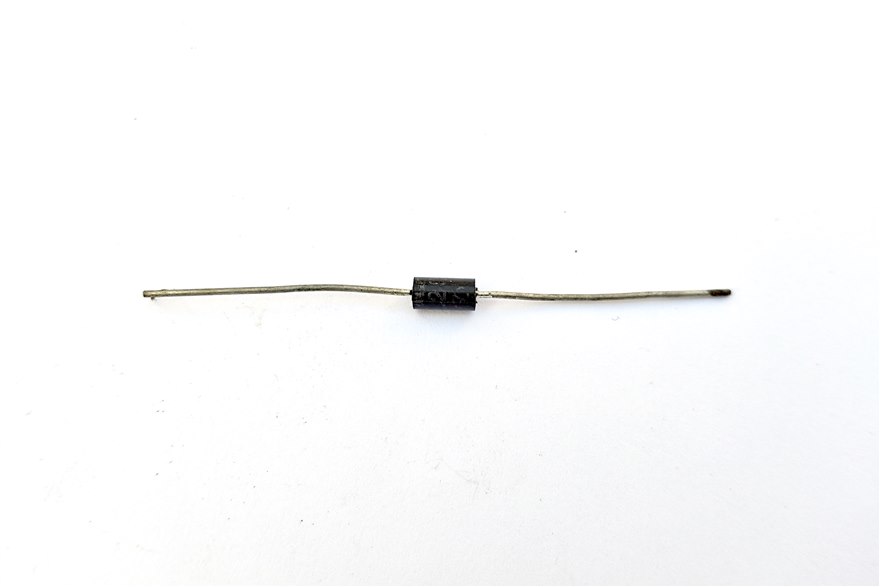
The common rectifiers come in two forms, loose or packaged. Many old designs still call out the 1N4000 series, and the modern replacements for the 1N4001 to 1N5408 cover the current parts that drop into those sockets with better recovery and the same footprint, the upgrade a refresh of an old board makes for nothing. The 1N4001 to 1N5408 span a range of blocking voltages and currents that a designer once memorised, and the modern fast or soft-recovery parts in the same axial body carry the same ratings with a cleaner switching behaviour, so a board that used a generic part for a switching job gains efficiency without a layout change.
Full-wave rectification raises a packaging choice. Weighing a bridge rectifier against four discrete diodes trades the board space and the assembly cost of one part against four, and where a packaged bridge wins, the stock and reliability of Diodes GBJ bridges make them a standard pick for the mains input of a supply, with the heat-sinkable case the current rating needs. A bridge puts four diodes and their interconnections in one part with a defined thermal tab, so it saves the board area and the four placements a discrete build costs, and it spreads the heat into one mountable case. A discrete build earns its place where the current is low, where one of the four positions needs a different part, or where the board already stocks the single diode.
The protection diodes
A second family of diodes does no rectifying at all; it sits idle and clamps a voltage that would otherwise destroy the circuit. The transient-voltage suppressor is the part for a surge on a power line, and setting the voltage margin on a Vishay TVS is the heart of using one, since the part has to stand off the normal rail voltage without conducting and clamp below the level the protected circuit can take. The part sits across the line doing nothing until a surge arrives, then it conducts hard and holds the voltage at its clamp, dumping the surge energy as heat in the few microseconds it lasts, so its joule rating is sized to the surge the line can deliver. The response is fast enough to catch a lightning-induced or a switching transient on a power input, and the part is placed at the port where that energy enters so its clamp protects everything behind it. A part too small for the energy survives the lab test and fails in the field on the first real strike.
The margin is where designs go wrong. Understanding why an oversized TVS may not protect comes down to the clamping voltage rising with the size of the part and the surge current, so a TVS rated too high for its working voltage clamps above what the downstream chip survives, and the part that looked safe lets the transient through. The standoff voltage, the clamping voltage at the rated surge, and the headroom of the protected part are read together. A larger TVS sounds safer, but a part rated for a higher working voltage has a higher breakdown and a higher clamp, so it lets a bigger spike through before it bites. The right part stands off the rail with a small margin and no more, so its clamp sits as low as the normal voltage allows, and the surge energy rating is then sized to the joules the line can deliver.
Data lines need a faster, smaller clamp.
For a high-speed port, the clamping capability of Bourns ESD diodes covers the static discharge that a finger or a cable delivers to a connector, and the reason USB data lines need ESD diodes is that the transceiver behind the connector has no tolerance for a kilovolt spike, so a low-capacitance ESD part clamps the line without slowing the data on it. The capacitance the part adds is the parameter that matters here, since a few picofarads across a high-speed line round the signal edges and close the data eye, so a USB or HDMI line uses a part built for sub-picofarad loading. The clamp still has to shunt the discharge to ground through a low inductance, so the part sits right at the connector where the surge enters.
Where the Zener still fits
The Zener conducts in reverse at a set voltage, and knowing where Zener diodes still fit covers the simple voltage reference, the clamp, and the bias point where a precise regulator would be more part than the job needs, long after the shunt regulator took the demanding references. A Zener costs one part and no quiescent design effort, so it holds its ground for a rail clamp, a gate-protection bias, or a rough reference where a few percent is fine, and the design reaches for a precision shunt only when the accuracy earns the extra part.
How diodes get chosen and sourced
A diode is read on the job: the blocking voltage with margin for the spikes the circuit throws, the average and surge current, the forward drop and the heat it makes, and the recovery speed the switching node demands. A substitution that keeps the voltage and current can still cost a converter its efficiency if its forward drop is higher, or its stability if its recovery is slower, so the swap is checked on the parameter the role leans on. A broad-line distributor that carries the rectifier, Schottky, bridge, TVS, ESD, and Zener families across the voltage and current range lets a design source each diode for its role and find a checked equivalent in the same package when the first part runs short. The role is the constant the selection answers to, since a part that is right as a rectifier is the wrong choice as a clamp. The diode families also differ in how easily one part stands in for another, since a jellybean rectifier has many sources and a specific SiC Schottky or a low-capacitance ESD array has few, so the parts with a thin supply base are the ones a design pins down and second-sources early. The package and the footprint travel with the choice, so an axial part, a surface-mount Schottky, and a bridge in a heat-sinkable case are each held to their own outline when a substitute is found.
The judgment that fits
Name the role first, then read the parameter that role leans on: the forward drop and recovery for a rectifier or Schottky, the standoff and clamping voltage for a TVS or ESD part, the reference voltage for a Zener.
The twelve pages below take the rectifiers, the bridges, the protection parts, and the Zener one at a time, each by the job it does and the number that job turns on.