The cabin of a commercial vehicle in 2026 looks closer to a passenger flagship than to the truck cab of five years ago, and the convergence is not cosmetic. Six related technologies arrived together because they share the same platform shift: AR scene navigation, AR head-up display, 4D millimeter wave radar, electronic mirrors compliant with UN R46, factory pre-installation under IATF 16949, and the intelligent integration found on electric heavy trucks. These are not six features bolted onto an old electrical architecture; they are one cabin sold under six product names.
Six pieces of one platform
The six pieces sit at different points in the cabin and on the vehicle, and the temptation is to procure them like other line items on a spec sheet. Two of them are optical and live in front of the driver: the AR scene navigation on the head unit and the AR-HUD throwing the same guidance onto the windshield, which together take the place of a separate map screen. Behind them sits the perception layer, the 4D radar and the ADAS cameras the truck already carries, feeding both the optical layer and the AR overlay. The electronic mirrors are a different case, since taking the glass off the cab and moving it to a cabin display wins back aerodynamics and field of view in the same move. And none of it reaches the vehicle cleanly without the integration layer underneath, the OEM pre-installation and the electric truck’s domain controllers that keep the entire set off an aftermarket harness.
Underneath the cabin pieces runs the vehicle CAN bus, with a gateway mapping signals between the cabin and the vehicle dynamics. Where after-market boxes once tapped a few signals through a piggy-back harness, the platform reads the full message set. On an electric truck this includes the brake-by-wire status, which it combines with the steering angle for AVM alignment before turning regenerative-braking torque into HUD warnings about energy use.
The optical layer in front of the driver
AR scene navigation puts the next move into the driver’s view of the road. The arrow rendered onto the live camera feed sits at the lane the driver should take, scaled to the distance ahead, refreshed at the frame rate of the camera. The system depends on three signals working at once. A GPS fix tracks position at highway speed, with a six-axis IMU estimating motion between fixes, while a vision pipeline finds the road surface in real time so the arrow can be projected onto it and locked to the road surface. Commercial AR navigation carries the IMU recovery in tunnels, the interchange exit logic, and the acceptance curve over months.
On the windshield, the head-up display puts that same guidance in front of the driver’s eyes. The optical setup runs a virtual image at five to ten meters of equivalent distance, allowing the driver to read speed without refocusing from the road. On commercial vehicles, the cabin geometry, mirror layout, and sun visor configuration shape what fits and what does not; freight tractor cabs in particular benefit from a wider projection window than typical passenger HUDs offer. HUD in a commercial cab is its own field of integration questions.
Why the platform shift happened now
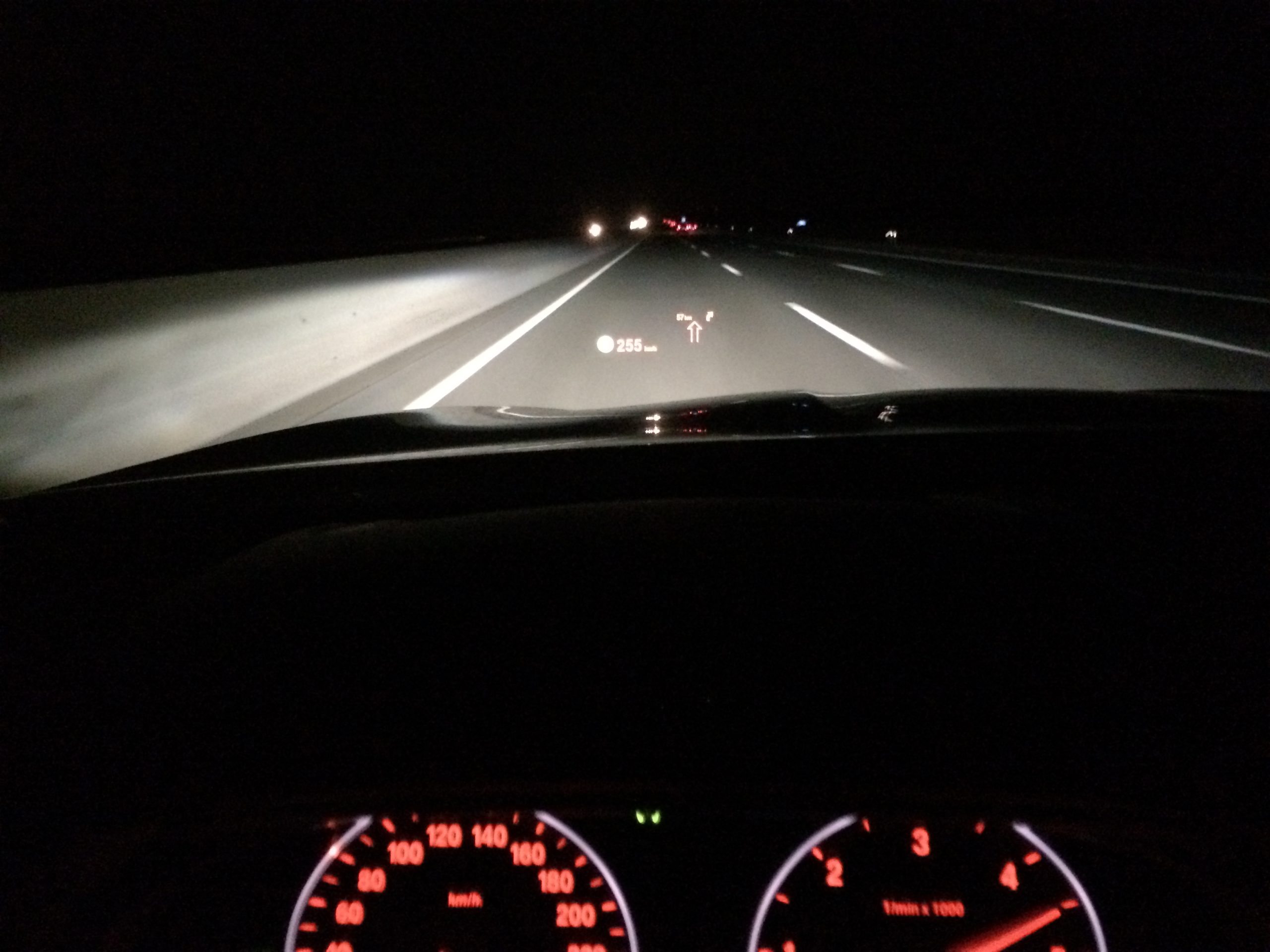
Head-up display on the windshield at night, the optical surface AR commercial cabin platforms project onto. Credit: Tlwt, Wikimedia Commons (CC BY-SA 3.0).
The platform shift that brought all six pieces into one cabin over three to four years came from four pressures combining, and the AR flagship cabin is the form their combination took. Regulation came first: UN R46 in Europe opened the door to electronic mirrors replacing exterior glass for the first time at scale, and once that door is open the aerodynamics savings (somewhere around 1 to 3 percent in highway-cycle fuel consumption for a long-distance tractor) become a hard line in the OEM business case. Electrification pushed the same way, since an electric heavy truck running 400 to 600 kilometers on a charge has every gram of mass and every count of aerodynamic drag on a spreadsheet, and the traditional outside mirror cannot defend its place when the electronic alternative passes the same regulation and saves the watt-hours. The optical cost curve made the cabin affordable: AR-HUD modules that cost upwards of four thousand US dollars in 2020 have come down sharply, with TFT-projector and waveguide-based units approaching commercial-vehicle-viable price points around 1500 USD by 2026, and the 4D millimeter-wave radar units that perceive at 200-meter range have followed a similar trajectory. OEM consolidation then pulled it together, since the legacy after-market video monitoring industry sold to fleet aftermarkets one box at a time, while the OEM that wants an integrated cabin asks its tier-1 to deliver all six pieces under one IATF 16949 quality system and one CAN-bus integration test plan.
Europe’s electronic mirror door opened in 2016, when UN R46 first let a camera system stand in for the glass, and the rest of the world followed at its own pace. The regulation specifies the minimum field of view classes (I through VII for different mirror positions), the camera and display latency budgets, the failure mode behavior, and the homologation pathway. China parallel regulation GB 15084 covers similar ground with locally specified test requirements. Electronic mirror as a commercial product line is shaped by both regulations and the integration choices the OEM makes around them.
The aerodynamics case was always there, but a diesel could largely absorb it. A legacy diesel tractor at 80 km/h burns roughly 30 liters of fuel per 100 km, and a 2 percent aerodynamic improvement saves around 0.6 liters per 100 km. An electric tractor on the same route is on a kWh budget; the same 2 percent recovers energy that ranges from 0.5 to 1 kWh per 100 km, which translates directly into range.
More of the integrating now happens at the factory than in the aftermarket. Pre-installation under IATF 16949 means everything from the cabin harness and gateway to the AR head unit is designed against one engineering release and ships, already validated, with the truck. After-market integration is a parallel path that survives, but for new builds the procurement shifts to the OEM tender, and the supplier set narrows to those who can ship under the OEM quality system.
None of this is set up to swing back. The regulatory door that opened only opens further, and the cost and electrification curves that made the electronic cabin pay on a heavy tractor are now working their way into medium trucks and buses, with the OEMs that took integration in-house in no hurry to give it up. Every year that holds, the older glass-and-boxes setup has a thinner case.
Radar, mirror, electric truck
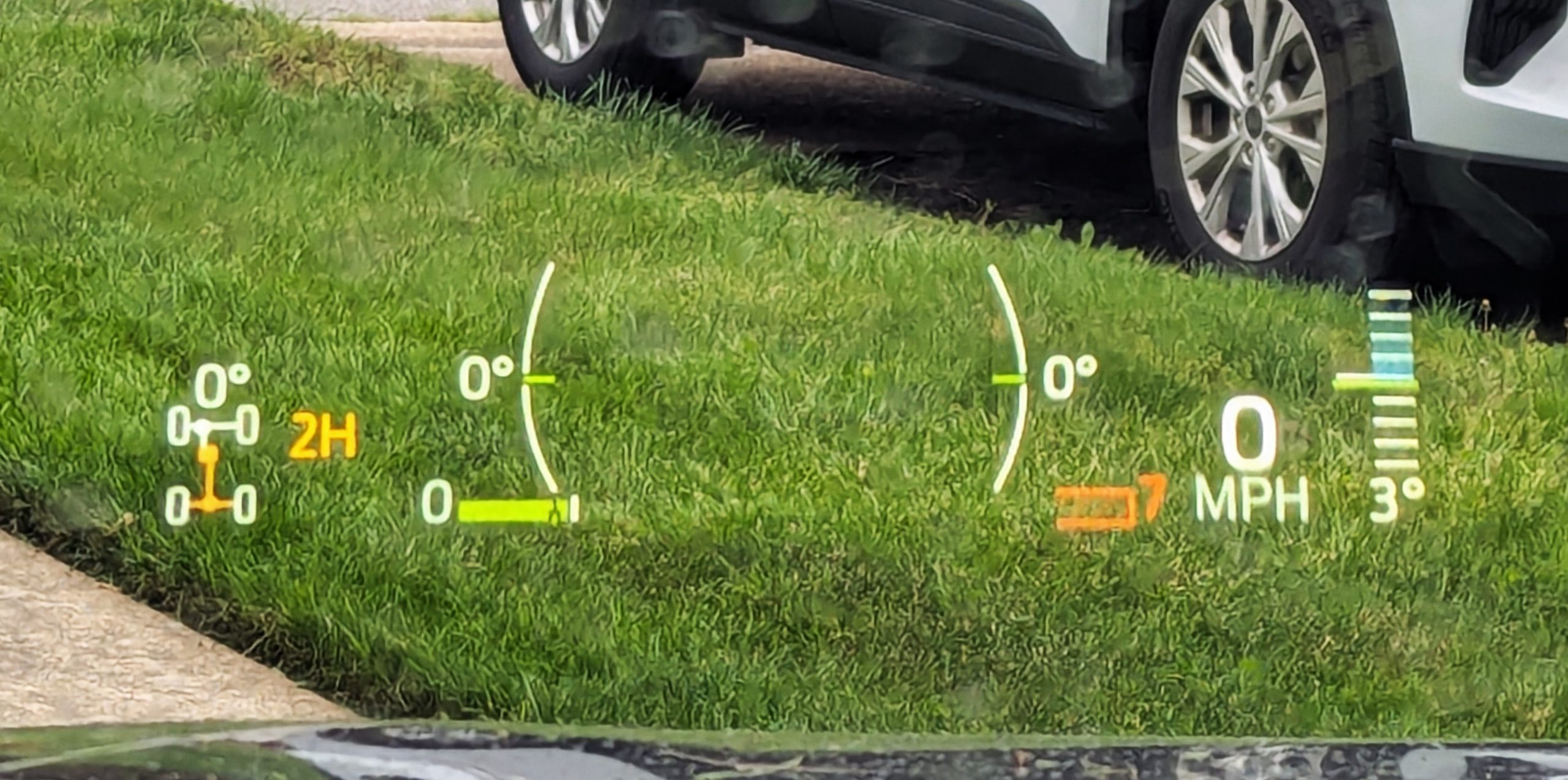
Modern HUD showing extended instrumentation, the optical surface electric heavy trucks integrate by default. Credit: McChizzle, Wikimedia Commons (Public Domain).
4D millimeter wave radar adds the fourth dimension that 3D radar lacks: elevation, the vertical angle that gives every return a height as well as a range and bearing. At 200-meter range in clear weather and somewhere around 120-meter range in heavy rain, the 4D unit feeds the platform’s perception layer with object lists that the AR overlay can render and the HUD can warn against. 4D radar in commercial vehicles carries the chip architecture and integration choices that turn the 200-meter number into a working system.
The fourth dimension that matters here is height, not speed. Range-rate the radar already had. What 3D radar could never do was separate a stopped car in your lane from the overpass or the sign hanging above it, since both come back as strong stationary metal at the same range. The fix the industry lived with for years was to tell highway AEB to ignore stationary returns, which is a large part of why you used to see cars drive straight into a stopped vehicle a human would have braked for. Resolving elevation is what breaks that bargain. Give the radar enough vertical resolution and it can place the return at a height, so it keeps the car and ignores the bridge above it.
Getting that resolution is a hardware problem. You cascade several MMICs so their transmit and receive channels build a virtual array far larger than any single chip carries, and that array is what buys angular resolution down near a degree in the 76 to 81 GHz band. The vertical axis runs the fewest antennas and is always the weak one, and that is where the better units pull ahead. Over the point cloud sits micro-Doppler, the small motion of a swinging arm or a spinning wheel, which is how the radar tells a pedestrian from a sign post and keeps doing it in rain or fog where the camera is already lost. A truck piles on its own trouble. The sensor usually sits behind a plastic fascia, so the beam crosses a layer that saps it and bends its phase, and that has to be measured back out. Guardrails and the chassis underside throw multipath at it. Heavy rain is what drags the clear-weather 200 m down toward the 120 m quoted for those conditions, and as more trucks start carrying radar the units begin to pick each other up, so interference stops being a lab problem.
Take the glass off the cab and move the view to a cabin display, and you free up the mirror’s job and its drag at once. UN R46 specifies the field of view classes; an electronic mirror that meets the regulation can replace the exterior Class II and Class IV units in a fleet retrofit or in an OEM new build. The mirror reads the world that the AR overlay then draws on, which is why the platform integrates the two on the same CAN bus.
Most of that performance detail lives in ISO 16505, the camera-monitor standard R46 leans on, and it polices a number that never reaches a sales sheet: glass-to-glass latency. People quote the frame rate. What the driver feels is the lag between the world moving and the screen catching up, and on a fast head-check a slow link smears the image enough that the digital mirror reads worse than the glass it replaced. A truck has it harder than a car, because one side camera has to carry the Class II main view and the Class IV wide-angle at the same time. Open the lens wide enough for Class IV and the edges bow; split the job across two sensors and you have bought a seam, and a cyclist crossing that seam can stretch or skip for a frame. The close-in views that do the real life-saving, Class V down beside the passenger door and Class VI across the nose, R46 spells out itself instead of handing them to ISO 16505, and they are the ones a cab shape fights hardest to cover.
Imaging is the part that sorts the vendors out. Come out of a tunnel and the scene can swing past 120 dB inside a second, so without real HDR the tunnel mouth blows white while the cab goes black. The same camera then has to hold a clean picture at night, where a pedestrian in dark clothing is the one thing you cannot lose in the noise, and the display has to stay readable against sun on the glass yet dim itself after dark so it does not dazzle. That tuning is the real work, and a brighter panel does not buy your way out of it. R46 will not pass a mirror that can fail without saying so, so the unit watches its own output for a frozen frame and drops into a defined state if the link dies. Past that you are into lens heaters for frost and seals against condensation, plus a vibration profile under ISO 16750-3 a passenger car never has to live through. Calibrate it on the line, run the truck a year, and the aim wanders, which is why the alignment has to be serviceable in the field rather than set once and forgotten.
It all comes together most cleanly on an electric heavy truck. The vehicle has a CAN bus already. The cabin spec that ships with an electric tractor in 2026 includes the AR head unit, the HUD, the electronic mirrors, and the radar by default. Pre-installation on an electric tractor involves more touch points than the diesel case. The build-side details of intelligence integration on electric heavy trucks follow from this cabin spec rather than from after-market additions.
Whether the platform ships at all turns on the parts nobody markets. AEC-Q100 component qualification, ISO 16750 environmental tests, and IATF 16949 quality system audits stay off a marketing comparison sheet. The OEM tender for an integrated cabin selects the supplier that can ship under one quality system and one validation plan.